
Modelling of Perception Covid-19
Mitigation policies, as their objective is the informative control of the pandemic in terms of its effects on public health, stand out because they consider risks as inherent to social communication. In this sense, the objective of this work was modeling the social perception of the risks associated with the SARS CoV-2 and Covid-19 pandemics. Axes, trajectories and relationships between categories were established that explain and anticipate the effects of confinement and social distancing strategies, alluding to the extension of the study in confinement and high-risk settings such as hospitals, the adoption of self-care and adherence to treatment from the impact of the pandemic on the parties involved.
Introduction
At the time of writing, the pandemic caused by the SARS- COV-2 coronavirus and the COVID-19 disease has infected 10 million, sickened 5 million and killed 500,000 people worldwide WHO [1]. In Mexico, it has infected 200,000, sickened 150,000 and killed 25,000 people. In this scenario, the perception of security is a central issue on the citizen’s agenda not only due to the health crisis, but also the economic crisis [2].
In this way, the escalation of violence against vulnerable groups such as children, women and the elderly has increased exponentially and added to the risks posed by the pandemic. Derived from this situation, the perception of security emerges, develops and consolidates as a central issue on the citizen’s agenda. It is a phenomenon in which potential victims appreciate the pandemic as unpredictable in its effects, immeasurable in its consequences and uncontrollable by the authorities [3].
Such phenomena, the pandemic and security, converge in the violence against the vulnerable groups as a result of the frustration of the heads of families in the face of unemployment, famine and unhealthiness. In this way, the areas at greatest risk are the most densely populated such as Mexico City, mainly in the Iztapalapa mayor’s office.
Security has concern authorities and civil society during last years. Different society’s substrates have different perceptions on security [4]. Present document explores reliability and validity of an instrument which measures security perception in bachelor’s students by reviewing seven dimensions: territorial, national, public (government), human, public (self-protection), private and internaut. Accordingly, setting values and residual permitted to accept the null hypothesis significant relationship between the theoretical dimensions with respect to the weighted factors.
Precisely, the objective of the present work is to specify a model for the study of the perceived security in the face of the pandemic, confinement and violence towards vulnerable groups such as the elderly, women and children with respect to the head of the family, civil and health authorities. What are the axes, dimensions, trajectories and relationships between the variables that reflect and determine the perception of pandemic in the literature consulted from 2010 to 2021?.
The premise that guides this work warns that public policies, focused on the mitigation of the pandemic and on the strategies of distancing and confining people, without considering preventive measures such as protection devices and oxygenation measurement, are perceived as risky by the governed towards their authorities [5]. This is so because the axes of discussion are centered on aversion and risk propensity [6]. That is, mitigation is assumed as risky or manageable [7]. Regarding the perceptual dimensions, the pandemic is considered as immeasurable or measurable, unpredictable or predictable, uncontrollable or controllable [8]. Regarding the trajectories, these are carried out from social communication, the need for citizen information and the expectations of control and management of the pandemic based on comparative data between countries by number of inhabitants, per capita income or access to health [9]. It is these relationships between the variables that determine the perception of the pandemic [10].
The contributions of the study to the discipline are:
- Systematic review of the state of the art,
- Systematization of findings,
- Proposal of a theoretical and conceptual model,
- Methodological approach,
- Diagnosis of the problem,
- Discussion between the findings and literature reviewed,
- Design of pedagogical sequences.
Thus, the first section reviews the theoretical and conceptual approaches that explain the phenomenon. The second section presents the results of studies related to the subject. In the third section the axes, trajectories and relationships between the variables are proposed. In the fourth section, the decisions to approach the problem are presented. In the fifth section, the results are described. In the sixth section, these findings are discussed. The seventh section reflects on the contribution and application of study in the classroom.
Theory of Perception Covid-19
Security, in several countries, have been suffered a lack, or absence, particularly when it is talked about governmental participation. Public security can be understood it as the state labor to protect and safe its population from internal dangers or threats. In Latin-American countries, public safe keeping is perceived as absent; due to big amount of press coverages which exposes mentioned lack [11]. In case of Mexico, day by day, they appear in the news, a bigger quantity of red notes’ coverages, which shows a violent face of the country. The structure of perception of security in: Territorial security; National security; Public safety (State as general attorney); Human security; Public safety (Self-protection); Private security; and, internaut perception of safety, scopes [12].
Public safety events occur throughout the world, posing a threat to personal safety, property and national defense. Mexico’s security problems are like the general context in Latin America in many ways. However, Mexico has an influence of organized crime due to the levels of consumption of illegal products in the US market UU [13].
Public security has traditionally been understood as the function of the State that consists in protecting its citizens from illegal attacks on (or crimes against) their property, physical integrity, sexual freedom, etc. The meaning of public safety is inferred as security of persons: inherence, inseparability, breadth and focus on justice [14].
It is stated that our reality’s perception is subjective and that our world’s perception depends of our life conditions. Perception of reality operates from a superior order, from a mesosystem that would include both (perception and reality), and in which each appear like elements and not like closed and independent units. The notion that: what we see, might not be what is truly there, has troubled and tantalized all the population in every sector, class, or roll of our society. Different population’s sector would have different perception of security [13].
It can also be mentioned that cultural stigma in the country, also affects and promotes a lack of public safe keeping, due to the general manner of Mexican population’s thinking, which in comparison with other cultures, appear to be like sluggish and with a short interest to develop in academic, professional, social, among other aspects. The administration of public security is the implementation of public policies that justify the guidance of the State in the prevention of crime and the administration of justice, but only the citizens’ distrust of government action is evidenced by a growing perception of insecurity reported in the literature in seven dimensions: territorial, national, public (government), human, public (self-protection), private and internaut [15].
Mexico can be seen from diverse scopes like economic, historic, or social. In that sense, there exist other sub-scopes (or sub-scales in the social scope) like health, public security, education, environmental consciousness, among others. As mentioned before, different population’s sectors have different perception of social sub-scopes (or sub-scales). In case of bachelor’s students, as its scholar formation gives the chance to generate critic manner of thinking, that population’s sector can generate a solid perception of factor that affects society’s context [16].
Studies of Perception Covid-19
The security perception theory alludes to dimensions that are convergent with respect to the trust between rulers and ruled. In this way, the central premise of the theory is that citizens have unfavorable or positive expectations of their authorities in charge of law enforcement and crime prevention, as well as social rehabilitation [17]. In this sense, security is a socio-political phenomenon, but reduced to media expectations of government action, as well as mistrust or empathy for its strategies, programs or policies in terms of safeguarding the integrity and dignity of its governed, as well as private property and public interests.
The dimensions of this perception of security have been structured in socio-spatial terms such as the territory or in social issues such as the nation, but with emphasis on the situation of sectors, strata or groups such as the so-called public and citizen security, as well as the interest’s individuals such as private and Internet security [18].
Territorial and national security have traditionally been the most widely addressed from risk sociology to account for the impact of climate change on sea level and coasts, as well as risk events derived from droughts, frosts, fires, floods or earthquakes in vulnerable areas, the trafficking of species or the appearance of epidemics due to the invasion of animal territories [19].
The so-called biosecurity focuses on food as the main indicator of health level in the face of a health or environmental crisis [20]. In this sense, territorial or national security should have specialized in public because each sector or social stratum demanded different needs according to contingent situations. The citizenization of this security gave way to the individualization of expectations and resources, leading to both personal and virtual self- protection, with the emergence of cybersecurity.
García, et al. [21] validated the Risk Perception Scale for SARS CoV-2, considering their exposure to the pandemic in community health institutions in central Mexico. A factorial structure was found that explained 60% of the total variance, suggesting the application of the scale in other scenarios and samples.
There are more differences between biosecurity and cybersecurity, but both are essential for the rule of law, the administration of justice, the procurement of crime, social rehabilitation and collective pacification. From a traditional perspective, both dimensions are observable as complementary, but from a progressive approach they are assumed as concomitants [22]. In other words, the effects of climate change are increasingly linked to identity theft, extortion or cooptation, since niches of environmental and social deterioration that originate cybercrime are assumed or, based on cybersecurity, the data of robberies, kidnappings or homicides in situations of natural disaster or health contingencies are observed in real time.
Modelling Perception of Covid-19
From the theoretical, conceptual and empirical review, the relationships between the variables were modeled. In this way, territorial and national security are concomitant given their level of generality in the protection of the country, as well as the multilateralism involved in international or regional pacification measures [23]. In the cases of public and citizen security, both share the imperatives of safeguarding common goods that, although they are public, can be established as socially and environmentally available to future generations. In this sense, private and digital security are also similar in terms of preventing crimes that threaten the dignity and integrity of the individual rather than of society.
The theoretical relationships between security perceptions are consistent with the observed data [24]. This is so because it is presumed that the instrument measures the seven dimensions of security, as well as its consistency when applied to bulls, scenarios and samples. Furthermore, safety as a multidimensional phenomenon suggests measurement levels concomitant (HC) with each other, reflective (HR) and with errors (HE) attributed to variance of the responses. The concomitant hypotheses allude to the covariances between the dimensions of the phenomenon, as well as to the explanation of its trajectory structure if a new specification or modeling arose by testing the null hypothesis [25].
The reflecting hypotheses allude to the relationships between the factors with respect to the indicators, suggesting the structuring of the phenomenon, as well as the convergence of the responses to the reactive that measure each feature of the dimensions [26]. The hypotheses of measurement errors refer to unexplained variances in estimating the structure of concomitant and reflective relationships. Furthermore, it suggests the probable incidence of other factors and indicators not included in the model [27].
Method
An exploratory work was carried out on the relationships between the variables that determine the perception of risk and the indicators that reflect this process, which goes from mistrust to public trust towards their authorities in the management of the pandemic.
A sample of 100 professional practitioners and social servants (M=26,5 SD=,43 age & M=7’892,300 SD=345,21 USD per capita annual) in hospitals in central Mexico were surveyed, considering the degree of exposure to contagion and the type of distancing and social confinement that they carried out when carrying out their work and academic tasks.
The Care on Covid-19 Perception Scale (2021) was used. It includes three dimensions related to risk (“Carry out professional practices in Covid-19 hospitals”), utility (“Use of face masks”) and the difficulty or ease of practicing the profession in low and high risk situations, as well as total and partial confinement (“In saturation of intubated”). Each item includes five response options ranging from 0 = “Not likely” to 5=”quite likely”.
Respondents were contacted by email, sending them a link www.academictransdisciplinarynetwork.es.tl to answer the survey online, indicating that no payment would be made for the activity, as well as the confidentiality and anonymity of the individual responses and findings. It was also reported that the results would not affect the work, academic or professional status of the respondents [28].
The data were captured in the statistical program for social sciences version 17.0 considering the antecedent parameters for the analysis such as normality, linearity, and homoscedasticity, which were used to rule out distributive biases and collinearity of the variables. Next, the validity was carried out by means of the exploratory factorial analysis of principal axes with promax rotation. Then a correlation and covariance analysis were performed to observe the factor structure. Finally, a model of structural equations was executed to be able to appreciate the axes, trajectories and relationships between the factors and indicators.
Results
Table 1 shows the parameters that describe the responses to the scale, as well as the values of the statistics that measure possible biases, their consistency and factorial weight.
| R | M | SD | A | F1 | F2 | F3 |
|---|---|---|---|---|---|---|
| r1 | 4,32 | 1,43 | ,782 | ,435 | ||
| r2 | 4,56 | 1,09 | ,762 | ,423 | ||
| r3 | 4,12 | 1,46 | ,761 | ,652 | ||
| r4 | 4,32 | 1,42 | ,704 | ,640 | ||
| r5 | 4,12 | 1,67 | ,724 | ,621 | ||
| r6 | 4,31 | 1,98 | ,705 | ,547 | ||
| r7 | 4,37 | 1,04 | ,762 | ,439 | ||
| r8 | 4,54 | 1,21 | ,704 | ,368 | ||
| r9 | 4,43 | 1,47 | ,762 | ,451 | ||
| r10 | 4,78 | 1,86 | ,761 | ,549 | ||
| r11 | 4,15 | 1,52 | ,704 | ,521 | ||
| r12 | 4,10 | 1,92 | ,793 | ,623 | ||
| r13 | 4,06 | 1,04 | ,773 | ,608 | ||
| r14 | 4,32 | 1,13 | ,763 | ,673 | ||
| r15 | 4,69 | 1,46 | ,705 | ,562 | ||
| r16 | 4,02 | 1,87 | ,749 | ,643 | ||
| r17 | 4,89 | 1,37 | ,713 | ,432 | ||
| r18 | 4,31 | 1,52 | ,786 | ,367 | ||
| r19 | 4,65 | 1,90 | ,794 | ,439 | ||
| r20 | 4,21 | 1,12 | ,792 | ,651 | ||
| r21 | 4,18 | 1,34 | ,789 | ,540 | ||
| r22 | 4,13 | 1,41 | ,779 | ,552 | ||
| r23 | 4,19 | 1,23 | ,776 | ,643 | ||
| r24 | 4,16 | 1,13 | ,753 | ,549 |
Table 1: Descriptive of instrument.
$$ \text{Source} \quad \text{Elaborated with data study; R=Reactive, M=Media,} $$
SD=Standard Deviation, A=Cronbach Alpha exclude value
item. Method: Principal axes. Rotation: Promax. Normalidad
Mardia’s=18, 35Adequation KMO=, 673. Sphericity Barttlet test=ꭔ2=13, 24
(23df) p <, 05. F1 = Risk Perception (22% total variance
explained and alpha with, 756), F2 = Perceived usefulness
(15% total variance explained and alpha with, 756), F3 =
Perceived ease of function (10% total variance explained and alpha with, 750). Each item includes five response options ranging from 0 = “Not likely” to 5 = “quite likely”.
In order to appreciate the relationships between the factors, we proceeded to estimate the structure of correlations and covariance, which would indicate the modeling of the factors and indicators with respect to a common factor that the literature identifies as the social perception of the pandemic see (Table 2).
| M | SD | F1 | F2 | F3 | F1 | F2 | F3 | |
|---|---|---|---|---|---|---|---|---|
| F1 | 24,32 | 13,25 | 1,000 | 1,732 | ,567 | ,435 | ||
| F2 | 21,46 | 15,43 | ,443 | 1,000 | 1,843 | ,621 | ||
| F3 | 27,68 | 16,57 | ,512 | ,672 | 1,000 | 1,467 |
Table 2: Relations between factors.
Source: Elaborated with data study; M= Media, SD = Standard Deviation. F1 = Risk Perception, F2 = Perceived usefulness, F3 = Perceived ease of function. * p <, 01; p <, 001; * p <, 0001.
The structural equations model was estimated, considering the values of normality, homoscedasticity, adequacy, sphericity, reliability, validity, and correlation. (Figure 1) shows a structure configured by an emerging second-order factor; the three established first-order factors and the 24 observe indicators.
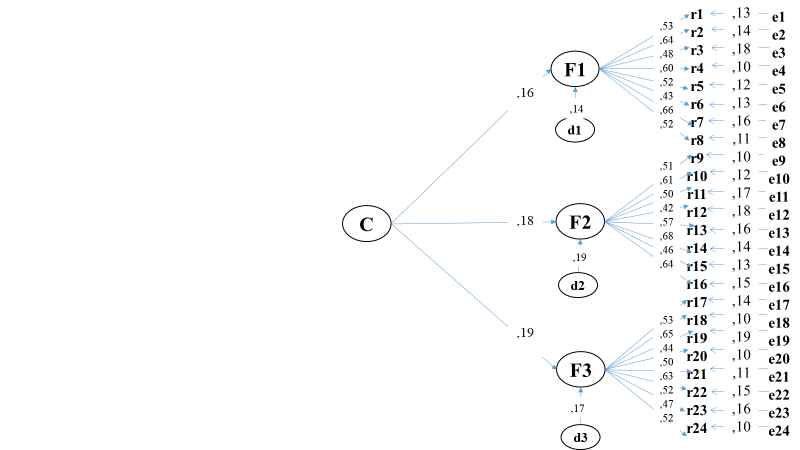
$$ \text{Source:} \quad \text{Elaborated with data study; C=Construct. F1=Risk} $$
Perception, F2=Perceived usefulness, F3=Perceived ease
of function, R = Reactive, e = Error measurement indicator,
d = Disturbance measurement factor. The adjustment and
residual parameters ⌠ꭔ2 = 15,43 (24df) p >,05; CFI = ,997;
NNFI = ,990; RMSEA = ,008⌡suggest the non-rejection of
the null hypothesis regarding the significant differences
between the axes, trajectories and relationships between the
perceptual dimensions of the pandemic with respect to the
structure observed in the present work.
Discussion
The contribution of this work to the state of the question is the validity of an instrument that measures three dimensions related to risks, utility, and ease around the pandemic. In relation to the theoretical, conceptual, and empirical frameworks, the findings are discussed.
In relation to the theoretical frameworks that allude to risk events because of public policies rather than frequency, magnitude or sequence, this work suggests considering the capacities of the actors as factors inherent in risk assessment. In the case of the pandemic, it is necessary to assume that the formation of intellectual capital in research and care for infected, sick, or deaths must be continuous. This is so because they are part of a structure of biased expectations in the face of the pandemic. Research lines concerning socio- educational variables will allow anticipating risk exposure scenarios in confinement and prolonged, total, or partial distancing.
Regarding the state of the matter, where the dimensions of incommensurability, unpredictability and uncontrollability of risk exposure events stand out, this work warns that the formation of intellectual capital should be limited to cases of minimal intensity. These are practitioners and social servants whose distance from the epicenter of infections, illnesses and deaths should be part of a professional and labor training protocol. Given that human capital is distinguished by its degree of experience in the face of contingencies and crises, the formation of intellectual capital should be on the fringes of the pandemic. Lines concerning the effects of the pandemic on traditional learning and the emergence of the virtual classroom should clarify the perceptual levels of risk exposure.
Regarding the modeling of the dimensions in which the prevalence of the determining relationships and the relationships that reflect the phenomenon is staked, the present study has demonstrated three reflective dimensions of the social perception of the pandemic. It is a structure in which the effects of risk communication by the authorities converge with respect to the responses of students to the pandemic and the use of devices to carry out their essential activity. Studies concerning the capacities perceived in the formation of intellectual capital will allow anticipating scenarios of failure and success in the learning of professional skills.
However, the structures of normality, homoscedasticity, adequacy, sphericity, validity, correlation, and prediction established in this work do not allude to perceptions of responsibility such as stigma towards health personnel as they are considered sources of contagion. It is a collateral phenomenon that would explain public mistrust towards health services and the consequent scenario of infections, diseases, and deaths in confinement, indicated by low percentages of saturation in hospitals. Research on the attributions of users and health personnel would test the hypothesis of health stigma. The inclusion of social and cognitive variables will allow the testing of a comprehensive model that explains adherence to treatment and self-care.
Conclusion
The objective of this work was to corroborate the factorial structure of perceived safety, although the research design limits the finding of the research scenario, suggests the construction of an agenda and the incidence in security policies based on opinions and expectations of the governed with respect to the performance of their rulers.
In relation to the theory of the perception of security, which raises nine dimensions related to territory, nation, citizenship, public, private, human and internet, this work demonstrated that human security is the factor that most reflects the perceptual security structure. Lines of study referring to the dimensions of human security will allow us to notice conflict scenarios between rulers and ruled, as well as the emergence of citizen and private security.
Regarding security studies where a continuous coercive and persuasive state in its relationship with citizen’s stands out, this work has shown that human security is a dimension that explains the differences and similarities between rulers and ruled. The development of this dimension will allow us to notice the transition from a coercive system to another persuasive one. That is, the security attributed to the legitimate violence of a democratic government will be observed up to the security that demarcates the regime from all responsibility and recharges the citizen with the attribution of prevention by confining their expression and their property.
Research lines concerning the emergence of this common factor will allow evaluating, accrediting, and certifying the relations between rulers and governors in matters of multidimensional security. In summary, perceived security is a multidimensional psychological phenomenon since it derives from the relations between authorities and citizens with respect to crime prevention, the administration of justice and social rehabilitation, although other dimensions such as sectorial or media security to explain the impact of policies, strategies and programs on civil decisions and actions.
In Mexico, a common interpretation or idea of which country is lacking in security prevails. The absence of custody is influenced by the presence of organized crime, the illegal sale of drugs and weapons, and the corruption available in each branch of the government, among the main aspects. The correlations of reliability and validity when the unit far shows that there are other dimensions linked to construct. In this sense, the inclusion of self-control explains the effects of state propaganda regarding crime prevention, law enforcement and peace education on lifestyles of civilian sectors.
The contribution of this study is concerned about the reliability and validity of an instrument which measured seven dimensions of security: territorial, national, human, public, public, private and digital.
The studies on public safety identify in the government’s expectations the predominant factor that explains the phenomenon as an efficient, effective and effective institution, but in the present work the emergence of this phenomenon has been demonstrated from a structure of perceptions around the personal, citizen, public, human, national and territorial agenda.
References
-
World Health Organization (2020) Statistic of coronavirus SARS CoV-2 and Covid-19 disease in the world. Ginevra.
-
Panamerican Health Organization (2020) Statistic of coronavirus SARS CoV-2 and Covid-19 disease in the America’s. New York: PAHO
-
Jiang F, Liu S, Zhao N, Xie Y, Wang S, et al. (2020) Psychological status of the staff in a general hospital during the outbreak of coronavirus disease 2019 and its influential factors. Zhong Nan 5(6): 641-648.
-
Al Sulais E, Mosli M, AlAmeel T (2020) The psychological impact of COVID-19 pandemic on physicians in Saudi Arabia: A cross-sectional study. Saudi J Gastroenterol 26(5): 249-55.
-
Carreon J, Hernandez J, Garcia C (2017) A theoretical review for the study of public security governance. Epysys 4(1): 1-15.
-
Garcia C, Carreon J, Hernandez J (2016) Gobernanza del terror a la delincuencia. Eureka 13(2): 168-185.
-
Garcia C, Carreon J, Hernandez J (2017) Co-Management as a Safety Device for Local Sustainable Development Eureka 14(2): 268-289.
-
Juarez M, Carreon J, Quintero ML, Espinoza F, Busto JM, et al. (2017) Reliability and validity of an instrument that measures dimension a security and risk perception in student of a public university. International Journal of Advances in Social Science and Humanities 11(12): 23- 13.
-
Mejia S, Carreon J, Garcia C (2016) Psychological Effects of Violence and Insecurity in Older Adults. Eureka 13(1): 39-55.
-
Mendoza D, Carreon J, Mejia S, Garcia C (2017) Specification of a model of propaganda representations in older adults before public safety. Tlatemoani 25(1): 21-31.
-
Rincon RM, Juarez M, Garcia C (2018) Interpretation of speeches around the mobility habitus to reveal the meaning of public transport. Margen 90(1): 1-13.
-
Bustos JM, Ganga FA Llamas B, Juarez M (2018) Contrastación de un modelo de decisión prospectiva e implicaciones para una gobernanza universitaria de la sustentabilidad. Margen 89(1): 1-16.
-
Carreon J, Blanes AV, Garcia C (2018) Reliability and validity of a perceived security governance model. Sin Frontera 27(11): 1-53.
-
Aldana WI Rosas FJ Garcia C (2018) Specification of a Model for the Study of the Public Safety Agenda. 9(1): 1-20.
-
Martinez E, Anguiano F, Garcia C (2018) Governance of social works towards network violence. Social Science Learning Educational Journal 6(1): 1-3.
-
Garcia C, Carreon J, Hernandez J (2017) Governance of public safety. Review of the literature for a discussion of the state of knowledge of criminal sociopolitical identity. Margen 84(1).
-
Carreon J (2020) Neural networks of scenarios, phases and discourses of violence of the Internet. Journal of Neurology NeUro Toxicology 4(3): 1
-
Garcia C (2019) Exploratory factor structure of the security public. International Systems Journal 23(1): 82- 86.
-
Quiroz CY (2019) Metanalytical retrospective of the policies in the handling of risk of transportation in the Mexico City. Net Journal of Social Science 7(4): 92-100.
-
Hernandez J (2019) Internet harassment in the documentary and expert agenda. Asian Journal of Science & Technology 10(8): 1-3.
-
Garcia C (2021) Security perception from the pandemic caused by the SARS CoV-2 coronavirus and Covid-19 disease. Epidemiology International Journal 5(1): 1-8.
-
Sandoval FJ (2020) Job expectations in the face of risk events and collateral social effects. International Journal of Humanities Social Science & Education 7(5): 1-7.
-
Quintero ML, Hernandez J, Sanchez A, Molina HD, Garcia C (2017) Expectations model around public safety in microentrepreneurs in central Mexico. Sin Frontera 10(26): 1-20.
-
Santos CF (2020) Reflections about the impact of the SARS-COV-2/COVID-19 pandemic on mental health. Braz J Psychiatry 42(3): 329.
-
Garcia C (2020) Specification a model for study of insecurity systems. Global Journal of Management & Business Research 20(1): 7-10.
-
Rivera BL (2020) Exploratory structural algorithmic of perceived risk factor. International Journal of Humanities and Social Science Invention 10(8): 26-30.
-
Amemiya M (2020) Retrospective metanalysis of the random and homogeneous effect of the validity of the risk perception scale. American Journal of Applied Scientific Research 10(4): 25-35.
-
Hernandez J (2020) Specification a model of sexual violence. British Journal of Medical and Health Science 2(2): 1-4.
- hMPV: Is It Another Covid-19 Like Situation?
- Streptomyces: Sources of Novel Discoveries in Antibiotic Research to Combat Antimicrobial Resistance
- A Review of Mosquitoes (Diptera: Culicidae) and Their Biodiversity, Medical and Veterinary Importance
- Past and Current Immunotherapy in Cancer
- Hematological Cancer and Viral Infection
- The Growing Threat of Antimicrobial Resistance in India: Challenges and Solutions