
The Role of Viruses in the Initiation of Autoimmunity
In the current study, a literature search was carried out to investigate the possible function that viruses play in autoimmune illnesses. In this investigation, we were able to demonstrate that autoimmune illnesses are not only significant clinical conditions but also that their prevalence is growing over the course of time. The idea that viruses may play a role in the beginning stages of autoimmune disorders presents an interesting research question with important diagnostic and therapeutic ramifications.
Introduction
Microbes are an important part, which could play a role in the development of autoimmune illnesses, and the immune responses that these microbes provoke can be divided into two categories: innate and adaptive [1]. The immune response can be presented as type 1 phenotype in the case of encountering intracellular pathogens such as viruses, or type 2 phenotype (allergic) in the case of encountering extracellular parasites such as helminthes [2, 3]. This varies depending on the type of microbe that is being removed [2, 3].
According to the information provided in this context, viruses are regarded to be the primary elements involved in the onset of autoimmune reactions, which are mostly defined by type 1 immune responses. Researchers from Manfredo and colleagues demonstrated that the translocation of the gut microbes Enterococcus gallinarum to the liver activated autoimmune responses in genetically modified mice, causing the development of systemic lupus erythematosus (SLE) in the mice [4]. This was accomplished by stimulating the production of multiple mediators, including cytokines, autoantigens, and endogenous retrovirus proteins. According to Ercolini and Miller, it is possible that the diagnosis of an autoimmune disease requires the presence of more than one pathogen [5]. This is something that should be mentioned. According to research done by Maizels et al., having an infection caused by helminthes is likely to provide some degree of protection from immunological reactions [6]. In addition, according to Manfredo researchers believe that helminthes have direct effects on the immunological processes that occur in response to auto antigens in autoimmune disorders [4].
The development of autoimmune responses has been attempted to be explained using a variety of different processes, which researchers have proposed. The entrance of intracellular pathogens like viruses is one of the primary methods that are regulated by the cellular immunity. According to Paul et al., viruses are responsible for the destruction of infected cells as well as a rise in the production of MHC molecules on the membranes of infected cells [7]. This is in addition to the effective function of antigen-presenting cells (APC). According to the information provided by this context, host epitopes are likely to be given in a fashion that activates self-T cells [8]. According to the second mechanism that has been hypothesized, infection- causing pathogens are responsible for activating the general host defence mechanisms, which then eradicate the invading germs [9]. Inflammatory mechanisms are triggered as a direct consequence of this, and they include an increase in the synthesis of prostaglandins, cytokines, and chemokines, as well as the activation of both the innate immune system and the adaptive immune system [10]. Other inflammatory mediators are believed to play a role in the development of autoimmune reactions, which is based on the fact that the adaptive immune system preferentially target infections [11].
According to Kaer, the third method involves the activation of T cells by interacting with superantigens [12]. These superantigens are able to bind MHC and TCR in an independent manner, which ultimately results in reactions against self-components. The fourth mechanism is based on the fact that viruses and hosts have some structural components, which results in specific immune reactions that are likely to interact with host structures. This process is called structural similarity. This could be detrimental to the concept of self-tolerance, according to research by Cusick, et al. and Christen (Figure 1) [13, 14].
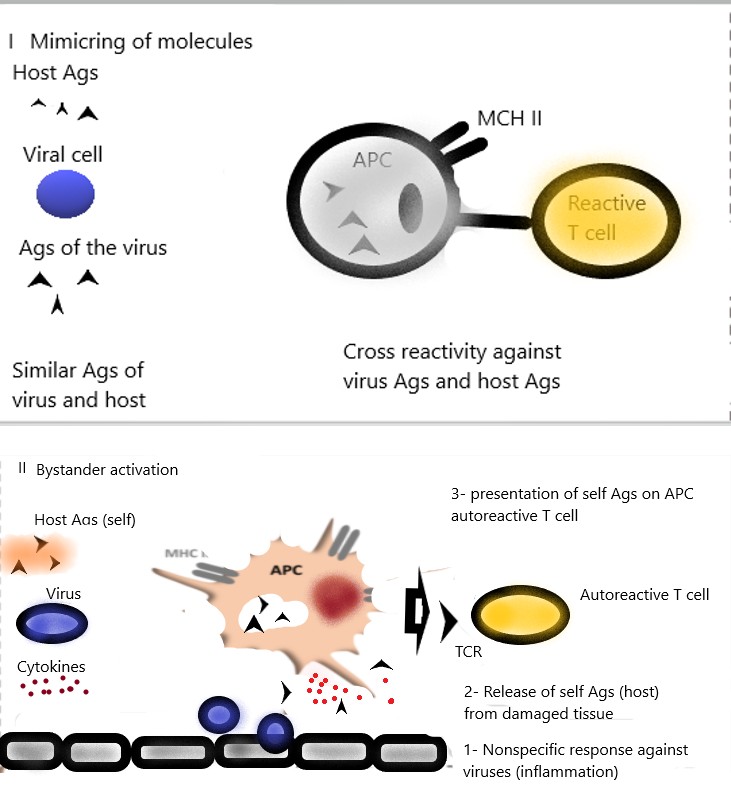
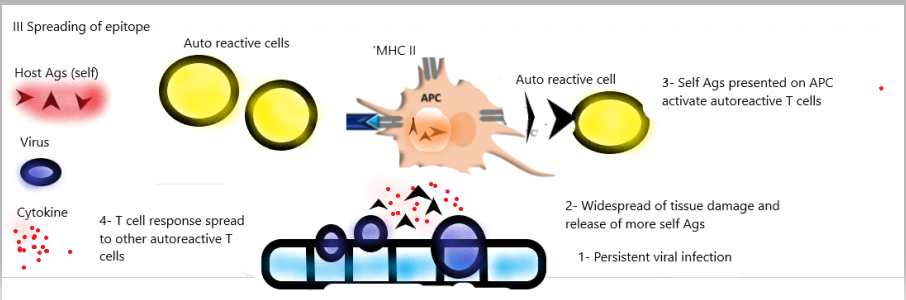
Figure 1 (I-III): The role of viruses in the induction of autoimmunity [1].
Conclusion
Viruses play roles in initiating autoimmunity disorders, and participate in the development of diabetes type 1. The pathological role of viruses through mediating of immunological reactions should be taken in clinical implications in terms of diagnosis and designing new therapeutic options.
References
-
Alkhatib AJ (2022) The Role of Microbes in Autoimmune Diseases: New Mechanisms of Microbial Initiation of Autoimmunity. 1st (Edn.), Springer Singapore, pp: 1-108.
-
Christen U, Hintermann E (2018) Pathogens and autoimmune hepatitis. Clinical and Experimental Immunology 195(1): 35-51.
-
Thakur A, Mikkelsen H, Jungersen G (2019) Intracellular Pathogens: Host Immunity and Microbial Persistence Strategies. Journal of Immunology Research pp: 1-24.
-
Manfredo VS, Hiltensperger M, Kumar V, Zegarra-Ruiz D, Dehner C, et al. (2018) Translocation of a gut pathobiont drives autoimmunity in mice and humans. Science 359(6380): 1156-1161.
-
Ercolini AM, Miller SD (2009) The role of infections in autoimmune disease. Clinical and Experimental Immunology 155(1): 1-15.
-
Maizels RM, McSorley HJ, Smyth DJ (2014) Helminths in the hygiene hypothesis: sooner or later? Clin Exp Immunol 177(1): 38-46.
-
Roche PA, Furuta K (2015) The ins and outs of MHC class II-mediated antigen processing and presentation. Nature reviews Immunology 15(4): 203-216.
-
Besser H, Yunger S, Merhavi-Shoham E, Cohen CJ, Louzoun Y (2019) Level of neo-epitope predecessor and mutation type determine T cell activation of MHC binding peptides. J immunotherapy cancer 7(1): 135.
-
Kobayashi SD, Malachowa N, DeLeo FR (2018) Neutrophils and Bacterial Immune Evasion. J Innate Immun 10(5-6): 432-441.
-
Nauseef WM (2007) How human neutrophils kill and degrade microbes: an integrated view. Immunol Rev 219: 88-102.
-
von Herrath MG, Fujinami RS, Whitton JL (2003) Microorganisms and autoimmunity: making the barren field fertile. Nat Rev Microbiol 1(2): 151-157.
-
Kaer LV (2018) How Superantigens Bind MHC. J Immunol 201(7): 1817-1818.
-
Cusick MF, Libbey JE, Fujinami RS (2012) Molecular mimicry as a mechanism of autoimmune disease. Clin Rev Allergy Immunol 42(1): 102-111.
-
Christen U (2014) Molecular mimiry. In: Shoenfeld Y (Eds.), Autoantibodies. Elsevier, USA, pp: 35-42.
-
Migliore L, Nicolì V, Stoccoro A (2021) Gender Specific Differences in Disease Susceptibility: The Role of Epigenetics. Biomedicines 9(6): 652.
-
Rodriguez Y, Rojas M, Pacheco Y, Acosta-Ampudia Y, Ramirez-Santana C, et al. (2018) Guillain-Barre syndrome, transverse myelitis and infectious diseases. Cell Mol Immunol 15(6): 547-562.
-
Sabouri S, Benkahla MA, Kiosses WB, Rodriguez-Calvo T, Zapardiel-Gonzalo J, et al. (2020) Human herpesvirus-6 is present at higher levels in the pancreatic tissues of donors with type 1 diabetes. J Autoimmun 107: 102378.
-
von Mutius E (2007) Allergies, infections and the hygiene hypothesis–the epidemiological evidence. Immunobiology 212(6): 433-439.
-
Filippi C, von Herrath M (2005) How viral infections affect the autoimmune process leading to type 1 diabetes. Cell Immunol 233(2): 125-132.
-
Christen U, von Herrath MG (2011) Do viral infections protect from or enhance type 1 diabetes and how can we tell the difference?. Cell Mol Immunol 8(3): 193-198.
-
Beck RW, Bergenstal RM, Laffel LM, Pickup JC (2019) Advances in technology for management of type 1 diabetes. Lancet 394(10205): 1265-1273.
- hMPV: Is It Another Covid-19 Like Situation?
- Streptomyces: Sources of Novel Discoveries in Antibiotic Research to Combat Antimicrobial Resistance
- A Review of Mosquitoes (Diptera: Culicidae) and Their Biodiversity, Medical and Veterinary Importance
- Past and Current Immunotherapy in Cancer
- Hematological Cancer and Viral Infection
- The Growing Threat of Antimicrobial Resistance in India: Challenges and Solutions