
SARS-CoV-2 Orf1ab Genome Mutations, the Driving Force for Virus Pathogenicity
Introduction: The proteins codified in the Open Reading Frame 1ab -Orf1ab- region of the SARS-CoV-2 genome triggers the virus transcription, replication, and translation processes inside the human cell. Targets: The purpose of the Mini Review is to present a systematic review as of October 31, 2023, on the Orf1ab region mutations of the SARS-CoV-2 genome, with the aim to predict, through the mutations profile on that region, the severity of an infection for a new SARS-CoV-2 variant that could emerge in the near future. Method: Original scientific articles published in Medline, Pubmed, Science Direct, Web of Science, Scopus, EBSCO and BioMed Central databases, official health organizations (WHO, CDC, ECDEC, NIH) electronic publications, and specialized media in the subject, were electronically searched to accomplish the aim of the study. Results: The search on scientific literature on Orf1ab SARS-CoV-2 genome region together with the analyses of the specific mutations, can be an invaluable tool for predict virus variants pathogenicity. Conclusions: The analyses of Orf1ab genome mutations, allows us to predict, through the mutations profile on that region, the severity of an infection for a new SARS-CoV-2 variant that could emerge in the near future. Outlook: As clearly illustrated, the pathogenicity of actual and future SARS-CoV-2 variants can be predicted.
Introduction
As of October 2023, the coronavirus disease 2019 (COVID-19) pandemic caused by the severe acute respiratory syndrome coronavirus-2 (SARS-CoV-2) has resulted in a staggering 770 million confirmed cases and 6.90 million deaths worldwide [1].
The SARS-CoV-2 genome is approximately 30 kb long (GenBank number MN908947), and it encodes 9,860 amino acids [2].
The NIH “National Human Genome Research Institute” define the Open Reading Frames (ORFs) as a portion of a DNA sequence that does not include a stop codon.
The Open Reading Frames encode accessory proteins transcribed from the 3′ one-third of the genome to form a set of subgenomic mRNAs (sg mRNAs) (Figure 1) [3].
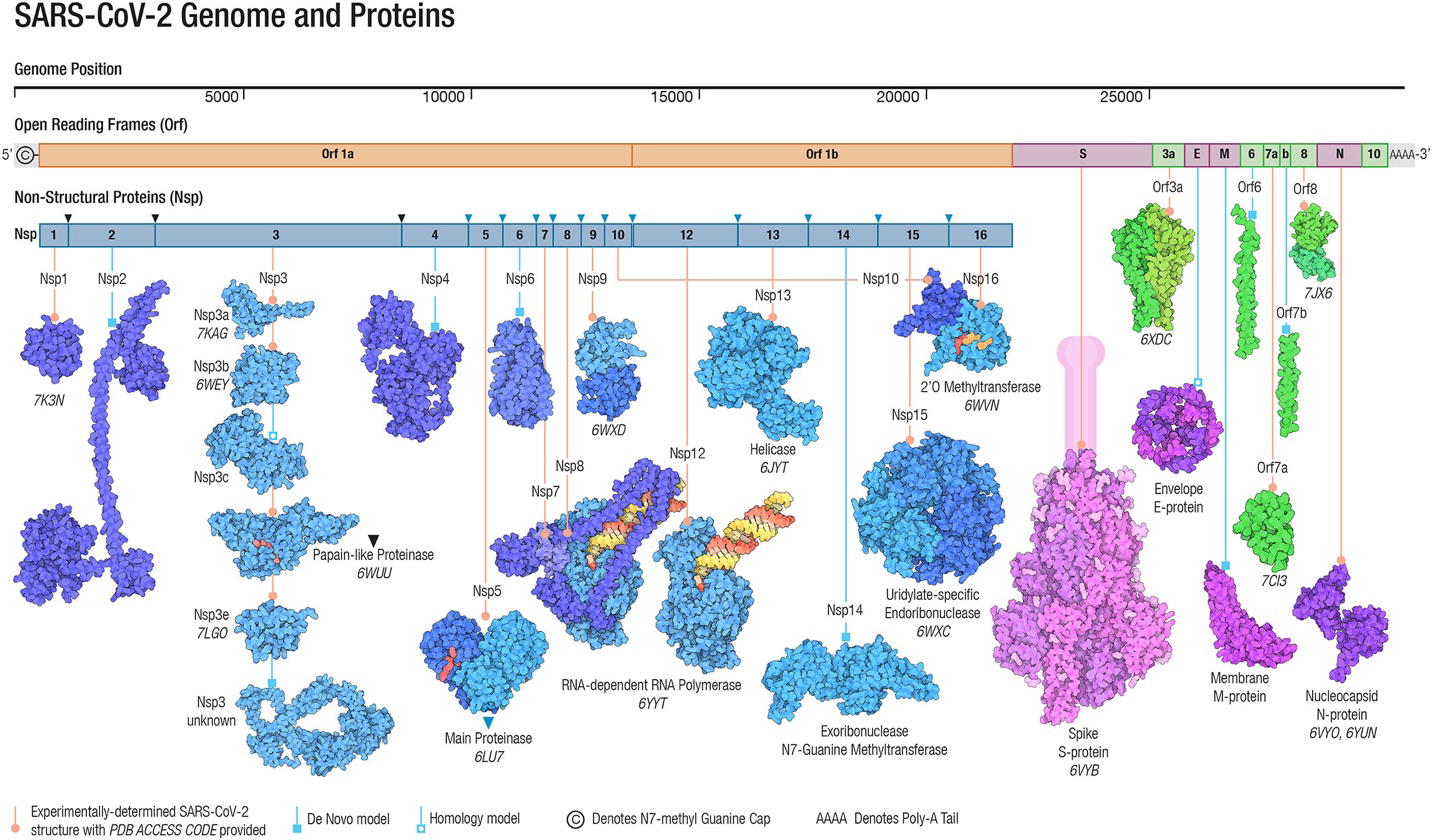
The proteins codified in the Open Reading Frame 1ab -Orf1ab- region of the SARS-CoV-2 genome are the main responsible for the virus transcription, replication, and translation processes inside the human cell.
Once inside the cell, the viral particle releases the genomic RNA molecule that is translated on two large open reading frames, ORF1a and ORF1b.
The largest gene, Orf1ab, contains overlapping open reading frames that encode polyproteins PP1ab and PP1a [4].
These polyproteins are cleaved to yield 16 nonstructural proteins, NSP1-16, and include the papain-like proteinase (NSP3), 3C-like proteinase (NSP5), RNA-dependent RNA polymerase (NSP12, RdRp), helicase (NSP13, HEL), endoRNAse (NSP15), 2’-O-Ribose-Methyltransferase (NSP16) and other nonstructural proteins.
Plpro -NSP3- and 3Cl-pro -NSP5-, process the polyproteins and generate the nonstructural proteins NSP1-NSP16 that directs the transcription, replication, proteolytic processing, suppression of host immune responses, suppression of host gene expression, and construction of new virions that are secreted by exocytosis from the infected cell.
NSP12 acts as the main component of replication machinery of SARS-CoV-2 and comprises RNA dependent RNA polymerase (RdRp), interface, and nidovirus RdRp- associated nucleotidyltransferase -NiRAN- [5].
Additionally, NSP12 directly interacts with helicase, which results in enhancing the helicase activity [6].
The location of NSP12 AASs (Amino acid Analog- Sensitive) mutations in the protein structure and their frequency were investigated between January 2020 and June 2021.
The Table 1 describes the first five frequent mutations regardless of geographical distribution.
| Rank | Residue | Frequency | Total Frequency |
|---|---|---|---|
| Top 1 | P(323)L | 0.98366 | 1,731,040 |
| Top 2 | P(227)L | 0.061411 | 108,071 |
| Top 3 | G(671)S | 0.028901 | 50,860 |
| Top 4 | V(776)L | 0.018056 | 31,775 |
| Top 5 | A(185)S | 0.017245 | 30,348 |
Table 1: First Five Frequent Mutations of NSP12 regardless of geographical distribution.
Interestingly, not all of these mutations are present among the continents as the top five mutations.
Among these mutations, the P323 mutation was present in all continents (North America (0.9862 frequency), South America (0.9896 frequency), Europe (0.9877 frequency), Asia (0.9491 frequency), Oceania (0.9098 frequency), and Africa (0.9394 frequency) as the mutation with the highest incidence rate.
P227 mutation has been observed as one of the top mutations in North America (0.1292 Frequency), Europe (0.0327 Frequency), South America (0.0193 Frequency), and Africa (0.0331 Frequency).
G671 mutation has been remarked in North America (0.008 Frequency), Asia (0.0454 Frequency), and Europe (0.0396 Frequency) among the top five mutations.
Finally, V776 mutation in North America (0.0085 Frequency), Europe (0.0254 Frequency), and Africa (0.0228 Frequency); A185 mutation in Europe (0.0262 Frequency) and America (0.0258 Frequency) are observed among the top five mutations.
The Table 2 shows the incidence of the global NSP12 top- five mutations on the world continents [6].
| North America | South America | Europe | Asia | Oceania | Africa | |
|---|---|---|---|---|---|---|
| P(323)L | 0.9862 | 0.9896 | 0.9877 | 0.9491 | 0.9098 | 0.9394 |
| P(227)L | 0.1292 | 0.0193 | 0.0327 | 0.1280 | 0.0055 | 0.0331 |
| G(671)S | 0.0080 | 0.0009 | 0.0396 | 0.0454 | 0.0091 | 0.0048 |
| V(776)L | 0.0085 | 0.0038 | 0.0254 | 0.0013 | 0.0026 | 0.0228 |
| A(185)S | 0.0042 | 0.0046 | 0.0262 | 0.0018 | 0.0022 | 0.0258 |
Table 2: Incidence of the global NSP12 top-five mutations on the world continents.
Altogether, the data strongly suggest that SARS-CoV-2 is acquiring mutations as it is spreading to new locations.
Most likely, these mutations are helping SARS-CoV-2 to adapt better inside hosts and in new geographical areas.
Key Mutations in Non-Structural Proteins
P323L, P227L, G671S, V776L and A185S are the first five frequent mutations of RdRp (NSP12), the mutations P227L and G671S might have functional consequences in the viral transcription and replication [7].
The mutations P227L and G671S might have functional consequences that need to be addressed in future studies.
Mutations in residues D499 to L514, K545, R555, T611 to M626, G678 to T710, S759 to D761 are directly implicated with the transcription-replication capability of the virus by RdRp [8].
In Mpro (NSP5) the mutation of residues H41, P132, C145, S145, L226, T234, R298, S301, F305, and Q306 may increase the efficiency of proteolytic cleavage of proteins such as NEMO, thereby improving the ability of the omicron series of viruses to suppress the immune system and accelerate the viral replication [9].
In Helicase (NSP13) the mutations of residues E261,
K218, K288, S289, H290, D374, E375, Q404, K460, R567, and A598 are involved in the separation of the double-stranded RNA or DNA with a 5′→3′ polarity as well as 5′ mRNA capping activity in the virus transcription-replication process [4, 10].
In the Orf1ab gene, ORF1b:V2354F mutation, corresponding to NSP15:V303F, may induce a conformational change and result in a disruption to a flanking beta-sheet structure.
The premature stop codon ORF7a:Q94*, truncates the transmembrane protein and cytosolic tail used to mediate protein transport, may affect protein localization to the ER- Golgi [11].
In the Orf1ab gene, ORF1b:V2354F mutation, corresponding to NSP15:V303F, may induce a conformational change and result in a disruption to a flanking beta-sheet structure.
The premature stop codon ORF7a:Q94*, truncates the transmembrane protein and cytosolic tail used to mediate protein transport, may affect protein localization to the ER- Golgi.
P77L mutation located within the N-terminal zinc- binding domain required for catalytic activity and interaction with NSP12 [12].
V226L mutation located in the 1B domain is involved in substrate binding.
A220, A394V and C484 residue mutations could impact protein–protein interactions [13].
V303F mutation introduces a potential conformational change to one of five α-helices which flank the two antiparallel β-sheets comprising the catalytic domain of NSP15 [14].
Conclusions
The evolution of key proteins in viral transcription and replication is clearly observed by carefully studying the structure, function, and evolution of RdRp, Mpro or 3Clpro, and NSP13 proteins directed by the Orf1a and Orf1ab genome mutations.
The analyses of Orf1ab genome mutations, allows us to predict, through the mutations profile on that region, the severity of an infection for a new SARS-CoV-2 variant that could emerge in the near future.
References
-
World Health Organization (2023) Coronavirus (COVID-19) Dashboard.
-
Wu CR, Yin WC, Jiang Y, Xu HE (2022) Structure genomics of SARS-CoV-2 and its Omicron variant: drug design templates for COVID19. Acta Pharmacol Sin 43(12): 3021-3033.
-
Lubin JH, Zardecki C, Dolan EM, Lu C, Shen Z, et al. (2022) Evolution of the SARS-CoV-2 proteome in three dimensions (3D) during the first 6 months of the COVID-19 pandemic. Proteins 90(5): 1054-1080.
-
Islam J, Islam NN, Alom S, Kabir M, Halim MA (2023) A review on structural, non-structural, and accessory proteins of SARS-CoV-2: Highlighting drug target sites. Immunobiology 228(1): 152302.
-
Ilmjärv S, Abdul F, Acosta-Gutiérrez S, Estarellas C, Galdadas I, et al. (2021) Concurrent mutations in RNA- dependent RNA polymerase and spike protein emerged as the epidemiologically most successful SARS-CoV-2 variant. Scientific Reports 11(1): 13705.
-
Wang Q, Wu J, Wang H, Gao Y, Liu Q, et al. (2020) Structural Basis for RNA Replication by the SARS-CoV-2 Polymerase. Cell 182(2): 417-428.
-
Eskier D, Karakülah G, Suner A, Oktay Y (2020) RdRp Mutations are Associated with SARS-CoV-2 Genome Evolution. PeerJ 8: e9857.
-
Yin W, Mao C, Luan X, Shen DD, Shen Q, et al. (2020) Structural basis for inhibition of the RNA-dependent RNA polymerase from SARS-CoV-2 by remdesivir. Science 368(6498): 1499-1504.
-
Koudelka T, Boger J, Henkel A, Schönherr R, Krantz R, et al. (2020) N-Terminomics for the Identification of In Vitro Substrates and Cleavage Site Specificity of the SARS-CoV-2 Main Protease. Proteomics 21(2): 2000246.
-
Zeng H, Gao X, Xu G, Zhang S, Cheng L, et al. (2022) SARS- CoV-2 helicase NSP13 hijacks the host protein EWSR1 to promote viral replication by enhancing RNA unwinding activity. Infectious Medicine 1(1): 7-16.
-
Brinkac L, Diepold S, Mitchell S, Sarnese S, Kolakowski LF, et al. (2022) SARS-CoV-2 Delta variant isolates from vaccinated individuals. BMC Genomics 23(1): 417.
-
Peacock TP, Penrice-Randal R, Hiscox JA, Barclay WS (2021) SARS-CoV-2 one year on: evidence for ongoing viral adaptation. Journal of General Virology 102(4): 001584.
-
Lin S, Chen H, Chen Z, Yang F, Ye F, et al. (2021) Crystal structure of SARS-CoV-2 nsp10 bound to nsp14-ExoN domain reveals an exoribonuclease with both structural and functional integrity. Nucleic Acids Research 49(9): 5382-5392.
-
Pillon MC, Frazier MN, Dillard LB, Williams JG, Kocaman S, et al. (2021) Cryo-EM structures of the SARS-CoV-2 endoribonuclease Nsp15 reveal insight into nuclease specificity and dynamics. Nature Communications 12(1): 636.
- hMPV: Is It Another Covid-19 Like Situation?
- Streptomyces: Sources of Novel Discoveries in Antibiotic Research to Combat Antimicrobial Resistance
- A Review of Mosquitoes (Diptera: Culicidae) and Their Biodiversity, Medical and Veterinary Importance
- Past and Current Immunotherapy in Cancer
- Hematological Cancer and Viral Infection
- The Growing Threat of Antimicrobial Resistance in India: Challenges and Solutions