
Overview of Gang Rape Registered in High Court Province Five of Nepal: An Analytical Study
Rape, which is a heinous crime criminalized by law in Nepal is increasing and includes cases of gang rape. The Case Law Study was done on the 5 years registered cases of gang rape in High Court, Butwal Bench with official ethical permission. There are 6 district courts under the jurisdiction of High Court with diverse population and geographical distribution. There were 472 cases registered as sexual violence. 141 cases with 149 survivors were awarded with final summary hearing; 12% of these were gang rape cases. There were 18 survivors of gang rape with 52 male perpetrators. More than half the survivors of gang rape were minors and almost 90% of perpetrators were adult men, two third of them known to the survivor. The gang attacked to rape a sole vulnerable survivor range from 2 to 8 perpetrators. There were more than 10% male children accompanying adults in the activity. Most of the noted site of gang rape was fields, followed by the survivor’s home. Two thirds of the cases had medical evidence suggestive of violence. One third of the cases were acquitted due to lack of evidence, and few of the survivors were punished with fines for wrongful accusation in the final verdict. There are several challenges and loopholes in the socio-cultural as well as criminal justice system in Nepal which demands to be scrutinized to justify the maxim, ‘Let hundred guilty be acquitted but one innocent should not be convicted’ in heinous crimes such as gang rape.
Introduction
The word rape is derived from Latin term RAPIO which means “to snatch”[1]. Absence of consent is the essential element in the crime of rape. The victim’s body is forcibly seized by the perpetrator to fulfill the gratification of sex. Sexual assault is an aggressive act driven by power and control. It is the crime against basic human rights and violation of the victim’s most cherished right, namely the right of life and human dignity. Gang rape is non-consensual sexual violence on a single survivor by more than 2 perpetrators [2].
Investigation Paper
Rape is heinous crime criminalized by the law in Nepal [3]. Nevertheless, the number of reported cases of sexual violence has increased by 256 percent in the past decade [4]. The Nepal Police report of October2020 shows that there are 7 reported cases of sexual violence every day; the report adds on that 61.3% of women with sexual violence never shared the incident to anyone, thus suffer in silence. Additionally, trusted national news media reports claim that the reported sexual violence cases suffer with inappropriate, inadequate investigations, impunities, and failure to give fair justice; thus, causing fading trust in the government system [5].
Nepal was declared a Federal Democratic Republic Sate on 28th May 2008 with 7 Provinces, 77 districts and 753 local levels. The published literature related to sexual violence reflecting the prevalence and pattern in rural and urban areas of the province is scarce.
The author focuses on the case law study on gang rape cases registered with final verdict in Province 5 in Nepal.
Methodology
This study is a retrospective descriptive focused analysis of gang rape cases registered at the High Court Butwal Bench from fiscal year 2012/13 to fiscal year 2017/18. Written official permission was obtained from High Court, Butwal Bench for this research. Butwal High Court provided permission to get the reference numbers of the registered cases. With this reference, the details of the cases were retrieved from the Supreme Court website (www. supremecourt.gov.np) for this study. The data were collected and processed with Microsoft Excel format for evaluation. Ethical approval was obtained from National Health Research Council.
Results and Discussion
There were 492 Rape cases registered in High Court, Butwal Bench over 5 years study period in 2012/13 till 2017/18.High Court (Table 1), Butwal Bench has jurisdiction over 6 different districts: Rupendehi, Nawalparashi, Kapilvastu, Palpa, Gulmi, and Argakhachi, covering about 65% of province 5 populations. There were 141 cases with 149 survivors received the final verdict at the time of this study. There were 18 cases of gang rape (Figures 1-8).
| District | Number of Cases Filed | Number of Survivors | Number of Gang Rape | Percentage of Gang Rape |
|---|---|---|---|---|
| Rupendehi | 55 | 62 | 6 | 9.60% |
| Nawalparashi | 29 | 29 | 7 | 27.50% |
| Kapilvastu | 23 | 23 | 2 | 8.60% |
| Palpa | 17 | 18 | 1 | 5.50% |
| Gulmi | 11 | 11 | 1 | 9.00% |
| Argakhanchi | 6 | 6 | 1 | 16.60% |
| Total | 141 | 149 | 18 | -12% |
Table 1: Gang Rape Cases.
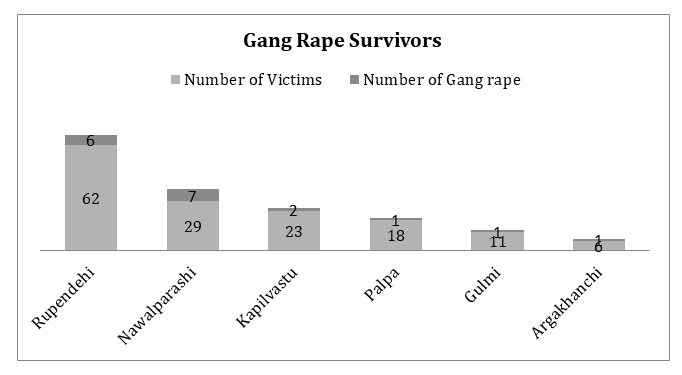
The Nepalese community has the traditional mindset of accepting rape as a way of life. People most of the time do not complain about the incident. Most of the incidents are hushed inside the house. Even if it spreads in the community, negotiation and keeping the incident silent is unfortunately befalls. People fear about their prestige in the eyes of community than the immediate, short-term and long- term consequences brought by the crime of rape, not only to the primary survivor, but also to the family and society at large. Only about 40% of the cases come into administrative procedure [4]. Many of them are encouraged by the authorities themselves for mediation and thus discouraged to continue the judicial process. The use of money, power and added threat from perpetrators compel the rape survivor(s) to become hostile at court. These issues are almost never brought to the surface to be analyzed.
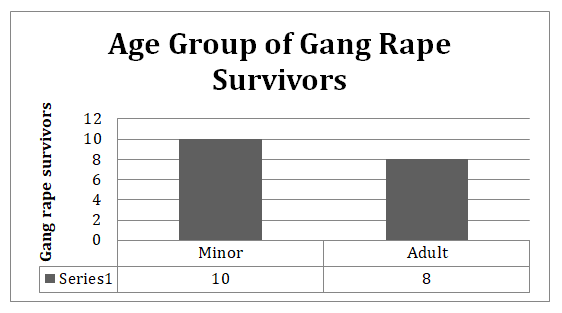
More than half (56%) of gang rape survivors were minor. The legal age for adult is more than 18 years of age. The youngest survivor of gang rape was child aged of two years.
The most vulnerable group was minors which raises the question of underlying unrecognized and unvoiced sexual violence in the community. The younger the girls, the more violence they suffer. Children less than 10 years of age are almost never aware of the difference between sexual activity and any other activities. Moreover, the act of violence is often done by someone trusted and known. The perpetrators take the advantage of vulnerabilities and innocence of children. All the gang rape survivors were female and perpetrators male.
The majority of culprits were found to be the someone known to the survivor: blood related neighbors, relatives and acquaintances; similar to findings in many other studies [6, 7, 8].
Multipronged approaches of moral education, school sexuality education and community parental awareness programs on children’s safety, societal reformation on myths related to sexual violence together with strong legislation is the urgent need of the day to combat sexual violence.
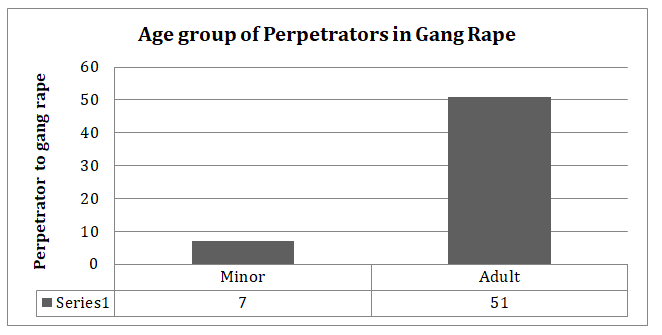
There were 58 perpetrators those were involved in Gang Rape in 18 cases. 12% of the perpetrators were minors, and 88% were adults. The youngest offender to gang rape was 11 years of age.
Most of the perpetrators were adult male, but there were 12% boy children involved in the gang rape accompanied with adult men suggesting their involvement caused by peer pressure and bad influence by adults [9, 10, 11]. Others
were due to curiosity and imitating influence by watching pornography.
This research finding illuminates the need to rethink on family upbringing, schooling, sex education and basic moral or legal education. Gang rape, as a mode of sexual violence, is not uncommon in the society. Many of the perpetrators in this were from minor age group too. The normal childhood curiosity, misuse of internet, easy access to pornography and lack of parental/guardians/teachers’ timely guidance and supervision leading to crime by male children. There remains a huge responsibility of the state to address the long- term adverse impacts that brings on the physical, mental and psychosexual health of the victims.
The myths and beliefs compelling to commit the action may not appear an offence to the actor in the first place. People in the particular community are living with such beliefs for ages, and they think that they are doing the right thing [12, 13, 14]. The person is acting as he had perceived in the society he lived. The myths such as having ‘intercourse with a child or a virgin treats all venereal diseases’ needs to be focused to eliminate from the mind and heart of the society before anything else to prevent rape in minors.
The concept of federalism, local governance comes into maximum useful in the applicability of the focused legislation, implementation modalities addressing issues prevalent in a particular society; for example, Nawalparashi district had proportionately (27%) gang rape compared to other districts studied. Laws, policies, rules and regulations including training to address myths on rape culture elimination will be beneficial. The government must create budget and provide resources towards public awareness, and easy, accessible, and affordable procedures to combat such crimes.
In patriarchy society, male dominance, power and machismo are a norm. Men are expected to act manly and keep their status as powerful, and not expected to express weakness, failure and frustration which many have the impression ismeant for females. To overcome these societal myths, a person may gratify himself using his sexual organ as a weapon, raping a woman to prove himself. This is a war of male versus female; male using his weapon to crush woman’s body, mind and soul so much so that she will not be able to rise again, thus keeping up the patriarchal status intact [15].
Most of the rape crimes are hushed inside the house; the culture of silencing the rape violence is also strongly engrossed with the patriarchy mindset. The community awareness, accessibility, affordability, and ensuring confidentiality in the process of justice are vital to come out of this cocoon. Economic empowerment, state sponsored rehabilitation and restorations are important factors to be ensured so that the tyrannized survivors can speak up without undue influence or fear of similar abuse [16].
The media, civil society, and public demanding amendments in law for death penalty for rapist are not in alignment to the ethos of human rights [17]. Hormonal treatment, medical castration or surgical castration to case basis could be an answer to the issue.
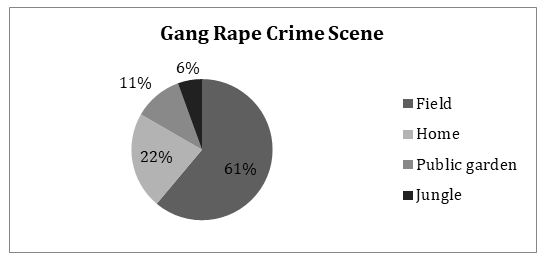
Most of the gang rape crime scene was in field, followed by survivor’s home, public garden and a nearby jungle. The survivors were either coming back from school or helping in farm or vulnerable child, girl, women, and even disabled at home.
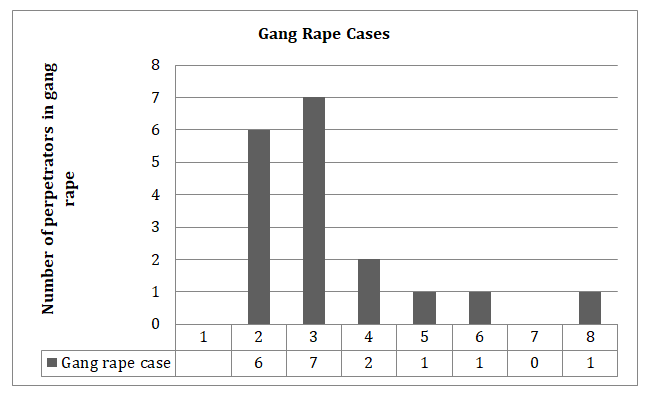
There were 2 to 8 perpetrators in 18 gang rape cases in the 5 years study period. 2 & 3 perpetrators made almost three fourth of the gang rape. There were as many as 8 perpetrators in one gang rape. There are similar reports from around the world in gang rape.
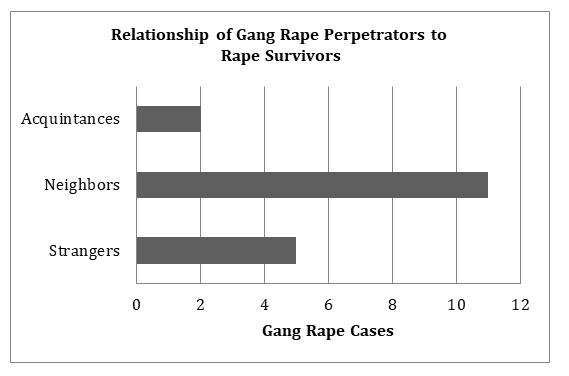
Most of the men and boys who gang raped were known to the rape survivor; they were often neighbors or family acquaintances. However, the findings contrasted with other studies: in America, where the perpetrators are mostly strangers and in a Johannesburg study, the perpetrators are mostly the boyfriend (2/ 61, 62).
The risk factors in the study are unfortunately the perpetrators who are known to the survivors and thus trusted. The perpetrators appear to be opportunistic to the vulnerability of trust and lonely situation at the time of crime. In addition, in Nepali culture, every single male neighbor or acquaintances are called as brother, uncle, father, grandfather according to age, and people trust easily.
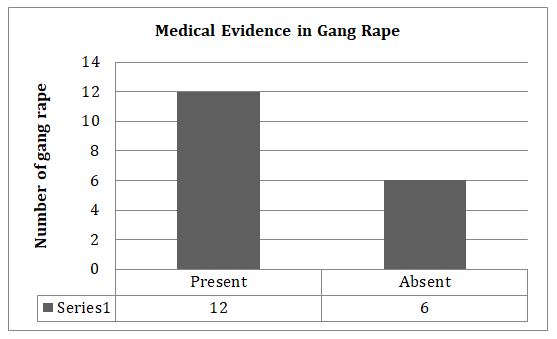
Medical evidence was present in 12 of 18 cases of Gang rape. Medical evidences are important complimenting the facts filed in court for justice [18].
The good report demands timely examination of rape survivor, so as not to erase the evidence, along with maintaining the chain of command in transferring the sample for laboratory testing. There are several challenges due to the lack of trained manpower, technology and geographical obstacles.
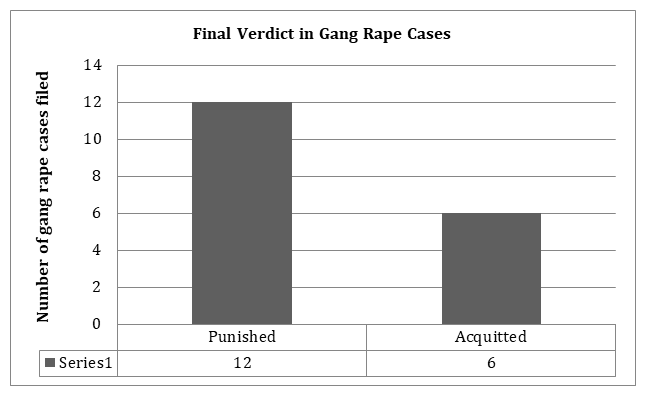
The final summary verdict awarded punishment for gang rape in 12 cases. One third of the gang rape cases were acquitted due to lack of evidence or due to hostile witness. In one of the cases where an 11-year-old child was gang raped by 3 adult men convicted by the Lower Court was not only awarded acquittal to perpetrators by High Court but also punished with the fine of Rs. 2000=00 (two thousand rupees) for wrongful accusation and wasting the time of the court [19, 20].
In the case law study of rape, none of the survivors received any interim compensation. There was no mention of psychosocial counseling.
The Office of the Attorney General Report for the fiscal year 2016-17 in the Supreme Court, reported a 64% conviction rate for rape, and 44% for attempted rape. In the High Court, there was a conviction rate of 42% for rape and 28% for the attempted rape.
Conclusion
Gang Rape is not unknown in community. All the survivors in this study were females and all the perpetrators were males. Children were also involved in the heinous crime: survivors as well as offenders. This adversely concerns the families and societal norms and values [21]. There is a serious need to look at the reasons why the rape culture is tolerated in society find ways to break the barriers of traditional patriarchy myths to combat the heinous crime.
Closing the Gaps in professional co-ordination of various stakeholders (police investigators, public prosecution, and court adjudication) in rape crime is important factor in the efficient management. The gang rape case law studies comparing with various theories of Crime, preventive modalities at home, school, colleges, and community along with medical treatment to specific groups of perpetrators facilitated by strong legislation to combat sexual violence are urgent need of the day.
References
-
Yubaraj S (2010) Jurisprudence, The Philosophy of Law, Bhaktapur lex & Juris Publication Pvt ltd, pp: 427.
-
WHO (2002) Sexual Violence, (Chapter 6) World report on violence and health.
-
(2017) Nepalese National Penal Code.
-
(2016) Ministry of Health, Nepal National Demographic Health Survey, pp: 1-591.
-
www.himalayantimes.com
-
Unicef Nepal/ UNDP/ WHO Nepal Report (Relationship/ age).
-
Bourgois P (1996) In search of respect: selling crack in El Barrio. Cambridge, Cambridge University Press.
-
Ariffin RE (1997) Shame, secrecy and silence: study of rape in Penang. Penang, Women’s Crisis Centre.
-
Petty GM, Dawson B (1989) Sexual aggression in normal men: incidence, beliefs and personality characteristics. Personality and Individual Differences 10: 355-362.
-
Randall M, Haskell L (1995) Sexual violence in women’s lives: findings from the women’s safety project, a community-based survey. Violence Against Women 1(1): 6-31.
-
Sanday P (1981) The socio-cultural context of rape: a cross-cultural study. Journal of Social Issues 37(4): 5-27.
-
Bennett L, Manderson L, Astbury J (2000) Mapping a global pandemic: review of current literature on rape, sexual assault and sexual harassment of women. Melbourne, University of Melbourne.
-
Jenkins C (1998) Sexual behavior in Papua New Guinea. In: Report of the Third Annual Meeting of the International Network on Violence Against Women, Washington, DC, International Network on Violence Against Women.
-
Bourgois P (1996) In search of masculinity: violence, respect and sexuality among Puerto Rican crack dealers in East Harlem. British Journal of Criminology 36(3): 412-427.
-
Ouimette PC, Riggs D (1998) Testing a mediational model of sexually aggressive behavior in nonincarcerated perpetrators. Violence and Victims 13(2): 117-130.
-
Swart L, Gilchrist A, Butchart A, Seedat M, Martin L (2000) Rape surveillance through district surgeons’ offices in Johannesburg, 1996–1998: findings, evaluation and prevention implications. South African Journal of Psychology 30(2): 1-10.
-
Greenfeld LA (1997) Sex offenses and offenders: an analysis of data on rape and sexual assault. Washington, DC, United States Department of Justice, Office of Justice Programs, Bureau of Justice Statistics.
-
Gartner R (1990) The victims of homicide: a temporal and cross-national comparison. American Sociological Review 55(1): 92-106.
-
Briggs CM, Cutright P (1994) Structural and cultural determinants of child homicide: a cross-national analysis. Violence and Victims 9(1): 3-16.
-
Smutt M, Miranda JLE (1998) El Salvador: socialization and juvenile violence.] In: Ramos CG, ed. America Central en los noventa: problemasdejuventud. [Central America in the 90s: youth problems.] San Salvador, Latin American Faculty of Social Sciences, pp: 151-187.
-
Lapsia T (2015) Impact of the Nirbhaya Rape Case: IsolatedPhenomenon or Social Change? Honors Scholar Thesis.
- The Need for Partner Education and Mental Health Support During Pregnancy and the Postpartum Period
- Application of Combined PGT-A and PGT-M for Reproductive Management in a Couple Carrying GCDH Mutations with Prior Affected Offspring: A Rare Case Report
- The Effect of Using a New Technique Karman Injector (Elif Technique) on the Healing Process of Wound Infection-Case Series
- GSM: Counseling Points to Discuss with Women Fearful of Vaginal Estrogen
- Antenatal Diagnosis of Meckel Syndrome: A Case Report
- Discrimination and Workplace Harassment (Mobbing) against Women in the Post-Pandemic Era