
Comparison between Outcome of Assisted Reproductive Technique (Art) Cycles with and Without OCP Pretreatment in Infertile Women: A Randomized Clinical Trial
The objective of this randomized clinical trial was to assess the effect of pretreatment with oral contraceptive pill (OCP) on assisted reproductive technique outcomes in patient’s candidate for assisted reproductive technique (ART). In a randomized clinical trial University-based infertility center, Tehran, Iran. 160 infertile patient who are candidate for IVF, randomly divided into two groups: 80 patients in OCP pretreatment group and 80 patients in non-OCP pretreatment group. The IVF protocol in all patients was standard long GnRH agonist (long protocol). The oocyte number, embryo formation, fertility rate, gonadotropin dose, ovarian cyst formation and cancelled cycles were evaluated. Oocytes number per patient in OCP group was 13.87 and in non-OCP group was 15.22, pregnancy rate in OCP group was 44.7% and in non-OCP was 31.2%, the abortion rate in OCP group was 10.5% and in non-OCP was 3.1%, that there was no significant difference between two groups, embryo formation in two groups was similar. ovarian cyst in OCP group was 2.6% and in non-OCP was 12.5% (P< 0.05) so the cancelled cycles due to ovarian cyst in OCP group was less than non-OCP group. Based on our data, OCP pretreatment have no effect on oocyte number, embryo formation, pregnancy rate and abortion, but this pretreatment can decrease the cyst formation so decrease the cancelled cycles in OCP pretreatment.
Introduction
Fertility is reproductive health landmark and infertility is recognized as a global public health problem by the World Health Organization (WHO) [1]. According to WHO, infertility is a disease of reproductive system that patient could not achieve pregnancy after one year or more of regular unprotected sexual intercourses [2]. The prevalence of female infertility is 12.5% and male infertility is 10.1% [3]. Despite efforts in this regard just 35% of couples that treated by assisted reproductive technique (ART) reach to live birth delivery [4].
The first and important step that determine the successful rate of ART is ovarian stimulation that have different treatment strategies [5]. Totally, the base of all ART
techniques are persuade folliculogenesis via prohibition of endogenous LH surge and give a chance to oocyte for maturation [6]. The ovarian stimulation protocols have some side effects such as ovarian cyst formation and ovarian hyperstimulation syndrome (OHSS) (that in this situation the cycles should be cancelled) [7, 8] and harmful effects of the hormonal environment on endometrial receptivity [9]. Control of ovarian hyperstimulation is very important. To obtain more mature follicles, the early LH surge should suppress [10].
The estradiol has negative feedback on LH secretion but at the end of follicular phase it has positive feedback on hypothalamus and pituitary so increase the level of plasma estradiol at the end of follicular phase induce LH surge [11]. An important factor that leads to controlled ovarian hyperstimulation (COH) failure and then cancels the ART cycle is premature LH surge in follicular phase, that it increases the number of immature oocyte and decrease the fertilization potential of them. Furthermore, LH surge persuade granulosa cells to luteinization and progesterone production that have different effects on endometrium and its receptivity, so premature LH surge can disrupt all of them [5]. LH surge induce ovulation so to retrieve mature follicles and have successful IVF cycle, it is important to inhibit the abrupt endogenous LH surge.
Contraceptive pills that have progesterone and estrogen suppress the endogenous gonadotropins [12] so block the spontaneous LH surge and therefore ovulation [9]. Also oral contraceptive pill (OCP) pretreatment in clomiphene citrate stimulation to retrieve oocyte and IVF, suppress LH surge [13]. Polycystic ovary syndrome (PCOs) is the most common cause of anovulatory infertility [14], in this way many of infertile women suffer from it. OHSS is more occur in PCOs patient, and use of GnRH agonist increases this risk, so one of the protocols that control this event in ART cycles is the dual pituitary suppression with OCP and GnRH-agonist overlap [15]. In some study OCP administration before ovarian stimulation has some effects such as changes in the amount and duration of prescribed gonadotropins [15, 16], number of oocytes, pregnancy rate [17], and thickness of endometrium [18] and its receptivity. Another important role of OCP pretreatment is better synchronization of follicular growth during ovarian stimulation [19].
Due to the importance of ovarian stimulation protocol for infertile women and some of infertility treatment side effects such as ovarian cyst formation and premature LH surge and following that, cancellation the IVF cycle and on the other hand suppression effect of OCP on these side effects, this randomized clinical trial (RCT) was conducted to compare outcome of standard GnRH agonist long protocol with and without OCP pretreatment on cancelled cycles and ART outcomes. This study received IRCT id: 2014112316705N3
Material and Method
Patient Population
In this research, which is a randomized clinical trial, one hundred- and sixty-women undergoing IVF treatment at the university-based infertility center in Mahdiyeh hospital, Tehran from 2014 to 2015 were divided random simple and based on random number table into two groups: OCP group that one period pretreated by OCP and non-OCP group that they take no OCP pretreatment. This study was done on infertile women that treated by standard GnRH agonist long protocol.
Inclusion Criteria Were
1) No endocrine disorder, 2) levels of FSH <10 IU/l, 3) normal uterus based on transvaginal sonography. Exclusion criteria were: 1) Azoospermia, 2) OCP contraindication.
Ovarian Stimulation
In OCP group, OCP administrate from day 3-4 of menstruation and after 15-18days transvaginal sonography was done, if ovaries were normal short acting GnRH agonist (Cinafact, Cinagen factory) 40 IU/ SQ/ daily was administrated. From day 2-3 of menstruation gonadotropin administration was started. ward protocol (Gonal F 150- 300IU/daily based on ward protocol ,based on patient age and patient ovarian reserve, Merck serono company) after 5 days stimulated, transvaginal sonography was done and stimulation continue and every 2-3 days transvaginal was repeated, whenever at least 3 follicle with 17-19 size were detected, 10000 HCG (Choriomon, Fering company ) administrated and 35-36 hours after ovarian puncture was done and after ovum injection by embryologist, at day 3 and 4 embryo transfer was done and luteal phase, 14 days late BHCG level was checked and if positive, support by progesterone continued, supported by Cyclogest sup 400mg, twice a day.(Actoverco company). One week later, an transvaginal sonography was performed, and data were recorded in other group. all steps are the same except OCP administration. In both group if there was any pathology in ovary including ovarian follicle >12mm cycle was cancelled.
Statistical Analysis
The result of quantitative variables presented with mean ± SD and quantitative result presented by percent. Chi-
square or Fisher tests were used to compare the qualitative variables and independent t-test or Mann-Whitney test were used to compare the quantitative variables. All tests were two-tailed evaluated with a confidence level of 95% (P < 0.05). Data were analyzed using SPSS software version 19 and SAS version 9.1.
Ethical Consideration
This study has been approved by the ethics committee of Shahid Beheshti University of Medical Sciences (SBMU. REC.1393.14).
Result
One hundred and sixty women undergoing IVF, prior to initiation of stimulation, randomized were divided into receive OCP pretreatment or non-OCP pretreatment. Twenty patients (non-OCP group: n = 16, OCP group: n = 4) did not start IVF cycle after the initial consultation for personal reasons. Based on Table 1, the average age of OCP group was 30.42 ± 4.11 and non- OCP was 30.75 ± 4.30, BMI in OCP group was 25.45 ±2.26 and in non-OCP group was 24.81 ±2.44, oocytes number per patient in OCP group was 13.87±8.79 an in non-OCP group was 15.22±7.60, and the use of gonadotropin vials in OCP group was 31.60±7.49 and in non-OCP group was 30.91±8.3, that in all mentioned variables there was no significant difference between two groups. The embryo formation in two groups was similar, too. Pregnancy rate in OCP group was 44.7% and in non-OCP group was 31.2%, the abortion rate in OCP group was 10.5% and in non-OCP was 3.1%, that there was no significant difference between two groups.
| Variable | OCP group | Non-OCP group | P value |
|---|---|---|---|
| Age | 30.42 ± 4.11 | 30.75 ± 4.30 | 0.645 |
| BMI | 25.4 ± 2.26 | 24.81 ± 2.44 | 0.115 |
| FSH level | 5.52 ± 31.3 | 6.08 ± 2.52 | 0.251 |
| AMH level | 3.28 ± 1.68 | 5.28 ± 4.21 | 0.447 |
| Infertility duration | 11.76 ± 1.61 | 11.29 ± 1.05 | 0.065 |
| Gonadotropin vials number | 31.60 ± 7.49 | 30.91 ± 8.31 | 0.0824 |
| Oocyte number | 13.87 ± 8.79 | 15.22 ± 7.60 | 0.331 |
| Embryo number | 42 55.3% | 36 56.2% | |
| Pregnancy rate | 34 44.7% | 20 31.2% | 0.102 |
| Cancelled cycle due to ovarian cysts | 2 2.6% | 8 12.5% | 0.03 |
Table 1: Multivariate Logistic Regression Model to Determine the Relationship between OCP Use and Positive Pregnancy Rate.
Table1: Baseline characteristics and outcomes of ART in the OCP and non-OCP groups.
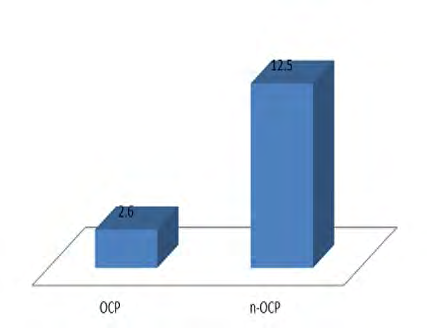
The ovarian cyst formation in OCP group was 2.6% and in non-OCP was 12.5% (P< 0.05) so the cancelled cycles due to ovarian cyst formation in OCP group was less than non- OCP group (Figure 1).
AMH level in OCP group was 3.28 ± 1.68 and in non-OCP was 4.21±5.28, an FSH level in OCP group was 5.52 ± 31.3 and in non-OCP was 6.08± 2.52, that there was no significant difference between two groups.
Evaluation based on multivariate logistic regression model showed that administration of OCP was not an effective factor in successful pregnancy, as there was no relationship between pregnancy rate and OCP adminastration with three factors including age, body mass index and infertility duration (Table 2).
- Item
- B
- S.E.
- Wald p-value
- Old ratio
- 95.0% CI for OR
- OCP
- -0.446
- 0.368
- 1.468
- 0.226
- 0.64
- 0.311
- 1.317
- Age
- -0.005
- 0.046
- 0.012
- 0.914
- 0.995
- 0.91
- 1.088
- BMI
- 0.127
- 0.081
- 2.473
- 0.116
- 1.136
- 0.969
- 1.331
- Duration
- 0.105
- 0.134
- 0.607
- 0.436
- 1.11
- 0.853
- 1.445 constant
- -4.09
- 2.921
- 1.96
- 0.161
- 0.017
Table 2: Multivariate Logistic Regression Model to Determine the Relationship between OCP Use and Positive Pregnancy Rate.
Also, evaluation based on multivariate linear regression model 22, considering the effect of OCP adminastration on oocyte number, and in presence of age, body mass index and duration of infertility, showed that OCP adminastration had no effect on oocyte number (Table 3).
| Item | Unstandardized coefficients | Standardized coefficients | T | Sig. | |
|---|---|---|---|---|---|
| B | Std.Error | Beta | |||
| OCP | 3.447 | 11.163 | 0.309 | 0.758 | |
| Age | 1.637 | 1.45 | 0.099 | 1.129 | 0.261 |
| BMI | -0.045 | 0.177 | -0.023 | -0.256 | 0.798 |
| Duration | 0.37 | 0.311 | 0.105 | 1.19 | 0.236 |
| constant | 0.063 | 0.534 | 0.011 | 0.118 | 0.906 |
Table 3: Multivariate Linear Regression Model to Determine the Relationship between OCP Consumption and Ovarian Response (Oocyte
Discussion
Ovarian stimulation protocol is the first and important factor to determine the successful ART outcome that has different treatment strategies [5]. IVF protocols include GnRH antagonist and GnRH agonist [10], in GnRH agonist protocol the number of oocytes, fertilization rate and pregnancy rate increase and the quality of embryo is better [20], but increase the risk of ovarian cyst formation in compared to GnRH antagonist [21]. Contraceptive treatment before administration of GnRH analogue improve the outcome of ART in some patients such as polycystic ovarian syndrome [15, 22].
The present study has shown that, one period OCP pretreatment in GnRH agonist cycles is not associate with pregnancy rates per started cycle, a systematic review and meta-analysis that evaluates the effect of OCP pretreatment in antagonist cycle on ongoing pregnancy indicated that this pretreatment had no effect on pregnancy rate, too [17]. In another study on 80 patients, compared the effect of OCP pretreatment in agonist GnRH and antagonist GnRH protocols, they indicated that there was no significant difference in pregnancy rate between two protocols [23]. Based on a pilot trial study, the OCP therapy before ART can improve the pregnancy rate, especially in endometriosis patient, that it may be caused by endometrial effect of OCP [24]. The results of the current research has demonstrated that OCP pretreatment in GnRH agonist cycle have no significant effect on oocyte number, embryo formation and pregnancy loss that this data confirmed by another RCT which indicate that OCP pretreatment had no effect on number of cumulus–oocyte complexes (COCs) [17], number of oocyte [25, 26], blast formation and number of 2PN embryos [23]. According the result of another RCT, OCP pretreatment decrease the risk of pregnancy loss in GnRH antagonist cycle [27, 28], That decrease may be due to GnRH antagonist administration. The results of the current study are in agreement with Chen S-U et al and Biljan MM et al that indicated OCP pretreatment decrease the ovarian cyst formation in GnRH agonist ovarian stimulation protocol and then cancelled cycle decreased [8, 29, 30], this may be due to facts that suppression of pituitary in the early follicular phase, shortens the time required to achieve pituitary suppression [29], so the formation of ovarian cyst decrease. Pretreatment with only progesterone decrease the risk of cyst formation in GnRH agonist cycle and only estrogen pretreatment have no important effect on ART outcomes [27]. The important issue in OCP pretreatment is, this protocol had no negative effect on recruitment of follicles and pregnancy rate.
Conclusions
Pretreatment with OCP in GnRH agonist ovarian stimulation protocol, suppress the cyst formation in ovaries, thus decrease the risk of IVF cycle cancellation. The oocyte number, embryo formation, pregnancy rate and pregnancy loss in both group (OCP pretreatment and non-OCP) were similar, so the prescription of OCP before the initiation the ovarian stimulation specially in GnRH agonist long protocol can decrease some ART related risks.
Conflict of Interest
The authors have no conflict of interest.
Foundation
This study is supported by Vice-Chancellor in Research, Shahid Beheshti University of Medical Sciences.
References
-
Boivin J, Bunting L, Collins JA, Nygren KG (2007) International estimates of infertility prevalence and treatment-seeking: potential need and demand for infertility medical care. Human reproduction 22(6): 1506-1512.
-
Zegers-Hochschild F, Adamson GD, de Mouzon J, Ishihara O, Mansour R, et al. (2009) The international committee for monitoring assisted reproductive technology (ICMART) and the world health organization (WHO) revised glossary on ART terminology. Fertil Steril 92(5): 1520-1524.
-
Datta J, Palmer M, Tanton C, Gibson L, Jones K, et al. (2016) Prevalence of infertility and help seeking among 15 000 women and men. Human Reproduction 31(9): 2108-2118.
-
Agarwal A, Majzoub A (2017) Role of antioxidants in assisted reproductive techniques. The world journal of men’s health 35(2): 77-93.
-
Gardner DK, Weissman A, Howles CM, Shoham Z (2016) Textbook of assisted reproductive techniques: laboratory and clinical perspectives: CRC press.
-
Grow D, Kawwass JF, Kulkarni AD, Durant T, Jamieson DJ, et al. (2014) GnRH agonist and GnRH antagonist protocols: comparison of outcomes among good- prognosis patients using national surveillance data. Reproductive biomedicine online 29(3): 299-304.
-
Aboulghar M (2009) Prevention of OHSS. Reproductive biomedicine online 19(1): 33-42.
-
Chen S-U, Chen C-D, Yang Y-S (2008) Ovarian hyperstimulation syndrome (OHSS): new strategies of prevention and treatment. Elsevier.
-
Massin N (2017) New stimulation regimens: endogenous and exogenous progesterone use to block the LH surge during ovarian stimulation for IVF. Human reproduction update 23(2): 211-220.
-
Shrestha D, La X, Feng HL (2015) Comparison of different stimulation protocols used in in vitro fertilization: a review. Annals of translational medicine 3(10): 137.
-
Messinis IE, Messini CI, Dafopoulos K (2014) Novel aspects of the endocrinology of the menstrual cycle. Reproductive biomedicine online 28(6): 714-22.
-
Cedrin-Durnerin I, Bständig B, Parneix I, Bied-Damon V, Avril C, et al. (2006) Effects of oral contraceptive, synthetic progestogen or natural estrogen pre-treatments on the hormonal profile and the antral follicle cohort before GnRH antagonist protocol. Human Reproduction 22(1): 109-116.
-
Branigan EF, Estes MA (2000) Minimal stimulation IVF using clomiphene citrate and oral contraceptive pill pretreatment for LH suppression. Fertility and sterility 73(3): 587-590.
-
Buyalos RP, Lee CT (1996) Polycystic ovary syndrome: pathophysiology and outcome with in vitro fertilization. Fertility and Sterilityn 65(1): 1-10.
-
Damario MA, Barmat L, Liu H-C, Davis O, Rosenwaks Z (1997) Dual suppression with oral contraceptives and gonadotrophin releasing-hormone agonists improves in-vitro fertilization outcome in high responder patients. Human reproduction 12(11): 2359-2365.
-
Huirne JA, van Loenen AC, Donnez J, Pirard C, Homburg R, et al. (2006) Effect of an oral contraceptive pill on follicular development in IVF/ICSI patients receiving a GnRH antagonist: a randomized study. Reproductive biomedicine online 13(2): 235-245.
-
Griesinger G, Venetis CA, Marx T, Diedrich K, Tarlatzis BC, et al. (2008) Oral contraceptive pill pretreatment in ovarian stimulation with GnRH antagonists for IVF: a systematic review and meta-analysis. Fertility and sterility 90(4): 1055-1063.
-
Tian L, Wu D, Shen H, Wei L (2010) Effect of oral contraceptive pills upon IVF outcomes of patients under a short GnRH agonist protocol. Zhonghua yi xue za zhi 90(7): 454-457.
-
Lu Y, Wang Y, Zhang T, Wang G, He Y, et al. (2020) Effect of pretreatment oral contraceptives on fresh and cumulative live birth in vitro fertilization outcomes in ovulatory women. Fertility and Sterility 114(4): 779- 786.
-
Hughes EG, Fedorkow DM, Daya S, Sagle MA, Van de Koppel P, et al. (1992) The routine use of gonadotropin- releasing hormone agonists prior to in vitro fertilization and gamete intrafallopian transfer: a meta-analysis of randomized controlled trials. Fertility and sterility 58(5): 888-896.
-
Ragni G, Vegetti W, Riccaboni A, Engl B, Brigante C, et al. (2005) Comparison of GnRH agonists and antagonists in assisted reproduction cycles of patients at high risk of ovarian hyperstimulation syndrome. Human reproduction 20(9): 2421-2455.
-
Ashrafi M, Moini A, Ezabadi Z, Zafarani F, Mohammadzadeh A, et al. (2005) A comparative study of GnRH antagonist and GnRH agonist in PCO patients undergoing IVF/ICSI cycles 3(1): 14-18.
-
Barmat LI, Chantilis SJ, Hurst BS, Dickey RP (2005) A randomized prospective trial comparing gonadotropin- releasing hormone (GnRH) antagonist/recombinant follicle-stimulating hormone (rFSH) versus GnRH- agonist/rFSH in women pretreated with oral contraceptives before in vitro fertilization. Fertility and sterility 83(2): 321-330.
-
de Ziegler D, Gayet V, Aubriot FX, Fauque P, Streuli I, et al. (2010) Use of oral contraceptives in women with endometriosis before assisted reproduction treatment improves outcomes. Fertility and sterility 94(7): 2796- 2799.
-
Duvan CI, Berker B, Turhan NO, Satiroglu H (2008) Oral contraceptive pretreatment does not improve outcome in microdose gonadotrophin-releasing hormone agonist protocol among poor responder intracytoplasmic sperm injection patients. Journal of assisted reproduction and genetics 25(2-3): 89-93.
-
Nejad EST, Ghaleh FB, Eslami B, Haghollahi F, Bagheri M, et al. (2018) Comparison of pre-treatment with OCPs or estradiol valerate vs. no pre-treatment prior to GnRH antagonist used for IVF cycles: An RCT. International Journal of Reproductive Biomedicine 16(8): 535.
-
Farquhar C, Rombauts L, Kremer JA, Lethaby A, Ayeleke RO (2017) Oral contraceptive pill, progestogen or oestrogen pretreatment for ovarian stimulation protocols for women undergoing assisted reproductive techniques. Cochrane Database of Systematic Reviews 5(5): CD006109.
-
Kolibianakis EM, Papanikolaou EG, Camus M, Tournaye H, Van Steirteghem AC, et al. (2005) Effect of oral contraceptive pill pretreatment on ongoing pregnancy rates in patients stimulated with GnRH antagonists and recombinant FSH for IVF. A randomized controlled trial. Human reproduction 21(2): 352-357.
-
Biljan MM, Mahutte NG, Dean N, Hemmings R, Bissonnette F, et al. (1998) Pretreatment with an oral contraceptive is effective in reducing the incidence of functional ovarian cyst formation during pituitary suppression by gonadotropin-releasing hormone analogues. Journal of assisted reproduction and genetics 15(10): 599-604.
-
Biljan MM, Mahutte NG, Dean N, Hemmings R, Bissonnette F, et al. (1998) Effects of pretreatment with an oral contraceptive on the time required to achieve pituitary suppression with gonadotropin-releasing hormone analogues and on subsequent implantation and pregnancy rates. Fertility and sterility 70(6): 1063- 1069.
- The Need for Partner Education and Mental Health Support During Pregnancy and the Postpartum Period
- Application of Combined PGT-A and PGT-M for Reproductive Management in a Couple Carrying GCDH Mutations with Prior Affected Offspring: A Rare Case Report
- The Effect of Using a New Technique Karman Injector (Elif Technique) on the Healing Process of Wound Infection-Case Series
- GSM: Counseling Points to Discuss with Women Fearful of Vaginal Estrogen
- Antenatal Diagnosis of Meckel Syndrome: A Case Report
- Discrimination and Workplace Harassment (Mobbing) against Women in the Post-Pandemic Era