
Acute Urinary Retention due to Hematocolpos: A Case Report
Acute urinary retention is an uncommon occurrence in the pediatric population, usually arising from a mechanical obstruction. It may result from hematocolpos, a gradual accumulation of menstrual blood in the vaginal cavity due to outflow tract disorders, with imperforate hymen being the most prevalent. Despite the simplicity of diagnosing and treating Imperforate Hymen, the occurrence of missed or delayed diagnoses is a common clinical challenge. This issue is attributed to the condition’s low incidence, the presence of nonspecific symptoms, or insufficient physical examinations. We present a case of a 16-year-old patient, presented to the emergency department with a one-day history of acute urinary retention. She had not yet begun menses, and reported a background of cyclical lower back-pain and discomfort during urination. After urethral catheterization, physical examination revealed a regular, resilient pelvic mass and the visual inspection of the external genital tract revealed a thick, bulging, and non-bluish hymen. An ultrasound scan confirmed the diagnosis of hematocolpos. She underwent a hymenectomy using a radial incision and made a good recovery postoperatively. Hematocolpos should be systematically sought in young girls with urinary symptoms and primary amenorrhea. If not managed at time, it may have devasting complication such as tubal adhesion, pelvic endometriosis, and infertility.
Introduction
Hematocolpos is a gradual accumulation of menstrual blood in the vaginal cavity. Due to an anomaly of the genital tract, with imperforate hymen being the most common one. It occurs in approximately 1 in 2,000 females, although true incidence is difficult to obtain [1].
Imperforation of the hymen is rarely diagnosed during the neonatal period and typically presents later in puberty with cyclic pelvic or lower abdominal pain, primary amenorrhea, or a pelvic mass. Despite the absence of menarche, secondary sexual characteristics are usually well developed. Acute urinary retention is a rare presentation of hematocolpos. The purpose of this case report is to enhance clinicians’ awareness about the potential presence of this condition while examining the adolescent girls with acute urinary retention.
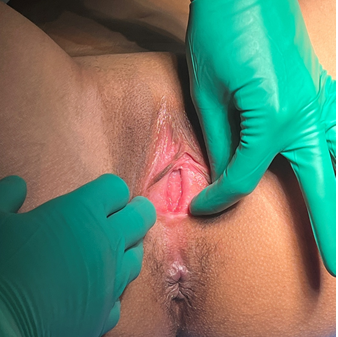
We present the case of a 16-year-old patient with no significant medical history, who was brought to the emergency department of Maternity Souissi Rabat due to lower abdominal pain and acute urinary retention. She reported no symptoms such as nausea, vomiting, burning during urination, or fever. Notably, the patient had not yet started menstruating. Approximately 5-6 months prior, she began experiencing cyclical lower back pain, followed by discomfort while urinating 2-3 weeks before presentation. Upon physical examination, after managing the urinary retention by bladder catheterization, the patient exhibited overall good health, normal vital signs, and appropriate development of secondary sexual characteristics. Abdominal palpation identified a regular, resilient mass extending from the pelvis to the epigastrium. During the examination in the presence of the child’s parents, visual inspection of the external genital tract revealed a thick, bulging, and non- bluish hymen that appeared to completely obstruct the vagina (Figure 1).
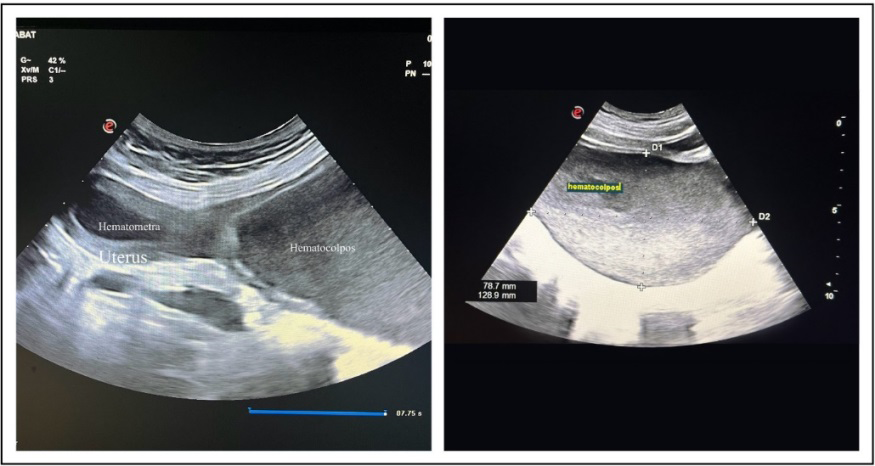
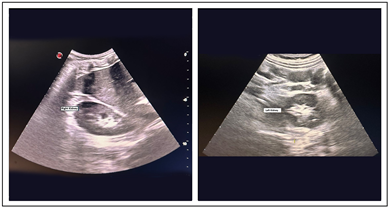
Transabdominal ultrasonography revealed a well-defined hypoechogenic intravaginal collection with mobile sediment, indicative of hematocolpos, with an estimated volume of 576 mL, accompanied by a hematometra measuring 17 x 34 x 45 mm (Figure 2). The kidneys appeared normal in size and echo pattern, with no signs of hydronephrosis or hydro ureter (Figure 3).
A Magnetic resonance imaging (MRI) was performed to identify potential malformations, such as uterus didelphys, obstructive hemivagina, vaginal diaphragm, or distal vaginal agenesis (Figure 4).
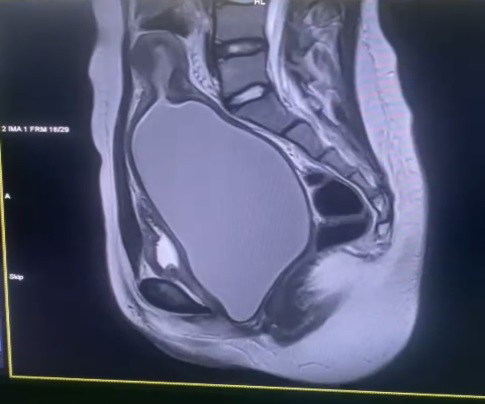
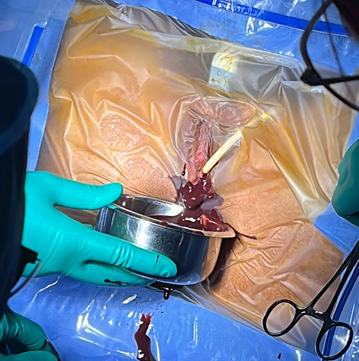
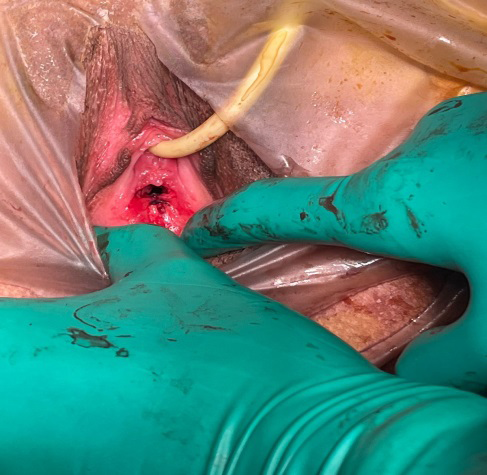
MRI findings confirmed the existence of substantial vaginal distension (hematocolpos), suggesting a probable hymenal imperforation. Notably, there was no visualization of any associated uterine, cervical, or vaginal malformation. Additionally, no hematosalpinx was observed. The patient underwent surgery, and a radial incision was made over hymen under general anesthesia. Approximately 900 cc of thick, chocolate-colored blood (Figure 5) consistent with old menstrual blood was drained followed by a vaginal lavage using saline solution. A few absorbable interrupted sutures of the hymenal edges were then performed to prevent refusion (Figure 6).The postoperative course was uneventful, and the patient was discharged on the same day.
Discussion
Urinary retention is uncommon in women, particularly in the pediatric population. Possible causes may encompass neurological disorders, urinary tract infections, and mechanical obstructions such as urinary tract stones, urethral strictures, trauma to external genitalia, and imperforate hymen. The hymen, in the initial stages of embryonic development, manifests as a compact structure consisting of a solid mass of epithelial cells. As embryogenesis progresses, these cells undergo a phase of rapid proliferation, those most centrally-situated begin to degenerate, this marks the site of the hymeneal orifice. Imperforate hymen results from the persistence of these central cells [2]. Keum Hwa Lee conducted a systematic review on imperforate hymen, which involved an analysis of 251 citations and 155 articles, encompassing data from 253 patients. Among the clinical symptoms observed, urinary retention emerged as the second most common, accounting for 20.3%, following abdominal pain (54,2%) [3].
A study conducted in Iran evaluated the causes leading to urinary retention in 89 patients under the age of 14, including 58 girls. In this study the causes in girls were: ureterocele in 6 cases, trauma in 5 cases and imperforate hymen in 3 cases (5,2%), leading to hematocolpos. It was associated with primary amenorrhea and abdominopelvic pains [4]. Therefore, hematocolpos should be kept in mind, as imperforate hymen could be an uncommon cause of urinary retention. It is easy to diagnose when the examiner is familiar with its typical presentation and physical finding should be supported by the patient’s medical history (anamnesis).The etiology of urinary retention remains a subject of contention, with differing viewpoints on the underlying mechanisms. Snodgrass posits that urinary retention results from direct pressure exerted on the urethra. In contrast, Belt proposes an alternative perspective, asserting, “It is my belief that the fixed position of the urethra allows a forward pressure on the bladder while the urethra remains fixed, causing an angulation of the urethra at the bladder neck and, consequently, an accumulation of urine within the bladder. Belt attributes significant pain to an over distended bladder, attributing its origin to neurogenic factors [5].
Hematocolpos due to imperforate hymen while simple to treat, may have devasting squeals if not managed at time, such as tubal adhesion, pelvic endometriosis, and infertility. Early diagnosis is crucial to prevent the development of hematosalpinx and avoid potential permanent lesions to the fallopian tubes, thereby mitigating the risk of future fertility problems. The most alarming complication is endometriosis, resulting from the retrograde flow of sloughed endometrial cells/debris through the fallopian tubes into the pelvic cavity [6]. The rupture of hematosalpinx due to an imperforate hymen has been documented as a fairly rare complication [7]. The primary goal of treatment is to establish a clear outflow tract. Standard intervention involves surgical hymenectomy, incorporating T, X, plus, or cruciform incisions, along with the removal of surplus hymenal tissue. When deciding on the appropriate course of action for the hymen, the choice between a simple incision, or complete excision must be carefully considered [8].
While satisfactory outcomes may result from a simple incision as a conservative surgery option for patients desiring ‘virginity’, a complete excision is deemed the preferred procedure. This approach allows for a wide opening, facilitating swift drainage of fluids and reducing the risk of infection. Indeed, old blood serves as an excellent culture medium, exposing the reproductive tract to an ascending infection that can lead to pelvic inflammatory disease. Once infection enters the vagina the dilated cervix, uterus and tubes offer no obstacle to its ascent [9].
Conclusion
Imperforate hymen is rare disease for which early diagnosis is easy to miss, representing an uncommon cause for abdominal pain in the pediatric population. Before the hematosalpinx occurs is important to prevent possible permanent lesions of the fallopian tubes and to avoid future fertility problems. Abdominal pain and urinary retention are the most common clinical symptoms. It is easy to diagnose by a simple physical examination of the external genitalia confirmed by ultrasound. The treatment is surgical with simple postoperative care.
References
-
Lausten-Thomsen MJZ, Mogensen H (2007) Hymen Imperforatus with Atypical Symptom Presentation. Ugeskrift Laeger 169(6): 523‑524.
-
Bloomfield A (1927) The Development of the Lower End of the Vagina. J Anat 62(pt 1): 9-32.
-
Lee KH, Hong JS, Jung HJ, Jeong HK, Moon SJ, et al. (2019) Imperforate Hymen: A Comprehensive Systematic Review. Journal of Clinical Medicine 8(1): 56.
-
Asgari SA, Ghanaie MM, Simforoosh N, Kajbafzadeh A, Zare A (2005) Acute Urinary Retention in Children. Urology Journal 2(1): 23-27.
-
Doyle JC (1942) Imperforate Hymen: With and Without Hematocolpos: A Review of the Literature and a report of Twenty Cases. Cal West Med 56(4): 242-247.
-
Sampson JA (1925) Heterotopic or Misplaced Endometrial Tissue. American Journal of Obstetrics and Gynecology 10(5): 649-664.
-
Bakos O, Berglund L (1999) Imperforate Hymen and Ruptured Hematosalpinx: A Case Report with a Review of the Literature. Journal of Adolescent Health 24(3): 226‑228.
-
Basaran M, Usal D, Aydemir C (2009) Hymen Sparing Surgery for Imperforate Hymen: Case Reports and Review of Literature. Journal of Pediatric and Adolescent Gynecology 22(4): e61‑e64.
-
Tompkins P (1939) The Treatment of Imperforate Hymen with Hematocolpos: A Review of 113 Cases in the Literature and a Report of Five Additional Cases. Journal of the American Medical Association 113(10): 913-916.
- The Need for Partner Education and Mental Health Support During Pregnancy and the Postpartum Period
- Application of Combined PGT-A and PGT-M for Reproductive Management in a Couple Carrying GCDH Mutations with Prior Affected Offspring: A Rare Case Report
- The Effect of Using a New Technique Karman Injector (Elif Technique) on the Healing Process of Wound Infection-Case Series
- GSM: Counseling Points to Discuss with Women Fearful of Vaginal Estrogen
- Antenatal Diagnosis of Meckel Syndrome: A Case Report
- Discrimination and Workplace Harassment (Mobbing) against Women in the Post-Pandemic Era