
Selection of Anti-Depressants in Geriatric Dermatoses- A Questionnaire Study of Dermatologists in Western Rajasthan, India
Background: The Global Wealth Migration Review 2019 report, published by New World Wealth, estimated that 48% of India\\\'s total wealth was held by high-net worth individuals. Distinct factors dominate the prescription of anti-depressants in the geriatric population. Accordingly, the intention of pharmacotherapy in geriatric psycho dermatoses is deciphered in the study. . Objective: To survey and analyze the selection of anti-depressants by the dermatologists in the practice of geriatric pharmacotherapy. Methods: A questionnaire was designed and circulated among ninety-three dermatologists in three sessions and the data collected was analyzed through the cross-sectional study statistics. Results: The typical senior people attending the specialist were 25-50%. A sizeable familiarity of psycho cutaneous disturbance was attributed to dermatophyte infections, lichen simplex chronic, and Prurigo in descending order. The largely established primary disorder was neurotic excoriation. The prescription pattern was classified and 51.9% dermatologists are customary with psychotropic agent Doxepin over other agents. The discipline of the multidisciplinary approach was also studied. Limitation: Small sample size, uniregional study, prevalence study. Conclusions: The survey aids in evaluating mental health in cutaneous dermatoses of the elderly and assists the dermatologists to offer understated economical options and amend existing guidelines.
Key Points
- Geriatric dermatoses are a mystery to the attending specialists who were surveyed to decipher the prescription of choice for individual dermatoses in daily practice in western Rajasthan, India.
- Understanding the geriatric dermatoses and newer management strategies is crucial to avoid unstructured polypharmacy and emphasizes risk: benefit analysis as needed.
- The data assists in the conformation of the existing approaches, thus refining the principles of geriatric pharmacotherapy in the skin.
Introduction
Psycho-cutaneous biology is the region of dermatology that entails the intricate interactions between the skin, brain, immune system, and cutaneous nerves [1]. This has expanded the responsibility of the attending specialist in sustaining the reliance of the clients. For example, a patient who cannot halt the itch-scratch cycle might lose confidence in his dermatologist, who did not foresee the coexisting psychological commotion of persistent disease.
Therefore, an expert poll was attempted in the locality of Western Rajasthan to comprehend the preference pattern of anti-psychiatric drugs in the common skin disorders of elderly The results retrieved will be extrapolated to understand the current structure of therapy.
Aim
- To understand the psychopharmacology for dermatoses of the elderly.
- To survey the preferences and alternatives of anti- psychiatric drugs by practicing Dermatologists
- To analyze the intention behind the chosen drug and to correlate with the existing policies.
Materials and Methods
The study began after ethical authorization to devise a questionnaire on anti-psychiatric agents needed in psycho- cutaneous disorders based on the existing literature. The questionnaire comprised 16 queries including the geriatric population, disease, chronicity, and preferred agent, the rationale for the options, unfavorable effects, and cure. The study group included ninety-three dermatologists working in various government colleges, private practitioners, final- year residents, and senior residents from all hospitals in Western Rajasthan. Various means were used to approach the doctors all of which were manual in a hard copy format. An appropriate elaboration was delivered before the study and written consent was obtained before participation. The study was conducted between August and September 2019. The data was collected and compiled for analysis. The results are as follows.
Results
The all-around respondents were 90.3% (n=84), of which 3.5% did not practice psycho-pharmacotherapy. Type of population: The standard day-to-day geriatric outpatient attendance was documented to be around 25-50%. Thirty- seven percent of dermatologists claim that maximum clients used to complain about a secondary psychiatric illness and 23.5% specialists met patients with mutually dependent psychiatric and dermatologic illnesses.
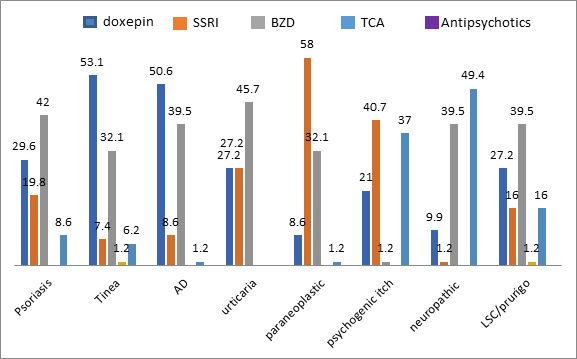
Type of diseases: The frequency prevalence of the common psycho-physiologic dermatomes experienced every day is illustrated in Figure 1, with descending frequency from dermatophyte infections (45.7% ;n=37), Lichen simplex chronicus (22.2%; n=18), Prurigo nodularis (18.5%; n=15), Urticaria (11.1%; n=9) and Psoriasis (4.9%; n=4).The primary psychiatric disorder dealt in descending commonness were neurotic excoriation (76.5%, n=62), fictitious dermatitis (14.8%; n=12), Delusional parasitosis (7.4%; n=6) and Trichitillomania (1.3%). They alleged secondary psychiatric diseases to originate from Obesity (28.4%; n=23), Androgenetic alopecia (27.2%; n=22), Acne scars (18.5%; n=15), Vitiligo (17.3%; n=14), Alopecia areata (4.9%; n=4), Keloids (2.5%; n=2) and post-burn scars (1.2%; n=1). Last, the sensory disorders acknowledged were Itching (100%; n=81), burning (63%; n=51) and both (37%; n=30).
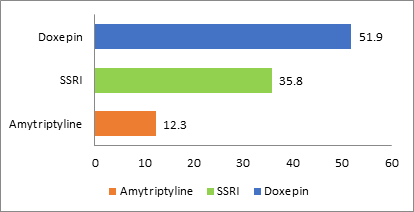
Figure 1: “Survey of Selection of Antidepressants by Dermatologists revealing the percentage of selected antidepressants and psychotropic agents in geriatric dermatoses for various indications.”; Abbreviations: SSRI- selective serotonin reuptake inhibitors Choices of anti-depressants (Figure 2): The prescribed psychotropic agent was Doxepin (TCA) as proclaimed by 51.9% dermatologists (n=42). SSRI (35.8%; n=29) and Amitriptyline (12.3%; n=10) were determined as an appropriate agent by distinct groups.
Distinctive inimical outcomes: Familiar tricyclic antidepressant among study group was Doxepin (51.9%; n=42), nominated for Psychogenic prorates (85.2%; n=69) than depression (14.8%; n=12). Aftermaths are depicted in Table 3 with sedation (85.2%) and abdominal complaints (14.8%). The non-psychotropic antidepressant was inferred as being Amitriptyline (50.6%; n=41) and indicated for secondary depression (46.9%; n=38) and their adverse effects are tabulated in table 3.
Commonest SSRI was fluoxetine (56.8%; n=46) > paroxetine (28.4%; n=23) used in secondary depression (60.5%; n=49). We divulge the conclusions on Figure 1 and 2.
Multi-disciplinary attitude: Dermatologists who preferred to suggest the client to a psychiatrist at the initial visit were 86.4% (n=70).
Discussions
The proficiency of fundamental psycho-cutaneous
disorders is decisive in practice. We can categorize these as, Psycho-dermatological disorders: 1. Psycho-physiologic skin diseases like psoriasis, LSC, Hyperhidrosis that contributes to stigma and stress
2. Primary psychiatric disorders like Neurotic excoriations, delusions, fictitious dermatitis, Trichotillomania, etc.
3. Secondary psychiatric disorders like vitiligo, alopecia areata, obesity, androgenetic alopecia which are induced because of stress
4. Cutaneous sensory disorders like burning and crawling [2].
Psychopathology conditions- anxiety, depression, Obsession & compulsive disorder, Psychoses should be primarily managed by a psychiatrist and might often exclusively need dermatological assistance [2].
Standard regimens and their known adverse reactions are provided in Table 1. It illustrates the therapeutic ladders for specific conditions in Table 2 [2, 3].
| Category | Names | Dose | Indication | Comments |
|---|---|---|---|---|
| SSRI | Paroxetine | 10-60 mg/d | Depression/OCD/PTSD/Panic/GAD | EPS/Withdrawal |
| Fluoxetine | 20-60 mg/d | Depression/OCD/BDD/Bulimia | ||
| Sertraline | 50-200 mg/d | Depression/OCD/PTSD/Panic | ||
| Citalopram | 10-40 mg/d | Depression/ Panic | Prolongs QT | |
| Escitalopram | 5-20 mg/d | Depression/ Panic/GAD | Prolongs QT | |
| Fluvoxamine | 50-300 mg/d | Depression/OCD | ||
| Duloxetine | 30-120 mg/d | Depression/GAD | ||
| Mirtazepine | 15-45 mg/d | Depression | Sexual dysfunction | |
| Venlafaxine | 37.5-225 mg/d | Depression/ GAD | BP monitor | |
| TCA | Amytryptiline | 10-200 mg/d | Depression /Neuropathic pain | Cardiotoxic drugs all except lofepramine |
| Clomipramine | 10-250 mg/d | Depression/Phobia/obsession | ||
| Dosulepin | 75-225 mg/d | Depression | ||
| Imipramine | 75-300 mg/d | Depression | ||
| Lofepramine | 140-210 mg/d | Depression | ||
| Nortriptyline | 10-150 mg/d | Depression/Neuropathic pain | ||
| Trimipramine | 150-300 mg/d | Depression | ||
| SNRI | Bupropion | 150-300mg/d | Depression | |
| Venlafaxine | ||||
| Duloxetine | ||||
| Rebexetine | ||||
| Mirtazapine | ||||
| Antipsychotics | ||||
| First- | Chlorpromazine | Delirium in elderly | Qt prolongation and cardiac effects | |
| Haloperidol | ||||
| Sulpiride | ||||
| Pimozide | ||||
| Prolactenemia | ||||
| Second | Amisulpiride | 400-1200 mg/d | Psychoses | Nausea |
| Aripiprazole | 10-30 mg/d | Weight gain | ||
| Quetiapine | 5-20 mg/d | Lesser TIA | ||
| Olanzepine | 25-800mg/d | Avoid in elderly | ||
| Risperidone | 2-16 mg/d | |||
| Anxiolytics | Benzodiazepines | Dependence | ||
| Buspirone | ||||
| Beta blocker | ||||
| SSRI | ||||
| Mood stabilizers | Pregabalin | |||
| Gabapentin | ||||
| Lithium | ||||
| Referral to psychiatrist | First line for primary psychiatric disorders | Aid in secondary psychiatric illness |
Table 1: Common agents and side effects-adapted from Wolverton’s comprehensive drug therapies, third edition.
| Diseases | Subtypes | Drugs used |
|---|---|---|
| 1. Chronic pruritis | • Dermatological – Atopic eczema, urticaria, psoriasis,etc | SSRI/Benzodiazepines/ TCA and Doxepin |
| • Paraneoplastic pruritis | ||
| • Senile pruritis | ||
| • Neuropathic pruritis (nostalgia, BRP,Etc) | ||
| • Psychogenic pruritis | ||
| 2. Prurigo nodularis | TCA>SSRI | |
| 3. Lichen simplex chronicus | ||
| Mucocutaneous pain syndromes: | 1. Post-herpetic neuralgia | SSRI |
| 2. Trigeminal neuralgia | SSRI/TCA | |
| 3. Burning mouth, vulvo-scroto-penodynia | BZD/SSRI/TCA | |
| 4. Chronic scalp pain | SSRI/TCA | |
| 5. Erythromelalgia | ||
| 1. Obsessive and compulsive disorders | • Body dysmorhic disorder | Refer to psychiatrist |
| • LSC and pruprigo | SSRI>Antipsychotics | |
| • Skin picking/ acne excoriee/ tricho and onychoitillomania | Refer/SSRI/TCA | |
| 2. Eating disorders | Refer | |
| 3. Factitious skin disease | Refer | |
| 4. Self harm | Refer | |
| 5. Delusions(infestation/olfaction) | Refer/Antipsychotics>SSRI=TCA | |
| Depression | Refer>SSRI and TCA | |
| Anxiety | Refer>SSRI and BZD | |
| Psychoses | Refer> Antipsychotics |
Table 2: “Side effect profile encountered while prescribing anti-depressants and psychotropic agents in geriatric dermatoses as a
- Sedation Addiction
- Disconti nuation symptoms seizure
- Anorexia/
- Bulimia
- Sexual dysfunction
- Cardiac side effects
- Insomnia
- EPS
- Abdom inal complaints
- Doxepin
- 85.2%;
- (n=69)
- 14.8% ;
- (n=12)
- BZD
- 66.7%;
- (n=54)
- 67.9%;
- (n=55)
- TCA
- 18.5%; (n=15)
- 16% ; (n=13)
- 32.1%;
- (n=26)
- 6.20%
- (n=5)
- 33.3%;
- (n=27)
- 29.6%;
- (n=24)
- 9.9%; (n=8)
- SSRI
- Antipsychotics
- 66.7%;
- (n=54)
- 14.8%;
- (n=12)
- 29.6%;
- (n=24)
- 18.5%;
- (n=15)
- Venlafaxine bupropion
- 18.5%;
- (n=15)
Table 3: “Side effect profile encountered while prescribing anti-depressants and psychotropic agents in geriatric dermatoses as
Table 3: “Side effect profile encountered while prescribing anti-depressants and psychotropic agents in geriatric dermatoses as answered by dermatologists” Geriatric dermatoses are the dermatoses of the aged (> or equal to 60 years of age). Yosipovitch, et al. discriminated neuropathic itch from Psychogenic itch which is defined as “an itching disorder where the itch is at the center of the symptomatology and where psychological factors show an obvious role in the provoking or persistence of the pruritus” [4, 5]. From the survey, the structure of popular geriatric dermatoses and the established agents used by dermatologists of the locality of Western Rajasthan are analyzed and we decipher the outcomes. The customary size of the geriatric population witnessed existed from 25% to 50% which compels a promising awareness on the management of the elderly. Over 60.5% of old people attending the skin clinic might require an appropriate exam of mental health as described by Capoore and workers [1].
Commonest psycho-physiologic diseases of this era were Dermatophyte infections identified before Lichen simplex chronicus, Prurigo, Urticaria, and psoriasis. Patrol and panda deduced that dermatophyte infections move beyond its territory as investigators anticipate fungal infections as a menace to the psychological fitness of the patients [6]. Tinea is one of the most common infections experienced in our dermatological practice. Wine, et al. in his study, remarks the necessity to appreciate the pattern of disease for realistic reasons [3]. For instance, the continual despair of everyday life in developing countries might be causal in impeding the recovery in an elderly man with tinea cruris, who labor in sweltering environments.
Park, et al. ascribed a tool of analyses on geriatric depression and these patients should be referred to a psychiatrist after receiving the history, evaluating the co- morbidities, and gauging the emotional state based on subjective judgments [7]. Patient displaying insignificant, subsyndromal or atypical traits are extensively under- diagnosed in preliminary visits [8]. Hence, a satisfying “itch remedy” can mean a deep sense in practice. Now that a wholesome business has sprouted from the existing deadlock to determine the standard agent, the management with several over-the-counter products has led to abominable effects which is an emerging catastrophe.
The quest is to learn the idealistic parameters for an agent that is safe and psychotropic, but there is none. The patient’s dependability on the drugs is greater than the doctor’s. Thus, the agent should ease itch or provide faster clearance rates. Thus for empirical reasons, dermatologists imply in amending the textbook management for Dermatophyte using agents such as Doxepin as it is claimed to curtail the monetary and systemic burden of anti-fungal agents besides ameliorating the symptoms [1].
Some disorders are causal to the clients’ altered psyche such as Psoriasis and some are triggered e.g., Lichen simplex and Prurigo, which are familiar as age advances. Adding an SSRI (35.8%) or Doxepin (51.9%) is offered as a competent accessory [3]. The largely seen primary psycho-cutaneous disorders were neurotic excoriations (76.5% answers). The survey of antidepressants desirable to this section was SSRI (39.5%) and TCA (49.4%) but primary psychiatric illness should be referred to a psychiatrist who can benefit the patient. A pointer here is to treat the skin and refer. TCA like Amitriptyline was selected despite their speculative hazard of cardiotoxicity, reasoning that these agents are safe in practice and the probability for such consequences is diminutive (32.1% answers). Hence it is relatively a risk: benefit setting according to the pharmacological practice by Lee and his workers [9]. While the comparable safety of Fluoxetine is better than TCA, fluoxetine 20mg is determined all-around as an ideal agent (35.8%) only second to Doxepin [10].
Cases of fictitious dermatitis and Trichitillomania should also be suitably referred to Psychiatrist (86.4%). Stress donates to common secondary psycho-dermatoses like Obesity, Androgenetic alopecia, and Alopecia areata. The psychopharmacologic therapy documented by Gupta, et al. indicates that adding an SSRI is not a profitable option for obesity as weight gain is overseen. Thus, suggesting to a psychiatrist who might start them on drugs like Bupropion sounds appropriate.6 adding a BZD or SSRI is an intriguing alternative for the rest of the illnesses [4, 9]. The common antidepressants used as a psychotropic agent was Doxepin, while Benzodiazepine in Urticaria, Prurigo, and lichen simplex chronicus, SSRI in Psychogenic itch, and Amitriptyline in neuropathic itch were preferred. This also corresponds to literature. Psychogenic itch is diagnosed after eliminating other factors of itching. For this, Co-morbidities and systemic causes should be evaluated after history and exam as discussed by Tactic and his colleagues. 10 This is crucial because diseases such as cutaneous T cell lymphoma in its premalignant stage can drive refractory prorates hence require an ethical evaluation. It was observed that Dermatologists (86.4%) are inclined to multidisciplinary referrals as and when necessary or sometimes mandatory i.e., while starting the drug while tapering and while withdrawal.
Limitation of the study
Small sample size, Uni-regional census, and prevalence study. This has to be expanded nationwide and transnational for farther awareness of prescription used around the globe. The study was a cross-sectional survey of current trends. This can be further experimented by providing a pre and postscholastic questionnaire to improve the prevailing trends and discern the readiness and aptitude of dermatologists.
Conclusion
The information on the structure of geriatric dermatoses and the selection of antidepressants/ psychotropic agents preferred by dermatologists is intensified in this study. There is no systematic review on this subject which broadens prospectively. This analysis also enhances the subsisting information in the practice of safer psychotropic agents and antidepressants. It comprehends the proper rationale for usage and insists on the importance of history taking, exam, investigation, and asking for help as the four cornerstones of Hippocratic practice. Similarly, psychiatrists’ hand in dealing with geriatric dermatoses is mandatory while following up and during withdrawal.
The primary outcome of the study is restricted to the patterns of disease and the preferred line of management.
The secondary outcome measures were to find out the rationale behind the choice of agent. E.g., Doxepin had overall been mostly used along with SSRI (fluoxetine) and Amitriptyline hence are idealistic additional agents in prescription.
References
-
Capoore HS, Rowland Payne CM, Goldin D (1998) Does psychological intervention help chronic skin conditions? Postgrad Med J 74(877): 662-664.
-
Griffiths C, Barker J, Bleiker T, Chalmers R, Creamer D (2016) Rook’s Textbook of Dermatology. 9th (Edn.), 1st (Vol.), Chichester, West Sussex, New Jersey: John Wiley Sons Inc.
-
Wine SJ, Steinberg S (1972) Neurodermatitis: what is it?. Can Fam Physician 18(4): 65-66.
-
Yosipovitch G, Samuel LS (2008) Neuropathic and psychogenic itch. Dermatologic therapy. Dermatol Ther 21(1): 32-41.
-
Misery L, Dutray S, Chastaing M, Schollhammer M, Consoli SG, et al. (2018) Psychogenic itch. Transl Psychiatry 8: 52.
-
Panda M, Patro N, Jena A (2019) The menace of superficial dermatophytosis on the quality of life of patients attending referral hospital in Eastern India: A cross-sectional observational study. Indian Dermatology Online Journal 10(3): 262.
-
Park M, Unützer J (2011) Geriatric depression in primary care. Psychiatr Clin North Am 34(2): 469–x.
-
Tarikci N, Kocatürk E, Güngör Ş, Topal IO, Can PÜ, et al. (2015) Pruritus in Systemic Diseases: A Review of Etiological Factors and New Treatment Modalities. Scientific World Journal 2015: 803752.
-
Lee CS, Accordino R, Howard J, Koo J (2008) Psychopharmacology in dermatology. Dermatologic therapy. Dermatol Ther 21(1): 69-82.
-
Gupta MA, Guptat AK (2001) The use of antidepressant drugs in dermatology. J Eur Acad Dermatol Venereol 15(6): 512-518.
- Epithelioid Granuloma; 3cases with Different Clinical Features
- Advancing Representation in Dermatology Clinical Trials: Ethical, Scientific, and Regulatory Imperatives for Inclusion Across all Fitzpatrick Skin Types
- A Case of Atopic Dermatitis with Concurrent Psoriasis Vulgaris: Successful Treatment with Upadacitinib
- Innovation Lifting Eyeshadow: A Synthesis of Makeup and Optical Illusion
- Distinguishing Superficial Actinic Porokeratosis from Actinic Keratosis with UVF Dermoscopy: A Case Report
- High Mobility Group Box 1 (HMGB1) in Cutaneous Inflammation: An Immune Modulator Bridging Cellular Stress, Ferroptosis and Danger Signaling