
Pompholyx as a Side Effect of Intravenous Immunoglobulin (IVIg)
A 43-year-old woman presented with a two-week history of progressive peripheral sensory neuropathy. Despite extensive investigations no cause had been identified. She has a background history of hepatitis C (treated successfully in 2018) and prior intravenous drug use. She was commenced on intravenous immunoglobulin (IVIg) at a dose of 400mg/kg daily for 5 days as a trial of treatment for her sensory peripheral neuropathy under the guidance of neurology. After receiving her third dose of IVIg she developed a discrete intensely pruritic vesicular rash on her palms and fingers bilaterally consistent with pompholyx. No other areas were affected. She was started on clobetasol proprionate 0.05% ointment once daily and advised to wash with soap substitutes and use non-fragranced emollients daily
Case
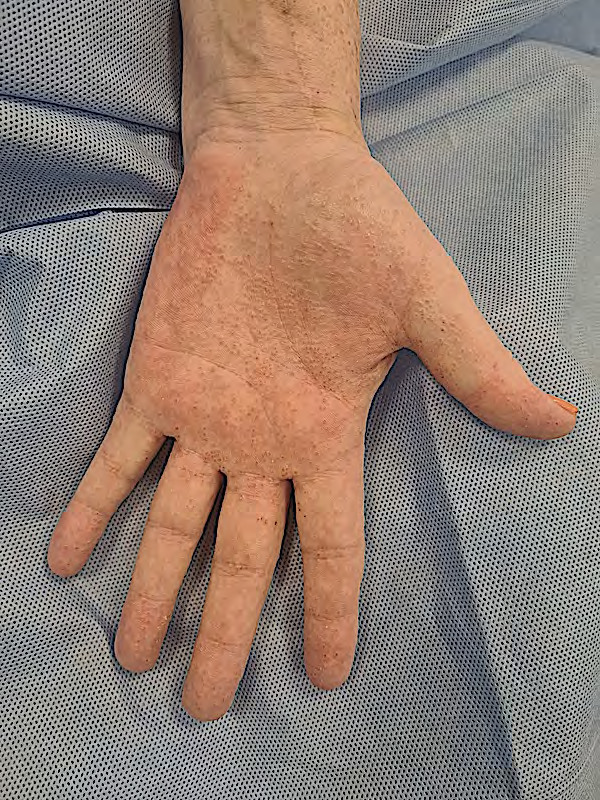
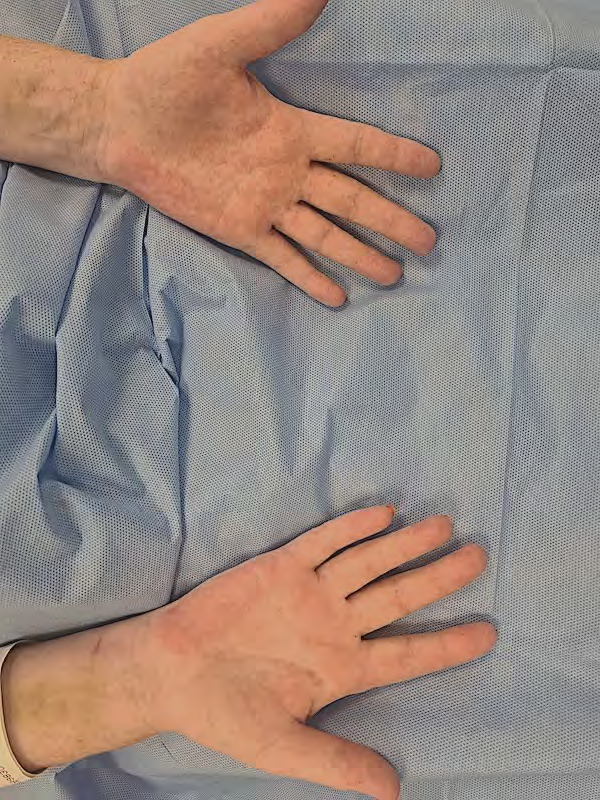
A 43-year-old woman presented with a two-week history of progressive peripheral sensory neuropathy. Despite extensive investigations no cause had been identified. Full blood count, renal profile and liver profile, thyroid function tests, haematinics and immunoglobulins were normal. She had a negative viral screen, connective tissue disease screen, ANCA, syphilis, anti-ganglioside antibodies, anti- myelin associated antibodies and paraneoplastic antibodies. Her cerebrospinal fluid (CSF) analysis was unremarkable. Imaging including a CT brain, an MRI whole spine and CT thorax, abdomen and pelvis were unremarkable. She has a background history of hepatitis C (treated successfully in 2018) and intravenous drug use. She was commenced on intravenous immunoglobulin (IVIg) at a dose of 400mg/ kg daily for 5 days as a trial of treatment for her sensory peripheral neuropathy. After receiving her third dose of IVIg she developed a discrete intensely pruritic vesicular rash on her palms and fingers bilaterally consistent with pompholyx (Figures 1,2).
No other areas were affected. She has no personal or family history of eczema or atopy. Apart from IVIg she had not been commenced on any other new medications. She was started on clobetasol proprionate 0.05% ointment once daily and advised to wash with soap substitutes and use non-fragranced emollients daily. She had an excellent clinical response to treatment. She has been seen back in dermatology clinic and her pompholyx eczema has not returned. The patient has not undergone further treatment with IVIg as it was not felt to be necessary by her neurology team.
Discussion
IVIg contains pooled plasma from multiple donors. It is used in the treatment of multiple inflammatory and autoimmune conditions across a wide range of specialities. In addition to IgG, other immunologically active molecules such as major histocompatibility complex (MHC) molecules and soluble CD4 and CD8 can be found in IVIg [1]. The differences in composition can be explained by a variety in purification methods used by manufacturers [2]. Rates of cutaneous adverse reactions to IVIg are reported at 0.4% to 6%. These include pruritus, urticaria, alopecia, erythema multiforme, cutaneous vasculitis, morbilliform eruptions, lichenoid and eczematous reactions, most often pompholyx [2, 3]. The aetiology of IVIg associated pompholyx is unclear [2]. The majority of affected patients do not have a personal history of eczema or atopy [3]. There have been no reported cases in the literature of patients with immunodeficiency developing pompholyx following IVIg administration [3]. This may be due to the lower dosages used in this population [3, 4] but could also lend support to the hypothesis that antibody mediated injury may play a part in the pathogenesis of IVIg induced pompholyx [5]. The development of pompholyx following IVIg treatment has been reported in both adults and children [2, 6] and has been more frequently described in patients that have received higher doses of IVIg of over 2g/kg over 3 to 5 days [3]. In the paediatric setting, pompholyx has been reported to occur in the setting of IVIg to treat Kawasaki disease and for clinically isolated syndrome [6, 7].
Pompholyx associated with IVIg, may remain localised to the palms or soles or can progress to involve the face, trunk or limbs [2]. Widespread eruptions have been reported in 17% of cases [3]. IVIg induced pompholyx usually occurs 2 to 5 days after IVIg and can last up to 30 days [1]. IVIg induced pompholyx has been reported to occur more frequently in men than in women [8]. In patients that require further doses of IVIg, cutaneous reactions are likely to recur and worsen [3, 4, 5, 6, 7, 8, 9]. Most reactions are successfully managed with topical steroids [8]. Recalcitrant cases have been managed with oral steroids to varying success [8]. It has been suggested that changing the IVIg preparation may reduce the recurrence of cutaneous reactions in the group of patients that require further treatment with IVIg [8]. It is important for dermatologists to be aware and recognise the cutaneous side effects of IVIg given its’ increasing use. It is also important for all specialists who use IVIg in the treatment of patients to be aware and recognise pompholyx as a side effect of IVIg.
Conclusion
• It is important for dermatologists to be aware and recognise the cutaneous side effects of IVIg given its’ increasing use.
• It is important for all specialists who use IVIg in the treatment of patients to be aware and recognise pompholyx as a side effect of IVIg.
• The pathogenesis of IVIg induced pompholyx is not fully understood. An antibody mediated reaction may play a role.
• Cutaneous reactions to IVIg are likely to recur and worsen if subsequent doses are given.
Competing Interests: The authors have no competing interests to declare.
Consent: The patient consented to the publication of her case, including the clinical images.
References
-
Dalakas MC (2004) The use of intravenous immunoglobulin in the treatment of autoimmune neuromuscular diseases: evidence-based indications and safety profile. Pharmacol Ther 102(3): 177-193.
-
Takci Z, Guler Simsek G, Uzuner H, Akbayrak A, Yıldız Seckin H, et al. (2020) Dyshidrotic eczema and Seborrheic Dermatitis‐like Eczamatous Eruption Following to Intravenous Immunoglobulin Therapy. Dermatologic Therapy 33(6): e14147.
-
Gerstenblith MR, Antony AK, Junkins-Hopkins JM, Abuav R (2012) Pompholyx and eczematous reactions associated with intravenous immunoglobulin therapy. J Am Acad Dermatol 66(2): 312-316.
-
Perez EE, Orange JS, Bonilla F, Chinen J, Chinn IK, et al. (2017) Update on the use of immunoglobulin in human disease: a review of evidence. J Allergy Clin Immunol 139: S1-46.
-
Blum AE, Burgin S (2021) Eczematous Drug Eruptions. Am J Clin Dermatol 22(3): 349-366.
-
Brazzelli V, Grassi S, Savasta S, Ruffinazzi G, Carugno A, et al. (2014) Pompholyx of the hands after intravenous immunoglobulin therapy for clinically isolated syndrome: a paediatric case. Int J Immunopathol Pharmacol 27(1): 127-130.
-
Shiraishi T, Yamamoto T (2013) Severe dyshidrotic eczema after intravenous immunoglobulin therapy for Kawasaki syndrome. Pediatr Dermatol 30(3): e30-1.
-
Cohen Aubart F, Barete S, Amoura Z, Francès C, Lyon- Caen O, et al. (2009) Intravenous immunoglobulins- induced eczematous eruption: a long-term follow-up study. Eur J Intern Med 20(1): 70-3.
-
Vecchietti G, Kerl K, Prins C, Kaya G, Saurat JH, et al. (2006) Severe eczematous skin reaction after high-dose intravenous immunoglobulin infusion: report of 4 cases and review of the literature. Arch Dermatol 142(2): 213- 217.
- Epithelioid Granuloma; 3cases with Different Clinical Features
- Advancing Representation in Dermatology Clinical Trials: Ethical, Scientific, and Regulatory Imperatives for Inclusion Across all Fitzpatrick Skin Types
- A Case of Atopic Dermatitis with Concurrent Psoriasis Vulgaris: Successful Treatment with Upadacitinib
- Innovation Lifting Eyeshadow: A Synthesis of Makeup and Optical Illusion
- Distinguishing Superficial Actinic Porokeratosis from Actinic Keratosis with UVF Dermoscopy: A Case Report
- High Mobility Group Box 1 (HMGB1) in Cutaneous Inflammation: An Immune Modulator Bridging Cellular Stress, Ferroptosis and Danger Signaling