
Pasteurella Dagmatis and Multocida Cellulitis Acquired from a Cat Bite : A Case Report
Pasteurellosis is reported after animal biting, particularly cats bites with Pasteurella multocida being the predominant isolate. Among others, Pasteurella dagmatis is rarely reported, causing cellulitis but is also associated with other more severe systemic infections, particularly in immunocompromised hosts. We described here the case of a cellulitis caused by Pasteurella dagmatis and multocida.
Case report
A 48-years-old woman known for opiate dependency under methadone substitution, type 2 diabetes and an epidermoid carcinoma of the larynx (cT3N3bM0) treated by chemotherapy (Cisplatine-Docetaxel) and radiotherapy in 2019 with remission, presented to our emergency department for right foot pain and fever at 38.9 °Celsius. She reported chronic cat scratching and biting on both legs at home but did not notice recent trauma on the right foot. She was admitted for cellulitis.
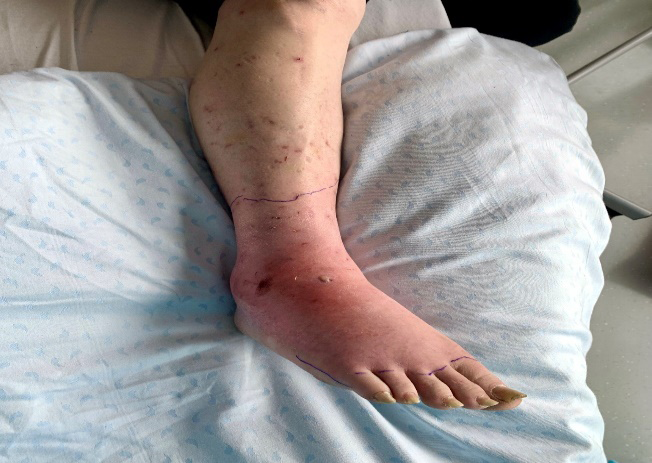
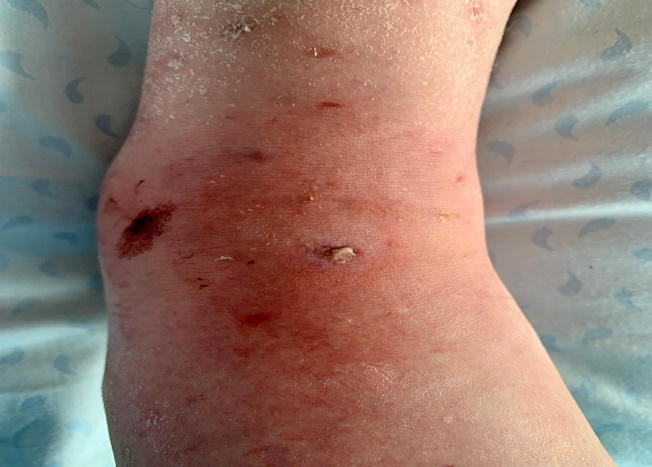
At admission, we noticed a lot of atrophic scar on the right leg and an erythematous tumefaction and induration of the right foot (Figure 1) with spontaneous purulent discharge at the center (Figure 2). She did not have lymphangitis or inguinal adenopathy palpable. The clinic was very suggestive of a Pasteurella’s infection. Laboratory exams revealed an inflammatory syndrome (PCR 165 mg/l with no leukocytosis). Bacterial smear was positive for Pasteurella dagmatis and Pasteurella multocida. Blood culture were negative. An ultrasound excluded subcutaneous abscess. We drained the wound daily the first 96 hours with pus attesting of superficial subcutaneous abscess collecting over time, and introduced a systemic antibiotherapy with co-amoxicillin 1.2 g every 8 hours. Clinical and biological evolution was good after 10 days.
Discussion
Animal bites are common and can lead to severe injuries, accounting each year for 4.7 million visits in the emergency units in the United States with costs estimated to 50 dollars per year, with cat bites responsible for 10% for all animal bite wounds [1]. Dogs and cats bites infections are often polymicrobial with anaerobic and aerobic bacteria [1]. Species belonging to the Pasteurellaceae family, a Gram negative aerobic bacterial, are known to be pathogens on the mucosal surfaces of upper respiratory tracts of vertebrates, and are described among dogs, cats but also other animals such as birds, horse, pigs, guinea pig and iguana [2, 3]. These species may be responsible of zoonotic infections in humans [4].
Pasteurella multocida is the predominant isolate found among cat bites following by P.dagmatis, P.stomatis and P.canis 2. Infection occurs rapidly during the firsts 24 hours following the injury, often manifesting as cellulitis but clinician should be aware of potential complications such as abscesses or sepsis [1]. Other clinical manifestations induced by P.dagmatis are rarely reported in the medical literature including bacteremia [3, 5] and septicemia [4, 6], prosthetic [7, 8] and native [9] valve endocarditis, pneumonia [10], chronic bronchiectasis [11], peritonitis [12, 13], vertebral osteomyelitis [14], spondylodiscitis [15]. Serious systemic infections due to Pasteurella species are unusual in individuals without predisposing illnesses such as diabetes or immunosuppression [4].
Concerning the treatment, due to high risk infections, cat bite wounds are never closed by primary intention and systemic antibiotics should be used for patients with higher- risk bites or bites on the hand using Penicillin in first line therapy (such as amoxicillin-clavulanate), a good choice in cases of animal bite prophylaxis [1, 4]. Pasteurella dagmatis is highly susceptible to many antibiotics, particularly, the beta- lactams [3] but it is to note that clindamycin does not cover the Pasteurella sp and should not be used alone [1].
In conclusion, Pasteurella dagmatis is responsible for skin and soft tissue infections and can be seen in association with Pasteurella multocida. Clinicians should be able to recognize and treat it fast as it can be responsible for severe disease, particularly in immunocompromised hosts.
References
-
Hurt JB, Maday KR (2018) Management and treatment of animal bites. JAAPA 31(4): 27-31.
-
Abrahamian F M, E J Goldstein (2011) Microbiology of animal bite wound infections. Clin Microbiol Rev 24(2): 231-246.
-
Xiong J, Krajden S, Kus JV, Rawte P, Blondal J, et al. (2015) Bacteremia due to Pasteurella dagmatis acquired from a dog bite, with a review of systemic infections and challenges in laboratory identification. Can J Infect Dis Med Microbiol 26(5): 273-276.
-
Fajfar-Whetstone CJ, Coleman L, Biggs DR, Fox BC (1995) Pasteurella multocida septicemia and subsequent Pasteurella dagmatis septicemia in a diabetic patient. J Clin Microbiol 33(1): 202-204.
-
Fernández-Ruiz M, Mestre-Gómez B, Calvo-Reyes MA, Librizzi S (2015) Pasteurella dagmatis bacteremia in a cirrhotic patient: Beware of contact with domestic pets. Enferm Infecc Microbiol Clin 33(7): 495-496.
-
Deschilder I, Gordts B, Van Landuyt H, Renders F, Selleslag D (2000) Pasteurella dagmatis septicaemia in an immunocompromised patient without a history of dog or cat bites. Acta Clin Belg 55(4): 225-226.
-
Rosenbach KA, Poblete J, Larkin I (2001) Prosthetic valve endocarditis caused by Pasteurella dagmatis. South Med J 94(10): 1033-1035.
-
Strahm C, Goldenberger D, Gutmann M, Kuhnert P, Graber P (2012) Prosthetic valve endocarditis caused by a Pasteurella dagmatis-like isolate originating from a patient’s cat. J Clin Microbiol 50(8): 2818-2819.
-
Sorbello AF, O’Donnell J, Kaiser-Smith J, Fitzharris J, Shinkarow J, et al. (1994) Infective endocarditis due to Pasteurella dagmatis: case report and review. Clin Infect Dis 18(3): 336-338.
-
Laurens C, Marouzé N, Jean-Pierre H (2012) Staphylococcus pseudintermedius and Pasteurella dagmatis associated in a case of community-acquired pneumonia. Med Mal Infect 42(3): 129-131.
-
Allison K, Clarridge JE 3rd (2005) Long-term respiratory tract infection with canine-associated Pasteurella dagmatis and Neisseria canis in a patient with chronic bronchiectasis. J Clin Microbiol 43(8): 4272-4274.
-
Wallet F, Touré F, Devalckenaere A, Pagniez D, Courcol RJ (2000) Molecular identification of Pasteurella dagmatis peritonitis in a patient undergoing peritoneal dialysis. J Clin Microbiol 38(12): 4681-4682.
-
Ashley BD, Noone M, Dwarakanath AD, Malnick H (2004) Fatal Pasteurella dagmatis peritonitis and septicaemia in a patient with cirrhosis: a case report and review of the literature. J Clin Pathol 57(2): 210-212.
-
Garcia-Hejl C (2007) Pasteurella dagmatis: an unusual cause of vertebral osteomyelitis. Pathol Biol (Paris) 55(7): 340-342.
-
Dupuy O, Garrabé E, Bordier L, Boyer B, Goasguen O, et al. (2006) Pasteurella dagmatis spondylodiscitis in a diabetic patient. Rev Med Interne 27(10): 803-804.
- Epithelioid Granuloma; 3cases with Different Clinical Features
- Advancing Representation in Dermatology Clinical Trials: Ethical, Scientific, and Regulatory Imperatives for Inclusion Across all Fitzpatrick Skin Types
- A Case of Atopic Dermatitis with Concurrent Psoriasis Vulgaris: Successful Treatment with Upadacitinib
- Innovation Lifting Eyeshadow: A Synthesis of Makeup and Optical Illusion
- Distinguishing Superficial Actinic Porokeratosis from Actinic Keratosis with UVF Dermoscopy: A Case Report
- High Mobility Group Box 1 (HMGB1) in Cutaneous Inflammation: An Immune Modulator Bridging Cellular Stress, Ferroptosis and Danger Signaling