
Clinical Educational Cases Easily Confused by New Medical Staff: Acne and Pityrosporum Folliculitis
Benzac AC Gel 10% is a drug commonly used in clinical treatment of acne, but it will not be effective cure for the abnormal abscesses in patients with atopic dermatitis. Besides, it is rarely discussed. Therefore, through this case report, we want to make fresh physicians, medical students, and patients understand these situations and know how to deal with them
Case Report
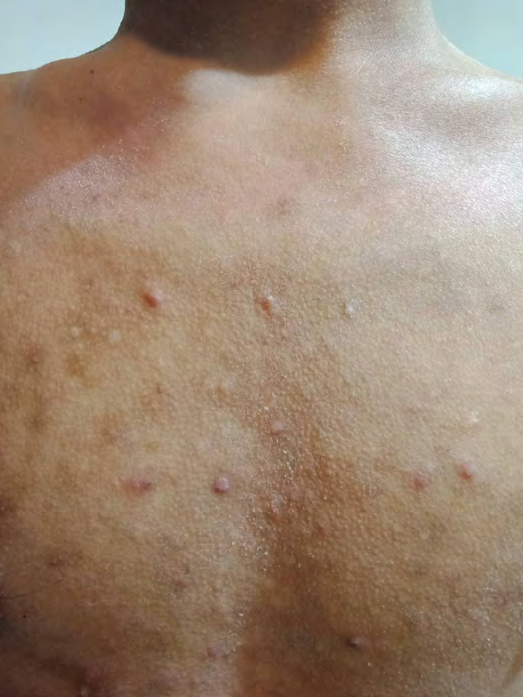
A 21-year-old patient with atopic dermatitis came to the clinic with large amounts of abscesses on his face, back, and chest. Since a lot of acne had affected the appearance of the patient [1, 2], we first let the patient use Benzac AC Gel 10% at the beginning [3]. However, after a week of use, there was no effective improvement. Therefore, we thought that the abscesses should not be acne, but it may be fungal acne caused by fungal infection [4, 5]. In view of this, we replaced the original treatment medication with Sulfamethoxazole 40 mg/ml [6]. After one week of use, most of the patients’ abscesses had decreased. However, after three months of use, the situation became serious. We speculated that it may be caused by infection of different fungal species, or the fungus might have developed drug resistance [7, 8], so We also prescribed another antibiotic for this patient. Indeed, the condition of the patient’s face, neck and chest did improve again after use. In the process of treatment, in addition to prescribing drugs to patients, the patient was also asked to pay attention to his personnel hygiene. We told him not to touch the infectious area unless it was necessary. Also, he was sure to wash the infectious part while taking a bath.
Acne is a normal thing for everyone. However, for patients with atopic dermatitis, sometimes it is not pimples, but pityrosporum folliculitis caused by fungal infection. Due to using corticosteroid or Immunosuppressive agents, patients with atopic dermatitis are prone to fungal infection. Fungus, such as P. ovale and P.orbiculare, may cause acne-like appearance and affect the appearance of patients. For new medical staff, students or patients themselves, pityrosporum folliculitis is often confused with acne, and useless treatment drugs may also be prescribed. However, no curative effect can be seen. In view of this, I want to cite this case here, so fresh physicians, medical students or patients can learn from this actual clinical case and avoid mistaking between acne and pityrosporum folliculitis.
Since each type of fungus has different resistance to specific antibiotics, and sometimes there may be drug resistance, it is also recommended for new medical staff to use not only one antibiotic. If the effect of a certain drug is limited, other antibiotics can also be used, so that the effect may be seen.
Discussion
For patients with atopic dermatitis, because of using corticosteroid or Immunosuppressive agents, acne on them often not be just pimple, but also pityrosporum folliculitis caused by fungal infection. The state of the disease is very similar to that of general acne. The patient’s neck, upper chest, back, shoulders, upper arms, and even the face will have many follicular papules and pustules with varying degrees of itching, so it often makes new medical staff, students or patients confused. As far as the diagnosis method is concerned, experienced doctors can mostly judge by naked eyes. However, for new medical personnel, further diagnosis should be made, such as dander microscopy or skin biopsy. If they find that the drug for acne treatment has no significant effect, they should consider replacing the drug with Antifungal antibiotics. Treatment options include topical antifungal/fungal medications and lotions, including 2% ketoconazole shampoo, ciclopirox olamine, and selenium sulfide. Alternatively, oral antifungal/fungal medications, such as keroconazole, fluconazole, and itraconazole, can be used. Patients usually need to take the medicine continuously for 2-4 weeks, for it is easy to relapse after oral medication is discontinued. It is recommended to take oral medication once a month or maintain weekly topical antifungal drugs to reduce the chance of disease recurrence.
For new medical staff, students or patients, pityrosporum folliculitis are often misdiagnosed as pimples, and the wrong medicine is prescribed. Therefore, this case is specially mentioned here. We hope that this case can be used to prevent such situations from happening, so that medical staff can prescribe the right medicine and effectively improve the quality of life of patients.
References
-
Woo TE, Sibley CD (2020) The emerging utility of the cutaneous microbiome in the treatment of acne and atopic dermatitis. J Am Acad Dermatol 82(1): 222-228.
-
Yim RM, Singh I, Armstrong AW (2020) Updates on treatment guidelines for psoriasis, atopic dermatitis (eczema), hidradenitis suppurativa, and acne/rosacea during the COVID-19 pandemic. Dermatol Online J 26(10): 13030.
-
Hamilton FL, Car J, Lyons C, Car M, Layton A, et al. (2009) Laser and other light therapies for the treatment of acne vulgaris: systematic review. Br J Dermatol 160(6): 1273- 85.
-
An MK, Hong EH, Cho EB, Park EJ, Kim KH, et al. (2019) Clinicopathological differentiation between Pityrosporum folliculitis and acneiform eruption. J Dermatol 46(11): 978-984.
-
Prindaville B, Belazarian L, Levin NA, Wiss K (2018) Pityrosporum folliculitis: A retrospective review of 110 cases. J Am Acad Dermatol 78(3): 511-514.
-
(1980) Sulfamethoxazole. IARC Monogr Eval Carcinog Risk Chem Hum 24: 285-295.
-
Revie NM, Iyer KR, Robbins N, Cowen LE (2018) Antifungal drug resistance: evolution, mechanisms and impact. Curr Opin Microbiol 45: 70-76.
-
Perlin DS, Rautemaa-Richardson R, Alastruey-Izquierdo A (2017) The global problem of antifungal resistance: prevalence, mechanisms, and management. Lancet Infect Dis 17(12): e383-e392.
- Epithelioid Granuloma; 3cases with Different Clinical Features
- Advancing Representation in Dermatology Clinical Trials: Ethical, Scientific, and Regulatory Imperatives for Inclusion Across all Fitzpatrick Skin Types
- A Case of Atopic Dermatitis with Concurrent Psoriasis Vulgaris: Successful Treatment with Upadacitinib
- Innovation Lifting Eyeshadow: A Synthesis of Makeup and Optical Illusion
- Distinguishing Superficial Actinic Porokeratosis from Actinic Keratosis with UVF Dermoscopy: A Case Report
- High Mobility Group Box 1 (HMGB1) in Cutaneous Inflammation: An Immune Modulator Bridging Cellular Stress, Ferroptosis and Danger Signaling