
Features of Emergency Remote Dermatological Care and Students Education in the Wartime
Introduction: On the night of February 23-24, 2022, numerous Russian missiles and shells suddenly flew into Ukraine. Unexpectedly for many residents of Ukraine, a full-scale war began. The way of life habitual for the whole Ukrainian society has changed irreversibly and instantly. .Most of medical services and qualified outpatient consultations have become impossible. This is probably the first real experience of organizing and providing professional remote medical care in the XXI century. Materials and Methods: Several posts were created on fb, where we announced a free online consultation of dermatovenereologists during the war. In addition, a corresponding telegram channel was created. Any doctor of Ukraine could register there at his own request. Results: During the first month and a half of the war, we received almost 200 inquiries from various patients with dermatological problems. The predominant part (about 95%) of these patients had various clinical manifestations of allergic reactions on the skin and mucous membranes or herpes simplex or shingles. Exacerbations of psoriasis, eczema, and Pityriasis rosea have been reported in other patients seeking remote professional care. Only one of the patients who contacted us remotely during this period of the war was diagnosed with hemorrhagic vasculitis associated with severe comorbidities Discussions: There were no citizens who had at least somehow linked the appearance of these skin rashes and itching to the effects of food or medicine. Food, according to them, was mostly habitual - as before the war. Previous (before the rash) use of drugs, patients also denied. The only thing they all noticed was their own "state of shock" in the first days and weeks after the war.
Introduction
On the night of February 23-24, 2022, numerous Russian missiles and shells suddenly flew into Ukraine. Uunexpectedly for many residents of Ukraine, a full-scale war began. The way of life habitual for the whole Ukrainian society has changed irreversibly and instantly. Due to the significant real risks to life from rocket and artillery fire, the usual and routine for peaceful time in Kiev medical care immediately became problematic. Most of these peacetime medical services and qualified outpatient consultations have become impossible. Almost immediately, the acute question arose as to how to continue to provide specialized dermatological care to patients in this extreme situation.
And the solution was quickly found through the active use of the Internet and online communication on Facebook and Telegram. Previously, such experience in providing medical care during the war was based solely on its implementation by doctors or directly on the battlefield or in hospitals [1, 2].
This is probably the first real experience of organizing and providing professional remote medical care in the XXI century.
Materials and Methods
Several posts were created on fb, where we announced a free online consultation of dermatovenereologists during the war. In addition, a corresponding telegram channel was created. Any doctor of Ukraine could register there at his own request. Thus, doctors began very soon to receive requests for help from potential patients in their medical field. Dermatologists have also benefited greatly from the fact that patients have been contacted by video link or sent numerous photographs of their affected areas of skin of various localizations.
The same circumstance helped to evaluate quite objectively the results of such remote therapy on the comparative monitoring of skin rashes before and after the recommended treatment. It was also a forced “base” for online clinical analysis of specific clinical cases with 4th year students who were currently undergoing a cycle of training in dermatovenereology.
Results
During the first month and a half of the war, we received almost 200 inquiries from various patients with dermatological problems. The predominant part (about 95%) of these patients had various clinical manifestations of allergic reactions on the skin and mucous membranes or herpes simplex or shingles. Exacerbations of psoriasis, eczema, and Pityriasis rosea have been reported in other patients seeking remote professional care. Only one of the patients who contacted us remotely during this period of the war was diagnosed with hemorrhagic vasculitis associated with severe comorbidities. And he was not directly anamnestic directly related to the psychosuppression of the shelling and bombing of Ukraine.
Discussion
Here are some different clinical cases that can be characterized as certain features of dermatological care and professional training of medical students of National medical university (NMU) in wartime.
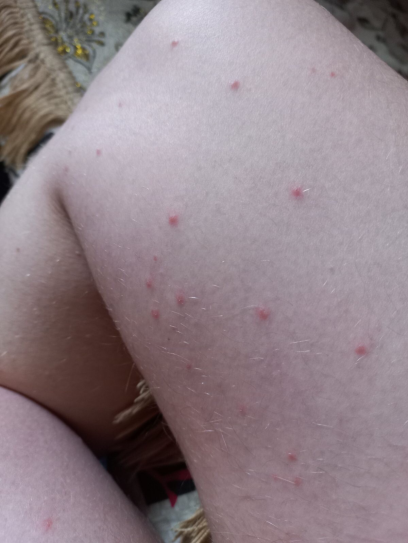
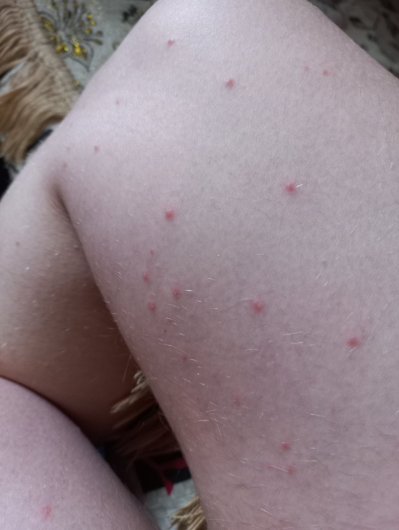
Clinical case 1 A 47-year-old woman from Mariupol (Ukrainian city most affected by the bombing), who addressed to us by skype on the third day of the war (February 26, 2022). Due to regular artillery shelling of her residential area by Russians, she was forced to walk and sleep in synthetic clothing for two days in a cold room (but not in the basement) of her apartment. As a result, a small focus papular rash appeared on the skin, accompanied by severe itching (Figures 1,2).
She never had skin problems before. One of the students present at this online consultation spontaneously advised her to check for any medications in the bag that was with her. Coincidentally, the patient found loratadine in her home bag, which was recommended for use as a therapy. For obvious reasons, it was not possible to prescribe more adequate treatment.
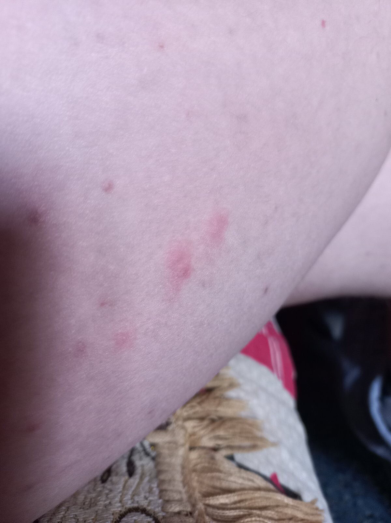
It was also recommended to change underwear into natural fabrics if possible. The next day she felt better - the itching almost disappeared and became noticeably paler (Figure 3). Unfortunately, we do not know the fate of the patient due to the telephone blockade.
Clinical cases 2-3 During the next online zoom session with students, 2 soldiers of the Kyiv Territorial Defense, aged 25 and 28 asked for consultation of dermatologist after a night shift they detected the incomprehensible rash on their hands.
Diagnoses of eczema were made according to photos sent by them. The younger patient had the reddening with rather accurate borders on skin of back surfaces of joints of fingers of hands (Figure 4).
He has never had such skin problems before. We prescribed to this patient Hormonal ointments, 3-4 times per day, topically. It was also recommended to use gloves to protect hands from the cold during the next shift at the checkpoint. In this case, patient had the opportunity to get medicine at the pharmacy.
The patient felt better at the end of the second day after the start of therapy.
The older soldier had a rash on the back of both hands and it also appear after the night shift. The rash was represented by diffuse redness with blurred borders (Figures 5,6) on both hands on the background of slightly swollen skin with an emphasized pattern.
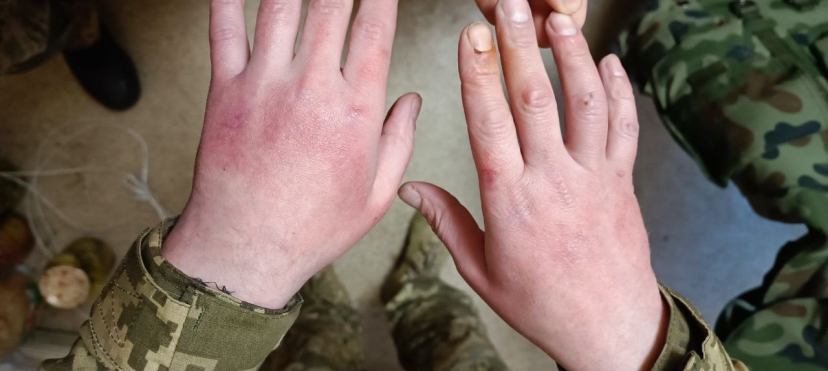
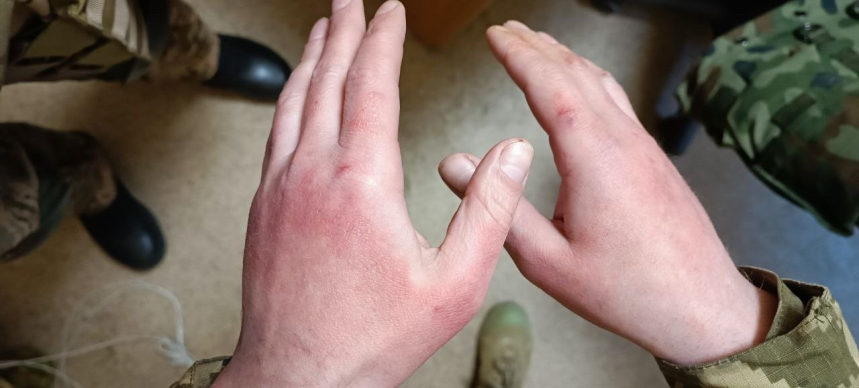
In the anamnesis - periodic occurrence of inflammatory rashes and itching during the last 2-3 years without obvious (understandable) reason. From time to time he also consulted a family doctor because of «rumbling in the abdomen» and was forced to have a diet for 2 weeks.
After a discussion of what they heard from the patient and what they saw in the photos, the students, with our help, conducted both a differential diagnosis and recommended appropriate treatment.
Triderm cream was recommended for topical therapy, as well as taking antihistaminic drugs for 7-10 days.
These patients no longer applied due to their active participation in the fighting and patrolling of the Kyiv region Clinical case 4 A young girl of 23 years with inflammatory rashes on the skin on the background of stressful information about the injuries of her friend. According to her, the feeling of nervous excitement intensified even more after visiting the military hospital where her boyfriend was hospitalized.
After a few days of periodic stay at the bedside of the wounded, she developed pustular rashes. It was the accession of pyoderma that forced her to seek dermatological help. She had no any skin problems before.
She was located near Kyiv at the time of the appeal. Access to medicines was, but rather limited.
Remotely, after a preliminary clinical discussion with students, she was diagnosed with herpes simplex of the facial skin complicated by streptoderma (Figures 7 & 8).
Acyclovir ointment and syntamycin emulsion were recommended topically. As well as acyclovir in tablets. It felt a bit better already next day. It was also recommended to re- consult in 3-5 days if necessary.
$$ - 1 $$ Figure 7: Clinical case 4 Before.
$$ - 1 $$ Figure 8: Clinical case 4. After.
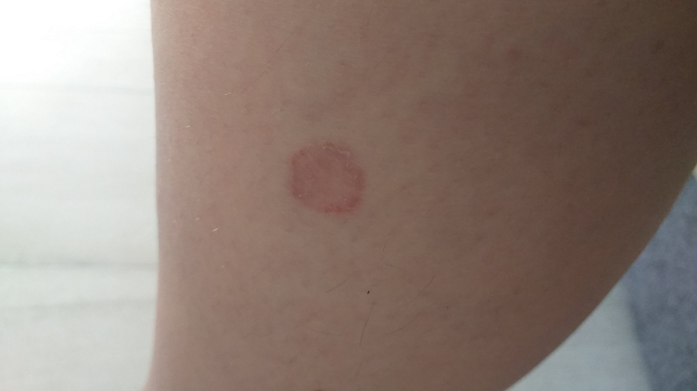
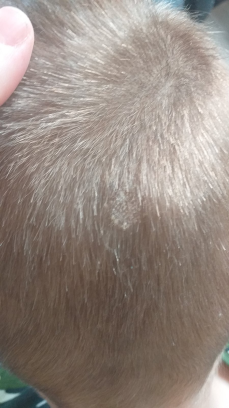
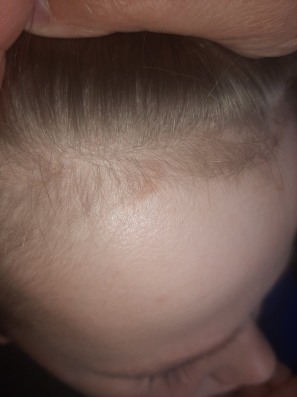
Clinical Cases 5, 6 This is a peculiar clinical case of the simultaneous appearance of similar rashes in 2 young brothers 7 and 8 years old (Figures 9-12). Due to the destruction of their home by artillery, they were forced to evacuate urgently to Slovakia, where their mother noticed the appearance of both rashes on the scalp and on smooth skin. Being from Kyiv and having a mobile phone, mother of children addressed to us from there via Viber for a consultation. This clinical cases were also discussed with our students who have to study online because of the dangerous situation. Children were diagnosed with microsporia based on the photos sent by their mother. It is recommended to urgently treat the rash with an alcoholic solution of iodine, cut hair on the head. Based on the acute contagiousness of this dermatosis and the impossibility of full examination and treatment, these young patients were transferred for further treatment and examination to Slovak colleagues who responded to our first request and agreed to take these boys for free. It was promised to inform about the further clinical course of these patients.
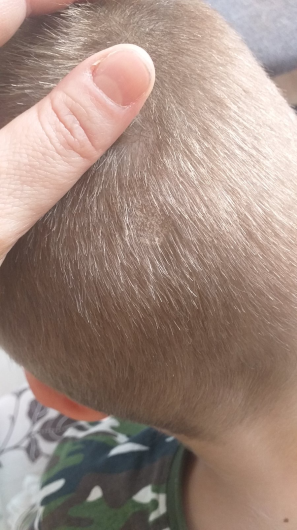
Clinical case 7 Woman 58 years old. She addressed because of the sudden appearance of a vesicular rash in her chest. She worried about the sharp pain and severe itching in this area.
The rash appeared on the 3rd day after the start of the war after severe stress during the night shelling of the neighbor apartment building. According to the photo she sent (Figure 13) and complaints, she was diagnosed with herpes zoster. She had access to medication and was therefore prescribed acyclovir tablets at a dose of 800 mg 5 times a day with an interval of approximately 4 hours (except at night).
Her attention was drawn to the urgent need for treatment for at least 7 days. In addition, local therapy is recommended – topical application of diamond green solution and acyclovir ointment 4-5 times a day for 7-10 days. Nimesil powder was recommended to relieve severe pain. To reduce itching she was prescribed Antihistamines (Claritin) 1 tablet a day. One week after the patient felt noticeably better. (Figure 14).
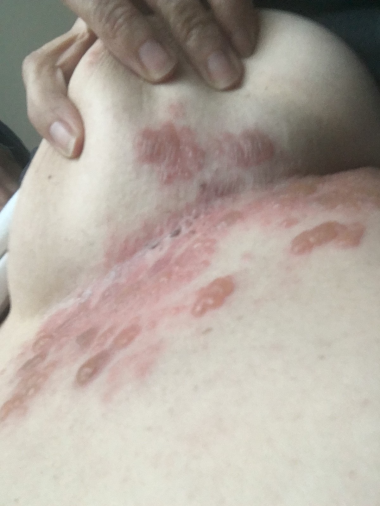
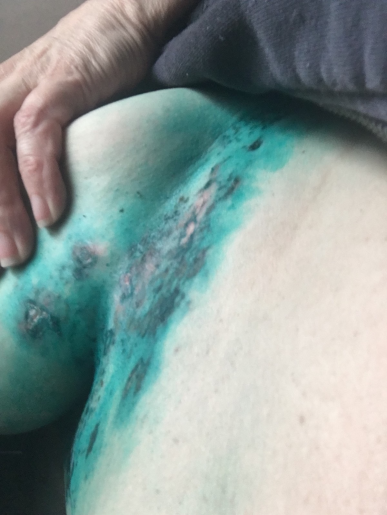
Figure 14: Clinical case 7 After. Clinical Case 8 Our colleagues’ ophthalmologists asked about their patient with ocular rosacea. During this period, she was already being treated with doxycycline tablets. Against the background of such antibiotic therapy, she became somewhat better. The patient evacuated to Spain on her own. Treatment (according to her) did not stop, but noted that her disease got worse in the facial skin. (Photo 16) Based on the fact that adjusting treatment in this case remotely is very problematic, the patient was referred to Spanish colleagues for laboratory follow-up and dose adjustment of antibiotics.
Based on the above, we express our sincere gratitude to fellow dermatologists from the European Academy of Dermatologists and Venereologists, who, if necessary and at our request, helped our patients evacuated to different countries with laboratory tests and necessary local prescriptions (Figure 15).
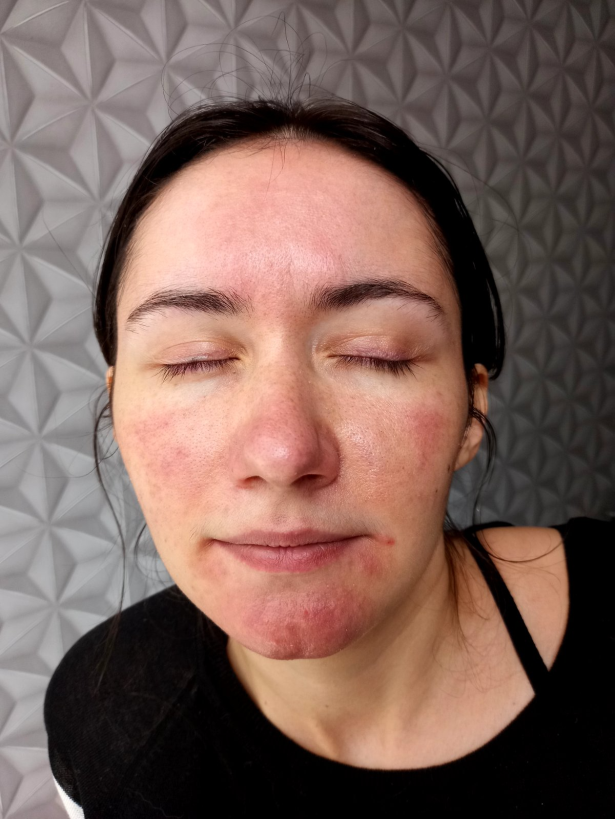
$$ - 1 $$ Figure 15: Clinical case 8.
Conclusions
- Modern means of communication have made technically possible for Ukrainian physicians the online consultations, regardless of their actual location, and to combine it at the same time with online teaching of medical students.
- A concrete manifestation of solidarity of the European Academy of Dermatovenereology was the voluntary and free cooperation of its members - doctors from many EU countries with Ukrainian colleagues in professional assistance to refugees-citizens of Ukraine who have temporarily found refuge in their countries.
- Preliminary comparative analysis of self-appeals of various patients showed a rather dramatical increase in both exacerbation of chronic and initial clinical manifestations of dermatological and other various somatic pathologies during the war under the influence of psychosuppression
- Dermatological pathology manifested itself most clearly in the sudden and seemingly unmotivated appearance of various allergic rashes and viral herpetic manifestations on the skin and mucous membranes.
- Their first feature was that these clinical manifestations were observed in people who had previously (before the war) never had such or similar skin problems.
- There were no citizens who had at least somehow linked the appearance of these skin rashes and itching to the effects of food or medicine. Food, according to them, was mostly habitual - as before the war.
- We believe that the appearance of such skin rashes with a high probability can be associated with sudden stress from the harsh reality of the beginning of the war, and subsequent bombings, shelling and understanding the real possibility of sudden death or injury at any time
- Unfortunately, in the future we will probably only see the deterioration of these sad medical statistics in the realities of collective trauma.
This tragedy will affect the health of our patients for a very long time.
References
-
Cropley TG (2008) Dermatology and skin disease in the American Civil War. Dermatol Nurs 20(1): 29-33.
-
Henning JS, Firoz BF (2010) Combat dermatology: the prevalence of skin disease in a deployed dermatology clinic in Iraq. J Drugs Dermatol 9(3): 210-214.
- Epithelioid Granuloma; 3cases with Different Clinical Features
- Advancing Representation in Dermatology Clinical Trials: Ethical, Scientific, and Regulatory Imperatives for Inclusion Across all Fitzpatrick Skin Types
- A Case of Atopic Dermatitis with Concurrent Psoriasis Vulgaris: Successful Treatment with Upadacitinib
- Innovation Lifting Eyeshadow: A Synthesis of Makeup and Optical Illusion
- Distinguishing Superficial Actinic Porokeratosis from Actinic Keratosis with UVF Dermoscopy: A Case Report
- High Mobility Group Box 1 (HMGB1) in Cutaneous Inflammation: An Immune Modulator Bridging Cellular Stress, Ferroptosis and Danger Signaling