
Impact of Covid-19 Lock down on Stress & Life Satisfaction of Diabetic People in Central Kerala
As COVID-19 is performing its cosmic dance, it has spread panic and disaster across the continents. In such a scenario, mental stress is likely to increase and life satisfaction indices may drop. This study was done to evaluate the impact of lockdown on diabetic population of Kerala, by measuring the proportion of diabetic patients who experienced stress and to find out the level of ‘Satisfaction with Life’ among them. Patients were telephonically interviewed during the nation-wide lockdown after taking their consent. The Perceived Stress Scale (PSS) and Satisfaction with Life Scale (SWLS) were used to assess stress and life satisfaction amongst the participants. Statistical analysis was performed in SPSSV. 16. Descriptive statistics was used to express Stress and Satisfaction with Life among the diabetic patients. Chi- square test was used to test for Association between Perceived Stress and Life Satisfaction. There were a total of 140 diabetic patients, who were willing to participate amongst the diabetic patients of our hospital. Mean age of the study participants was 52.38 + 14.9 years. Nearly half (46.4%) of the study population were above 55 years of age. Half (50%) of the participants had moderate to high levels of stress, indicating the urgent need of implementing stress busters. Though the majority (80.8%) reported to be ‘Satisfied with Life’, Poor Satisfaction with Life (p- 0.001) and age (p-0.034) were factors that found to have a statistically significant association with stress. Also, nearly 20% of the participants were unable to cope with stress. Stress may have a deleterious effect on glycemic control of diabetic patients and interventions that prevent or help to cope with stress may have an important role in preventing the occurrences of serious complications of diabetes in future.
Introduction
COVID-19 pandemic is turning out to be a major stressor for most of humanity. The COVID 19 pandemic has led the Governments of various countries to adopt unprecedented measures to curb the spread of the infection. It has wreaked a havoc that our generation has not witnessed ever before, ravaging country after country. It has caused generalized economic depression, unemployment and worldwide quarantines, apart from its effects on the physical and mental health of the people. On March 24, 2020, the Indian government imposed the first nationwide lock down for 21
days, restricting movement of the entire 1.3 billion people, except for essential services and health emergencies. The lockdown continued till May 31st, 2020 and the Unlocking began in a phased manner, though in the containment zones, strict lockdown measures continue to be imposed.
Mental health issues following the COVID-19 pandemic stem from ‘normal’ people being exposed to ‘extraordinary situations’. Lockdown has meant long separation from families for those working away from their hometown and loss of jobs implies financial stress, which could be major stressors in the long run. The presentations are myriad, and include emotional difficulties like anxiety, depression, biological effects like sleep and appetite disturbances as well as severe mental illness and substance misuse.
Though the lockdown was imperative to get the infection under control, especially to save the vulnerable sections such as the elderly, the diabetics and cancer patients, the stress induced by such restrictive measures is likely to have serious mental health effects on the population [1]. Many people were jobless and became economically deprived, people from various parts of India faced starvation [2], exhaustion [3], police brutality [4, 5] and were denied timely medical care.
Also, diabetes is portrayed as an important risk factor for COVID-19 [6]. The media barraging about such instances as well as the number of COVID 19 cases and death toll, could have added on to the stress, already caused by fear of contracting COVID-19.
Evidence suggests that the COVID 19 crisis has had a negative impact on the mental health of vulnerable populations [1]. Unfortunately, no data is available in specific populations such as the diabetic population. In recent years, some researchers have suggested the possibilities of stressful experiences influencing diabetes control [7, 8, 9] and showed that there is an association between stressful experiences and control of diabetes mellitus [10]. Psychological reaction to stressors of defeatism or helplessness lead to the activation of the hypothalamo-pituitary-adrenal (HPA) axis, leading to various endocrine abnormalities, such as high cortisol and low sex steroid levels, that antagonize the actions of insulin. Reactions to external stressors such as feelings of anxiety and panic related to COVID 19, lockdown-imposed restrictions of movement, may all lead to difficulties with self-care as well. It manifests as reduced physical activity, poorer diet and an overall ‘low feeling’ which further impedes self-care practices.
Kerala Government has been actively engaged in providing psychosocial support to people in quarantine and also adopted an inclusive approach by addressing the special needs of the elderly people living alone, children with special needs, mentally ill patients and migrant laborers. Till date, the psychosocial services have reached out to about 1.2 million people in the state, with a population of around 3.5 million [11]. The key to prevention of psychological problems is to practice ‘Psychological First Aid’, i.e, providing comprehensive stress prevention support to people in distress so that they feel calm and adopt better coping strategies.
Considering the mammoth nature of the pandemic and the already fragile mental health services across the country, it is necessary to address the existing mental health gaps, especially of the diabetic population, considering the negative consequences stress can have on the control of Diabetes. The aim of this study is to estimate the impact of COVID 19 related lockdown on mental stress and Life Satisfaction of Diabetic Patients of an Endocrinology Outpatient Service Department of a tertiary care institution in Central Kerala.
Objectives
To find out the proportion of diabetic patients who experienced stress during the COVID- 19 lockdown.
To find out the level of ‘Satisfaction with Life’ among the diabetic patients, measured by Satisfaction with Life Scale (SWLS).
To explore the association between Perceived stress and socio-demographic factors and Life Satisfaction.
Methodology
The study was conducted after obtaining clearance by the Institutional Ethics Committee. (IEC no. 2020/5/153) It was a Cross-sectional Study done in patients who were on regular follow up with the Endocrinology Department of the Institution. The patients were telephonically interviewed during the nation-wide lockdown, after appropriate self- introduction by the interviewer and asking their consent to participate in the study. The Perceived Stress Scale (PSS) and Satisfaction with Life Scale (SWLS) were used to assess stress and life satisfaction amongst the participants. Both the scales were translated to Malayalam, the language of the people in Kerala, and back translated to the English language, by two independent people proficient in both languages. Those adult patients who were seen regularly in the Endocrinology OPD for at least five times in the previous year were included in the study. Patients who did not give consent for the survey were excluded. There were a total of 140 patients who satisfied the above mentioned criteria and participated in the study.
The PSS Scale is a classic stress assessment instrument consisting of 10- items. The tool helps to understand how different situations affect one’s feelings and the perceived stress, during the previous month. The respondent is asked to indicate how often he/she felt or thought a certain way, on a Likert Scale from 0 to 4, where 0 indicates never, 1- almost never, 2- sometimes, 3- fairly often, 4- very often. Questions which were positively worded were reverse scored.
Individual scores on the PSS can range from 0 to 40 with higher scores indicating higher perceived stress. Scores ranging from 0-13 would be considered low stress, 14-26 would be considered moderate stress and scores ranging from 27-40 would be considered as high levels of perceived stress [12]. Those with moderate- high levels of perceived stress were categorized as having Stress.
The Satisfaction with Life Scale is a short 5-item instrument designed to measure global cognitive judgments of satisfaction with one’s life. It is also rated on a Likert Scale ranging from 1-7. ‘1’ indicating Strong Disagreement and ‘7’ indicating Strong Agreement. The total score is 35; higher scores indicating higher life satisfaction. Those with a score above 20 were considered to be Satisfied with Life and those with a score below 20 were considered to be Dissatisfied with Life [13] (Table 1).
Statistical Analysis
Data was entered in Microsoft Excel and statistical analysis was performed in SPSS v. 16. Demographic characteristics, proportion of participants with high levels Perceived stress and Dissatisfaction with life, were measured using descriptive statistics. Chi- square test was used to test for association between Perceived Stress and Life Satisfaction.
| 31-35 | Extremely Satisfied |
| 26-30 | Satisfied |
| 21-25 | Slightly Satisfied |
| 20 | Neutral |
| 15-19 | Slightly dissatisfied |
| Oct-14 | Dissatisfied |
| 05-Sep | Extremely Dissatisfied |
Table 1: Scores indicating Level of Satisfaction with Life.
Results
The number of diabetic patients who participated in the study was 140. The mean age of the study participants was 52.38 + 14.9 years. The youngest participant was 18 years of age and the oldest participant was 80 years old. Those above 55 years of age comprised of 46.4% of the study population. Nearly three-fourths of the study participants were females. One- fourth of them had an education up to graduation/ diploma (Table 2).
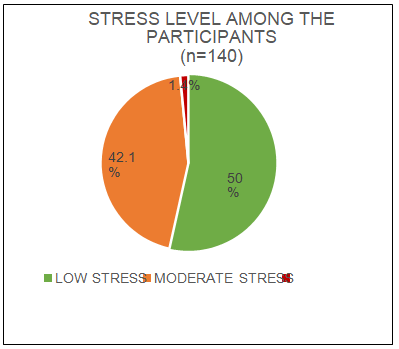
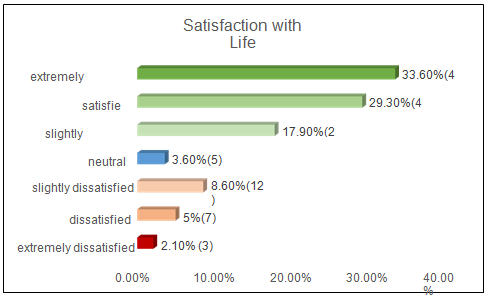
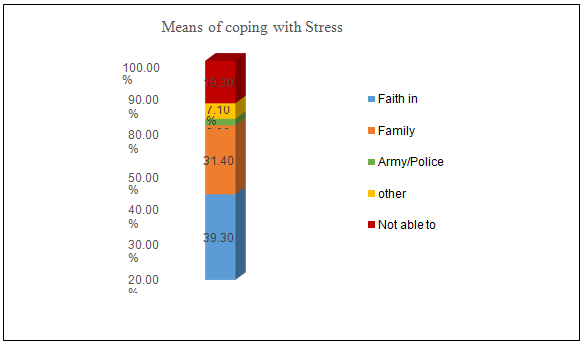
Exactly 50% of the participants had moderate- high levels of stress, as assessed by the Perceived Stress Scale (Figure 1). Though majority had high scores on the Satisfaction with Life Scale (indicating Satisfaction in Life), about 15% expressed that they were dissatisfied in life (Figure 2). When considering the factors that were associated with Stress, Age (p =0.034) and Satisfaction with Life (p= 0.001) were found to have a significant association in determining Stress. Among the participants, nearly 20% were unable to cope up with stress. Among the rest, “Faith in God” and “Family support” were reported as the most common means of trying to cope up with Stress induced by COVID- 19 Lockdown (Figure 3).
| Variables | Number (n=140) | Percentage |
|---|---|---|
| Age | ||
| </= 30 years | 12 | 8.60% |
| 31-55 years | 63 | 45% |
| > 55 years | 65 | 46.40% |
| Gender | ||
| Male Female | 38 | 27.10% |
| 102 | 72.90% | |
| Education | ||
| Primary school High School Higher Secondary Graduate/ Diploma Professional | 15 | 10.70% |
| 38 | 27.10% | |
| 25 | 17.90% | |
| 35 | 25% | |
| 27 | 19.30% |
Table 2: Socio-demographic Profile of the Participants.
| Variables | Stress | Total | Chi-square | p-value | |
|---|---|---|---|---|---|
| Present | Absent | ||||
| Age | |||||
| (n=140) | |||||
| </= 30 years | 4 (33.3%) | 8 (66.7%) | 12 | ||
| 31-55 years | 39 (61.9%) | 24 (38.1%) | 63 | 6.76 | 0.034 |
| >55years | 27 (41.5%) | 38 (58.5%) | 65 | ||
| Gender | |||||
| (n=140) | |||||
| Male | 21 (55.3%) | 17 (44.7%) | 38 | 0.58 | 0.447 |
| Female | 49 (48%) | 53 (52%) | 102 | ||
| Physical Activity | |||||
| (n=140) | |||||
| Present | 42 (53.8%) | 36 (46.2%) | 78 | 1.042 | 0.307 |
| Absent | 28 (45.2%) | 34 (54.8%) | 62 | ||
| Satisfaction With Life* | |||||
| (n= 135) | |||||
| Dissatisfied with Life | 18 (81.8%) | 4 (18.2%) | 22 | 11.935 | 0.001 |
| Satisfied with Life | 47 (41.6%) | 66 (58.4%) | 113 | ||
| *Those people who are neutral on Satisfaction with Life scale are omitted from the analysis |
Table 3: Socio-demographic Profile of the Participants.
Discussion
In the initial days of lockdown, people thought that the crisis would end soon. But when lockdown continued and COVID 19 remained uncontrolled, it led to stress, depression and sleep related issues in many people. Any stressful event might be judged by people in different ways, based on factors such as previous experience, psychological factors, and social influences. When a threat seems to have a potential to cause harm to the individual, a specific pattern of physiological responses is elicited, known as the stress response or “fight/ flight” response. But when it comes to the COVID 19-threat, which is one of a kind that our generation has ever witnessed, we are just left with one option, ’fight response’. We can’t flee from it, as it is literally everywhere. Thus, the different stressors experienced by people could be the fear of COVID-19 infection, together with inadequate/ confusing information, frustration and boredom , lack of social togetherness and financial problems [14]. Thus, many people are prone to develop new- onset mental health problems such as health related anxiety, low mood, dissatisfaction in life, acute stress reaction and emotional exhaustion. Thus, it was important to measure the stress experienced by our people.
In our study, we found that half of our diabetic patients experienced stress. This is certainly an alarming proportion. Kerala is named ‘the diabetic capital of India’, with a prevalence of nearly 20% and more than two-thirds of people above 45 years of age are either diabetic or pre- diabetic [15]. Studies indicated that a wide variety of factors were important in stress-related/ aggravated diabetes, including relationships with health care professionals , the interaction between diabetes and daily life and work, and fear of the future. In the present scenario, during lockdown, diabetic patients were denied access to their regular routine surveillance and positive reassurances from their trusted health care provider. Further, all work places remained closed and people were unable to socialize, remained secluded, which could have added to their stress levels. Social support is shown to have a buffering effect in times of stress [8]. Research has shown that stress also interferes with the ability to self-manage diabetes. Doing everyday self- care tasks, such as monitoring glucose frequently, following a meal plan, and correctly preparing or remembering to take insulin or oral medications at the right time, is difficult during times of stress. So, it is necessary to be aware that our people are under stress and therefore it is imperative to learn to control the negative responses to stress; particularly when the causes of it, i.e, COVID 19, is going to be with us for a long time. Our study also showed that age had a significant association with Stress. Among the age group between 31- 55 years, majority (61.9%) were stressed. This age group comprises of the working population and could have had worries of raising their children, looking after their family, fear of job losses and financial crisis; which could have contributed to high levels of stress in this age group.
Satisfaction with Life is a measure of well-being and is shown to correlate with measures of mental health. It is also predictive of future behaviors such as suicide attempts [16]. Our study revealed that majority of the participants were satisfied with their life. But, it is among the 15% who were dissatisfied with life, stress levels were found to be high; showing a significant association between Dissatisfaction in Life and stress. Amongst those who were dissatisfied with life, 81.8% were found to be stressed. It is also the responsibility of the health care providers to differentiate stress from Depression, as Depression is more common in diabetes than in the general population [17, 18]. Tools such as the Beck Depression Inventory or the Hospital Anxiety and Depression Scale are useful in screening for depression and must be used as depression is responsive to both medication and psychotherapy. Studies have also shown that there is a significant association between media reports related to COVID 19 pandemic and depression and anxiety. Frequent media exposure to COVID-19-related news can have detrimental mental health effects [19]. Therefore, in dealing with stress, behavioral modification is required such as de-emphasizing stress with distractors like pursuing one’s hobbies and trying out new ones and avoiding constant exposure to media reports of COVID 19. It is also important to emphasize that many people can handle this situation more constructively- by learning to stay calm by placing trust and Faith in God, by busying themselves with simple daily activities with children, connecting with others through telephone or digital means and cultivating or rediscovering old interests. Our study showed that Faith in God and family support were the most important means by which people were trying to cope up with stress.
Psychological issues related to COVID-19 will last long and the counselling being provided now should continue for months even after the lockdown through online digital communication platforms [20]. It is important to anticipate that stress, depression, and anxiety, if not effectively recognized and handled can transform into more severe distress, even leading to negative thoughts about the future, helplessness, hopelessness and suicidal thoughts and feelings [21].
Psychological crisis intervention for the high risk population must be ongoing in times of pandemic. Helplines are lifelines in such situations. It is necessary to ensure adequate and appropriate care to the many thousands who are psychologically disturbed following the pandemic and build resilience which is the ultimate requirement to tide over these difficult times.
Conclusion
In summary, stress is as high as 50% among the diabetics in Kerala. However, nearly 85% of them were ‘Satisfied with Life’. Those who were dissatisfied with life were more prone to develop stress, with a significant association between stress and Life Satisfaction. People in the age group between 31-55 years were among the most stressed. Although majority reported that they were trying to cope up with stress by placing Faith in God and Family support, one- fifth of the participants were unable to cope up with stress. Stress may have a deleterious effect on glycemic control of diabetic patients and so interventions that prevent or cope with stress can have an important role in improving glycemic status and in the long run, reduce their propensity to suffer serious complications.
References
-
Aragona M, Barbato A, Cavani A, Costanzo G, Mirisola C (2020) Negative impacts of COVID-19 lockdown on mental health service access and follow-up adherence for immigrants and individuals in socio-economic difficulties. Public Health 186: 52-56.
-
Maria AH, Sameer Y (2020) India’s Coronavirus Lockdown Leaves Vast Numbers Stranded and Hungry. The New York Times.
-
Venkatesha B, Sachin S, Vijay S (2020) Across the country, migrants still forced to walk thousands of miles. Hindustan Times.
-
Piyush S (2020) ‘Beaten’ for stepping out for biscuits, UP teen dies. The Telegraph. Kolkota.
-
Anuraag S (2020) Farmer beaten by cops amid lockdown dies in Madhya Pradesh, six officers suspended, SP transferred. The New Indian Express.
-
Uvais NA, Nalakath MJ, Shihabudheen P, Hafi NAB, Rasmina V, et al. (2020) Psychological distress during COVID-19 among Malayalam-speaking Indian expats in the Middle East. Indian J Public Health 64: S249-S250.
-
Delamater AM, Cox DJ (1994) Psychological stress, coping, and diabetes. Diabetes Spectrum 7:18-49.
-
Viner R, McGrath M, Trudinger P (1996) Family stress and metabolic control in diabetes. Arch Dis Child 74(5): 418-421.
-
DeVries JH, Snoek FJ, Heine RJ (2004) Persisitent poor glycaemic control in adult Type 1 diabetes: a closer look at the problem. Diabet Med 21(12):1263-1268.
-
Mooy JM, De Vries H, Grootenhuis PA, Bouter LM, Heine RJ (2000) Major stressful life events in relation to prevalence of undetected type 2 diabetes. Diabetes Care 23(2): 197-201.
-
World Health Organization (2020) Responding to COVID-19 - Learnings from Kerala.
-
Cohen S (1994) Perceived Stress Scale. Mind Garden.
-
Pavot W, Diener E (2013) The Satisfaction with Life Scale (SWL). Measurement Instrument Database for the Social Science.
-
Brooks SK, Webster RK, Smith LE, Woodland L, Wessely S, et al. (2020) The psychological impact of quarantine and how to reduce it: rapid review of the evidence. The Lancet 395(10277): 912-920.
-
(2017) Diabetic patients: Kerala tops list of Indian states. Kochi News: Times of India.
-
The Satisfaction with Life Scale (SWL). Whitaker Instiutute.
-
Lloyd CE, Dyer PH, Barnett AH (2000) Prevalence of symptoms of depression and anxiety in a diabetes clinic population. Diabet Med 17(3): 198-202.
-
Anderson RJ, Freedland KE, Clouse RE, Lustman PJ (2001) The prevalence of comorbid depression in adults with diabetes: a meta-analysis. Diabetes Care 24(6): 1069-1078.
-
Gao J, Zheng P, Jia Y, Chen H, Mao Y, et al. (2020) Mental health problems and social media exposure during COVID-19 outbreak. PLoS One 15: e0231924.
-
(2020) Stress, stigma and sleep loss: COVID-19 takes a heavy toll on mental health. The New Indian Express.
-
(2020) Mental Health in the times of COVID-19 Pandemic. Department of Psychiatry National Institute of Mental Health & Neurosciences, Bengaluru, India.
- Investigation of Polymorphisms in PPAR-Ɣ and TRHR Genes and their Impact on Turkish Diabetic and Obese Individuals
- The Impact of Aircraft Noise Exposure on the Efficacy of Empagliflozin Therapy in an Animal Model of Obesity
- Rooibos Mitigates Metabolic and Inflammatory Dysfunctions in Mice Fed a High-Carbohydrate Diet
- Synergistic Effect of Combined Leaf Extract of Vernonia amygdalina, Ocimum gratissimum, and Zingiber officinale Tuber on Phytochemical Profile, Antioxidant Activity, Serum Insulin, and Biochemical Parameters in Streptozotocin-Induced Diabetic Rats
- Investigation of Cardiovascular Responses to Aerobic Exercise in Obese University Students
- A Look at the Phase Angle Obtained by Electrical Bioimpedance