
Study on the Extraction of Colorant from Areca Nut and Employing it in Dyeing Silk Fabric
The effect of parameters on the extraction process of colorant from areca nut and the application of extracted colorant in dyeing silk fabrics has been studied. The optimum dye extraction conditions are obtained: 10 grams of areca nut / 100 mL of water, pH = 10, extraction temperature 90°C, extraction time 120 minutes. Areca nut extract is a natural dye for dyeing silk fabrics under conditions of 90 minutes dyeing time, 80°C dyeing temperature. In this study, aluminium sulphate was used as a mordant. The dyeing properties were evaluated by CIELAB. The areca nut dyes provide a reddish brown shade on the fabric. The color fastness to washing, perspiration and rubbing of the dyed fabric was in good level. The dyed silk fabric has no formaldehyde and azo-amine compounds.
Introduction
In the textile dyeing industry, most of the dyes used in fabric dyeing are synthetic dyes [1]. Synthetic dyes have caused huge consequences for water pollution, affecting the health of producers and consumers. Some synthetic dyes also contain some azo-amine compounds that are carcinogenic and banned for use [2, 3]. Therefore, the problem of researching dyeing fabrics with non-toxic, environmentally safe natural dyes has been interested by many scientists around the world, mainly focusing on pigments extracted from plant species. Natural dyes are non-toxic, renewable, degradable and environmentally friendly dyes alternatives. The advantage of using natural dye is because it has economic value and environmentally friendly. Research results have shown that natural colorants isolated from plant materials are suitable for dyeing silk and cotton fabrics and confirm color fastness as well as some preeminent properties of dyed Investigation Paper products from natural dyes [4, 5, 6, 7, 8, 9, 10, 11, 12, 13, 14, 15, 16, 17].
In this work, we present the results of research on extracting colorants from areca nut and its application in dyeing silk fabrics in Quang Nam province of Viet Nam country.
Materials and Methods
Materials
Areca nuts used in this study were collected in Viet Nam. A commercially produced plain-weave silk fabric (thickness 0.15 mm, weight 65 g/m2) was scoured and bleached (supplied by Ma Chau Silk Co., Viet Nam). Sodium sulphate (Na2SO4), Aluminium sulphate (Al2(SO4)3), Sodium hydroxide (NaOH) used were laboratory grade reagents.
Methods
Extraction of colorant from areca nut: Aqueous extraction method was employed for extraction of coloring components from areca nuts. The dried areca nut was grined and sieved with 0.5mm particle size to obtained powder. The influence of factors such as the ratio of areca nut mass/volume of water solvent, extraction time, extraction temperature, pH of extraction medium on the extraction process of colorant from areca nut was studied. The extract was filtered through a filter paper and filtrate was diluted using 100 times with distilled water and UV-Vis spectra of the extract were measured in the wavelength range from 400 nm to 600 nm by Jasco V-730 Spectrophotometer. Dyeing process: The dyeing process has been carried out in a full scale commercial Arm Dyeing Machine by following the exhaust method. In the dyeing process the material to liquor ratio is maintained at 1:20. Sodium sulphate with the concentration of 5 g/L was used as a dyeing auxiliary. The influence of factors on the dyeing process of silk fabrics was studied such as: dyeing temperature, dyeing time. The color change of the fabric after dyeing was measured in the CIELAB color space to determine L*, a* and b* values. By L* represents brightness, a* represents red-green colors, and b* represents yellow-blue colors. The chroma (C*) can be calculated from equation (1):
C* = (a*2 + b*2)1/2 (1)
Mordanting process: Aluminium sulphate was used as a mordant at 5 g/L concentration. Mordanting was carried out in post-mordanting. The dyed fabric was treated with mordant at 80oC for 60 min with M:L ratio 1:20. Characterization Methods: The phase compositions of the samples were confirmed by X-ray diffraction (XRD, X’Pert PRO, PANalytical B.V, Almelo, The Netherlands) with Cu-Kα radiation operating at 2.2 kW, and the step size was 0.0167111. The microstructure of the samples was characterized with a scanning electron microscope (SEM, Ultra 55, Carl Zeiss AG, Heidenheim, Germany).
Fastness testing: The dyed fabric is tested for washing fastness, rubbing fastness, perspiration fastness according to ISO 105-C10:2006, ISO 105-X12:2016, ISO 105-E04:2013, respectively. Analysis of formaldehyde and azo-amine compounds: The formaldehyde and azo-amine compounds of dyed fabric were determined according to ISO 14184-1:2011 and ISO 14362-1:2017, respectively.
Results and Discussion
The Effect of Factors on the Extraction of Colorants from Areca Nut
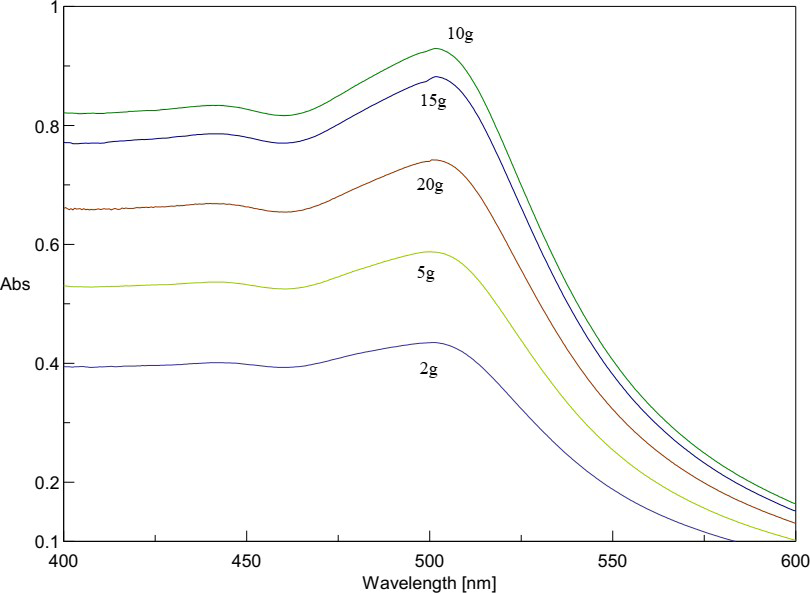
Effect of the ratio of areca nut mass/volume of water solvent: The colorant extraction process was carried out at a temperature of 80°C, extraction time 90 minutes, pH 7. The ratio of areca nut mass/100 mL of water was changed: 2 g, 5 g, 10 g, 15 g, 20 g. The effect of the ratio of areca nut mass/ volume of water solvent on the UV-Vis spectrum of the color solution is presented in Figure 1 and Table 1.
| Areca nutm ass/100 mL of water | 2g | 5g | 10g | 15g | 20g |
|---|---|---|---|---|---|
| A | 0.44 | 0.57 | 0.92 | 0.84 | 0.75 |
Table 1: Effect of the ratio of areca nut mass/volume of water solvent on the value of optical density A at λmax of the extract.
The results in Figure 1 and Table 1 show that, when the ratio of areca nut mass/volume of water solvent increases, the optical density of the extract increases and is optimal at the ratio of 10 g of areca nut/100 mL of water solvent. If the weight ratio of areca nut continues to be increased then the amount of solvent will not be enough to dissolve the color compounds in areca nut. Therefore, the optimal ratio is 10 g of areca nut/100 mL of water solvent.
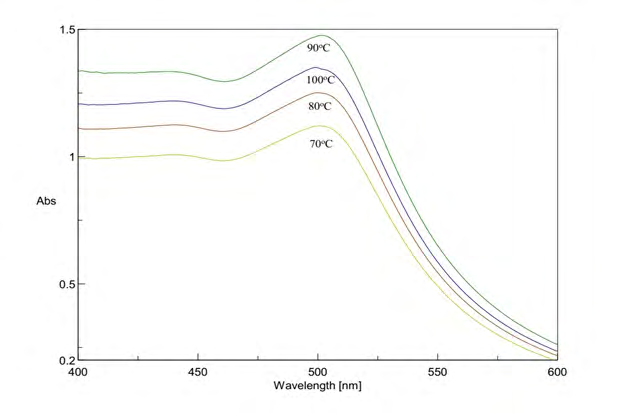
Effect of Extraction Time: The effect of extraction time on the colorants extraction process of areca nut was investigated under the following conditions: extraction temperature 80°C, 10 g of areca nut/100 mL of water solvent, pH 7. Extraction time was changed: t=60 minutes, 90 minutes, 120 minutes, 150 minutes and 180 minutes. The effect of extraction time on UV-Vis spectrum and optical density of the extract is presented in Figure 2 and Table 2.
| Time (minute) | 60 | 90 | 120 | 150 | 180 |
|---|---|---|---|---|---|
| A | 0.75 | 0.92 | 1.36 | 1.19 | 1.17 |
Table 3: Effect of the extraction time on the value of optical density A at λmax of the extract.
The results showed that, when the extraction time increased, the optical density increased and reached the optimum after 120 minutes; if the extraction time exceeds 120 min, the optical density decreases. This may be because when increasing the extraction time, the ability to separate the colorants increases, thus increasing the optical density. But when the extraction time is over 120 minutes, it can affect the structure of the colorant or can separate other substances that affect the color of the solution, so the optical density decreases.
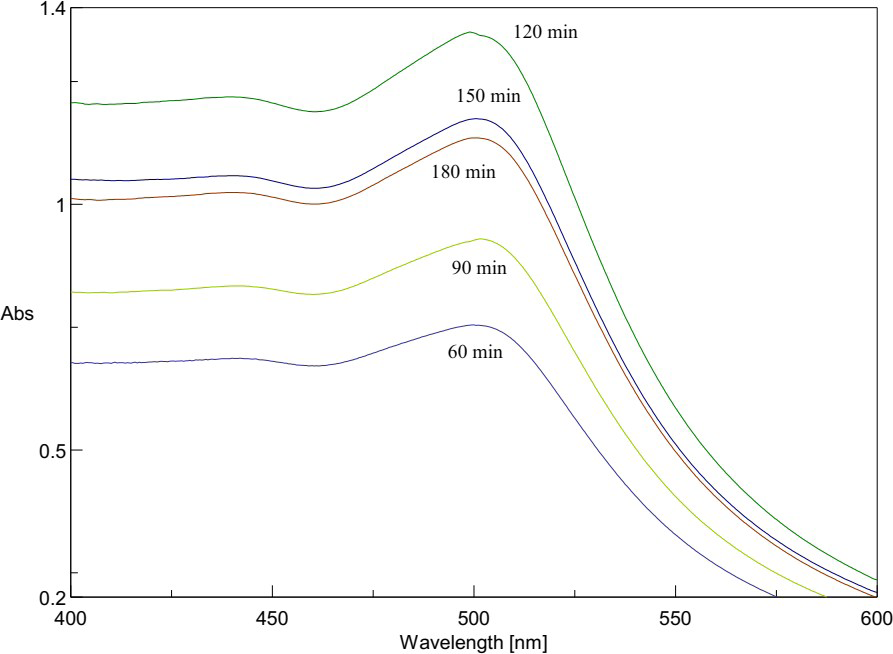
Effect of extraction temperature: The effect of temperature on the extraction process was investigated under the following conditions: 10 g of areca nut/100 mL of water, extraction time 120 minutes, pH 7. The extraction temperature changes: 70°C, 80°C, 90°C, 100°C. The effect of temperature on UV-V is spectrum and optical density of extracts is presented in Figure 3 and Table 3.
According to Figure 3 and Table 3, it was found that when increasing the extraction temperature, the extraction process increases, so the optical density increases and reaches the optimum at 90°C. However, when the temperature rises above 90°C, the extraction efficiency of colorants decreases. This may be because at high extraction temperature the structure of the colourant molecules is affected, thus reducing the optical density. Therefore, the optimal extraction temperature of colorants from areca nut is 90°C.
| Temperature (oC) | 70 | 80 | 90 | 100 |
|---|---|---|---|---|
| A | 1.15 | 1.35 | 1.48 | 1.25 |
Table 2: Effect of the extraction temperature on the value of optical density A at λmax of the extract.
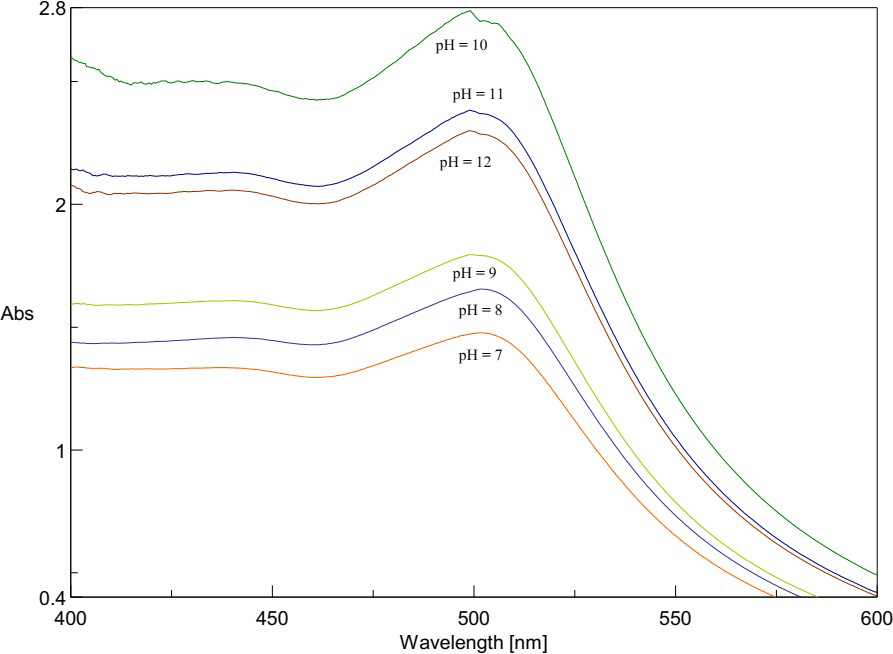
Effect of extraction medium pH: The effect of extraction medium pH on the extraction process was carried out in the following conditions: 10 g of areca nut/100 mL of water solvent, extraction time 120 minutes, extraction temperature 90°C. The medium pH varies from 7 to 12. The results of UV-V is spectroscopy and optical density A are presented in Figure 4 and Table 4.
| pH | 7 | 8 | 9 | 10 | 11 | 12 |
|---|---|---|---|---|---|---|
| A | 1.48 | 1.67 | 1.79 | 2.78 | 2.35 | 2.25 |
Table 4: Effect of extraction medium pH on the value of optical density A at λmax of the extract.
From Figure 4 and Table 4, it was found that when the pH of the extraction medium increased, the color separation efficiency from areca nut increased. The reason is that areca nut contains polyphenols as the main ingredient and these substances are easily soluble in alkaline medium, so the optical density of the extract increases with increasing pH and maximum at pH = 10. However, when the pH continues to increase, the optical density decreases; this may be too high pH has affected the structure of the pigment.
Thus, the optimum extraction conditions for colorants from areca nut such: The ratio of areca nut mass/solvent volume is 10 g/100 mL water, extraction temperature 90°C, extraction time 120 minutes, pH = 10. The obtained extract of areca nut is dark brown color.
Dyeing Silk Fabrics with Colorants Extracted from Areca Nut
The process of dyeing silk fabric with colorants extracted from areca nut is done by exhaust method. The dyed silk fabric sample is 10 cm x 10 cm in size. The ratio of fabric weight/volume of dye solution is 1/20. Factors affecting the dyeing process such as dyeing temperature, dyeing time were investigated.
Effect of dyeing temperature: The influence of dyeing temperature was carried out in the following conditions: dyeing time 60 minutes and dyeing temperatures from 50°C to 90°C. The results of measuring the chroma (C) of silk fabric samples at different dyeing temperatures are presented in Table 5.
| Temperature | 50oC | 60oC | 70oC | 80oC | 90oC |
|---|---|---|---|---|---|
| Chroma (C*) | 24.13 | 25.32 | 27.43 | 28.24 | 24.76 |
Table 5: The influence of dyeing temperature on the chroma of silk fabric.
Table 5 shows that temperature affects the chroma of fabrics when dyeing. When the temperature increases from 50°C to 80°C, the chroma of the fabric increases and reaches the highest at 80°C. The reason is that when the temperature increases, the structure of the silk fiber will open, and at the same time, the mobility of the color-carrying elements increases, so the pigment is easily attached to the fabric. However, the fabric chroma decreased when the dyeing temperature increased from 80°C to 90°C; This may be due to the fact that at too high temperature, the dye molecules move strongly and are not bonded to the surface of the material due to a decrease in affinity for the silk fiber, so the color is lighter. In addition, at too high temperature will not ensure the softness, good hygroscopicity of silk fabrics, leading to poor adhesion of colorants to the fabric. Therefore, the suitable dyeing temperature is 80°C.
Effect of dyeing time: The effect of dyeing time on the chroma of the fabric is carried out under the following conditions: dyeing temperature 80°C and dyeing time varies from 30 minutes to 150 minutes. The results of measuring the chroma of the fabric samples are presented in Table 6.
| Time (min) | 30 | 60 | 90 | 120 | 150 |
|---|---|---|---|---|---|
| Chroma (C*) | 25.55 | 28.24 | 36.24 | 34.52 | 28.78 |
Table 6: The influence of dyeing time on the chroma of silk fabric.
Table 6 shows that, as the dyeing time increases, the amount of colorants attached to the silk fiber increases and the chroma of fabric. However, if the dyeing time is longer, the chroma tends to decrease because the color carriers in the dyes have been oxidized into pigments. Thus, the optimal dyeing time is 90 minutes.
Thus, the conditions for dyeing silk fabrics with colorants extracted from areca nut are dyeing temperature of 80°C, dyeing time of 90 minutes.
After dyeing, silk fabric is mordanted in 5 g/L Al2(SO4)3
solution at 80°C for 60 minutes to increase color fastness. The role of Al2(SO4)3 salt is to form complexes with organic pigments and strongly bond with fabric fibers [18]. The color of silk fabric after dyeing and mordanting is reddish brown.
Scanning Electron Microscope (SEM) and X-ray Diffraction (XRD) Curves: Figure 5 shows the morphology of silk fabrics. The control silk fabric had a smooth and uniform appearance in portrait orientation. The surface of the dyed silk fabric was covered with colorants and became tough.
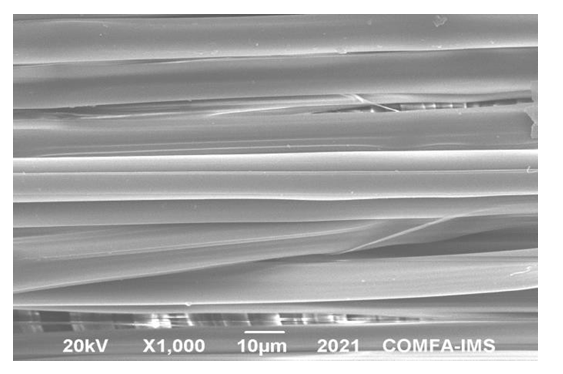
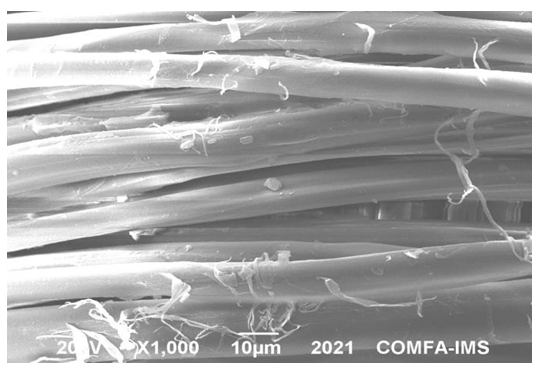
(a) (b) Figure 5: SEM images of (a) the control silk fabric, (b) silk fabric dyeing the extract of areca nut.
Figure 6 shows the XRD curves of the silk samples before and after dyeing.
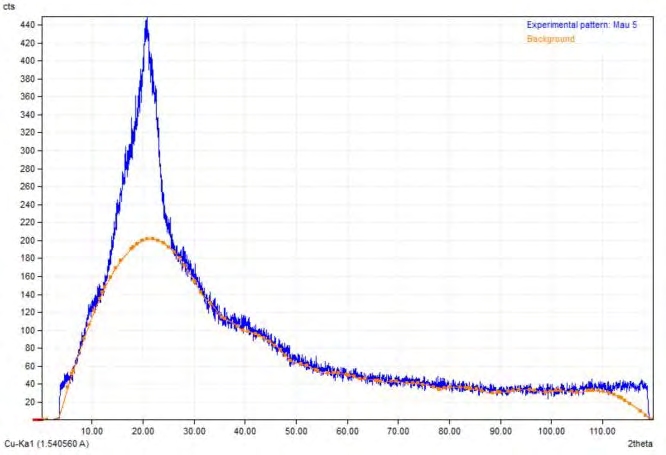
(a) (b) Figure 6: XRD curves of (a) the control silk fabric, (b) silk fabric dyeing the extract of areca nut.
It could be seen that control silk fabric and the dyeing silk fabric all exhibited a major X-ray diffraction peak at 20.5°, which is characteristic peak of silk with highly ordered β-structure [19]. The position and intensity of the major X-ray diffraction peak did not change regardless of the dyeing. That is to say, the dyeing has no effect on the crystalline region of silk fibers, and it is also reasonable to assume that the dyeing is not harsh and causes no damage to the crystalline region of silk fibers.
Color fastness test: Table 7 shows the fastness properties of the silk sample dyed with extracted dye.
| Washing fastness | Perspiration fastness | Rubbing fastness | ||
|---|---|---|---|---|
| 3-4 | Acidic | Alkali | Dry | Wet |
| 3-4 | 4 | 4-5 | 4-5 |
Table 7: Fastness properties for silk fabric dyed with areca nut extract.
These results are assessed in the usual way interms of the gray scale values for the staining of adjacent silk and cotton material. As can be seen, dyed silk fabric show a good rating to washing fastness, perspiration fastness, rubbing fastness and as a result of a good fixation of the dye in the fabric.
Analysis of formaldehyde and azo-amine compounds in dyed silk fabric: Analysis results showed that formaldehyde and azo-maine compounds were not detected in silk fabric dyed with areca nut extract and the dyed silk fabric can be considered eco-friendly.
Conclusion
- The optimal conditions for the extraction of colorants from areca nut: The ratio of areca nut mass/water solvent volume is 10 g/100 mL, extraction temperature 90°C, extraction time 120 minutes, pH = 10.
- The optimum parameters of the dyeing process are as follows: Dyeing temperature 80°C, dyeing time 90 minutes, mordanting in 5g/L Al2(SO4)3 solution.
Silk fabric dyed with areca nut extract has reddish brown color and color fastness to washing, perspiration and rubbing. There are no formaldehyde and azo-amine compounds in dye silk fabric. This result shows that it is possible to use colorants extracted from areca nut to dye silk fabrics to replace synthetic colorants and create silk fabrics that are completely environmentally friendly and safe for users.
References
-
Sudha M, Saranya A, Selvakumar G, Sivakumar N (2014) Microbial degradation of azo dyes: a review. Int J Curr Microbial Appli Sci 3(2): 670-690.
-
Panesar R, Kaur S, Panesar P (2015) Production of microbial pigments utilizing agro-industrial waste: A review. Curr Opin Food Sci 1: 70-76.
-
Pervaiz S, Mughal T, Khan Z, Najeebullah M (2016) Extraction of natural dye from Rosa damascena miller: A cost effective approach for leather industry. Inter Network for Natural Sci 8(6): 83-92.
-
Debasish D, Sankar RM, Subhash CB (2007) Dyeing of wool and silk with Bixa orellana. Indian Journal of Fiber & Textile Research 32: 366-372.
-
Suitcharit C, Awae F, Sengmama W (2010) Effect of Chitosan’s Molecular Weights on Mangosteen dye Fixation on Cotton Fabric. Journal of Mels Materials and Minerals 20(1): 27-31.
-
Supaluk Teppanrin, Porntip Sae-be (2012) Dyeing of Cotton, Bombyx Mori and Silk Fabrics with the Natural Dye Extracted from tamarind Seed. International Journal of Biochemistry and Bioinformatics 2(3): 159-163.
-
Redwan Jihad (2014) Dyeing of Silk Using Natural Dyes Extracted From Local Plants. International Journal of Scientific & Engineering Research 5(11): 809-818.
-
Suk-Yuk Jung, Su-Youn Park (2014) Comparison of staining by Sophora japonica L. and Phellodendron amurense Ruprecht. Advanced Science and Technology Letters 56: 22-25.
-
Mohammad Gias Uddin (2015) Extraction of eco-friendly natural dyes from mango leaves and their application on silk fabric. Textiles and Clothing Sustainability, pp: 1-7.
-
Ashis Kumar Samanta (2016) Dyeing of Textiles with Natural Dyes, University of Calcutta, pp: 3-55.
-
Adisak Jitphusa, Tanwalai Rattanankij (2016) Process of dyeing Chinese silk fabric using color of water betel nuts. Journal of Thai Interdisciplinary Research 11(6): 20- 26.
-
Hemalatha Jain, Vasantha M (2016) Ecofriendly dyeing with natural mordants and increasing the antibacteride activity. Archives of Applied Science Research 8(8):1-7.
-
Shristi Purwar (2016) Application of natural dye on synthetic fabrics: A review. International Journal of Home Science 26(2): 283-287.
-
Abraham K, Musa A, Emmy K (2017) Towards technical development of natural dyes for the textile industry in Kenya: A case stydy of Bixa Orellana solvent extracts. African Journal of Education, Science and Technology 4(2): 216-233.
-
Teklemedhin TB, Gopalakrishnan LH (2018) Environmental friendly dyeing of silk fabric with natural dye extracted from Cassia singueana plant. J Textile Sci Eng S3: 001.
-
Vicente A Hermandez (2018) A Note on the Dyeing of Wool Fabrics Using Natural Dyes Extracted from Rotten Wood-Inhabiting Fungi. Coatings Journal 8(77): 1-6.
-
Pratap Singh P, Sharma D, Chatterjee S (2020) Application of Acacia Catechu Natural Dye on Banana Fiber. Ergonomics International Journal 4(1): 000229.
-
Ashis Kunar Samantra, Adwaita Konar (2011) Dyeing of textiles with natural dyes. Intech Open, pp: 29-56.
-
Manickam P, Thilagavathi G (2015) A natural fungal extract for improving dyeability and antibacterial activity of silk fabric. J Ind Text 44(5): 769-780.
- The Expanding Landscape of Road Rage: A Systematic Review of Conflicts Involving Drivers, Pedestrians, and Micromobility
- Validating Cognitive Models of Royal Navy Performance on Control Systems
- Comparing Standard and State-of-the-art Firefighter Coats on Postural Balance and Gait in a Live Burn Environment
- Investigating the Integration of Telemedicine into Clinicians Workflow: A Review of Methods
- Risk Assessment of Ergonomic Factors in a Textile Firm by RULA, REBA and Fine Kinney Methods
- Impact of Self-Esteem Training on Individuals with Disabilities Aged 17-30