
Ergonomics Workspace Design for Work from Home (WFH) during COVID-19 Pandemic Using CATIA V5
The Covid-19 pandemic has resulted in enforced scenario of working from home; Most of the IT professional’s corporate office employees are working from home. Therefore, the present study is an attempt for designing office for work from home (WFH). In this study ergonomic analysis of IT based working Professional performed in which a Model created using CATIA V5. The model reveals effects of bad postural working conditions on human body. The results also revealed that mismatch between awkward postures and anthropometric parameters contributed to musculoskeletal disorder. It is necessary to obtain the relevant information or data on task performance, equipment, working posture and environment. Too high workplace results in cramp in shoulder of worker whereas too low workplace may result in backache, therefore, may results in reduced performance. Also as the operator is a highly paid skilled employee, the reduction in performance that can lead to economic consequences for the employer organizations. Therefore, the present study assumes its significance in the pandemic scenario.
Introduction and Background
Ergonomics is the application of scientific principles, methods, and data drawn from a variety of disciplines to the development of the engineering systems in which people play a significant role. Among the basic disciplines are psychology, cognitive science, physiology, biomechanics, applied physical anthropometry, and industrial systems engineering. The engineering systems to be developed range from the use of a simple tool by a consumer to a multi-person, sociotechnical systems. In principle, ergonomics is the study of people and their work. Objective of the ergonomics is to optimally match workforce and the work environment to human being.
A lack of rigor ergonomics studies has been reported by Heacock, et al. (1997), who compiled a checklist that is useful both for planning experiment and for assessing past studies. Investigations of, and experiment with, human being and their performance must be carefully planned, executed, evaluated, and reported in order to test a theory or, more often, a hypothesis. The usual approach is to state a hypothesis and then determine whether it is true or false based on the experimental result. Testing is commonly done in term of the null hypothesis. There is no difference between the outcomes of the test. Whether the null hypothesis is rejected or not is determined by statistical evaluation of the experimental data. Weimer (1995) discussed, in a down- to-earth manner, how to develop and carry out a research project. This is also a topic of many more theoretical treatises on methodological and statistical aspects in human-factors research. Through guide to the design of experiments and the analysis, the result has been compiled by Williges (1995) and Han, et al. (1997), with the latter dealing with complex studies with multiple variables. A major aspect of their discussion is how to control individual differences among the subjects who participate in experiments [1, 2, 3, 4].
Methodology
RULA Analysis
RULA (Rapid Upper Limb Assessment) is a survey method developed for use in ergonomics investigations of workplaces where work-related upper limb disorders are reported. This tool requires no special equipment in providing a quick assessment of the postures of the neck, trunk and upper limbs along with muscle function and the external loads experienced by the body. A coding system is used to generate an action list which indicates the level of intervention required to reduce the risks of injury due to physical loading on the operator. It is of particular assistance in fulfilling the assessment requirements of both the European Community Directive (90/270/EEC) on the minimum safety and health requirements for work with display screen equipment and the UK Guidelines on the prevention of work-related upper limb disorders. RULA was developed to investigate the exposure of individual workers to risk factors associated with work related upper limb disorders. Part of the development took place in the garment-making industry, where assessment was made of operators who performed tasks including cutting while standing at a cutting block, machining using one of a variety of sewing machines, clipping, inspection operations, and packing. RULA was also developed through the evaluation of the postures adopted, forces required and muscle actions. RULA was developed without the need for special equipment. This provided the opportunity for a number of investigators to be trained in doing the assessments without additional equipment expenditure. As the investigator only requires a clipboard and pen, RULA assessments can be done in confined workplaces without disruption to the workforce. Those who are trained to use it do not need previous skills in observation techniques although this would be an advantage [5, 6, 7, 8].
Ergonomics Analysis in CATIA V5R16
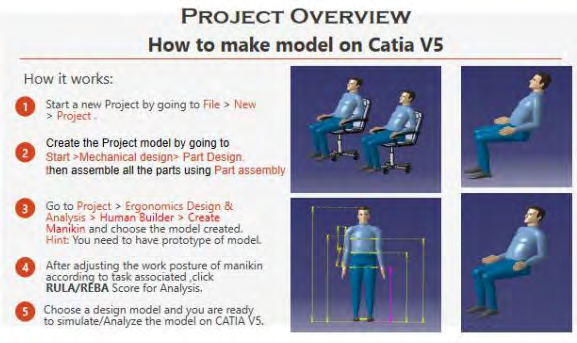
CATIA V5R16 was included with Ergonomics Design and Analysis (EDA) module. By implementing and using the ergonomics facilities, a CAT Product in CATIA is generated. The ergonomics design processes are defined by four sub modules which are: i. Human Builder, ii. Human Measurements Editor, iii. Human Posture Analysis, iv. Human Activity Analysis. Design Sketching has proved to be the fastest way to define problem, explore ideas and develop. Sketch generally the meaning of a rough or unfinished drawing, and the activity to sketch for general outline of something. Benefit of sketching is that the mere acts of formulating a mental image in a concrete way possible for designer to reflect over the concept at once. Sketching is valuable activities such as brainstorming and concept evaluation. Detail of design detailed design is the process of developing a fully defined design from a clear set of requirement while creating deliverables and documentation appropriation. In this project, CATIA (Computer Aided Three Dimensional Interactive Application) is use for the proper drawing (Figure 1).
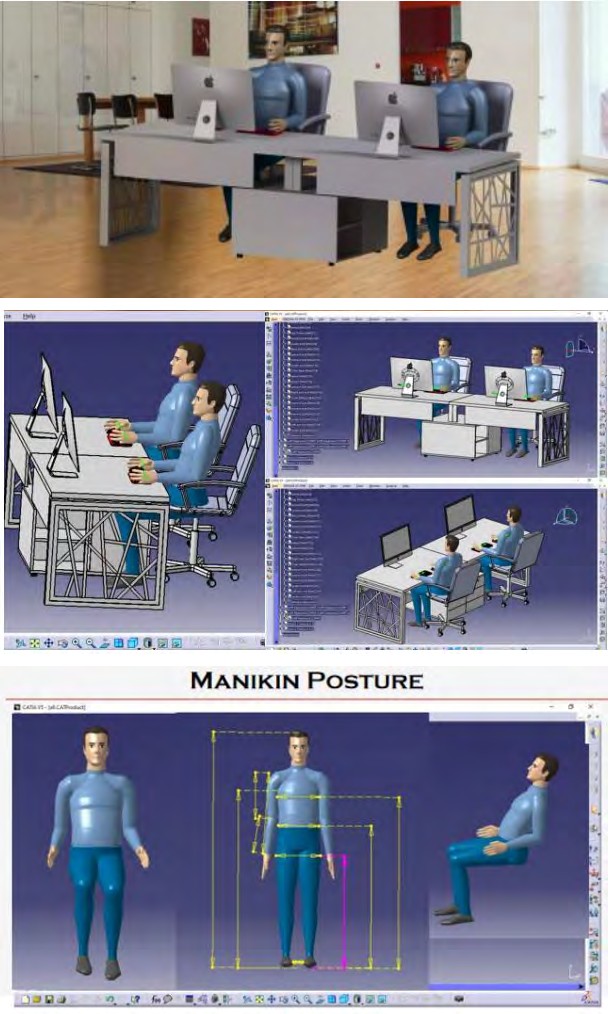
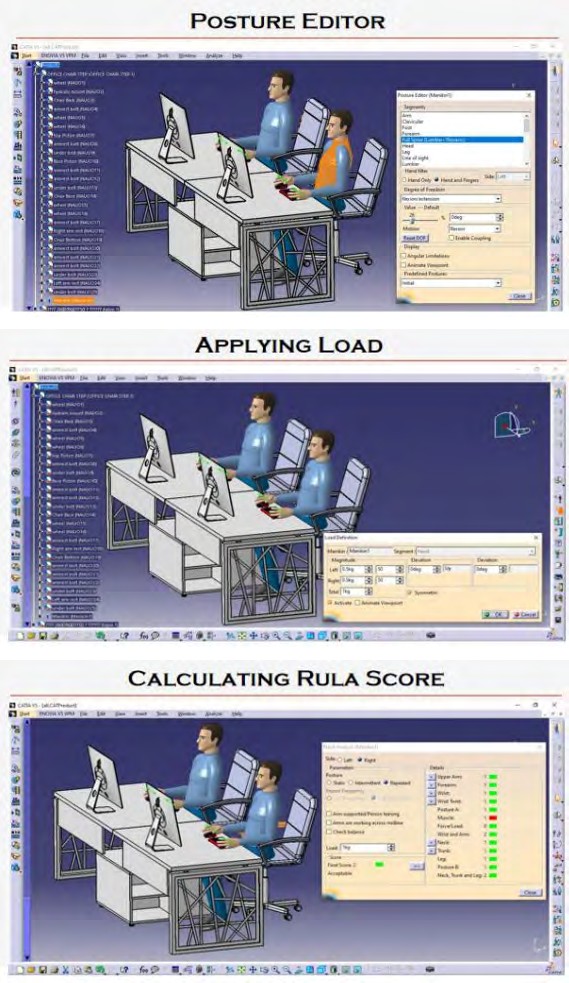
Design analysis had used for every type of design development and research effort imaginable. Design analysis can elucidate a wide range of development problems. In this research, RULA analysis was used for the analysis. These RULA analysis descriptions have been mention at the beginning of this research (Figure 2).
Result and Conclusion
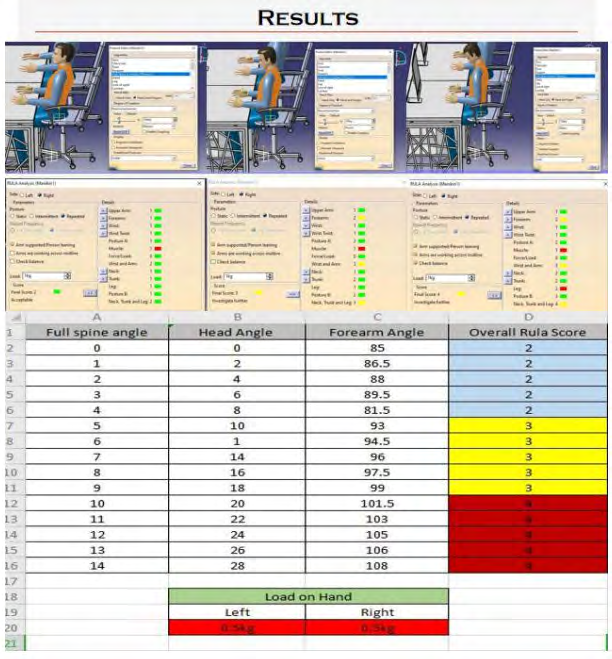
The results of the analysis reveals that overall RULA score varies from 2-4 with varying range of angles of spine, neck and forearm. The trunk angles more (>10 degree) along with neck (>20 Degree) and fore arm (>100 Degree) generates RULA score in range of 4 which is indicator of mild risk of MSDs and need further investigation. However, otherwise prior to the design using CATIA Model, the further increase in posture angles of the respective body parts would have further deteriorated the overall posture and results in higher range of overall RUL Scores. Therefore, it is concluded that the proposed model is suitable for designing the safe work place for WFH.
References
-
David G, Woods V, Buckle P, Stubbs D (2003) Further development of the Quick Exposure Check (QEC). In: Ergonomics in the Digital Age. Proceedings of the XV Triennial Congress of the International Ergonomics Association, Seoul, Korea.
-
Goonetilleke RS Ho, Edmond CF, So RHY (1997) Foot Anthropometry in Hong Kong. Proceedings of the ASEAN 97 Conference, Kuala Lumpur, Malaysia, pp: 81-88.
-
Kilbom A (1994) Repetitive work of the upper extremity: Part I - Guidelines for the practitioner. International Journal of Industrial Ergonomics 14(1-2): 51-57.
-
Kilbom A (1994) Repetitive work of the upper extremity: Part II-The scientific basis (knowledge base) for the guide. International Journal of Industrial Ergonomics 14(1-2): 59- 86.
-
Kroemer KHE, Kroemer HB, Kroemer-Elbert KE (2001) Ergonomics: How to Design for Ease and Efficiency, 2nd (Edn.), Prentice Hall, New Jersey.
-
McAtamney L, Corlett EN (1993) RULA: a survey method for the investigation of work-related upper limb disorders. Applied Ergonomics 24(2): 91-99.
-
McAtamney L, Corlett EN (2004) Rapid Upper Limb Assessment (RULA). In: Stanton N, (Ed.), Handbook of Human Factors and Ergonomics Methods, Boca Raton, FL, pp: 1-11.
-
(2004) Design Tips and Information – Safety/ Ergonomics, Race Car.
- The Expanding Landscape of Road Rage: A Systematic Review of Conflicts Involving Drivers, Pedestrians, and Micromobility
- Validating Cognitive Models of Royal Navy Performance on Control Systems
- Comparing Standard and State-of-the-art Firefighter Coats on Postural Balance and Gait in a Live Burn Environment
- Investigating the Integration of Telemedicine into Clinicians Workflow: A Review of Methods
- Risk Assessment of Ergonomic Factors in a Textile Firm by RULA, REBA and Fine Kinney Methods
- Impact of Self-Esteem Training on Individuals with Disabilities Aged 17-30