
Bioclimate in Built Environment
The bioclimatic aspects are associated with building environmental performance that makes a building help minimum impact on the environment, attention to human health and safety, minimum energy consumption. The ergonomic design of buildings contributes to maintaining the bioclimatic aspects of the buildings. The study reflects building structure and materials used depend on occupant choices, lifestyle, and economic viability. Therefore, the low-cost mud houses of the coastal regions often follow local practices. The dwelling pattern (two adjacent rooms opening to the corridor) was more prevalent in rural and semiurban areas. The housing exteriors are typical rural locales, commonly comprising agricultural fields, vegetation areas, and ponds. The statistical analysis covering different bioclimatic components, such as transportation availabilities, surrounding environment, and building structure, indicated a significant difference among remote rural, rural and semi-urban residences. The climatic conditions of the four village blocks covered in the study were hot and humid. The component structures provided a basis to explore further the possible influence of additional passive design options in constructing dwellings in coastal rural and semi-urban areas and enhancing thermal comfort. Selective passive design solutions indicate improvements in yearly total thermal comfort hours. Given the viability of poor residents in coastal rural and semi-urban areas, introducing interventions like passive solar direct gain, high thermal mass, night flush, natural and fan-forced ventilation, and evaporative cooling can improve the extent of ~18% in yearly thermal comfort hours. An overall bioclimatic analysis of the rural and semiurban coastal dwellings suggests that some passive design strategies can substantially enhance the thermal comfort of the inhabitants.
Highlight
- Structure of rural and semi-urban dwellings
- Suitable passive design strategies of the hot and humid climatic region
- Application of bioclimatic design strategies in rural and semi-urban settings
Introduction
India is the third-highest energy consumer after the USA and China. India’s contribution to energy consumption amounts to 5.6% of the global share (BP Statistical review of world energy, 2018) [1], covering sectors like industrial, transportation, agriculture, and buildings. Increasing
urbanisation brings in a dramatic increase in residential and commercial buildings [2]. Building energy consumption relates to a substantial environmental impact, including climate change [3]. The residential sector in India contributes nearly 22% of the total energy consumption. The buildings’ energy consumption in residential sectors is projected to grow eight times by 2050 compared to 2012 emitting seven times more greenhouse gas by 2050 than 2005 [4].
Nearly 70% of India’s populations live in the rural area. The rural territories extensively depend on conventional energy sources for their household core. The predominance of low-cost settings (kaccha and mud house) in rural India make the scenario unique to evaluate the characteristics of rural housing. Low-cost dwellings bring various environmental concerns like harmful gas (GHGs) emissions from conventional burning fuels, congested room structures and cattle sheds. Analyzing and designing dwellings on bioclimatic aspects (i.e., eco-friendliness, human-friendliness and energy-friendliness) aims to reduce the environment’s impact, enhance human health, comfort, safety, and reduce energy consumption [5, 6]. The bioclimatic approach also minimises building energy demands, improve comfort and energy efficiency using appropriate passive design strategies [2, 5]. The bioclimatic design combines “biology” and “climate” to build and landscape design based on microclimate. The tec7hniques include natural ventilation, sun shading, solar heating, and building materials for thermal storage [7]. Moreover, the bioclimatic approach adopts passive design strategies to create a comfortable occupant condition [5, 8, 9]. In addition, ergonomics of the built environment are associated with design that helps improve human performance and the well-being of the residents in the buildings [10]. The essential elements of the ergonomics design are the linkage of human, system, environment and task. In addition, ergonomics-aided architectural design that addresses interactions between humans, buildings, and their environment. Furthermore, this approach addressed guidance for designers to generate human- centred environment-friendly designs [11]. Therefore, both the bioclimatic and ergonomics aspects of the buildings are addressed to improve the resident’s performance, well- being, and comfort.
The research emphasizes that the passive design technique, associated with minimising building energy demand, increases the occupants’ thermal comfort [2, 12, 13]. Nag PK [5] reported that implementation of bioclimatic design in the building associated with site and location (green area, watershed, transportation facilities), interior design (zoning and space arrangement), exterior design (exterior wall and roof) of the buildings. In addition, Researchers [6, 14, 15] illustrated that climate and surrounding environment, operation and maintenance management, construction methods are the elements to consider the analysis of bioclimatic aspects. Furthermore, a study Attaianese [10] reported the building ergonomics approach associated with the design of physical space as environmental support for users’ performance and comfort in a sustainable way.
The characteristics of rural and semi-urban housing in the coastal regions of eastern India is linear and scattered settlements with low height structures. The clusters of houses are practically heat islands due to the trapping of short wave and longwave radiation in and around the households, anthropogenic heat produced from the combustion of fuel, reduced evapotranspiration and poor indoor environmental quality. This study primarily focuses on examining the above stated bioclimatic design components of the dwellings in rural and semi-urban coastal settings.
Methods and Materials
The study is associated with examining bioclimatic strategies based on the surrounding environment, interior and exterior design of rural and semi-urban dwellings of the coastal region of West Bengal in eastern India. South 24 Parganas district was selected for the primary survey. The selected area has ~10 million population, spread over 29 blocks of remote rural, rural, and semi-urban settings. The remote rural is where people depend on bicycles, motor van and boats, public transport facilities (bus and railway) are unavailable. The areas are deprived of public hospital systems and modern educational systems (school and college). The area is considered rural, where public transportation facilities (bus stands) are an available and regular supply of potable water. In addition, the road conditions good (concrete), block hospitals and educational facilities are relatively good in rural areas. Semi-urban areas have outstanding transportation facilities, communication facilities, educational institutes, advanced hospitals and nursing homes, supply of potable water.
A questionnaire survey covered interviewing 1332 villagers from randomly chosen fifteen villages of 4 blocks. Human volunteers gave their ethical consent in participating in the questionnaire survey. The questionnaire survey associated with various bioclimatic aspects of rural and semi-urban households includes transportation availabilities, surroundings environment (plants, water body and landscape elements), building design (orientation, form, envelope, ventilation opening, sun shading, and window), building materials. The selected variables primarily correspond to various building rating systems (e.g. LEED) to evaluate the environmental performance of the rural and semi-urban dwellings. The study took a quantitative approach to evaluate the bioclimatic aspects, with the requirement of human health, comfort, safety, and architectural solution [5]. The residents responded to the questionnaire entries by a single-digit score on a five-point common Likert scale [16], referred to as strong disagreement (1) to a strong agreement (5) to a defined requirement and condition. The statistical analysis (ANOVA) was considered to compare various bioclimatic designs among the remote rural, rural, and semi-urban communities. The climatic data such as ambient temperature, humidity, wind speed were collected during the field study and secondary sources, e.g., the NASA and Weather Spark website. The dwellings’ bioclimatic analysis and suitable passive design were done using the Climate Consultant 6.0 software [17, 18, 19].
Results
Dwellings Structure and Ergonomics
Bioclimatic design strategies make a buildings minimum impact on the environment (eco-friendliness); attention to human health, comfort and safety (human-friendliness); minimum energy consumption of building premises (energy- friendliness) [5]. On the other hand, the application of suitable ergonomic design on building associates with improving user performance, health and well-being, and comfort in a sustainable way [10, 20]. Therefore, the bioclimatic and ergonomic designs simultaneously improve the user thermal comfort, well-being, buildings indoor environmental quality etc. (Figure 1).
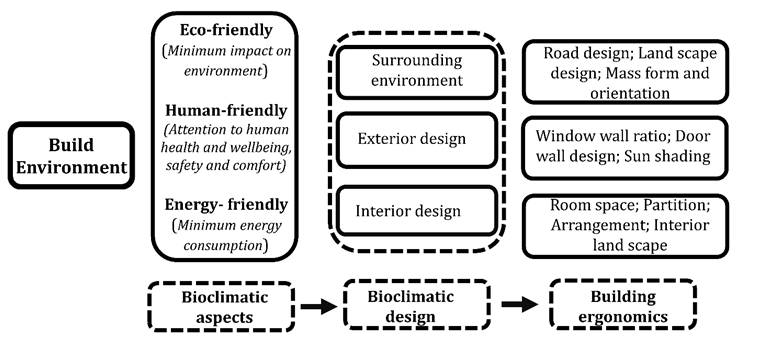
Various bioclimatic design strategies are also applied in the low-cost rural and semi-urban dwellings. The housing features in the selected villages differ in bioclimatic approaches among the areas, based on the surrounding areas, exterior and interior design (Figure 2). Maximum house settlements are isolated in remote rural areas, whereas houses in rural and semi-urban areas are rectangular and linear low-rise settlements. The characteristics of maximum rural and semi-urban settings are that two bedrooms were situated alongside and a corridor located on two sides of the dwellings (front and left side). In remote rural areas, most of the buildings have two bedrooms (one in the middle portion and another on the right side) and a corridor located partially at the front and right side of the built structure. The approximate surface area of the built structure ranges from 49 to 78 sqm. The dwellings in remote rural and rural areas primarily used clay or mud for floors and walls, whereas, in the semi-urban area, the floor is cement or concrete layered (Pukka). Tiles are used as roof materials in remote rural and rural areas. Most semi-urban buildings have concrete layered roof materials. The farmhouse, cattle sheds, and toilets were utterly away from housing units.
The exterior design of the dwellings includes the surrounding green areas, water bodies (pond), road and infrastructure constructions. The big trees, agricultural fields are abundantly present in the selected rural areas. Green areas help to wind flow and sunlight penetration. In the remote rural areas, big trees were close to the windows. Trees planted at a distance of 15 to 20 feet from the windows were found in the rural and semi-urban areas.
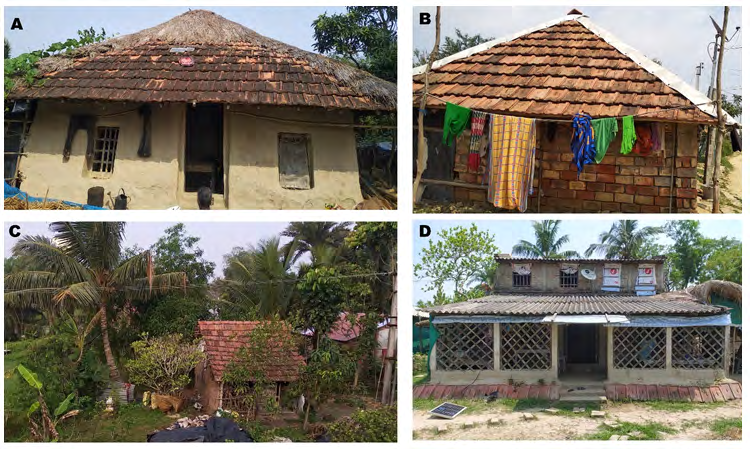
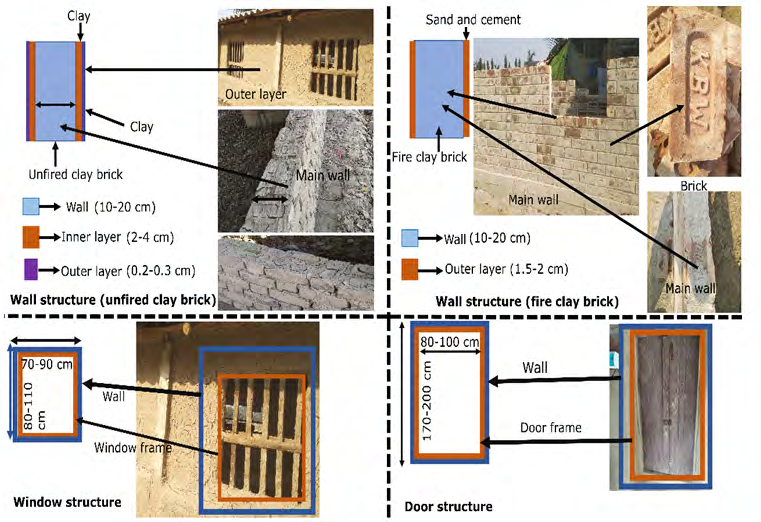
The kitchen is an essential part of housing units, and it influences indoor environmental conditions, including ambient temperature, air quality. However, the structure of kitchens is different in rural and semi-urban dwellings. The maximum number of dwellings had kitchens attached to the house in remote rural and semi-urban locales. Whereas the kitchens were at separate house locations in rural settings. Windows are another essential component of the interior design of a dwelling that helps natural ventilation, indoor wind circulation and controls ambient temperature [5]. Most of the buildings had two windows on the adjacent wall in semi-urban, rural, and remote rural dwellings. Moreover, roofs structure determine heat absorption and reflection. The hipped roofs were present in most remote rural and rural, and the flat roof was in semi-urban dwellings. Various bioclimatic components structures (wall, door, window) are depicted in Figure 3. In addition, Table 1 embodies economic condition, materials availability, the lifestyle of residents that influence the dwelling design and pattern.
The study considered transportation availability, surrounding environment, and house pattern regarding the site and location. The transportation facility is a part of the exterior design. The maximum number of houses in remote rural and rural areas had bicycle stand, green vehicle stand, and motor van stand at close vicinity. The semi-urban areas had the most kinds of transport facilities.
| Village farmer | Commercial farmer | Fisherman | Government service | Businessman | |
|---|---|---|---|---|---|
| Agriculture practices | Traditional | Modern | Traditional | Traditional/ modern | Traditional/ modern |
| Income | Low | Medium, high | Low, medium | High, very high | Medium, high |
| Type of building | Kacha or semi pukka | Semi pukka or pukka | Kacha or semi pukka | Semi pukka or pukka | Pukka or semi pukka |
| Settlement | Cluster | Isolated | Cluster | Isolated or cluster | Isolated or cluster |
| Building design | Traditional | Traditional or modern | Traditional | Modern | Modern or traditional |
| Building material | Local materials | Local and few industrial | Local materials | Industrial, few local materials | Industrial, few local materials |
| Building envelope | Bad | Medium or good | Bad | Good or very good | Medium or good |
Table 1: Bioclimatic and building ergonomics design parameters in different areas.
The numbers given in Table 2 are non-dimensional units of the relative five-point scale values, as described in the methods and materials. One-way analysis of variance (ANOVA) indicated a significant difference among the parameters (transportation availabilities, surrounding environment, dwellings design) among the dwellings of the remote rural, rural and semi-urban communities.
| Remote Rural (N=514) | Rural (N=473) | Semi-urban (N=345) | ANOVA F Values (df=2, 1329) | |
|---|---|---|---|---|
| Transportation Availability | ||||
| Bicycle stand | 3.7 (±1.0) | 3.5(±1.0) | 3.3(±.9) | 20.1 (p<0.001) |
| Bus | 1.7(±.9) | 2.5(±1.5) | 3.6(±.6) | 313.2 (p<0.001) |
| Railway station | 1(±0.0) | 1.7 (±.9) | 3.3(±.7) | 1321.7 (p<0.001) |
| Surrounding Environment | ||||
| Watershed | 2.3(±.7) | 2.3(±.5) | 2.2(±.5) | 0.99 (NS*) |
| Plantation or Vegetation | 4.6(±.7) | 4.3(±1.0) | 4.5(±.9) | 13.6 (p<0.001) |
| Dwellings Pattern | ||||
| Building pattern | 3.8(±.8) | 3.7(±.6) | 3.5(±.7) | 16.6 (p<0.001) |
| Windows | 3.4(±1.2) | 3.2(±1.5) | 3.3(±1.3) | 1.3 (NS*) |
| Roof structure | 4(±1.5) | 3.6(±1.6) | 3(±1.6) | 43.4 (p<0.001) |
| Kitchen | 2.4(±1.5) | 3.3(±1.4) | 2.8(±1.5) | 45.8 (p<0.001) |
| Floor materials | 1.6(±1.2) | 1.8(±1.3) | 2.7(±1.6) | 73.8 (p<0.001) |
| Roof materilas | 3.5(±1.0) | 3.2(±1.1) | 2.9(±1.0) | 34.8 (p<0.001) |
| Wall materials | 1.3(±0.06) | 1.5(±0.07) | 1.2(±0.06) | 38.6 (p<0.001) |
| Insulation | 2.3(±0.8) | 3.2(±1.2) | 2.7(±0.9) | 101.4 (p<0.001) |
| Building envelope | 2.6(±1.0) | 3.5(±1.1) | 2.9(±1.2) | 77.9 (p<0.001) |
| Values (means ± SD) are non-dimensional units of the relative five-point scale; NS*= not statistically significant. | ||||
Table 2: Bioclimatic and building ergonomics design parameters in different areas.
Passive Design Strategies
A particular area’s suitable passive design strategies are based on surrounding climate, including ambient, humidity, wind speed, etc. [17, 21]. The Climate Consultant 6.0 software is an important tool to evaluate bioclimate design strategies in specific climatic regions [17, 19]. The climatic conditions influence bioclimatic strategies in the dwelling’s design and practices in coastal rural and semi-urban areas. The climatic condition of the four coastal blocks selected in the present study is considered hot and humid. During the summer sessions (March to June), the average ambient temperature exceeds 320C and rarely above 370C. The average ambient temperatures during the winter months (mid-December to mid-February) remain below 260C. The relative humidity increased up to 85% and rarely above 93% and below 45%. The wind speed in the areas ranges from 5-8 m/s from May to September and about 2-4 m/s from October to April.
The adjacent district to the study area is Kolkata (22.650N, 88.450E), and the climate of Kolkata closely corresponds to the study area. The meteorological data at the geospatial coordinate (Kolkata district) were utilized to identify the bioclimatic characteristics of the dwellings of the study region. The data were gathered from EnergyPlus [22] using Climate Consultant software 6.0. The software was helpful to evaluate bioclimate strategies in a specific climatic zone [17, 18]. The climate data (temperature, humidity, wind speed) and passive design solutions were plotted in the Psychrometric Chart provided by ASHRAE 2005 [23, 24], thereby identifying comfort conditions in a hot and humid region. The residents of low-cost rural and semi- urban coastal areas, only ~7.4% of yearly thermal comfort hours can be achieved in the dwellings without any passive design strategies. In addition, passive design (Table 3) in constructing the houses can improve total thermal comfort hours yearly. The cooling and dehumidification strategy is a massive contribution to the rise of thermal comfort hours in buildings; however, the strategy may not be suitable for the selected local communities.
| Comfortable hours achieved (%) | |
|---|---|
| Comfort (without any passive design) | 7.4 (644 hrs) |
| Sun shading of windows | 25.5 (2236 hrs) |
| Passive solar direct gain high mass | 6.2 (545 hrs) |
| High thermal mass | 2.0 (173 hrs) |
| High thermal mass night flushed | 2.3 (205 hrs) |
| Direct evaporative cooling | 2.0 (178 hrs) |
| Two stages evaporative cooling | 2.3 (205 hrs) |
| Fan forced ventilation cooling | 1.5 (129 hrs) |
| Natural ventilation cooling | 0.7 (58 hrs) |
| Passive solar direct gain low mass | 0.4 (34 hrs) |
Table 3: Suitable passive design strategies of hot and humid climatic regions (passive design strategies and its contributing com
Discussion
The study evaluated bioclimatic components, such as the surrounding environment and dwellings’ interior and exterior layout in rural and semi-urban coastal settings. The bioclimatic strategies consideration in residences designing includes ecologic regeneration, local resources, renewable energy, and enhanced passive systems of the micro-environment [5, 15, 17]. These strategies can improve occupants’ comfort, health, and well-being and building a life cycle and infrastructure in a sustainable way [17]. In the context that the coastal regions of eastern India are tornado and flood-prone, the low-cost rural and semi-urban housings are distinctive in terms of low height settlements. Applying ergonomic design (surrounding environment, interior and exterior) on the building construction might maintain the building eco-friendliness, human-friendliness, energy-friendliness [20]. Building structure and materials used depend on occupant choices, lifestyle, and economic condition. Therefore, the low-cost mud houses of the coastal regions often follow local practices. The dwelling pattern (two adjacent rooms opening to the corridor) was more prevalent in rural and semi-urban areas. The housing exteriors are typical rural locales, commonly comprising agricultural fields, vegetation areas, and ponds. The abundant garden and green areas in the remote rural and rural areas contribute to the environment comfortably sunny and windy. The statistical analysis covering different bioclimatic components (such as transportation availabilities, surrounding environment, and building structure) indicated a significant difference among remote rural, rural and semi-urban communities.
The climatic conditions of the four village blocks covered in the study were hot and humid. These component structures provided a basis to explore further the possible influence of additional passive design options in constructing dwellings in coastal rural areas and enhancing thermal comfort. Selective passive design solutions (Table 3) indicate improvements in yearly total thermal comfort hours. Given the viability of poor residents in coastal rural areas, introducing interventions like passive solar direct gain, high thermal mass, night flush, natural and fan-forced ventilation, and evaporative cooling can improve the extent of ~18% in yearly thermal comfort hours. Structural changes to the house by sun shading of windows may contribute substantially to thermal comfort hours. Sun shading windows and corridors and planting trees outside the windows control direct sunlight penetration. The window opening and extended narrow corridors adjacent to windows help maximize cross-ventilation. The eco-friendly materials (such as mud, wood, paddy straw) used for the roof, room partition and envelope have optimal thermal inertia values to limit overheating the residence [5, 6, 25].
The dwellings of the hot and humid climate regions can include passive design strategies (as per Climate Consultant 6.0). These are as follows:
- Use lightweight construction with shaded outdoor porches raised above the ground;
- Window overhangs or operable sunshades to eliminate the need for air conditioning, which is not viable in rural communities;
- Use high ceilings and tall operable windows protected by deep overhangs and verandahs;
- Minimize west-facing glazing to minimise summer and fall afternoon heat gain;
- Use plant materials, especially on the west, to reduce heat gain;
- Extended narrow building floorplan that maximizes cross-ventilation in hot and humid climates;
- Natural ventilation helps to reduce or eliminate air conditioning in warm weather if windows are well shaded and oriented to prevailing breezes;
- Use light-coloured building materials and cool roofs to reduce conducted heat gain;
- In the moist soil, raise the building high above the ground to minimise dampness and enhance the natural ventilation of the building.
An overall bioclimatic analysis of the rural and semi-urban coastal dwellings suggests that some passive design interventions can substantially enhance the thermal comfort of the inhabitants. Health and safety and infrastructure sustainability are distinctive apparent priorities for low-cost interventions in the coastal regions prone to natural disasters at regular frequencies.
Conclusion
The bioclimatic design strategies addressed to make a built environment in the coastal regions of eastern India. It intends to apply the strategy to (a) minimize the impact on the environment, (b) attention to occupant’s health, safety and comfort, and (c) enhance energy efficiency. The study evaluates bioclimatic components (such as surrounding areas, interior and exterior houses) in rural and semi-urban coastal settings. The consideration includes ecologic regeneration, water and local resources, renewable energy, and enhanced passive microenvironment systems. An overall bioclimatic analysis of the dwellings in remote rural, rural and semi-urban settings suggests that selective application of passive design interventions can enhance the thermal comfort of the inhabitants. The study was limited to the coastal settings of West Bengal (India). However, the conceptual perspectives might vary in different communities and regions. The research may further be extended to assessing the strategies of different building sectors like commercial buildings, office buildings, educational institutes and industrial buildings.
Acknowledgement
The authors appreciatively acknowledge the kind permission of the Vice-Chancellor of the University in undertaking the study. Partial financial support of the Government of West Bengal (India) under Swami Vivekananda Merit cum Means Scholarship is gratefully acknowledged.
References
-
(2018) BP Statistical Review of World Energy, London, 67th (Edn.), British Petroleum Company.
-
Bhamare DK, Rathod MK, Banerjee J (2020) Evaluation of cooling potential of passive strategies using bioclimatic approach for different Indian climatic zones. Journal of Building Engineering 31: 101356.
-
Naïma F, Mébirika B, Belkacem D, Claude-Alain R (2016) The traditional house with horizontal opening: a trend towards zero-energy house in the hot, dry climates. Energy Procedia 96: 934-944.
-
GBPN (2014) Residential Buildings in India: Energy Use, Projections and Saving Potentials. Global Buildings Performance Network.
-
Nag PK (2019) Bioclimatic approach: Thermal environment. In Office Buildings, Springer, Singapore, pp: 243-278.
-
Zr DL, Mochtar S (2013) Application of bioclimatic parameter as sustainability approach on multi-story building design in tropical area. Procedia Environmental Sciences 17: 822-830.
-
Loftness V (2020) Sustainable Built Environments: Introduction. Sustainable Built Environments, pp: 1-16.
-
Manzano-Agugliaro F, Montoya FG, Sabio Ortega A, García-Cruz A (2015) Review of bioclimatic architecture strategies for achieving thermal comfort. Renew Sustain Energy Rev 49: 736-755.
-
Kishore KN, Rekha J (2018) A bioclimatic approach to develop spatial zoning maps for comfort, passive heating and cooling strategies within a composite zone of India. Building and Environment 128: 190-215.
-
Attaianese E (2017) Ergonomics of built environment ie how environmental design can improve human performance and well-being in a framework of sustainability. Ergonomics International Journal 1(1): 1-8.
-
Eilouti B (2021) A framework for integrating ergonomics into architectural design. Ergonomics in Design.
-
Liu S, Kwok YT, Lau KKL, Ouyang W, Ng E (2020) Effectiveness of passive design strategies in responding to future climate change for residential buildings in hot and humid Hong Kong. Energy and Buildings 228: 110469.
-
Zahiri S, Altan H (2020) Improving energy efficiency of school buildings during winter season using passive design strategies. Sustainable Buildings 5(1): 14.
-
Larasati D (2000) Sunshading Design Method on Preliminary Design Stage for Multi-storey Building. Thesis of Master Program, Institute Technology of Bandung, Indonesia.
-
Hyde R (2008) Bioclimatic housing: innovative designs for warm climates. Earthscan, CRC Press, Routledge Taylor & Francis Groups.
-
Likert R (1932) A technique for the measurement of attitudes. Archives of psychology 22: 140-155.
-
Košir M (2019) Bioclimatic Design-Where to Start? In Climate Adaptability of Buildings, Springer, pp: 33-65.
-
Khambadkone NK, Jain R (2017) A bioclimatic analysis tool for investigation of the potential of passive cooling and heating strategies in a composite Indian climate. Building and Environment 123: 469-493.
-
Madhumathi A, Sundarraja MC (2014) Understanding Climate For Sustainable Building Design –A Case Study In Warm Humid Region In India. Journal of Applied Sciences Research 10(2): 69-87.
-
Nowakowski P (2020) Ergonomic Design of Private Outdoor Living Spaces. In International Conference on Applied Human Factors and Ergonomics, Springer, Cham, pp: 97-104.
-
Chen Y, Mae M, Taniguchi K, Kojima T, Mori H, et al. (2021) Performance of passive design strategies in hot and humid regions. Case study: Tangerang, Indonesia. Journal of Asian Architecture and Building Engineering 20(4): 458-476.
-
Sharma A (2021) Engineering for Sustainable Development and Living: Preserving a Future for the Next Generation to Cherish, pp: 153.
-
ASHRAE (2005) ASHRAE Handbook: Fundamentals. Atlanta: American Society of Heating, Refrigerating and Air-Conditioning Engineer, Inc.
-
Attia S, Lacombe T, Rakotondramiarana HT, Garde F, Roshan G (2019) Analysis tool for bioclimatic design strategies in hot humid climates. Sustainable cities and society 45: 8-24.
-
El Fgaier F, Lafhaj Z, Brachelet F, Antczak E, Chapiseau C (2015) Thermal performance of unfired clay bricks used in construction in the north of France: Case study. Case studies in construction materials 3: 102-111.
- The Expanding Landscape of Road Rage: A Systematic Review of Conflicts Involving Drivers, Pedestrians, and Micromobility
- Validating Cognitive Models of Royal Navy Performance on Control Systems
- Comparing Standard and State-of-the-art Firefighter Coats on Postural Balance and Gait in a Live Burn Environment
- Investigating the Integration of Telemedicine into Clinicians Workflow: A Review of Methods
- Risk Assessment of Ergonomic Factors in a Textile Firm by RULA, REBA and Fine Kinney Methods
- Impact of Self-Esteem Training on Individuals with Disabilities Aged 17-30