
Impact of Consciousness Energy Healing Treatment on the Physicochemical and Thermal Properties of Vitamin D3 (Cholecalciferol)
Vitamin D3 is a fat-soluble vitamin, which helps in the absorption of minerals like calcium, magnesium, iron, zinc, and phosphate and also responsible for other biological activity. The aim of the research work was to evaluate the impact of the Trivedi Effect®-Consciousness Energy Healing Treatment on the physicochemical, thermal, and behavioral properties of vitamin D3 using PSA, PXRD, DSC, and TGA/DTG analytical technique. The vitamin D3 powder sample was divided into two parts, one part of the sample was considered as control (no Biofield Energy Treatment was provided), while the other part was treated with the Trivedi Effect®-Consciousness Energy Healing Treatment remotely by a renowned Biofield Energy Healer, Dahryn Trivedi and termed as a treated sample. The particle size values in the treated vitamin D3 powder sample were significantly decreased by 21.46%, 18.29%, 17.87%, and 18.11% at d10, d50,d90, and D(4,3) compared to the control sample. Thus, the specific surface area of the treated sample (0.0317 m2/g) was significantly increased by 16.97% compared to the control sample (0.0271 m2/g). The PXRD data showed that the peak intensities and crystallite sizes of the treated vitamin D3 powder sample were significantly altered ranging from -85.18% to 286.11%and -62.06% to 237%, respectively compared to the control sample. The average crystallite size of the treated sample(339.92 nm) was significantly decreased by 6.94% compared with the control sample (365.25 nm). The melting point and latent heat of fusion of the treated sample were slightly increased by 0.49% and 1.01%, respectively compared to the control sample. The total weight loss was decreased by 0.83%; hence the residue amount was significantly increased by 42.09% in the treated sample compared with the control sample. The maximum thermal degradation temperature was significantly increased by 9.82% in the treated sample compared with the control sample. The Trivedi Effect®- Consciousness Energy Healing Treatment generates a new polymorphic form of vitamin D3 which might offer better solubility, dissolution, absorption, bioavailability, and be thermally more stable compared with the control sample. Hence, the Biofield Energy Treated vitamin D3 would be more beneficial to maintain the overall quality of life and increase the intestinal absorption of several vital minerals like calcium, magnesium, iron, zinc, and phosphate in the body. Similarly, it would be very much useful in designing novel nutraceutical/pharmaceutical formulations for the better therapeutic responses against hypovitaminosis D, rickets, osteoporosis, cardiovascular diseases, diabetes mellitus, cancer, mental disorders, infections, multiple sclerosis, etc.
Introduction
Cholecalciferol (1, 25-dihydroxyvitamin D or vitamin D3) is a fat-soluble vitamin helps in the absorption of the minerals like calcium, magnesium, iron, zinc, and phosphate and responsible for other biological activity [1]. Human body produces vitamin D from 7- dehydrocholesterol by means of photochemical reaction in the skin due to ultraviolet light exposure. The main sources of vitamin D are the food items like cod liver oil, milk, fatty fish like salmon, and tuna, nutraceutical and pharmaceutical supplements. It plays an important role in maintaining the hypovitaminosis D, immunity, skeletal, cardiovascular, and reproductive systems [2, 3]. It also plays an important role for the prevention and treatment of several diseases like rickets, osteoporosis, cardiovascular diseases, diabetes mellitus, cancer, mental disorders, infections, multiple sclerosis, etc. [4, 5, 6]. All over the world vitamin D3 deficiency is pandemic, mostly under-diagnosed and under-treated nutritional deficiency. It can be used as a dietary supplement for the prevention and treatment of vitamin D3 deficiency diseases [7]. The biologically active form of vitamin D3 is 1, 25-dihydroxycholecalciferol also known as calcitriol [5, 6, 7]. Hypervitaminosis D can cause vomiting, constipation, hypercalcemia, kidney stone, polyuria, polydipsia, insomnia, weakness, confusion, and mental retardation [1]. As vitamin D3 is a fat-soluble vitamin; it is insoluble in water and poor bioavailability. The other factors that directly affect its bioavailability are genetic factors, dietary fiber, and the effect of vitamin D3 status [8, 9]. Vitamin D3 is very sensitive to the light and air [10, 11]. Thus, stability, solubility, and bioavailability of vitamin D3 are the major concern for the storage and pharmaceutical formulations. Scientists are carrying out extensive research work for the improvement of physicochemical properties of the pharmaceutical and nutraceutical compounds, because of its crucial role in dissolution, absorption, and bioavailability in the body [12].
The Trivedi Effect®-Consciousness Energy Healing Treatment has been proved experimentally that, it has a significant impact on various physicochemical properties such as particle size, surface area, thermal behaviour, and bioavailability of nutraceutical and pharmaceutical compounds [13, 14, 15, 16]. The Trivedi Effect® is natural and only scientifically proven phenomenon in which an expert can harness this inherently intelligent energy from the Universe and transmit it anywhere on the planet through the possible mediation of neutrinos [17]. There is an infinite and para-dimensional unique electromagnetic field exists surrounding the body of every living organism originated from the continuous moment of the charged particles (ions, cells, blood, etc.) is called Biofield. The Biofield based Energy Healing Therapies have been reported with significantly beneficial outcomes against various disease conditions [18]. The National Institutes of Health/National Center for Complementary and Alternative Medicine (NIH/NCCAM) recommend and included the Energy therapy under the Complementary and Alternative Medicine (CAM) category along with other therapies, i.e., homeopathy, Ayurvedic medicine, naturopathy, acupuncture, acupressure, Tai Chi, Qi Gong, Reiki, healing touch, hypnotherapy, Rolfing, etc., which has been accepted by the most of the USA population with several advantages [19, 20]. Similarly, the Trivedi Effect®- Consciousness Energy Healing Treatment has gained popularity all over the world and reported with the significant impact on the physicochemical, structural, and behavioral properties of metals, ceramics, and polymer [21, 22, 23], organic compounds [24, 25], microorganisms [26, 27], cancer cells [28, 29], crops [30, 31], etc. Seeing all these outstanding results, this study was designed to evaluate the impact of the Trivedi Effect®-Consciousness Energy Healing Treatment on the physicochemical, and thermal properties of vitamin D3 using particle size analysis (PSA), powder X-ray diffraction (PXRD), differential scanning calorimetry (DSC), and thermo gravimetric analysis (TGA)/differential thermo gravimetric analysis (DTG).
Materials and Methods
Chemicals and Reagents
The vitamin D3 powder sample (> 98%) was purchased from Sigma-Aldrich, India. All other chemicals used in the experiments were of analytical grade available in India.
Consciousness Energy Healing Treatment Strategies
The vitamin D3 powder sample was divided into two equal parts. One part of the test sample was provided the Trivedi Effect®-Consciousness Energy Healing Treatment remotely under standard laboratory conditions for 3 minutes by a renowned Biofield Energy Healer, Dahryn Trivedi, USA, known as Biofield Energy Treated sample. However, the second part of vitamin D3 did not treat with the Biofield Energy Treatment called as control sample. Later, the control sample was treated with a “sham” healer, where the “sham” healer did not have any knowledge about the Biofield Energy Treatment. After the treatment, the Biofield Energy Treated and untreated samples were kept in sealed conditions and characterized using PSA, PXRD, DSC, and TGA/DTG techniques.
Characterization
Particle Size Analysis (PSA): The particle size analysis of vitamin D3 was conducted with the help of Malvern Mastersizer 2000, from the UK, with a detection range between 0.01 µm to 3000 µm using wet method [32, 33]. The calculations were done by the using software Mastersizer Ver. 5.54. The percent change in particle size (d) for vitamin D3 at below 10% level (d10), 50% level (d50), 90% level (d90), and D (4,3) was calculated using the following equation 1:
dTreated−dControl % change in particle size =
dControl × 100 (1) Where dControl and dTreated are the particle size (μm) at below 10% level (d10), 50% level (d50), and 90% level (d90) of the control and treated samples, respectively. The % change in surface area (S) was calculated using the following equation 2:
S Treated−S Control
% change in surface area =
S Control × 100 (2)
Where SControl and STreated are the surface area of the control and the treated vitamin D3, respectively.
Powder X-ray Diffraction (PXRD) Analysis: The PXRD analysis of vitamin D3 was performed with the help of Rigaku Mini Flex-II Desktop X-ray diffract meter (Japan) [34, 35]. The average size of individual crystallites was calculated from PXRD data using the Scherrer’s formula (3) G = kλ/βcosθ (3) Where k is the equipment constant (0.94), G is the crystallite size in nm, λ is the radiation wavelength (0.154056 nm for Kα1 emission), β is the full-width at half maximum, and θ is the Bragg angle [36]. The % change in crystallite size (G) of vitamin D3 was calculated using the following equation 4:
% change in crystallite size =
G Treated−G Control
G Control (4)
Where GControl and GTreated are the crystallite size of the control and the treated vitamin D3 samples, respectively. Differential Scanning Calorimetry (DSC): The DSC analysis of vitamin D3 was performed with the help of DSC Q200, TA instruments. The sample of ~1-2 mg was loaded to the aluminum sample pan at a heating rate of 10°C/min from 30°C to 350°C [32, 33]. The % change in melting point (T) was calculated using the following equation 5:
TTreated−TControl
% change in melting point =
TControl × 100 (5)
Where TControl and TTreated is the melting point of the control and treated samples, respectively. The % change in the latent heat of fusion (ΔH) was calculated using the following equation 6: % change in latent heat of fusion = ∆HTreated−ΔHControl ΔHControl × 100 (6) Where ΔHControl and ΔHTreated are the latent heat of fusion of the control and the treated vitamin D3, respectively. Thermal Gravimetric Analysis (TGA)/ Differential Thermogravimetric Analysis (DTG): TGA/DTG analysis of vitamin D3 was performed with the help of TGA Q50TA instruments. A sample of ~1-4 mg was loaded to the platinum crucible at a heating rate of 10°C/min from 25°C to 1000°C with the recent literature [32, 33]. The % change in weight loss (W) was calculated using the following equation 7:
W Treated−W Control
Similarly, the particle sizes of the Biofield Energy Treated vitamin D3 at d10, d50, d90, and D(4,3) were 169.17 µm, 431.79 µm, 861.5 µm, and 477.15 µm, respectively. The particle size values in the Biofield Energy Treated vitamin D3 were significantly decreased by 21.46%, 18.29%, 17.87%, and 18.11% at d10, d50, d90, and D(4,3), respectively compared with the control sample. Thus, the specific surface area (SSA) of Biofield Energy Treated vitamin D3 (0.0317 m2/g) was significantly increased by 16.97% compared to the control sample (0.0271 m2/g). From the results it was assumed that the Trivedi Effect®- Consciousness Energy Healing Treatment might be acting as an external force for breaking the larger particles of vitamin D3 to smaller particles; hence increased the surface area. The particle size, shape, and surface area have their significant impact on the solubility, dissolution rate, absorption, bioavailability, and even the therapeutic efficacy of a drug substance [12, 37]. Vitamin D3 is a lipophilic compound and the solubility profile is very poor in water responsible for the poor bioavailability in the body [8, 9]. Thus, the Biofield Energy Treated vitamin D3 was expected to enhance the solubility, absorption, and therapeutic efficacy in the nutraceutical/pharmaceutical formulations.
% change in weight loss =
W Control × 100 (7)
Where WControl and WTreated are the weight loss of the control and the treated vitamin D3, respectively. The % change in maximum thermal degradation temperature (Tmax) (M) was calculated using the following equation 8:
M Treated−M Control
% change in Tmax (M) =
M Control × 100 (8)
Where MControl and MTreated are the Tmax values of the control and the treated vitamin D3, respectively.
Results and Discussion
Particle Size Analysis (PSA)
The particle sizes of both the control and Biofield Energy Treated vitamin D3 were analyzed and the data are presented in Table 1. The particle size values of the control vitamin D3 at d10, d50, d90, and D(4,3) were 215.39 µm, 528.46 µm, 1048.92µm, and 582.64µm, respectively.
| Parameter | d (µm) 10 | d (µm) 50 | d (µm) 90 | D(4,3)(µm) | SSA(m2/g) | ||||||||||||
| Control | 215.39 | 528.46 | 1048.92 | 582.64 | 0.0271 | ||||||||||||
| Biofield Treated | 169.17 | 431.79 | 861.50 | 477.15 | 0.0317 | ||||||||||||
| Percent change* (%) | -21.46 | -18.29 | -17.87 | -18.11 | 16.97 |
Table 1: Particle size distribution of the control and Biofield Energy Treated vitamin D3. d10, d50, and d90: particle diameter c
Table 1: Particle size distribution of the control and Biofield Energy Treated vitamin D3. d10, d50, and d90: particle diameter corresponding to 10%, 50%, and 90% of the cumulative distribution, D(4,3): the average mass-volume diameter, and SSA: the specific surface area. *denotes the percentage change in the Particle size distribution of the Biofield Energy Treated sample with respect to the control sample.
Powder X-ray Diffraction (PXRD) Analysis
The PXRD diffractograms of both the control and Biofield Energy Treated vitamin D3 showed sharp and intense peaks (Figure 1), which indicated that both the samples were crystalline. Both the control and Biofield Energy Treated vitamin D3 samples showed highest peak intensity at 2θ equal to 18.01° in the PXRD diffractograms (Table 2), entry 9. The peak intensities of the Biofield Energy Treated vitamin D3 were significantly altered ranging from -85.18% to 286.11% compared to the control sample. Similarly, the crystallite sizes of the Biofield Energy Treated vitamin D3 sample were significantly altered ranging from -62.06% to 237% compared to the control sample. Overall, the average crystallite size of the Biofield Energy Treated vitamin D3 (339.92 nm) was significantly decreased by 6.94% compared with the control sample (365.25 nm).
| Bragg angle (°2) | Peak Intensity (%) | Crystallite size (G, nm) | ||||||||||||||||||||||||
|---|---|---|---|---|---|---|---|---|---|---|---|---|---|---|---|---|---|---|---|---|---|---|---|---|---|---|
| E | ntry No | . | ||||||||||||||||||||||||
| Control | Treated | Control | Treated | % changea | Control | Treated | % changeb | |||||||||||||||||||
| 1 | 5.10 | 4.93 | 823.00 | 122.00 | -85.18 | 601.00 | 363.00 | -39.60 | ||||||||||||||||||
| 2 | 6.69 | 6.54 | 236.00 | 182.00 | -22.88 | 535.00 | 203.00 | -62.06 |
Table 2: PXRD data for the control and Biofield Energy Treated vitamin D3. adenotes the percentage change in the peak intensity o
| 3 | 8.89 | 8.79 | 340.00 | 333.00 | -2.06 | 104.00 | 145.00 | 39.42 |
|---|---|---|---|---|---|---|---|---|
| 4 | 13.19 | 12.93 | 604.00 | 631.00 | 4.47 | 96.00 | 172.00 | 79.17 |
| 5 | 13.89 | 13.53 | 36.00 | 139.00 | 286.11 | 789.00 | 510.00 | -35.36 |
| 6 | 15.18 | 15.43 | 269.00 | 831.00 | 208.92 | 353.00 | 165.00 | -53.26 |
| 7 | 15.66 | 15.53 | 1151.00 | 559.00 | -51.43 | 101.00 | 341.00 | 237.62 |
| 8 | 16.10 | 16.29 | 545.00 | 236.00 | -56.70 | 123.00 | 244.00 | 98.37 |
| 9 | 18.01 | 17.99 | 2486.00 | 1121.00 | -54.91 | 780.00 | 558.00 | -28.46 |
| 10 | 21.66 | 21.43 | 250.00 | 56.00 | -77.60 | 301.00 | 931.00 | 209.30 |
| 11 | 21.93 | 21.86 | 311.00 | 375.00 | 20.58 | 498.00 | 245.00 | -50.80 |
| 12 | 23.68 | 23.57 | 335.00 | 410.00 | 22.39 | 102.00 | 202.00 | 98.04 |
| 13 | Average crystallite size | 365.25 | 339.92 | -6.94 |
Table 3: PXRD data for the control and Biofield Energy Treated vitamin D3. adenotes the percentage change in the peak intensity o
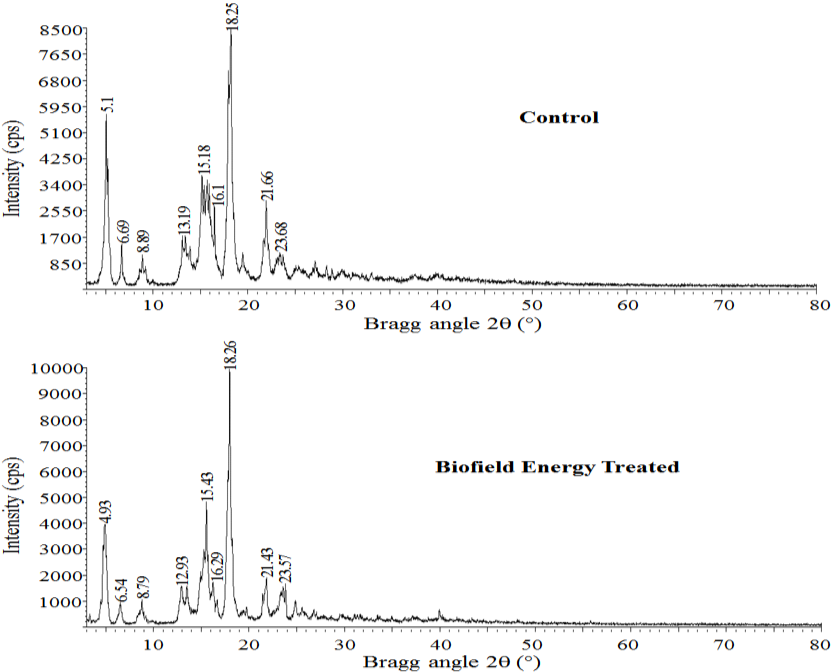
The experimental observations were significant with respect to the crystallite sizes and peak intensities indicated the modification of the crystal morphology of the Biofield Energy Treated vitamin D3 compared to the control sample. The change in the peak intensity of the diffraction face of the crystalline compound indicated the alterations in the crystal morphology [38]. The alterations in the PXRD pattern provide the proof of polymorphic transitions [39, 40]. The Trivedi Effect®-Consciousness Energy Healing Treatment assumed to be responsible for the new polymorphic form of vitamin D3 probably through the Biofield Energy via neutrino oscillations [17]. The drug performance of the pharmaceuticals, such as bioavailability, therapeutic efficacy, and toxicity is different from the original form due to different polymorphic forms [12, 41]. Therefore, the Trivedi Effect®-Consciousness Energy Healing Treated vitamin D3 would be advantageous for the designing of novel pharmaceutical formulations which would offer better therapeutic efficacy.
Differential Scanning Calorimetry (DSC) Analysis
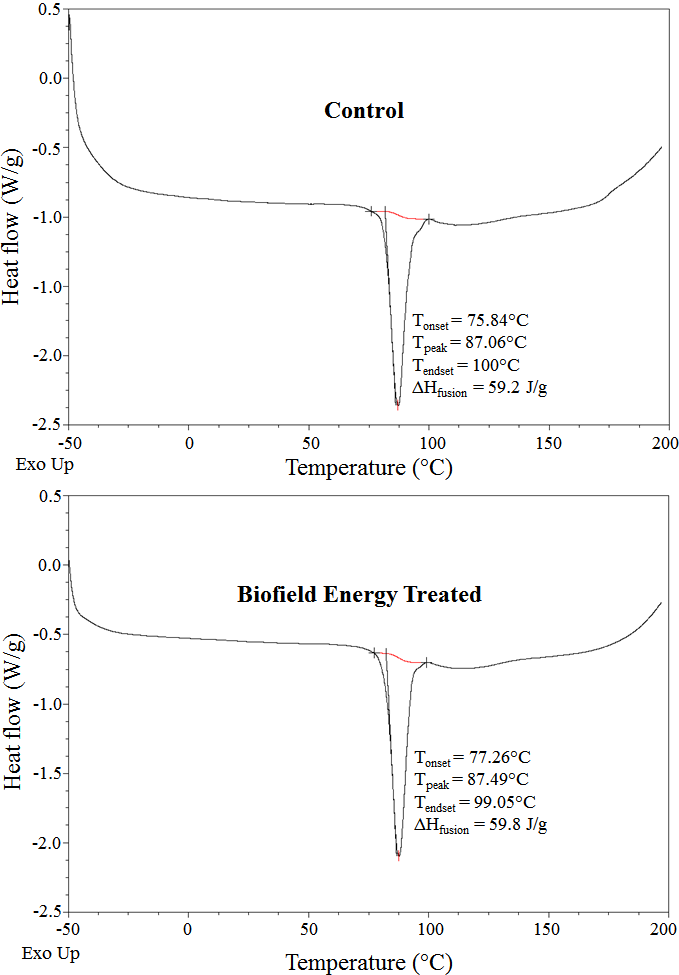
The control and Biofield Energy Treated vitamin D3 showed the sharp endothermic peak at 87.06°C and 87.49°C, respectively in the DSC thermograms (Figure 20). The literature reported data closely match to the experimental results [42]. Likewise, latent heat of fusion (∆Hfusion) of the control and Biofield Energy Treated vitamin D3 was 59.2 J/g and 59.8, respectively Table 3. The melting point and ∆Hfusion of the Biofield Energy Treated vitamin D3 sample were increased by 0.49% and 1.01%, respectively compared to the control sample. Any change in the latent heat of fusion can be attributed to the disrupted intrinsic molecular and the crystal structure [43]. Therefore, the Trivedi Effect®-Consciousness Energy Healing Treatment assumed to be responsible for the disruption the molecular and crystal structure of vitamin D3 leads to the improved the thermal stability of the treated sample compared with the control sample.
| Sample | Melting Temp (°C) | ∆H (J/g) fusion | ||||||
|---|---|---|---|---|---|---|---|---|
| Control Sample | 87.06 | 59.20 | ||||||
| Biofield Energy Treated | 87.49 | 59.80 | ||||||
| % Change* | 0.49 | 1.01 |
Table 4: DSC data for both control and Biofield Energy Treated samples of vitamin D3. ΔHfusion: Latent heat of fusion, *denotes t
Thermal Gravimetric Analysis (TGA)/ Differential Thermo gravimetric Analysis (DTG)
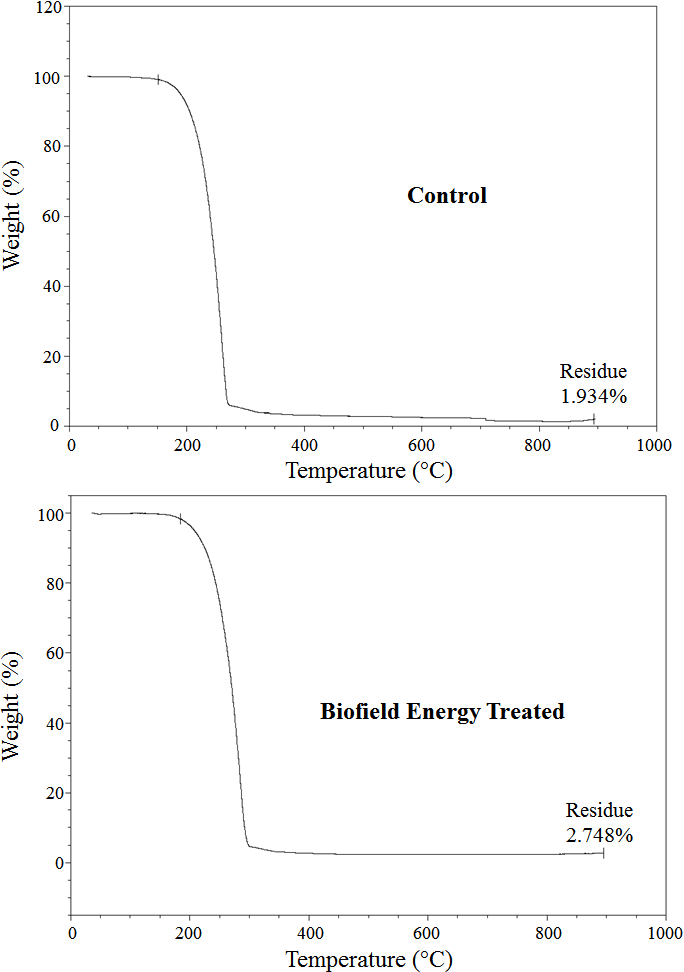
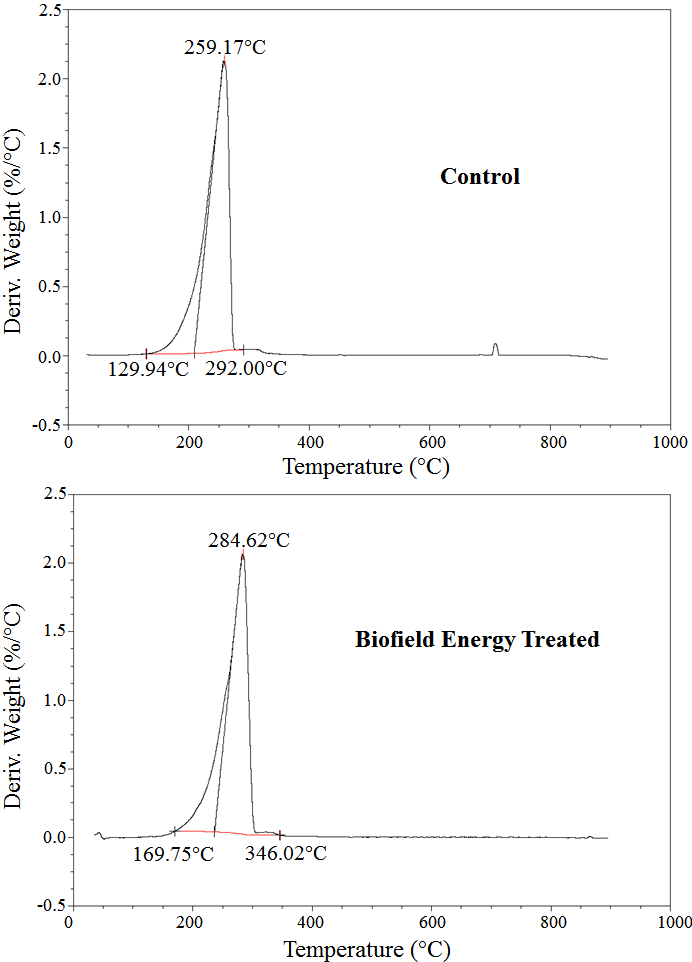
The TGA thermograms of the control and Biofield Energy Treated vitamin D3 samples showed one step of thermal degradation (Figure 3). The total weight loss of Biofield Energy Treated vitamin D3 was decreased by 0.83% compared to the control sample (Table 4). Hence, the residue amount was significantly increased by 42.09% in the Biofield Energy Treated vitamin D3 compared to the control sample (Table 4).
| TGA | DTG | ||||||||||
|---|---|---|---|---|---|---|---|---|---|---|---|
| Sample | |||||||||||
| Total weight loss (%) | Residue % | T (°C) max | |||||||||
| Control | 98.066 | 1.934 | 259.17 | ||||||||
| Biofield Energy Treated | 97.252 | 2.748 | 284.62 | ||||||||
| % Change* | -0.83 | 42.09 | 9.82 |
Table 5: TGA/DTG data of the control and Biofield Energy Treated samples of vitamin D3.*denotes the percentage change of the Biof
Conclusions
The Trivedi Effect®-Consciousness Energy Healing Treatment has the significant effects on the particle size, surface area, crystallite size, and thermal behavior of vitamin D3. The particle size values in the Biofield Energy Treated vitamin D3 powder sample were significantly decreased by 21.46%, 18.29%, 17.87%, and 18.11% at d10, d50, d90, and D(4,3) compared to the control sample. Thus, the specific surface area of the Biofield Energy Treated sample was significantly increased by 16.97% compared to the control sample. The PXRD results showed that the peak intensities and crystallite sizes of the Biofield Energy Treated vitamin D3 powder sample were significantly altered ranging from -85.18% to 286.11% and -62.06% to 237%, respectively compared to the control sample. The average crystallite size of the Biofield Energy Treated sample was significantly decreased by 6.94% compared with the control sample. The melting point and ∆Hfusion of the Biofield Energy Treated sample were slightly increased by 0.49% and 1.01%, respectively compared to the control sample. The total weight loss was decreased by 0.83%; hence the residue amount was significantly increased by 42.09% in the Biofield Energy Treated sample compared with the control sample. The Tmax was significantly increased by 9.82% in the Biofield Energy Treated sample compared with the control sample. The Trivedi Effect®- Consciousness Energy Healing Treatment generates a new polymorphic form of vitamin D3 which might offer better solubility, dissolution, absorption, bioavailability, and be thermally more stable compared with the control sample. Hence, the Biofield Energy Treated vitamin D3 would be more beneficial to maintain the overall quality of life and increase the intestinal absorption of several vital minerals like calcium, magnesium, iron, zinc, and phosphate in the body. Similarly, it would be very much useful in designing novel nutraceutical/pharmaceutical formulations for the better therapeutic responses against hypovitaminosis D, rickets, osteoporosis, cardiovascular diseases, diabetes mellitus, cancer, mental disorders, infections, multiple sclerosis, etc.
Acknowledgements
The authors are grateful to Central Leather Research Institute, SIPRA Lab. Ltd., Trivedi Science, Trivedi Global, Inc., Trivedi Testimonials, and Trivedi Master Wellness for their assistance and support during this work.
References
-
Kulie T, Groff A, Redmer J, Hounshell J, Schrager S (2009) Vitamin D: An evidence-based review. J Am Board Fam Med 22: 698-706.
-
Zhang R, Naughton DP (2010) Vitamin D in health and disease: Current perspectives. Nutr J 9: 65.
-
Gouni-Berthold I, Krone W, Berthold HK (2009) Vitamin D and cardiovascular disease. Curr Vasc Pharmacol 7(3): 414-422.
-
Simana E, Simian R, Portnoy S, Jaffe A, Dekel BZ (2015) Feasibility Study -Vitamin D loading determination by FTIR-ATR. Information & Control Systems 76: 107-111.
-
Ritu G, Gupta A (2014) Vitamin D Deficiency in India: Prevalence, Causalities and Interventions. Nutrients 6(2): 729-775.
-
Lawson DE, Wilson PW, Kodicek E (1969) Metabolism of vitamin D. A new cholecalciferol metabolite, involving loss of hydrogen at C-1, in chick intestinal nuclei. Biochem J 115(2): 269-77.
-
Mattila P, Lehikoinen K, Kiiskinen T, Piironen V (1999) Cholecalciferol and 25-hydroxycholecalciferol content of chicken egg yolk as affected by the cholecalciferol content of feed. J Agric Food Chem 47(10): 4089-4092.
-
Lehmann U, Hirche F, Stangl GI, Hinz K, Westphal S, Dierkes J (2013) Bioavailability of vitamin D(2) and D(3) in healthy volunteers, a randomized placebo- controlled trial. J Clin Endocrinol Metab 98(11): 4339-4345.
-
Borel P, Caillaud D, Cano NJ (2015) Vitamin D bioavailability: State of the art. Crit Rev Food Sci Nutr 55(9): 1193-1205.
-
Koshy KT, Beyer WF (1984) Vitamin D3 (Cholecalciferol) in Analytical Profiles of Drug Substances, Florey K (Edn.) Academic Press, Inc., Orlando, USA 13: 656-707.
-
Collins ED, Norman AW (2001) Vitamin D in Handbook of Vitamins (3rd Edn) Rucker RB, Suttie JW, McCormick DB, Machlin LJ, Marcel Dekker, Inc., New York, pp: 51-114.
-
Chereson R (2009) Bioavailability, bioequivalence, and drug selection. 1st (Edn.), In: Makoid CM, Vuchetich PJ, Banakar UV, Basic pharmacokinetics Pharmaceutical Press, London.
-
Trivedi MK, Branton A, Trivedi D, Nayak G, Wellborn BD, et al. (2017) Characterization of physical, structural, thermal, and behavioral properties of the consciousness healing treated zinc chloride. World Journal of Applied Chemistry 2(2): 57-66.
-
Trivedi MK, Branton A, Trivedi D, Nayak G, Wellborn BD, et al. (2017) Characterization of physicochemical, thermal, structural, and behavioral properties of magnesium gluconate after treatment with the Energy of Consciousness. International Journal of Pharmacy and Chemistry 3(1): 1-12.
-
Trivedi MK, Patil S, Shettigar H, Bairwa K, Jana S (2015) Spectroscopic characterization of biofield treated metronidazole and tinidazole. Med chem 5: 340-344.
-
Branton A, Jana S (2017) Effect of The biofield energy healing treatment on the pharmacokinetics of 25- hydroxyvitamin D3 [25(OH) D3] in rats after a single oral dose of vitamin D3. American Journal of Pharmacology and Phytotherapy 2(1): 11-18.
-
Trivedi MK, Mohan TRR (2016) Biofield energy signals, energy transmission and neutrinos. American Journal of Modern Physics 5(6): 172-176.
-
Rubik B, Muehsam D, Hammerschlag R, Jain S (2015) Biofield science and healing: History, terminology, and concepts. Glob Adv Health Med 4: 8-14.
-
Barnes PM, Bloom B, Nahin RL (2008) Complementary and alternative medicine use among adults and children: United States, 2007. Natl Health Stat Report 12: 1-23.
-
Koithan M (2009) Introducing complementary and alternative therapies. J Nurse Pract 5(1): 18-20.
-
Trivedi MK, Nayak G, Patil S, Tallapragada RM, Latiyal O, et al. (2015) Characterization of physical and structural properties of brass powder after biofield treatment. J Powder Metall Min 4(1): 134.
-
Trivedi MK, Nayak G, Patil S, Tallapragada RM, Latiyal O (2015) Studies of the atomic and crystalline characteristics of ceramic oxide nano powders after bio field treatment. Ind Eng Manage 4: 161.
-
Trivedi MK, Nayak G, Patil S, Tallapragada RM, Mishra R (2015) Influence of biofield treatment on physicochemical properties of hydroxyethyl cellulose and hydroxypropyl cellulose. J Mol Pharm Org Process Res 3: 126.
-
Trivedi MK, Branton A, Trivedi D, Nayak G, Sethi KK, et al. (2016) Gas chromatography-mass spectrometry based isotopic abundance ratio analysis of biofield energy treated methyl-2-napthylether (Nerolin). American Journal of Physical Chemistry 5(4): 80-86.
-
Trivedi MK, Branton A, Trivedi D, Nayak G, Panda P, et al. (2016) Isotopic abundance ratio analysis of 1,2,3- trimethoxybenzene (TMB) after biofield energy treatment (The Trivedi Effect®) using gas chromatography-mass spectrometry. American Journal of Applied Chemistry 4(4): 132-140.
-
Trivedi MK, Branton A, Trivedi D, Shettigar H, Nayak G, Gangwar M, Jana S (2015) Assessment of antibiogram of multidrug-resistant isolates of _Enterobacter_ _aerogenes_ after biofield energy treatment. J Pharma Care Health Sys 2: 145.
-
Trivedi MK, Branton A, Trivedi D, Shettigar H, Nayak G, et al. (2015) Antibiogram, biochemical reactions and genotyping characterization of biofield treated _Staphylococcus_ _aureus_. American Journal of BioScience 3(6): 212-220.
-
Trivedi MK, Patil S, Shettigar H, Mondal SC, Jana S (2015) The potential impact of biofield treatment on human brain tumor cells: A time-lapse video microscopy. J Integr Oncol 4: 141.
-
Trivedi MK, Patil S, Shettigar H, Gangwar M, Jana S (2015) In vitro evaluation of biofield treatment on cancer biomarkers involved in endometrial and prostate cancer cell lines. J Cancer Sci Ther 7: 253- 257.
-
Trivedi MK, Branton A, Trivedi D, Nayak G, Mondal SC, et al. (2015) Evaluation of biochemical marker - Glutathione and DNA fingerprinting of biofield energy treated _Oryza sativa_. American Journal of BioScience 3: 243-248.
-
Trivedi MK, Branton A, Trivedi D, Nayak G, Gangwar M, et al. (2015) Analysis of genetic diversity using simple sequence repeat (SSR) markers and growth regulator response in biofield treated cotton (_Gossypium hirsutum_ L.). American Journal of Agriculture and Forestry 3: 216-221.
-
Trivedi MK, Sethi KK, Panda P, Jana S (2017) A comprehensive physicochemical, thermal, and spectroscopic characterization of zinc (II) chloride using X‑ray diffraction, particle size distribution, differential scanning calorimetry, thermogravimetric analysis/differential thermogravimetric analysis, ultraviolet-visible, and Fourier transform‑infrared spectroscopy. International Journal of Pharmaceutical Investigation 7(1): 33-40.
-
Trivedi MK, Sethi KK, Panda P, Jana S (2017) Physicochemical, thermal and spectroscopic characterization of sodium selenate using XRD, PSD, DSC, TGA/DTG, UV-vis, and FT-IR. Marmara Pharmaceutical Journal 21(2): 311-318.
-
Desktop X-ray Diffractometer “MiniFlex+” (1997) The Rigaku Journal 14: 29-36.
-
Zhang T, Paluch K, Scalabrino G, Frankish N, Healy AM, et al. (2015) Molecular structure studies of (1S,2S)-2-benzyl-2,3-dihydro-2-(1Hinden-2-yl)-1H- inden-1-ol. J Mol Struct 1083: 286-299.
-
Langford JI, Wilson AJC (1978) Scherrer after sixty years: A survey and some new results in the determination of crystallite size. J Appl Cryst 11: 102- 113.
-
Khadka P, Ro J, Kim H, Kim I, Kim JT, et al. (2014) Pharmaceutical particle technologies: An approach to improve drug solubility, dissolution and bioavailability. Asian J Pharm Sci 9: 304-316.
-
Raza K, Kumar P, Ratan S, Malik R, Arora S (2014) Polymorphism: The phenomenon affecting the performance of drugs. SOJ Pharm Pharm Sci 1: 10.
-
Brittain HG (2009) Polymorphism in pharmaceutical solids in Drugs and Pharmaceutical Sciences, volume 192, 2nd Edn, Informa Healthcare USA, Inc., New York.
-
Censi R, Martino PD (2015) Polymorph Impact on the Bioavailability and Stability of Poorly Soluble Drugs. Molecules 20(10): 18759-18776.
-
Blagden N, de Matas M, Gavan PT, York P (2007) Crystal engineering of active pharmaceutical ingredients to improve solubility and dissolution rates. Adv Drug Deliv Rev 59(7): 617-630.
-
Vora L, Sita V G, Vavia P (2017) Zero order controlled release delivery of cholecalciferol from injectable biodegradable microsphere: _In-vitro_ characterization and _in-vivo_ pharmacokinetic studies. European Journal of Pharmaceutical Sciences 107: 78-86.
-
Zhao Z, Xie M, Li Y, Chen A, Li G, et al. (2015) Formation of curcumin nanoparticles _via_ solution- enhanced dispersion by supercritical CO2. Int J Nanomedicine 10: 3171-3181.
- The Role of Podocyte Apoptosis and the Involvement of SIRT1 in Diabetic Nephropathy
- Dealcoholization of Beer by Osmotic Distillation for the Beverage Industry
- Biopolymer-Based Edible Packaging- Biomaterials, Methods, and Applications in Food Industry: An Updated Review
- Influence of Bioprocessing Methods on 'China Rice' (Gawal R1), and Soyabean Supplementation on the Quality of Complementary Food
- Cassava (Manihot esculenta) Varietal Growth, Yield and Cyanide Content Performance in Three Sites in the South- Eastern Semi Arid Regions of Kenya
- Food Waste Treatment, Recycling, Management and Production of Value-Products-An Update on Methodologies and Current Trends