
Keratin Degradation by Aspergillus Niger and Penicillium Purpurogenum Isolated from Nigerian Soil
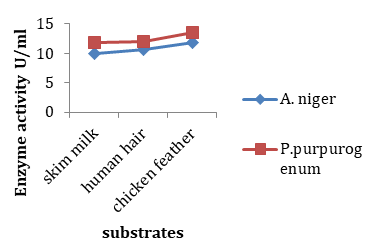
Keratin degrading Aspergillus niger and Penicillium purpurogenum were isolated from soils collected from human hair dumping ground using skim milk agar screening method. These fungi hydrolyzed skim milk casein indicated by halo zones of hydrolysis of 62mm and 64mm produced by them respectively. The fungal species also utilized keratin of ground human hair and chicken feather and hydrolyzed them to reducing sugars and proteins with P. purpurogenum being a better degrader of chicken feather and human hair producing 13.5 and 12.0 U/ml respectively than A. niger.
Introduction
Keratinases are enzymes including the large serine or metallo-proteases which are capable of degrading the keratinous proteins of all kinds as most of the purified keratinases known to date cannot completely solubilize native keratin [1]. The polypeptide of keratin is densely packed which is strongly stabilized by several hydrogen bonds and hydrophobic interactions. Furthermore, cross- linking of protein chains resulted by disulfide bonds in keratin are also responsible for its high degree of recalcitrance in degradation processes [2, 3].
Keratinous wastes such as human hair and chicken feather have high protein content, they could be used as a source of protein and amino acids for animal feed and any other applications [4]. Microorganisms such as fungi which produce keratinases may have important use in hydrolysis of keratin-containing wastes from leather, poultry and other keratin producing industries. This represents an attractive alternative method for efficient bioconversion and improving the nutritional value of keratin wastes by developing economically and environmentally friendly technology [2, 5, 6]. In the present study, keratinolytic activity of Aspergillus niger and Penicillium purpurogenum was assayed using human hair and chicken feather as keratinous substrates.
Materials and methods
Screening of Fungal Isolates for Proteolytic Activity Using Skim Milk Agar Medium
Two fungal species, Aspergillus niger and Penicillium purpurogenum isolated from soil collected from human hair dumping ground using hair baiting technique were assayed for proteases production employing agar plates with skim milk casein, as sole sources of carbon and nitrogen. Basal salt solution, which contained (gL-1) K2HPO4 0.4; MgSO4.7H2O 0.05; NaCl 0.01; FeCl3 0.01, agar powder, 2% and supplemented with 1% skim milk powder was employed [7]. The medium was sterilized at 121°C at 15psi for 15mins. The medium was allowed to cool to 44oC and then dispensed in Petri dishes and were allowed to solidify. The test fungal species were inoculated on the Petri dishes with 5mm mycelia discs from the edge of actively growing 4-day old cultures. The plates were incubated at 28±2°C for 7 days. The diameter of the colonies of the fungi and the diameter of zones of enzyme activity were measured (mm) in triplicates. These measurements were used to determine the Relative Enzyme Activity (REA) of the protease enzyme produced using the formula: REA= Diameter of zone of enzyme activity (mm)/ Diameter of the colony (mm).
Fungal Cultivation for Crude Protease and Keratinase Production Using Liquid Basal Medium
Fungal cultivation for crude protease and keratinase production was done using modified method of Wawrzkrewicz, et al. [8]. Submerged fermentation (SMF) was performed by inoculating disc of pure cultures of actively growing A. niger and P. purpurogenum into 100ml the production medium containing (gL-1) skim milk powder (1%) as a sole source of carbon and nitrogen, K2HPO4 0.4; MgSO4.7H2O 0.05; NaCl 0.01; FeCl3 0.01 in different McCartney bottles. This same procedure was carried out with production medium supplemented with ground human hair (1%) and ground chicken feather (1%) used as keratin sources respectively. The McCartney bottles were incubated for fifteen days at room temperature (28±2°C) without agitation. The supernatant after the mycelia was filtered off served as the crude enzyme source. The supernatant was assayed for extracellular proteases (skim milk casein) and keratinases (human hair and chicken feather). The experiments were carried out in triplicates
Assay of Keratinolytic Protease
Determination of Proteolytic Activity Using Skim Milk Casein as Substrate
The modified method of Hankin, et al. [7] was employed for the assay. The reaction mixture contained 1ml of crude enzyme, 1ml of phosphate buffer, pH 7.0, 1 ml of 1% skim milk casein and 1 ml of 10mM CaCl2. The reaction tubes were incubated at 37°C for 30mins. The reaction was stopped by placing the tubes in an ice bath, followed by filtration after cooling to remove the substrate. The supernatant was spectrophotometric ally measured at 280nm. One unit of protease activity was defined as an increase in absorbency of 0.01 at 280nm under standard assay conditions. The experiments were done in triplicates
Determination of Keratinolytic Activity Using Human Hair and Chicken Feather as Substrates
The assay was done according to modified method of Hankin, et al. [7]. The reaction mixture contained 1ml of crude enzyme, 1ml of 1% ground human hair (substrate) and 1 ml of Glycine- NaOH buffer, pH 9.0. The reaction tubes were incubated at 37°C for 1hr and the reaction was stopped by placing the tubes in an ice bath, followed by filteration after cooling to remove the substrate. The supernatant was spectrophotometrically measured at 520 nm. One unit of keratinase activity was defined as an increase in absorbance of 0.01 at 520 nm under standard assay conditions.
Results and Discussion
Proteolytic Activity of the Test Fungi Using Skim Milk Casein Agar Medium
The two test fungi were found positive for protease hydrolysis. Maximum protease activity of 64mm with Relative Enzyme Activity (REA) of 0.91 was recorded for Penicillium purpurogenum while the least protease activity of 62mm with REA of 0.84 was noted for Aspergillus niger respectively (Table 1). The results of the zone of clearance of the skim milk agar medium by the test fungi are shown in Figure 1. The finding of this work is in agreement with the result of Jain, et al. [9] in which actinomycetes demonstrated excellent, good, fair and poor protease activity and that of Kannahi & Ancy [10] in which Fusarium oxysporum demonstrated higher protease activity of 33.6% than A. flavus with activity of 19.2%.
| Protease activity | ||||||
|---|---|---|---|---|---|---|
| S/No | Organism | Colony (mm) | Activity zone (mm) | REA | ||
| 1 | A. niger | 74 | 62 | 0.84 | ||
| 2 | P. purpurogenum | 70 | 64 | 0.91 |
Table 1: Proteolytic activity of the test fungi using skim milk casein agar medium.
![Figure 1: The finding of this work is in agreement with the result of Jain, et al. [9] in which actinomycetes demonstrated excellent, good, fair and poor protease activity and that of Kannahi & Ancy [10] in which Fusarium oxysporum demonstrated higher protease activity of 33.6% than A. flavus with activity of 19.2%.](/fulltextimages/3275/fig_1.png)
Keratinolytic Activity of the Test Fungi Using 1% Skim Milk, Human Hair and Chicken Feather
The keratinolytic activity of the cell free supernatant from Aspergillus niger and Penicillium purpurogenum used to degrade the three substrates, 1% skim milk, human hair and chicken feather at 37°C, showed that there was enzyme activity on proteinous and keratinous substrates used as sole sources of carbon and nitrogen (Figure 2). The highest activity of 13.5U/ml was observed in chicken feather, followed by human hair with activity of 12.0U/ml for P. purpurogenum. Skim milk agar had the least activity of 11.9U/ml for P. purpurogenum. For A. niger, the highest activity of 11.8U/ml was observed in chicken feather, followed by human hair with activity of 10.6U/ml while skim milk agar had the least activity of 10.0 U/ml. Soomro & Zardari [11] reported the keratinolytic activity of the genera Fusarium and the mucorales when grown on substrates that are rich in keratins.
Nwadiaro, et al. [12] also reported keratinolytic activity in P. purpurogenum isolated from tannery wastes in Jos, Nigeria. Sunil-Dutt, et al. [13] reported glutaminase production in P. expansum which is an enzyme that catalyzes the deamination of L-glutamine to glutamic acid and ammonia. This is an indication that fungal species produce array of enzymes which are used in pharmaceutical and food industries. In addition, some of these enzymes are very useful in solving environmental problems such as that of pollution as these organisms have been found to play a significant role in the natural degradation of keratinized residues [14, 15].
Keratinolytic fungi have been frequently isolated from soil, where they colonize various keratinous substrates, degrade them and add the mineral content to the soil. The keratinolytic fungi use the proteins in keratins as sole source of carbon and nitrogen and remove excess nitrogen through deamination and ammonia production which are prevalent during keratinolysis [16]. The authors also reported keratinolytic activity in five hyphomycetous fungi including Aspergillus oryzae, A. niger, A. flavus, Trichophyton megninii and Candida species. These keratinolytic fungi have been recorded from different parts of the globe [11]. Other reports on keratin degrading fungi include those of Ugo and Ijigbade [17] which recorded keratinase activity of 14.56 Ku in Aspergillus niger and 13.18 Ku in Penicillium chrysogenum. Keratin is sulphur-rich substrate. Keratinolytic fungi would release the enzyme keratinase that degrade keratin which then allow them to metabolize the sulphur in keratin thereby disrupting the disulphide bonds.
These two fungal strains isolated from Nigerian soil were able to grow on basal media with human hair and feather meal as their primary source of carbon, nitrogen and sulphur for their energy. They in turn produced keratinase that enable them degrade and utilize the substrates. Hair from hair dressing and barbing salons as well as feathers from poultry houses cause major environmental problem in Nigeria. The strains of fungi used in this study could help in clearing the hair and feather pollutant from our environment.
During the study on the determination of keratinolytic activity of the fungi using plate assay, they were found to grow luxuriantly on the media supplemented with human hair and chicken feather. It was observed that the particles of the hair and feather were significantly cleared indicating that they have been hydrolyzed. This shows that these strains of A. niger and P. purpurogenum could be potential dermatophytes. This is the first report of keratinolytic activity in P. purpurogenum in Nigeria.
Conclusion
Human hair and chicken feather have constituted serious environmental pollution problems. Keratinolytic fungi such as the ones used in this study could not only remove the wastes from the environment but could also convert the by-products of the biodegradable human hair and chicken feather substrates to valuable proteins which could be used to fortify animal feeds. Research work is on- going on the identification and characterization of the proteins produced by these fungi during hydrolysis of keratin substrates.
Acknowledgement
Authors are thankful to the Department of Basic and Biological Sciences of Federal College of Forestry Jos for providing us with facilities and Mrs JS Tanko for her technical assistance.
References
-
Noval JJ, Nickerson WJ (1959) Decomposition of native keratin by Streptomyces fradiae. J bacteriol 77(3): 251-263.
-
Bo X, Qiaofang Z, Xianghua T, Yunjuan Y, Zunxi H (2009) Isolation and characterization of a new keratinolytic bacterium that exhibits significant feather-degrading capability. African Journal of Biotechnology 8(18): 4590- 4596.
-
Jeong JH, Lee OM, Jeon YD, Kim JD, Lee NR, et al. (2010) Production of keratinolytic enzyme by a newly isolated feather-degrading Stenotrophomonas maltophilia that produces plant growth-promoting activity. Process Biochem 45(10): 1738-1745.
-
Onifade AA, A1-Sane NA, Al-Musallam AA, Al-Zarban S (1998) Potentials for biotechnological applications of keratin degrading microorganisms and their enzymes for nutritional improvement of feathers and other keratins as livestock feed resources. Biores Technol 66: 1-11.
-
Gupta R, Ramnani P (2006) Microbial keratinases and their perspective applications: an overview. Appl Microbiol Biotechnol 70(1): 21-33.
-
Brandelli A, Daroit DJ, Riffel A (2010) Biochemical features of microbial keratinases and their production and applications. Appl Microbiol Biotechnol 85(6): 1735-1750.
-
Hankin L, Zucker M, Sands DC (1971) Improved solid medium for the detection and enumeration of pectolytic bacteria. Applied Microbiology 22(2): 205- 209.
-
Wawarzkiewicz K, Lobarzewski J, Wolski T (1987) Intracellular Keratinase of Trichophyton gallinae Med. Myco 25(4): 261-268.
-
Jain R, Agrawal SC, Jain PC (2009) Proteolytic actinomycetes from Indian habitats. Journal of culture collections 6(1): 28-37.
-
Kannahi MD Ancy RJ (2012) Keratin Degradation and Enzyme Producing Ability of Aspergillus Flavus and Fusarium Solani from Soil. Journal of Chemical and Pharmaceutical Research 4(6): 3245-3248.
-
Soomro IH, Zardari M (2002) Investigation keratinophilic fungi from saline soil in Khairpur, Sindh, Pakistan. Hamdard Medicus 46: 82-85.
-
Nwadiaro PO, Chuku A, Onyimba IA, Ogbonna AI, Nwaukwu IA, et al. (2015) Keratin Degradation by Penicillium purpurogenum Isolated from Tannery Soils in Jos, Nigeria. British Microbiology Research Journal 8(1): 358-366.
-
Sunil-Dutt PLNSN, Siddalingeshwara KG, Sudipta K, Mohanty, Karthic J, Shantaveer G (2010) A Promising Technique for Rapid Screening and Confirmation of L- Glutaminase - A Tumour Inhibitor from Novel Pencillium expansum. International Journal of Pharmaceutical Sciences and Drug Research 2(4): 275-277.
-
Fillipello MV (2000) Keratinophilic fungi: Their role in nature and degradation of keratinic substrates. In: Biology of dermatophytes and other keratinophilic fungi, Kushawaha RKS, Guarro J, editors. Revista Iberoamericana deMicologia. Spain, pp: 77-85.
-
Sharma M, Sharma M (2013) Incidence of dermatophytes and other keratinophilic fungi in the schools and college playground soils of Jaipur, India. African Journal of Microbiology Research 4(24): 2647-2654.
-
Umedum CU, Ugorji IR, Okoye EC, Egemonye OC, Obiora SO (2013) Keratinase Activity and Biodegradation Properties of Hyphomycetous Fungi from Fowl Feather. International Journal of Agriculture and Biosciences 2(6): 306-309.
-
Ugoh SC, Ijigbade B (2013) Production and Characterisation of Keratinase by Fungi Isolated from Soil Samples at Gwagwalada, FCT-Abuja, Nigeria. Nat Sci 11(10): 1-7.
- The Role of Podocyte Apoptosis and the Involvement of SIRT1 in Diabetic Nephropathy
- Dealcoholization of Beer by Osmotic Distillation for the Beverage Industry
- Biopolymer-Based Edible Packaging- Biomaterials, Methods, and Applications in Food Industry: An Updated Review
- Influence of Bioprocessing Methods on 'China Rice' (Gawal R1), and Soyabean Supplementation on the Quality of Complementary Food
- Cassava (Manihot esculenta) Varietal Growth, Yield and Cyanide Content Performance in Three Sites in the South- Eastern Semi Arid Regions of Kenya
- Food Waste Treatment, Recycling, Management and Production of Value-Products-An Update on Methodologies and Current Trends