
Screening of Tolerant Genotypes of Spring Barley for Terminal Drought Stress Based on Grain Yield and Yield Components
The pot experiment with spring barley was carried on in 2011 and 2013-2014 years. The total number of 263 genotypes was tested against short-term drought stresses introduced at the tillering stage for 11 days or at full flag leaf stage for 14 days. At the control treatment, plants were grown at the optimal soil moisture level of 13-15% weight by weight for the whole vegetation period and in the stress treatments, the moisture was maintained at the level of 5-6% weight by weight. Spring barley showed a higher tolerance to the drought stress at tillering stage than at flag leaf stage. Barley genotypes differed in their response to terminal drought stresses due to diverse ability for regenerating after the stress removal. The resistance and tolerance of the genotypes to the drought stress imposed at tillering stage resulted from their ability to produce additional fertile tillers and to the stress at flag leaf stage by compensation of the reduced grain number per spike through increasing the weight of 1000 grains. The grain yield of tolerant genotypes named as MCAM: 85, 86, 102, 128 and 129 was stable independent on water supply and the most suitable for breeders in Poland.
Alicja Pecio* and Damian Wach
Poland
State Research Institute in Pulawy, Poland, Email: alicja.pecio@iung.pulawy.pl Keywords: Spring Barley; Drought Response; Grain Yield; Yield Components
Introduction
Soil and climatic conditions of Poland do not favor stabile yielding of cereals. Periodical drought is one of the major yield-limiting factors on the prevailing permeable light-textured soils with a frequently negative balance between evapotranspiration and precipitation [1]. Increasing frequency of the climatic phenomenon is a significant problem for agricultural production [2, 3].
According to IPCC (Intergovernmental Panel on Climate Change) forecast, the average annual temperature in Poland could rise over the next 100 years by 4OC. The simple model of the effect of weather warming on crop development showed that temperature increase by 1OC per 100 years fastens cereal crop maturity in Poland by 1 week [2]. The other climate change models indicate that a higher air temperature causes weather anomalies, which in turn bring about yield losses [4]. Moreover, more heterogenous distributions of rainfall during the whole year, and particularly during the vegetation period cause that plants are exposed to frequent drought stresses [1, 2].
Barley is an important cereal crop in Poland. It covers about 1 mln ha and takes about 12% in structure of cropland. The grain is normally used as food, animal fodder and as raw material for beer production. Spring form of this crop dominates strongly over the winter one. Due to short vegetation period extending for about 100 days and poorly developed root system, spring barley is very sensitive to drought stresses, even if they are temporary.
The phenomenon of decreasing spring barley yields under conditions of poor water supply is well known in the literature [5, 6]. Drought stress reduces grain yield of barley through negative affecting the yield components i.e. number of plants per unit area, number of spikes and grains per plant or unit area and single grain weight, which are determined at different stages of plant development [7, 8, 9]. The values of yield components are genetically-based, but they can be strongly modified by the pattern of moisture conditions in the growing period [10, 11]. Tillers and primordia of generative organs (spikes, spikelets and florets), which determine the number of grains per spike and unit area are initiated at tillering stage, and developed at the stage of stem elongation [12, 13]. Insufficient water and nutrients supply or poor effectiveness of photosynthesis during tillering or stem elongation can decrease the number of fertile florets and the number of grains per spike [14]. Brestič [15] noticed that the development of the florets into grains was decreased most considerably by the reduction of initiated florets under stress at the stem elongation stage as compared to stresses in the period of anthesis or grain filling only. In the meantime, according to Savin and Slafer [16], environmental conditions around 20 days pre- and 10 days post-anthesis are considered as critical for grain yield determination. At heading stage, when in case of barley anthesis takes place, sufficient moisture supply supports pollination and fertilization processes, and therefore initiation of grain primordia [17]. During pre-anthesis, the potential grain number per unit area and potential grain weight are defined [18, 19]. The final number of grains per unit area is set immediately after anthesis, while grain filling and accumulation of biomass of grains take place during the remaining post-anthesis period [20]. At that time, good moisture and light conditions increase the effectiveness of photosynthesis, which is related to plant assimilation area, developed at the previous stages. Finally, weight of 1000 grains depends on the physiological functionality of genotype and length of photosynthesis period [21]. The numbers of spikes per unit area, i.e. number of fertile stems is determined by weather conditions during the whole growing period from the emergence through tillering and stem elongation up to the stages of spike development. Hence, although late-emerged tillers contribute less to grain yield than do tillers that emerged earlier [22], there still exists a possibility for plant to re- growth after temporary stress abating and it is considered as one of the implications of adaptation responses to the different water supply [13, 23].
Barley species and cultivars differ considerably in their response and adaptation to the drought stresses [6, 7, 24, 25]. These differences are partly attributed to different re-growth ability of plants after the stress removal. The regenerating ability is manifested by the strength of compensation of one yield component by another/other ones [26]. Therefore, understanding the relationships between yield components in yield compensation after temporal drought stress may help target the key traits that limit yield. Selecting different genotypes under environmental stress conditions is one of the main tasks of plant breeders for exploiting the genetic variations to improve the stress tolerant cultivars [5]. Agronomic traits such as grain yield and its components are the major selection criteria for evaluating drought tolerance of barley [24, 27]. Available reports show that drought-tolerant species perform high productivity under both drought and well-watered conditions [5, 10, 28] and can be recommended to be used as parents for improvement of drought tolerance in other cultivars [5, 25]. Therefore the comparative analysis of the yield components under stressed and unstressed conditions can be helpful in predicting stress tolerance of genotypes, and then in selection of more tolerant entries [29].
Based on the previous literature findings the hypothesis was defined as follows: the tolerance of spring barley genotypes to temporary drought stress results from their ability to regrow after the stress removal, which is related to phenomena of late tillering and compensation of yield losses by yield components.
The purpose of the study was to specify spring barley genotypes tolerant to terminal drought stress on the base of individual plant yield and the following yield components: number of fertile tillers per plant, grain yield per spike, number of grains per spike, weight of 1000 grains (WTG) and harvest index (HI). Due to the constant number of plants per pot the grain yield per plant was considered as a measure of genotype productivity.
Experimental Procedures
The pot experiment with spring barley was carried on in 2011, 2013 and 2014 years at the glasshouse of Grabow Experimental Station of the Institute of Soil Science and Plant Cultivation - State Research Institute in Pulawy, Poland (E 21o 39’, N 51o 21’). The total number of 263 genotypes, including 199 lines, their parental forms Maresi (Germany), CAM/B1/CI08887//CI05761 and Harmal (Syria), Georgia (Great Britain) and 60 cultivars registered and cultivated in Poland was tested against short-term drought stresses introduced at the tillering stage (BBCH 23, 31 days after sowings) for 11 days (S1) or at full flag leaf stage (BBCH 45-47, 50 days after sowings) for 14 days (S2). At the control treatment (C), soil moisture was maintained at the optimal level of 13-15% weight by weight for the whole vegetation period, and in the treatments S1 and S2, at the level of 5- 6% weight by weight.
The two-factor experiment was set up each year at the second decade of April i.e. at optimal sowing time of spring barley in Eastern Poland, in three replicates (pots) with 10 plants per pot. Each pot was filled with 9 kg of mixture of loamy soil with sand in the 7:2 proportions, sufficiently supplied with all necessary nutrients according to fertilization recommendations of the Institute of Soil Science and Plant Cultivation State Research Institute. Drip irrigation of each pot was steered by a computer system (Adviser company, www.phu- adviser.pl), and corrected using an electronic balance.
The glasshouse provided with mobile glass roof and walls enabled plants to grow under conditions close to natural in the field, and protected them against rainfall. The mean air temperature inside the glasshouse at S1 stress equaled to 15.2OC and at S2 stress to 19.9OC. Air moisture varied on average between 71% and 75%, respectively. The air temperature and humidity inside the glasshouse were measured each second by the AR 236 recorder (www.sitaniectech.pl). After harvest, grain and straw yield, and number of fertile spikes per pot were determined. Then, based on selected randomly 10 main stems and 20 tillers number of grains per each spike, and 10- and 20 spike grain weight means were estimated. The other yield components were calculated according to the following formulas: Grain yield per plant = grain yield per pot / number of plants per pot Grain yield per spike - grain yield per pot / number of spikes per pot In order to specify the spring barley genotypes the most suitable for heterogenous pattern of precipitation in Poland they were segregated with respect of their response to drought stress. The clusters grouping genotypes resistant, tolerant and sensitive to the stresses were recognized according to the Tolerancy index (TOL). The qualification has been performed separately for the results obtained under early and the late drought stress. The analysis of barley response to the stress at the tillering stage (S1) showed that 7.5% of tested genotypes increased grain yield significantly (by more than 5%), and they were recognized as resistant ones (Figure 1). The other 79% significantly decreased grain yield (by more than 5%), therefore they were recognized as sensitive and the rest of 13.5% didn’t respond to the stress (grain yield under stress ranged from -5% to +5% of the control) - they were recognized as tolerant. The barley genotypes exposed to later stress (S2) mostly (84%) responded to the stress by the significant reduction of grain yield. Only 9% of tested genotypes were resistant and 7% of them tolerated drought stress at flag leaf stage.
Number of fertile tillers per plant) = number of spikes per pot / number of plants per pot Weight of 1000 grains (WTG) = (grain yield / number of grains)*1000 Harvest index (HI) = grain yield / (grain yield + straw yield) The obtained data was statistically analyzed separately for data referring to the stress at tillering stage and at flag leaf stage. The tested genotypes were segregated into clusters of resistant, tolerant and sensitive to each stress based on grain yield per pot according to Tolerancy index [30]. TOL = yield under stress - yield under non-stress environments.
Then, by one-way ANOVA, stressed treatments of all the clusters were tested against controls for the effects on yield and yield components. The means were compared by Tukey’s HSD procedure at the α= 0.05 significance level. The statistical analyses were performed using Statgraphics Centurion XVI statistical package.
Results
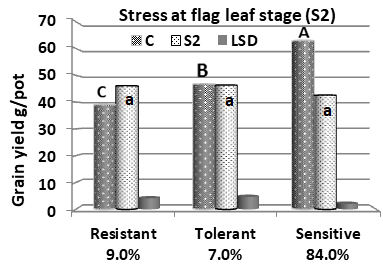
The analysis of the response of barley genotypes grain yield to the both drought stresses at tillering and flag leaf stages was performed in the response type groups. The means of the analyzed yield components are presented in tables 1-4 below.
Stress at Tillering Stage (S1)
that lessened drought stress tolerance. In the groups of resistant and tolerant genotypes, positive effect of drought on increasing tiller number prevailed over the negative effect of decreasing WTG.
The resistant genotypes responded to the drought stress at tillering stage by increased productivity as a result of higher number of productive tillers per a single plant. The tolerant ones didn’t react with grain yield per plant despite increased number of fertile tillers. The reason was a decreased weight of 1000 grains. Genotypes which were sensitive to the drought stress decreased productivity of both single plant and single spike due to both decreased WTG and number of grains per spike.
- Treatment
- Grain yield per
- Number of fertile tillers
- Grain yield per
- Number of grains
- WTG plant (g) per plant spike (g) per spike (g) index genotypes resistant to S1 stress
- Control
- 4.14 b
- 4.75 b
- 0.87 a
- 19.3 a
- 45.0 a
- 0.47 b
- S1 stress
- 4.81 a
- 5.65 a
- 0.85 a
- 19.2 a
- 44.2 a
- 0.51 a
- LSD0.05
- 0.435
- 0.506
- 0.119
- 2.45
- 4.87
- 0.023 genotypes tolerant to S1 stress
- Control
- 4.77 a
- 5.11 b
- 0.93 a
- 20.6 a
- 46.1 a
- 0.49 b
- S1 stress
- 4.78 a
- 5.62 a
- 0.85 a
- 20.1 a
- 43.4 b
- 0.51 a
- LSD0.05
- 0.309
- 0.357
- 0.888
- 1.572
- 2.78
- 0.016 genotypes sensitive to S1 stress
- Control
- 6.36 a
- 7.48 a
- 0.85 a
- 16.9 a
- 52.7 a
- 0.50 b
- S1 stress
- 4.76 b
- 7.46 a
- 0.64 b
- 14.6 b
- 46.6 b
- 0.52 a
- LSD0.05
- 0.201
- 0.398
- 0.037
- 0.79
- 1.28
- 0.010
Table 1: Mean grain yield per plant and yield components of barley genotypes depending on the drought stress at
The more detailed analysis of a singular plant considered the main shoot and the tillers (Table 2). As a result of water shortage at tillering stage tolerant genotypes reduced productivity of main stem. In the case of resistant genotypes, the productivity of main stem and a singular tiller didn’t change, but simultaneously the total grain yield produced by the tillers significantly increased. It confirmed the increase in their number. In the response to the stress, sensitive genotypes decreased the grain yield of both the main stem and the tillers due to the both reduced number of grains per spike and the weight of 1000 grains.
| Main stem | Total grain | A tiller | |||||||||||||||||||||
|---|---|---|---|---|---|---|---|---|---|---|---|---|---|---|---|---|---|---|---|---|---|---|---|
| t | |||||||||||||||||||||||
| Grain yield per | g | Number of | e | WTG | yield of | Grain yield pe | r | N | umber of grains pe | r | WTG | ||||||||||||
| Treatmen | |||||||||||||||||||||||
| spike (g) | rains per spik | (g) | tillers (g) | spike (g) | spike | (g) | |||||||||||||||||
| genotypes resistant to S1 stress | |||||||||||||||||||||||
| Control | 1.16 a | 23.1 a | 50.2 a | 2.98 b | 0.77 a | 19.0a | 40.5a | ||||||||||||||||
| S1 stress | 1.12 a | 22.5 a | 49.8 a | 3.69 a | 0.79 a | 20.0 a | 59.5a | ||||||||||||||||
| LSD0.05 | 0.146 | 2.43 | 4.47 | 0.375 | 0.120 | 2.11 | 5.06 | ||||||||||||||||
| genotypes tolerant to S1 stress | |||||||||||||||||||||||
| Control | 1.21 a | 24.2 a | 50.0 b | 3.56 a | 0.87 a | 20.0 a | 43.5 a | ||||||||||||||||
| S1 stress | 1.10 b | 23.1 a | 47.6 a | 3.68 a | 0.80 a | 10.0 a | 42.1 a | ||||||||||||||||
| LSD0.05 | 0.093 | 1.38 | 3.34 | 0.250 | 0.087 | 1.19 | 2.84 | ||||||||||||||||
| genotypes sensitive to S1 stress | |||||||||||||||||||||||
| Control | 1.23 a | 22.1 a | 55.7 a | 5.13 a | 0.79 a | 18.8 a | 42.0 a | ||||||||||||||||
| S1 stress | 0.84 b | 17.9 b | 46.9 b | 3.92 b | 0.61 b | 15.9 b | 38.4 b | ||||||||||||||||
| LSD0.05 | 0.039 | 0.68 | 1.19 | 0.194 | 0.036 | 0.56 | 1.33 |
Table 2: Mean grain yield per spike and yield components of barley genotypes depending on the drought stress at flag leaf stage (
- Table 2: Mean grain yield per spike and yield components of barley genotypes depending on the drought stress at tillering stage (S1).
- Control - control treatment (no drought stress); S1 - stress at tillering stage; WTG - weight of 1000 grains; LSD - Least Significant Difference; means marked with the same letter are not significantly different.
- Stress at Flag Leaf Stage (S2)
- In the response to the stress at flag leaf stage, resistant genotypes increased their grain yield per plant and per spike, and harvest index following the increase of weight of 1000 grains (Table 3).
- Among yield components, weight of 1000 grains seems to be the one that decides upon the resistance and tolerance of spring barley genotypes to drought stress at flag leaf stage.
- Treatment
- Grain yield per
- Number of fertile
- Grain yield per
- Number of grains
- WTG plant (g) tillers per plant spike (g) per spike genotypes resistant to S2 stress
- Control
- 3.90 b
- 5.09 a
- 0.77 b
- 20.6 a
- 37.9 b
- 0.46 b
- S2 stress
- 4.61 a
- 4.97 a
- 0.93 a
- 19.7 a
- 48.2 a
- 0.49 a
- LSD0.05
- 0.413
- 0.559
- 0.085
- 1.40
- 3.73
- 0.021 genotypes tolerant to S2 stress
- Control
- 4.67 a
- 4.99 a
- 0.94 a
- 21.6 a
- 42.1 b
- 0.50 a
- S2 stress
- 4.63 a
- 4.70 a
- 0.99 a
- 20.2 a
- 50.5 a
- 0.50 a
- LSD0.05
- 0.469
- 0.553
- 0.146
- 2.50
- 3.65
- 0.023 genotypes sensitive to S2 stress
- Control
- 6.30 a
- 7.31 b
- 0.86 a
- 15.8 a
- 54.4 a
- 0.50 a
- S2 stress
- 4.26 b
- 8.04 a
- 0.53 b
- 11.0 b
- 48.3 b
- 0.43 b
- LSD0.05
- 0.207
- 0.519
- 0.043
- 0.82
- 0.91
- 0.010
Table 3: Mean grain yield per plant and yield components of barley genotypes depending on the drought stress at flag
The sensitive genotypes responded to the stress with reducing the productivity per plant due to the diminished number of fertile tillers and the diminished productivity of a singular spike. This decrease in the grain yield of a spike resulted from the reduction of both the weight of 1000 grains, and the number of grains per spike. The sensitive genotypes reduced also harvest index.
Genotypes tolerant didn’t respond significantly to the S2 stress with plant productivity despite the increase of weight of 1000 grains of main stem and decrease of tiller WTG. The response of sensitive genotypes to the stress at flag leaf stage depended on the decrease of productivity of both types of the shoots due to reduced number of grains per spike and weight of 1000 grains. In combination with decreased number of fertile tillers, it caused a significant reduction of grain yield per the whole plant.
The performance of barley genotypes depended on both main stems, and the tillers (Table 4). Stress at flag leaf stage of resistant genotypes increased grain yield, and the weight of 1000 grains of both main stems, and the tillers. Despite the number of fertile tillers per plant, the stress increased total grain yield produced by tillers.
| Main stem | A tiller | ||||||||||||||||||||||
|---|---|---|---|---|---|---|---|---|---|---|---|---|---|---|---|---|---|---|---|---|---|---|---|
| T | otal grain yiel | d | |||||||||||||||||||||
| Number of | WTG | Number of | WTG | ||||||||||||||||||||
| Treatment | Grain yield | ) | of tillers | G | rain yield pe | r | |||||||||||||||||
| grains per | grains per | ||||||||||||||||||||||
| per spike (g | (g) | spike (g) | |||||||||||||||||||||
| spike | (g) | spike | (g) | ||||||||||||||||||||
| genotypes resistant to S2 stress | |||||||||||||||||||||||
| Control | 1.04 b | 24.7 a | 42.1 b | 2.86 b | 0.70 b | 20.3 a | 34.5 b | ||||||||||||||||
| S2 stress | 1.31 a | 25.2 b | 52.0 a | 3.30 a | 0.83 a | 19.1 b | 43.5 a | ||||||||||||||||
| LSD0.05 | 1.104 | 1.38 | 3.61 | 0.407 | 0.082 | 1.09 | 3.72 | ||||||||||||||||
| genotypes tolerant to S2 stress | |||||||||||||||||||||||
| Control | 1.21 a | 24.7 a | 49.0 b | 3.46 a | 0.87 a | 20.4 a | 42.6 a | ||||||||||||||||
| S2 stress | 1.37 a | 25.0 a | 54.8 a | 3.26 a | 0.88 a | 19.1 a | 46.1 b | ||||||||||||||||
| LSD0.05 | 0.171 | 2.66 | 3.46 | 0.376 | 0.141 | 2.33 | 3.66 | ||||||||||||||||
| genotypes sensitive to S2 stress | |||||||||||||||||||||||
| Control | 1.24 a | 22.0 a | 22.0 a | 5.06 a | 0.80 a | 18.7 a | 42.8 a | ||||||||||||||||
| S2 stress | 1.04 b | 19.3 b | 19.3 b | 3.22 b | 0.46 b | 14.3 b | 32.2 b | ||||||||||||||||
| LSD0.05 | 0.039 | 0.65 | 0.65 | 0.202 | 0.041 | 0.57 | 1.020 |
Table 4: Mean grain yield per spike and yield components of barley genotypes depending on the drought stress at flag leaf stage (
Discussion of Results
In the present study, the population of 263 spring barley genotypes, including 199 breeding lines, their parental forms characterized by different climatic habits, and 60 cultivars registered and cultivated in Poland showed differentiated behaviors in terms of their response with grain yield and yield components to temporary drought stresses under climate conditions of Poland. The stresses were applied for 11 days at tillering stage or for 14 days at flag leaf stage. The results of the study allowed segregating tested genotypes into the clusters of resistant, tolerant and sensitive ones, separately to each stress.
Most of the tested genotypes were identified as sensitive to both drought stresses; however more genotypes tolerated an early stress than they did the late one. It is in agreement with other studies on the effects of drought stresses at different growth stages of barley. According to Samarah barley was the most sensitive to later drought stress just before and during spike emergence, as well as during and post-anthesis stages of grain filling [23].
The phenomenon is well explained in the literature [23, 25, 31]. Soil water regime and the pattern of precipitation during the vegetation period affect grain yield through modifications in the processes of yield components forming [8]. Water deficit at tillering stage usually causes yield losses due to reductions in number of fertile tillers and spikes. However, under propitious moisture conditions, and after the stress removal, plants get the possibility to create new tillers and continue their growth and development [12, 13, 32]. According to Self and Pederson [33] grain yield is positively correlated with rainfall during stem elongation, which is the most active growing period of cereal crops. This creates good possibility of regeneration after the stress, which occurred at earlier development stages. Brestíč [15] explained that water deficits affecting plants at earlier stages of ontogenesis can be compensated for by an activity of the root system and adaptation and rehydratation support functions of self-regulating systems. If the stress is present at early growth stages only, its implications are smaller than those at later growth stages because re-growth processes at later stages are more difficult [34].
Drought stress at the growth period from double ridge to anthesis, and around anthesis, reduces potential grain number per unit area [16, 18, 35] due to lower fertilization caused by pollen sterility and/or ovule abortion [24] and the sink strength soon after anthesis, which might have been a major factor affecting post-anthesis growth, as reported by other authors [36]. The stress, which is usually accompanied by high temperatures during grain filling period decreases mean grain weight [37]. It results from the reductions in the time of translocation of carbohydrate reserves to the grain [21] in the duration and rate of grain filling [5, 9], and in activities of sucrose- and starch-synthesizing enzymes [8]. Plant behaviors to cope with drought normally involve a mixture of stress avoidance and tolerance strategies, which are specific for each genotype [6, 8]. Different types of the response to drought stress were partly explained by ability to re-grow under conditions of subsequent watering [13, 32].
In our study barley genotypes resistant and tolerant to the stresses showed a good ability to re-grow. In the case of the stress at tillering stage they did not reduce or even increased their grain yield due to the increased number of fertile tillers per plant without improved productivity of singular spike. It indicates that these genotypes showed ability to regeneration after subsequent watering by production of additional tillers and explains the reason for their tolerance and resistance to drought stress at early development stage. Tillering has a great agronomic importance in cereals since it may partially or totally compensate the differences in plant number after crop establishment and may allow crop recovery from early stress [37]. In the study of Svobodová and Míša [13], spring barley plants compensated for stress implications by productive tillers that developed after the stress at the beginning of stem elongation stage.
In the case of the response to drought stress at flag leaf stage (S2), the resistant genotypes mitigated the stress effects due to increased productivity of both main stems and tillers as a result of a higher weight of 1000 grains. Simultaneously, they reduced the number of grains per spike of a tiller. Therefore, the re-grow ability of genotypes resistant to drought stress at flag leaf stage resulted from the possibility to increase singular grain weight on both types of shoots, which was related to compensation between the yield components. The genotypes recognized as tolerant didn’t reduce the number of grains per spike and the compensation by WTG didn’t occur.
The phenomena of mutual compensation, competition, and other complicated relations between yield components, and plants in the canopy were described by many authors [12, 13]. Reduced number of grains per spike was usually compensated by higher weight of 1000 grains and adversely, bigger grains were possible to obtain only under conditions of place availability from diminished grain set and kernel growth.
In our study, genotypes sensitive to drought stresses showed poor ability to re-grow after the stresses removal. Those sensitive to the drought stress at tillering stage reduced grain yield by decreasing singular spike productivity. It could be concluded, that water deficit restricted initiation of generative organ primordia. Additionally, the genotypes did not show ability to produce new tillers after the stress removal. Both main stems and the tillers reduced number of grains per spike and weight of a singular grain. Similar results were presented earlier by Jamieson, et al. [34] and Svobodová & Míša [13].
Genotypes sensitive to the stress at flag leaf stage decreased plant productivity by reduction of the number of fertile tillers, and the productivity of singular spike of both the main stem and the tillers as a result of a decreased number of grains per spike and weight of 1000 grains. Eivazi, et al. [28] observed similar effects for drought stress at grain filling stage. However, in studies of Samarah [23] the late stress was detrimental to grain yield mainly due to reduction in the number of tillers bearing fertile spikes and grains. Simultaneously, late formed tillers significantly contributed to a higher number of fertile spikes and total grain yield under optimal water conditions compared with terminal drought stress treatment. Under Mediterranean conditions of the study by Cossani et al. [35], the differences between the tested genotypes generated by water shortage in post-flowering growth stages were explained mainly by differences in grain number per unit area, which could be related to both increased grain number per spike or number of fertile tillers per area unit.
According to García del Moral, et al. [38] & Křen, et al. [12] a cultivar with high plasticity, in years unfourable for achieving a high spike number, should provide sufficient compensation by increasing the spike productivity associated with high number of grains per spike ensuring the achievement of high number of grains per unit area.
In this paper, the general morphological constrains in productivity of spring barley genotypes as a result of drought stress imposed separately at early and late growth stage were highlighted. It made possible to categorize the 263 genotypes into groups of resistant, tolerant and sensitive to the drought stresses. It was found that, genotypes resistant to temporary drought stress were suitable for the cultivation in poor moisture conditions rather than in optimal ones. The conditions enabled the compensation of yield losses by late tillering in the case of the stress at tillering stage or by the increased WTG in the case of the stress at flag leaf stage. The tolerant genotypes were just stabile independent on water supply. Among tested in the study the lines MCAM: 85, 86, 102, 128 and 129 were tolerant to both early at tillering and late at flag leaf stages. They were the most suitable for breeders in Poland characterized by heterogeneity of precipitation distributions at vegetation period. Sensitive genotypes were more profitable only in well-watered conditions. Water shortage can reduce their yield potential.
Conclusion
Barley genotypes differ in their response to terminal drought stresses due to diverse ability for regenerating after the stress removal.
The resistance and tolerance of the genotypes to the drought stress imposed at tillering stage result from their ability to produce additional fertile tillers. The resistance and tolerance of the genotypes to the drought stress imposed at flag leaf stage results from their ability to compensate reduced grain number per spike by increased weight of 1000 grains. The grain yield of tolerant genotypes named as MCAM: 85, 86, 102, 128 and 129 was stable independent on water supply and the most suitable for breeders in Poland.
Acknowledgement
This work was supported by the European Regional Development Fund through the Innovative Economy Program for Poland 2007-2013. Project WND- POIG.01.03.01-00-101/08 POLAPGEN-BD „Biotechnological tools for breeding cereals with increased resistance to drought”. The project is realized by POLAPGEN Consortium coordinated by Institute of Plant Genetics. Polish Academy of Sciences in Poznań. Further information about the project can be found at www.polapgen.pl.
References
-
Kozyra J, Doroszewski A, Nieróbca A (2009) Climate Change and its Expected Impact on Agriculture in Poland. 2009. Studia I Raporty 14: 243.
-
Górski T, Kozyra J, Doroszewski A (2008) Field Crop Losses in Poland Due to Extreme Weather Conditions - Case Studies. In: Liszewski (Edn.). The Influence of Extreme Phenomena on the Natural Environment and Human Living Conditions. Lodz Scientific Society.
-
Mizak K, Nieróbca A, Kozyra J, Doroszewski A (2016) Losses in Yields of Different Crop Species Caused by Deficiency or Excess Rainfall in Poland.
-
Liszewska M, Osuch M (1997) Assessment of Impact of Global Climate Change Simulated by the Echam/Lsg General Circulation Model Onto Hydrological Regime of Three Polish Catchments. Acta Geophys Pol 45(4): 363.
-
Haddadin MF (2015) Assessment of Drought Tolerant Barley Varieties Under Water Stress. Int J Agr 5(2): 131.
-
Zare M, Azizi MH, Bazrafshan F (2011) Effect of Drought Stress on Some Agronomic Traits in Ten Barley (Hordeum Vulgar) Cultivars. Tech J Eng Appl Sci 1(3): 57.
-
Beigzadeh S, Fatahi K, Sayedi A, Fatahi F (2013) Study of The Effects of Late-Season Drought Stress on Yield and Yield Components of Irrigated Barley Lines Within Kermanshah Province Temperate Regions. World Appl Program 3(6): 226.
-
Farooq M, Wahid A, Kobayashi N, Fujita D, Basra SMA (2009) Plant Drought Stress: Effects, Mechanisms and Management. Agron Sustain Dev 29(1): 185-212.
-
Samarah NH, Alqudah AM, Amayreh JA, Mcandrews GM (2009) The Effect of Late-Terminal Drought Stress on Yield Components of Four Barley Cultivars. J Agron Crop Sci 195(6): 427-441.
-
Ajalli J, Salehi M (2012) Evaluation of Drought Stress Indices in Barley (Hordeum Vulagare L.). Ann Biolm Res 3(12): 5515.
-
Francia E, Tondelli A, Rizza F, Badeck FW, Thomas WTB, et al. (2013) Determinants of Barley Grain Yield in Drought-Prone Mediterranean Environments. Ital Agron 8 (1).
-
Křen J, Klem K, Svobová I, Míša P, Neudert L (2014) Yield and Grain Quality of Spring Barley as Affected by Biomass Formation at Early Growth Stages. Plant Soil Environ 60(5): 221-227.
-
Svobodová I, Míša P (2004) Effect of Drought Stress on The Formation of Yield Elements in Spring Barley and The Potential of Stress Expression Reduction by Foliar Application of Fertilizers and Growth Stimulator. Plant Soil Environ 5(10): 439-446.
-
Ferrante A, Savin A, Slafer GA (2008) Wheat and Barley Floret Development in Response to Nitrogen and Water Availability. Ital J Agron 3(Suppl): 205- 206.
-
Brestič M (1996) Vodný Režim, Rastové A Akumulačné Procesy Jarného Jačmeňa. Rostlinna Výroba 42(11): 481-487.
-
Savin RS, Slafer GA (1991) Shading Effects on the Yield of an Argentinian Wheat Cultivar. J Agric Sci 116(1): 1-7.
-
Briggs KG, Kiplagat OK, Johnsonflanagan AM (1999) Floret Sterility and Outcrossing nn Two Spring Wheat Cultivars. Can J Plant Sci 79(3): 321-328.
-
Fisher RA (1985) Number of Kernels in Wheat Crops and the Influence of Solar Radiation and Temperature. J Agr Sci 105(2): 447-461.
-
Calderini DF, Savin R, Abeledo LG, Reynolds MP, Slafer GA (2001) The Importance of the Period Immediately Preceding Anthesis for Grain Weight Determination in Wheat. Euphytica 119(1-2): 199-204.
-
Ugarte C, Calderini DF, Slafer GA Grain Weight and Grain Number Responsiveness to Pre-Anthesis Temperature in Wheat, Barley and Triticale. Field Crop Res 100(2-3): 240-248.
-
Przulj N, Momcilovic V (2001) Genetic Variation for Dry Matter and Nitrogen Accumulation and Translocation in Two-Rowed Spring Barley. I Dry Matter Translocation. Eur J Agron 15(4): 241-254.
-
Lauer JG (Barley Tiller Response to Plant Density and Ethephon. Agron J 83: 968-973.
-
Samarah N.H. Effects of Drought Stress on Growth and Yield of Barley. Agron Sustain Dev 25(1): 145-149.
-
Hossain A, Teixeira Da Silva JA, Lozovskaya MV, Zvolinsky VP, Mukhortov VI (2012) High Temperature Combined with Drought Affect Rainfed Spring Wheat and Barley in South-Eastern Russia: Yield, Relative Performance and Heat Susceptibility Index. J Plant Breeding Crop Sci 4(11): 184-196.
-
Khokhar MI, Da Silva JAT, Spiertz H (2012) Evaluation of Barley Genotypes for Yielding Ability and Drought Tolerance Under Irrigated and Water-Stressed Conditions. Am Eurasian J Agricultural & Environ Sci 12(3): 287-292.
-
García Del Moral LF, García Del Moral MB, Molina- Cano JL., Slafer G.A (2003) Yield Stability and Development in Two- and Six-Rowed Winter Barleys Under Mediterranean Conditions. Field Crops Res 81(2-3): 109-119.
-
Niazi-Fard A, Nouri F, Nouri A, Yoosefi B, Moradi A, et al. (2012) Investigation Of The Relationship Between Grain Yield And Yield Components Under Normal And Terminal Drought Stress Conditions In Advanced Barley Lines (_Hordeum Vulgare_) Using Path Analysis In Kermanshah Province. Int J Agric Crop Sci 4(24): 1885.
-
Eivazi AR, Mohammadi S, Rezaei M, Ashori S, Hossien F (2013) Effective Selection Criteria for Assessing Drought Tolerance Indices in Barley (Hordeum Vulgare L.) Accessions. Intl J Agron Plant Prod 4(4): 813-821.
-
Plaut Z (2003) Plant Exposure to Water Stress during Specific Growth Stages. Encyclopedia of Water Science, Taylor & Francis.
-
Rosielle AA, Hamblin J (1981) Theoretical Aspects of Selection for Yield in Stress and Non-Stress Environments. Crop Sci 21(6): 943-946.
-
Khaiti M (2012) Correlation between Grain Yield and its Components in Some Syrian Barley. J Appl Sci Res 8(1): 247-250.
-
Dhanagond S, Neumann K, Klukas C, Chen D, Graner A, et al. (2014) Influence of Seasonal Drought on Yield in Spring Barley (_Hordeum Vulgare_ L.). Joint Eucarpia Cereal Section & Itmi Conference,b Wernigerode, Germany.
-
Self E, Pederson DG (1978) Effect of Rainfall on the Grain Yield of Spring Wheat, with an Application of the Analysis of Adaptation. Aust Agric Res 29(6): 1107-1115.
-
Jamieson PD, Martin MJ, Francis GS (1995) Drought Influences on Grain Yield of Barley, Wheat, and Maize. New Zeal J Crop Hort 23(1): 55.
-
Cossani CM, Slafer GA, Savin R (2009) Yield and Biomass in Wheat and Barley under a Range of Conditions in a Mediterranean Site. Field Crop Res 112(2-3): 205-213.
-
Acreche MM, Slafer GA (2009) Grain Weight, Radiation Interception and Use Efficiency as Affected By Sink-Strength in Mediterranean Wheat Released From 1940 To 2005. Field Crop Res 110(2): 98-105.
-
Acevedo E, Silva P, Silva H (2002) Wheat Growth and Physiology. In: Curtis BC, Rajaram S and Macpherson GH (Eds.). Bread Wheat, Improvement and Production, Fao Plant Production and Protection Series.
-
García Del Moral LF, Ramos JM, García Del Moral MB (1991) Jiménez-Tejada MO Ontogenetic Approach to Grain Production in Spring Barley Based on Path- Coefficient Analysis. Crop Sci 31(5): 1179-1185.
- The Role of Podocyte Apoptosis and the Involvement of SIRT1 in Diabetic Nephropathy
- Dealcoholization of Beer by Osmotic Distillation for the Beverage Industry
- Biopolymer-Based Edible Packaging- Biomaterials, Methods, and Applications in Food Industry: An Updated Review
- Influence of Bioprocessing Methods on 'China Rice' (Gawal R1), and Soyabean Supplementation on the Quality of Complementary Food
- Cassava (Manihot esculenta) Varietal Growth, Yield and Cyanide Content Performance in Three Sites in the South- Eastern Semi Arid Regions of Kenya
- Food Waste Treatment, Recycling, Management and Production of Value-Products-An Update on Methodologies and Current Trends