
Manufacture of a Coffee Substitute from Date Kernels of the Algerian Variety Mech-Degla
The present study has two components, in the first place the morphological and physicochemical characteristics of the inedible part of the date (kernels) have been determined, in order to bring additional knowledge on these characteristics, which helps to highlight the possibility of their valuations. The dimensions of the date kernels are between (0.9021 to 1.2829g) for the weight, (1.9 to 2.5cm) for the length and (0, 5 to 0.8cm) with an average of 0.6cm for the width of the core. An acidic pH of 4.55, and a moisture content of 6.38% has 0.8% ash content and a crude fiber content of 76.37%, a total sugar content of 4.69%, a crude protein content of 5.42% a fat content of 15.9% and the pulp / core ratio is 4.79. The second part deals with the valorization of the "Mech-Degla" date kernels in the manufacture of a coffee substitute. A sensory evaluation of color, smell, flavor and general appreciation of the date kernel coffee substitute was performed. The production of a date-kernel-based coffee substitute is one of the processes for exploiting the by-products of date processing. Statistical analysis of the sensory evaluation results of color, odor, flavor,and general acceptability reveals that although this is the first time for most tasters to taste a coffee substitute at core dates, but they showed great acceptability towards this new product especially when they added sugar (sweetener).
Redouane Khelladi1* and Nadia Berber2
to highlight the possibility of their valuations.
15.9% and the pulp / core ratio is 4.79.
product especially when they added sugar (sweetener).
Keywords: Mech-Degla; Date Kernels; Coffee Substitute; Tasting Test
Introduction
Dates (Phoenix dactylifera L.) have always been a valuable crop in arid and semiarid parts of the world and play an important role in the economic and social lives of the people of these zones [1].
The fruit is composed of a fleshy pericarp and seed Thesis
which constitutes between 10% and 15% of date fruit weight [2]. The date seeds are considered a waste by-product; date processing plants produce pitted dates, date powders, date syrup, date juice, chocolate coated dates and date confectionery [3]. Date seeds are discarded or used mainly as animal feeds for cattle, sheep, camel and poultry [4]. With world production of dates reaching 8.1 million tonnes in 2017, from this approximately 1.01 million tonnes of date seeds are produced [5]. Thus, utilization of such waste is very important to date cultivation and to increase the income to this sector. Little research has been undertaken on date seeds and this has focused particularly on their chemical composition for nutritional purposes. Hence, studies on product development from date seeds are limited [6]. Some applications such as oil extraction from the seeds and the use of the seeds as a dietary-fiber provider in bakery formulations [4] have been reported. Others suggest some potential uses of the date seeds and their constituents in cosmetics, pharmaceuticals and to a lesser degree for food products [7]. In search of other areas of application of this abundant by-product, a possible solution is its transformation in roasting the date seeds and making a caffeine-free drink which can substitute coffee. A coffee substitute extracted from roasted dates kernels, its smell and taste are much more pleasant than traditional coffee. Less strong and softer, long used by the ancient Bedouins of the desert, coffee dates stones is known for its many virtues. Rich in minerals, soluble and insoluble fiber [8]. The objectif of this study is to valorize the date kernels of the Mech-Degla variety for the production of a coffee substitute and to realise a sensory analysis to determine the organoleptic profile.
Materials and Methods
Materials
The date variety used in this study is widespread in the palm groves of the south-eastern region of Algeria. It is a variety known as Mech-Degla. Our raw material comes from the Biskra region, bought in a local market.
The Physical Characteristics of the Date Kernels (Mech-Degla)
The characterization is carried out on 12 nuclei taken at random on which we have determined:
1- The dimensions of the cores (length and width), using a vernier caliper
2- The weights of the cores, using a precision analytical balance of ±0.001 g.
Preparation of Roasted Date Kernel Powder
The cores obtained after coring are cleaned, washed, dried in the open air and then roasted in an oven for 40 minutes at a temperature of 200°C. They are then ground with a copper mortar and then finely ground by a coffee grinder electric.
Physico-Chemical Characteristics
Determination of the water content Moisture content was determined according to NF V 05-105 (1974) [9].
Determination of the ash content according to the AFNOR standard (NF V 05-113, 1972) [9].
Determination of the pH
The pH was potentiometrically measured using a digital pH-meter equipped with a temperature control probe (NF V 05-108, 1970) [9].
Biochemical Characteristics
Protein Assay: The protein assay is performed by the method of Lowry [10].
Determination of total sugars: The determination of total sugars was carried out according to the method of Dubois, et al. [11].
Determination of the lipid content: The fat contained in the date nucleus is extracted from 30 g of powder using the Soxhlet method, the solvent used is hexane. After the distillation, the percentage of lipids is expressed by weight of the dry matter [12].
Determination of crude cellulose: The method for determining dry fiber is based on the solubilization of non-cellulosic compounds in solutions of sulfuric acid and potassium hydroxide, according to the method of Weende [13].
Sensory Analysis
The aim of this sensory evaluation is to know the organoleptic characteristics (color, smell, flavor and general acceptability) of the coffee substitute by a tasting panel. which consists of 24 subjects composed mainly of students and teachers. The tasters are aged from 20 to 56 olds and all motivated to participate in the test and answer questions.
Preparation of the Coffee Substitute
The preparation of the samples to be analyzed was made the same day of the evaluation between 8:30 am and 9:00 am in order to keep the heat of the prepared products. Samples are prepared using an Italian coffee maker.
Sensory Evaluation Procedure
The assessment was made on 28/02/2019 at the pedagogical laboratory in mostaganem agronomy school, which was clean, well lit and empty from odors that can hinder the sensory evaluation. The time of the tasting is between 10:00 and 11:00 in the morning. Each tasting station is equipped with a cup, a spoon and a tissue and a sensory evaluation sheet (Table 1).
| Yes | No | ||
|---|---|---|---|
| OLFACTORY EXAMINATION | |||
| Is the smell without stirring the coffee satisfactory? | |||
| Is the smell after stirring the coffee with a spoon satisfactory? | |||
| VISUAL EXAMINATION | |||
| Is the presence of a cream on the top satisfactory? | |||
| Is the color of the cream satisfactory? | |||
| Is the thickness of the cream satisfactory? | |||
| TASTING CRITERION | |||
| Body (strength): consistency, velvety sensation, compact, strong in mouth | /5 | ||
| Acidity: flavor felt on the side and tip of the tongue | /5 | ||
| Embittering: flavor felt on the flat of the tongue rather on the back of the tongue | /5 | ||
| Flavor: aromatic notes on the palate | /5 | ||
| RATING | 0: Bad, 1: Very average, 2: medium, 3: Correct, 4: Appreciated 5: Excellent | ||
| DEFAULTS | absent | present | trace |
| Earthy (flavor reminiscent of dust) | |||
| Burnt and / or acre | |||
| Your comments: (specify and characterize the qualities or defects): | |||
Table 1: Sensory test evaluation sheet.
| VISUAL EXAMINATION | Yes | No |
|---|---|---|
| Is the presence of a cream on the top satisfactory? | ||
| Is the color of the cream satisfactory ? | ||
| Is the thickness of the cream satisfactory? |
| TASTING CRITERION | NOTES | |
|---|---|---|
| Body (strength): consistency, velvety sensation, compact, strong in mouth | /5 | |
| Acidity: flavor felt on the side and tip of the tongue | /5 | |
| Embittering : flavor felt on the flat of the tongue rather on the back of the tongue | /5 | |
| Flavor: aromatic notes on the palate | /5 | |
| RATING | 0: Bad, 1: Very average, 2: medium , 3: Correct, 4: Appreciated 5: Excellent |
| Yes | No | ||
|---|---|---|---|
| OLFACTORY EXAMINATION | |||
| Is the smell without stirring the coffee satisfactory? | |||
| Is the smell after stirring the coffee with a spoon satisfactory? | |||
| VISUAL EXAMINATION | |||
| Is the presence of a cream on the top satisfactory? | |||
| Is the color of the cream satisfactory? | |||
| Is the thickness of the cream satisfactory? | |||
| TASTING CRITERION | |||
| Body (strength): consistency, velvety sensation, compact, strong in mouth | /5 | ||
| Acidity: flavor felt on the side and tip of the tongue | /5 | ||
| Embittering: flavor felt on the flat of the tongue rather on the back of the tongue | /5 | ||
| Flavor: aromatic notes on the palate | /5 | ||
| RATING | 0: Bad, 1: Very average, 2: medium, 3: Correct, 4: Appreciated 5: Excellent | ||
| DEFAULTS | absent | present | trace |
| Earthy (flavor reminiscent of dust) | |||
| Burnt and / or acre | |||
| Your comments: (specify and characterize the qualities or defects): | |||
Table 1: Sensory test evaluation sheet.
Results and Discussion
The Physical Characteristics of The Date Kernels (Mech-Degla)
The dimensions of the date kernels are between (0.9021 to 1.2829 g) with an average of 1.097g for the weight, (1.9 to 2.5cm) with an average of 2.14cm for the length and (0.5 to 0.8 cm) with an average of 0.6 cm for the width of the core.
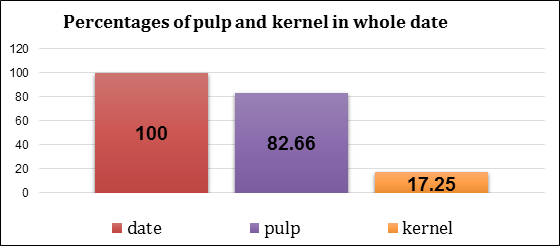
The pulp / core ratio of the date studied is 4.79. This ratio is slightly higher than the Tunisian Kentichi (dry variety), which has a ratio of 4.3 [14] (Figure 1).
Results of Physicochemical and Biochemical Analyzes of the Non-Edible Part «Kernels»
The moisture content of date kernels is 6.38%. This value is consistent with that found by (3), which is 7% for Khalas variety .On the other hand, it is higher than those found by AOAC [15] (2.96 %) for Deglet-Nour variety [8] (3.14%: Mabseli variety, 4.4%: Um-Sallah variety and 5.19% Shahal variety). According to Hamada JS, et al. [3], the water content of date kernels of Khalas, Lulu and Fard varieties is between 7.1 - 10.3 %. The ash content represents the total amount of mineral salts present in the roasted date kernel ,Mech-Degla has 0.8% ash content. This value is found in the range (0.5 to 2%) given by Besbes S, et al. [1], Lowry Oh, et al. [8], AOAC [15]. The total sugar content of date kernels is 4.69% dry matter. Our results are higher then those found by Rahman MS, et al. [4]. 2.98% for total sugars of roasted date pits ; The date kernels contains a quantity of crude protein 5.42% dry matter. This value is similar than those found (5.56%) by Besbes S, et al. [1], (5-6.3%) by Hamada JS, et al. [3], and lower then those found by AOAC [15] (9.37 %) for Deglat-Nour .The yield of the fat obtained by hot extraction is 15.9%. However, this rate is relatively high compared to that reported by Normes françaises [16] for the Allig variety (12.73%) and (10.13%) Deglat-Nour variety [3], for the Khalas variety (13.2%).The crude fiber content of our cultivar is 76.37%, The results of this study are lower than those obtained by Lowry OH, et al. [8] for (79.84 %) Mabseeli, Um-sellah (80.15%,) and (77.75%,) Shahal varieties and also lower then those found by AOAC [15] (77.8 %) for Deglat- Nour but higher then (0.24 %) kentichi and (1.4 %) allig varieties (Table 2).
- Results of physicochemical and biochemical analyzes of the non-edible part “Kernels”
- Humidity level
- 6.38%
- Ash content
- 0.8% pH
- 4.55
- Protein
- 5.42g/100g
- Lipids
- 15.9 %
- Crude cellulose
- 76.37 %
- Total sugars
Table 4: Results of the physicochemical characteristics of
Sensory Analysis Results of the Coffee Substitute
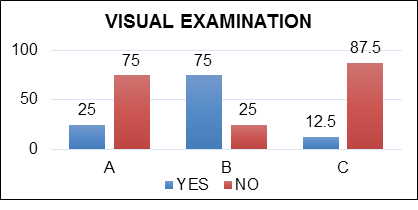
Results of the visual examination: A : Is the cream on the top satisfactory ? B : Is the color of the cream satisfactory ? C : Is the thickness of the cream satisfactory ?
It is noted that 75% of tasters are not satisfied with the cream on the top, however 75% adhere to the color of the cream which is similar to that of normal coffee, almost all 87.5% are not fans of the thickness of this last so for a conclusion of this test the presence and the thickness of the cream are not the strong points of our products but that color has obtained a great satisfaction (Figure 2).
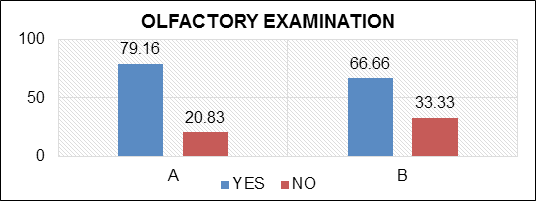
Results of the Olfactory Examination: A : Is the smell without stirring the coffee satisfactory? B : Is the smell after stirring the coffee with a spoon satisfactory?
For the 79.16% olfactory examination adore the smell without stirring the coffee, the percentage decreases a bit after stirring the coffee with a 66.66% spoon, but in general the smell of our product is a strong asset because almost all the tasters adore it (Figure 3).
Tasting Results
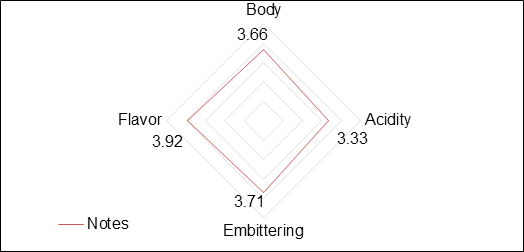
For the body aspect which indicates a strong consistency, velvety sensation, compact, strong in mouth obtained an average of 3.66, the aspect acid, it is the flavor felt on the side and the tip of the tongue obtained an average of 3.33, for the Embittering which means the flavor felt on the flat of the tongue rather at the back of the tongue had an average of 3.71 and in the end, the flavor which obtained the best average of 3.92; a general conclusion of the four aspects studied our products has an appreciation on the part of the tasters which varies between the average and the correct one (Figure 4).
Results of Defects
For the earthy defect most of the tasters perceived that it was absent (83.33%). However for the burned defect is 50% who perceive traces and 25% who opts for the presence of this felt is probably due to excessive roasting (Table 3).
| Absent | Present | Trace | |
|---|---|---|---|
| Earthy (flavor reminiscent of dust) | 83.33% | 4.16% | 12.5% |
| Burnt and / or acre | 25% | 25% | 50% |
Table 5: Results of Defects of the Substitute.
General Discussion of the Tasting Test
The results of this test and the comments of the tasters are very encouraging for this new by-product as it is the first time for most tasters to taste a date-based coffee substitute, but they have showed some enthusiasm, willingness and curiosity about this new product and even in several comments they described their astonishment of the great resemblance to normal coffee.
It should also be noted that our coffee was presented without sugar «nature» to perceive at best these organoleptic characteristics. The only problem is the thickness and the presence of the cream above the substitute but conversely its color is a strong point, for the smell is one of these strengths, it had strong impression on the tasters and even according to the bibliography it is more appreciated, intense and soft than that of the normal coffee.
During the tasting a sip of a few milliliters is enough for a profile of the flavors is gradually developing the acidity and then the Embittering, the sweetness, the body and the length in the mouth are staged. According to our tasters our substitute has an average of 3.66 on its consistency and strength in the mouth «body» this sensation defined as the perception of the texture, the viscosity of coffee in the mouth. It comes from oils, sediments dissolved in water, in short, a very physical perception of the liquid. So we can conclude that our coffee substitute is bodied is an aspect that characterizes a coffee that has the power, with a increased flavor that fills the mouth and gives the impression of filling it, it has a thick consistency.
For the acid aspect our coffee has obtained a correct average of 3.33, the acidity is a flavor sought by coffee lovers that brings freshness on the attack in mouth. This same acidity is therefore the aromatic development of coffee. We often speak of acidity for a coffee.
For the bitter appearance of our substitute had the correct average of 3.71, it should be known that Embittering is one of the primary of the flavor, a aftertaste, mainly detected by the soft palate or towards the back of the stuffy. Although Embittering is desirable up to a certain level, too much bitterness creates an unpleasant taste, especially if it is caused by too much roasting or too fine grinding. In our case we have mastered these two parameters to get in the end a degree of bitterness perfect according to our tasters.
For the flavor of our substitute, it obtained the highest average of the four parameters 3.92, according to our tasters, the flavor refers to the mixture of olfactory and taste perceptions. I like to use the word flavor because it is impossible to dissociate the taste of the perfume. However, it is possible to smell without tasting, but you can not taste without smelling. At least, I do not know how, since a food is in the mouth, its scent goes up to the palate to the nasal cavity. It is this feeling that allows the most poetry since we have both senses stimulated. Our drink is full of aroma and taste that explode in the mouth with a Fruity flavor characteristic, (flavored like a fruit), it is perceived by both taste and smell.
For the two defects indicated in the test there is almost unanimity for the absence of the earthy aspect and for the burned aspect, it is about 75% indicated its perception and it varies from the trace to the presence, it is due to the major part to an excess of roasting.
For a general rating of 14.62 / 20 we can say that our substitute is very good with no defects in terms of the scale of defects.
Scale of Defects
0-3 undrinkable, ..., 3-5 very average, ..., 5-10 acceptable / good presence or trace of defects, ..., 10-15 very good absence of defects, ..., > 15 excellent absence of defect.
In the end we can describe our substitute as Complete ; a coffee substitute that meets all the criteria of a good balance, that is to say an aromatic nose as well as an attack in the mouth in harmony with the middle and the final. It is a coffee substitute with a balance of good acidity and good Embittering.
Conclusion
Algeria is a country traditionally large producer of dates. The dattière production of the marketing year 2008 was 0.5 millions tonnes all confused varieties, 0.9 million tonnes in 2014 and 1.05 million tonnes in 2017 [5].
The objective of this study is the valorization of the cores of dates with commercial low value Mech-Degla by technological processes. It aims mainly a contribution to the safeguard of the phoenicicole inheritance and to bring a supplement of knowledge on the characteristics physicochemical and morphological of the date cores what can contribute to highlight the possibility of their valorization.
The manufacture of succedaneous of coffee containing date core is one of the processes of exploitation of the by- products of the transformation of dates.
The statistical analysis of the results of sensory evaluation of color, odor, savour, flavor and general acceptability reveals that although it is the first time for the majority of the tasters to taste with a coffee substitute containing date core, but they showed a great acceptability
References
-
Besbes S, Blecker C, Deroanne C, Nour-Eddine D, Attia H (2004) Date Seeds: Chemical Composition and Characteristic Profiles of the Lipid Fraction. Food Chemistry 84(4) : 577-584.
-
Hussein AS, Alhadrami GA, Khalil YH (1998) The use of dates and date pits in broiler starter and finisher diets. Bioresource Technology 66: 219-223.
-
Hamada JS, Hashim IB, Sharif FA (2002) Preliminary Analysis and Potential Uses of Date Pits in Foods. Food Chemistry 76(2) : 135-137.
-
Rahman MS, Kasapis S, Al-Kharusi NSZ, Al-Marhubi IM, Khanb AJ (2007) Composition Characterisation and Thermal Transition of Date Pits Powders. Journal of Food Engineering 80(1) : 1-10.
-
Briones R, Luis S, Younes RB, Mondragon I, Labidi J, et al. (2011) Polyol Production by Chemical Modification of Date Seeds. Industrial Crops and Products 34(1) : 1035- 1040.
-
Devshony S, Eteshola A, Shani A (1992) Characterisation and some potential application of date palm (Phoenix dactylifera L.) seeds and seeds oil. Bioresour Technol 67: 291-295.
-
Al-Farsi M, Alasalvar C, Al-Abid M, Al-Shoailya K, Al- Amry M, et al. (2007) Compositional and Functional Characteristics of Dates, Syrups and Their by- Products. Food Chemistry 104(3) : 943-947.
-
Lowry Oh, Rosebrough Nj, Farr Al, Randall Rj (1951) Protein Measurement With The Folin Phenol Reagent. J Biol Chem 193(1): 265-275.
-
Dubois M, Gilles KA, Hamilton JK, Rebers PA, Smith E (1956) Colorimetric method for determination of sugar and related substances. Anal Chem 28: 350- 356.
-
De Castro Md, Garcia-Ayuso LE (1998) Soxhlet Extraction Of Solid Materials: an Outdated Technique With a Promising Innovative Future. Analytica Chimica Acta 369(1-2): 1-10.
-
Reynes M, Bouabidi H, Piombo G (1994) Characterization Of The Main Varieties Of Dates Grown In The Djerid Region Of Tunisia. Fruits (France) 49(4): 289-298.
-
Jemni M, Chniti S, Maachia S, Besma R, Ahmed N (2017) Coffee Of Roasted Kernels of Three Date’s Varieties: Deglet Nour, Kentichi And Alligh 1(1): 1-7.
-
Chaira N, Ferchichi A, Mrabet A, Maherur S (2007) Composition of the Flesh and The Pit of Date Palm Fruit and Radical Scavenging Activity of Their Extracts. Pak J Biol Sci 10(13) : 2202-2207.
-
FAOSTAT (2017) Food and Agriculture Organization of the United Nations Statistics Division.
-
AOAC (1997) Total Dietary Fibre (Applicable to determination of total fibre in cereals, beans, vegetables and fruits). Enzymatic-Gravimetric Method. Accessed 2019 november.
-
AFNOR (1986) Normes françaises NF V 05-108 (1970), NF V 05-101 (1974) , NF V 05- 113 (1972). In: AFNOR Produits dérivés des fruits et légumes. 2ème ed. Lavoisier Techniques et Documents, Paris.
- The Role of Podocyte Apoptosis and the Involvement of SIRT1 in Diabetic Nephropathy
- Dealcoholization of Beer by Osmotic Distillation for the Beverage Industry
- Biopolymer-Based Edible Packaging- Biomaterials, Methods, and Applications in Food Industry: An Updated Review
- Influence of Bioprocessing Methods on 'China Rice' (Gawal R1), and Soyabean Supplementation on the Quality of Complementary Food
- Cassava (Manihot esculenta) Varietal Growth, Yield and Cyanide Content Performance in Three Sites in the South- Eastern Semi Arid Regions of Kenya
- Food Waste Treatment, Recycling, Management and Production of Value-Products-An Update on Methodologies and Current Trends