
SDG 2 - Zeros Hunger & Nut and Cereal Bars Enriched with Tenebrio Molitor Flour
The increase in world population will be accompanied by the need to increase food production, especially protein foods. In the way we produce food today, we are moving towards an increase in areas destined for production, land, and water depletion, and greater greenhouse gas emissions, among other worrying situations. However, if we do not achieve this increase in production, the world will be more susceptible to hunger. An alternative to mitigate this problem is to encourage anthropoentomophagy, that is, to produce insects and develop new foods using edible insects. The production of insects for human consumption can be an important step towards circular agriculture, minimizing the use of land, water, and climate change, increasing efficiency in protein conversion, as well as promoting food security, thus contributing to the SDGs, especially SDGs 2 (Zero Hunger) and 12 (Responsible Consumption and Production). This work aimed to develop five formulations of oleaginous and cereal bars, one control and four with added Tenebrio molitor flour, and sensory analysis. The results of the microbiological analysis showed the absence of pathogenic microorganisms and molds, and yeasts below the value stipulated by Brazilian legislation. The sensory analysis proved that in addition to being possible to produce a product with insect flour, the bars containing T. molitor flour had higher acceptance rates than the control bar (without insect flour), between 73.71% to 77.14%).
Introduction
Protein foods have become an increasingly valuable food component with high global demand, so unconventional sources such as edible insects emerge as an alternative to meet this demand since food security is a socioeconomic and public health priority and is included in the Sustainable Development Goals (SDG) adopted by the United Nations in 2015, in addition to contributing to the transition to a circular economy [1, 2]. In all, 17 SDGs are promoting a universal call to action to end poverty, protect the planet and ensure that by 2030 all people enjoy peace and prosperity. The implementation of the SDGs will balance social, economic, and environmental sustainability [3].
It is estimated that in 2050 the world population will be 9.7 billion and, in 2100, 10.4 billion [4]. Still, according to data from the United Nations, 1.3 billion tons of food are wasted every year, while almost 2 billion people face food insecurity, an increase of 350 million compared to the period before the COVID-19 pandemic is a fact that restricts achieving the goal of UN SDG 2 - Zero Hunger 2030 by Roush K [5] and faced with the current perspective of hunger and land exploitation, alternatives are being sought to overcome the lack of food and nutritional deficiencies and means of production that do not affect the planet so much.
During the pandemic, there was a reduction in food production in the world, and the war between Ukraine and Russia also impacted the supply of fertilizers and further worsened the situation in regions dependent on imports [6].
Siddiqui, et al. [7] report sustainability in insect production, as they use low levels of land and water resources, and produce fewer greenhouse gases, feed on organic waste, which makes them able to significantly reduce environmental pollution and costs of production, in addition to the amount available for human consumption and its expressive feed conversion rate. The efficiency of insects in protein production (37 to 72 g/100 g) is significantly higher when compared to chicken meat (23 g/100 g), cattle (26 g/100 g), and pork (35 g/100 g), meaning a significant reduction in invested resources and food waste [8, 9].
The composition of insects varies according to the species, feeding, development stage (eggs, pupae, larva, or adult), and environmental aspects [10]. Insects contribute to food security and can be part of the solution to protein shortages due to their high nutritional value [11, 12], there is a great challenge to make the insect a substitute for animal meat, and this goes through changes in the behavior of consumption of products of animal origin. There are several barriers to be overcome, including neophobia or reluctance to consume, behavior/prejudice about habits and diets, and food safety [13, 14]. Lack of knowledge about the benefits attributed to insect feeding means that it should be included gradually, in the form of flour, along with other ingredients [2, 15]. For Sriprablom, et al. [16], acceptance of edible insects as food can be promoted by processing them into attractive meals without visible insects or their parts and can be achieved by adding insect meals to familiar foods, developing new products, or imitating commonly consumed products.
Tenebrio molitor has been authorized by the European Food Safety Authority [17] to be used as food in the form of a dehydrated whole insect or powder [17]. With this authorization, there are indications for the growth of a food market niche in the coming years, in which edible insects demonstrate the potential to be one of the best alternative sources of protein to conventional meat.
According to EFSA [17], insects under the condition of new food, in its dry form, snacks, and ingredient in various food products are considered safe given the proposed uses and levels and do not present nutritional disadvantages.
There is a need to meet the individual dietary needs of consumers, and edible insects are promising sources for the development of new products [18], remembering that economic growth and sustainable development require a reduction in the ecological footprint, that is, there has to be a change in the way we produce and consume goods and resources, especially in terms of food waste [19].
Material and Methods
Dehydrated T. molitor was purchased by e-commerce (Terra dos Pássaros – Dois Córregos/SP/Brazil). Upon arrival, they were unpacked and placed in an air circulation oven at 55°C for four hours. Then, vacuum packed and stored in a freezer at -18ºC. For the elaboration of the bars, it was crushed, still frozen. Five different nut and cereal bar formulations were developed using a 2x2 factorial scheme (soy flour X T. molitor flour). The different formulations consisted of a control bar (without incorporation of T. molitor flour) and four formulations incorporating the insect flour (at a 3% - 5% level) (Table 1).
| Ingredients | Control (%) | F1 (%) | F2 (%) | F3 (%) | F4 (%) |
|---|---|---|---|---|---|
| Peanut | 30 | 30 | 30 | 30 | 30 |
| Nuts and dried fruit* | 20 | 20 | 20 | 20 | 20 |
| Cereals** | 15 | 15 | 15 | 15 | 15 |
| Glucose | 15 | 15 | 15 | 15 | 15 |
| Soy flour | 10 | 3 | 3 | 5 | 5 |
| T. molitor flour | - | 3 | 5 | 3 | 5 |
| Raw sugar | 5 | 5 | 5 | 5 | 5 |
| Coconut fat | 4 | 4 | 4 | 4 | 4 |
| Himalayan salt | 1 | 1 | 1 | 1 | 1 |
Table 1: Composition of ingredients in the formulations of oleaginous and cereal bars and the control formulation. *pecan nuts, s
The ingredients were separated into dry (Figure 1a) and wet and weighed according to each formulation, always following the same procedure for the five formulations developed.
In the elaboration process, the binder ingredients (glucose and coconut fat) were added to a non-stick frying pan, starting the heating, and in the sequence, the dry ingredients were added under heating and homogenized until their conglutination. Afterward, they were spread in an aluminum mold greased with a culinary release agent and on a sheet of parchment paper. The dough was compacted and shaped into bars, which were later cut, placed in individual packages, sealed, and stored at room temperature (https:// youtu.be/MBMSkqz6yJo) (Figure 1b).
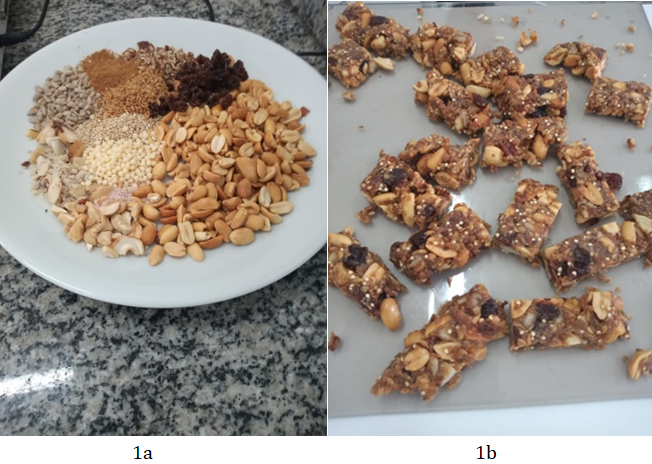
Source: Authors Figure 1: a) Dry ingredients used in the formulation of oleaginous and cereal bars; b) Oleaginous and cereal bars being prepared for sensory analysis.
For greater food safety of the product to be offered to judges, microbiological analysis was performed before the sensory evaluation and followed the BAM [20] methodology, which was: Salmonella/ 25 g, Escherichia coli/ g, and molds and yeasts/ g.
The sensory analysis of the bars was carried out by a semi- trained team of 23 judges who have participated since 2019 in the Project “Edible Insects: consumer perception”, CAAE nº 6727018.4.00005346 (Research Ethics Committee of the Federal University of Santa Maria). After signing the Free and Informed Consent Form - FICF, the judges evaluated the following attributes: color, aroma, flavor, texture, and overall appearance, using a structured 7- point scale (1 = disliked very much and 7 = liked very much), in individual sensory booths at the CCR/UFSM Sensory Analysis Laboratory. About 20 g of each sample was presented to the judges in a balanced monoadic form in white plastic dishes marked with three random digits, along with a glass of still mineral water at room temperature and a cream cracker biscuit to clean the palate. The results were evaluated by Analysis of Variance (ANOVA) and Tukey’s test (5%) for comparison of means [21]. The acceptability index was calculated based on the expression: AI (%) = A x 100/B, where A = average score obtained for the product, and B = maximum score given to the product.
Results and Discussion
The results for the microbiological analysis were satisfactory, that is, they showed the absence of bacteria Salmonella/25g and E.coli/g and count 101 for molds and yeasts, being, therefore, fit for human consumption, as recommended in IN 161/2022 [22].
Our research group analyzed the protein content of T. molitor larvae and found levels of 50.63 g/100 g of protein [9], indicating that this insect has a considerable supply of proteins. Table 2 shows the average sensory evaluation scores of the bar formulations developed and analyzed by 23 semi- trained judges.
| Control | F1 | F2 | F3 | F4 | |
|---|---|---|---|---|---|
| Color | 5.4±1.24a | 5.7±1.26a | 5.6±1.03a | 6.0±0.67a | 5.8±1.09a |
| Aroma | 4.8±1.37a | 5.2±1.04a | 5.2±1.15a | 5.3±1.03a | 5.2±1.15a |
| Flavor | 5.0±1.38a | 5.5±1.08a | 4.9±1.39a | 5.0±1.66a | 5.1±1.31a |
| Texture | 5.1±1.63a | 5.0±1.30a | 4.6±1.34a | 5.3±1.18a | 4.9±1.49a |
| Overall Appearance | 5.2±1.34a | 5.4±0.84a | 5.5±1.08a | 5.4±1.50a | 5.2±1.03a |
| Acceptance Index (AI)(%) | 72.86 | 76.57 | 73.71 | 77.14 | 74.86 |
Table 2: Mean scores of sensory attributes of oleaginous and cereal bars prepared with soy flour and T. molitor flour.
The results showed that was no significant difference between the attributes of color, aroma, flavor, texture, and general appearance in the tested formulations. The scores of the control formulation remained below the scores of the formulations with T. molitor. It was observed that the color and aroma attributes in the control formulation, made only with soy flour and without T.molitor flour, obtained the lowest scores of the other formulations (F1, F2, F3, and F4).
The AI was performed based on the scores obtained in the acceptability test, that is, for a product to be accepted by the judges, it must reach a percentage greater than or equal to 70%. Table 2 shows the AI values, where all evaluated formulations reached values between 73.71% and 77.14%. In Table 2 it can also be seen that the formulations with T. molitor flour had higher AI than the control formulation.
Sriprablom, et al. [16] used T. molitor flour in the preparation of cookies and observed that the greater the addition of insect flour, the greater the nutritional values, however, the average scores of the sensory analysis of the prepared products were inversely proportional to the increase in flour. In our study, we noticed that in terms of flavor, although there was no significant difference, there was a tendency for better flavor in formulations with similar concentrations of soy flour and T. molitor (F1 = -1 -1 and F4 = +1 + 1) and an improvement in color in the formulations with T. molitor (when compared to the control formulation).
Conclusion
The use of edible insects in the development of new products such as oleaginous and cereal bars appears as an opportunity to be explored to achieve goals 2 and 12 of the SDG, that is, available food and the establishment of economic, environmental and social sustainability through the circular economy. The bars developed had an acceptance rate of over 70%, indicating that they would have good acceptance in the consumer market. The creation of a protein bar from insect flour brings nutritional benefits to the consumer, as it is an alternative to replacing conventional proteins. The continuity of studies focused on this topic is extremely important for obtaining healthier foods that contribute to the Sustainable Development Goals (SDGs), mainly SDG 2 (Zero Hunger and Sustainable Agriculture) and 12 (Consumption and Production Responsible).
Conflict of Interests
The authors declare that the research was conducted in the absence of any commercial and financial relationships that could be interpreted as a potential conflict of interest.
References
-
FAO (2021) Food and Agricultural Organization of the United Nations. Looking at edible insects from a food safety perspective. Challenges and opportunities for the sector. FAO, Rome, Italy.
-
Schardong IS, Freiberg JA, Santana NA, Richards NSPS (2019) Brazilian consumers’ perception of edible insects. Ciência Rural 49(10): e20180960.
-
Lange KW, Nakamura Y (2023) Potential contribution of edible insects to sustainable consumption and productions. Front Sustain 4: 1112950.
-
UN (2022) World Population Prospects 2022. United Nations Department of Economic and Social Affairs Population Division, NY, USA.
-
Roush K (2023) Global Hunger. AJN 123(1): 17-18.
-
FAO (2022) The State of Food Security and Nutrition in the World 2022. Food and Agricultural Organization of the United Nations, Rome, Italy.
-
Siddiqui AS, Alvi T, Sameen A, Khan S, Blinov AV, etal. (2022) Consumer Acceptance of Alternative Proteins: A Systematic Review of Current Alternative Protein Sources and Interventions Adapted to Increase Their Acceptability. Sustainability 14(22): 1-19.
-
Menezes EA, Oliveira AF, França CJ, Souza GB, Nogueira ARA (2018) Bioaccessibility of Ca, Cu, Fe, Mg, Zn, and crude protein in beef, pork and chicken after thermal processing. Food Chem 240: 75-83.
-
Pedroso MAP, Schardong IS, Jiménez MSE, Boff JS, Bernardi O, et al. (2022) Teor de proteína: Tenebrio molitor & Chrysodeixis includens. Open Science Research 3: 337-351.
-
Piña-Domínguez IA, Ruiz-May E, Hernández-Rodríguez D, Zepeda RC, Melgar-Lalanne G (2022) Environmental effects of harvesting some Mexican wild edible insects: An overview Front Sustain. Food Syst 6: 102186.
-
Patel S, Suleria HAR, Rauf A (2019) Edible insects as innovative foods: Nutritional and functional assessments. Trends Food Sci Technol 86: 352-359.
-
Ojha S, Bekhit AED, Grune T, Schlüter OK (2021) Bioavailability of nutrientes from edible insects. Current Opinion in Food Science 41: 240-248.
-
Abril S, Pinzón M, Hernández-Carrión M, Sánchez- Camargo ADP (2022) Edible Insects in Latin America: A Sustainable Alternative for Our Food Security. Front Nutr 9: 904812.
-
Ismail BP, Senaratne-Lenagala L, Stube A, Brackenridge A (2020) Protein demand: review of plant and animal proteins used in alternative protein product development and production. Anim Front 10(4): 53-63.
-
Dicke M (2018) Insects as feed and the Sustainable Development Goals. Journal of Insects as Food and Feed 4(3): 147-156.
-
Sriprablom J, Kitthawee S, Suphantharika M (2022) Functional and physicochemical properties of cookies enriched with edible insect (Tenebrio molitor and Zophobas atratus). Food Measure 16(3): 2181-2190.
-
Turck D, Castenmiller J, Henauw SD, Hirsch-Ernst KI, Sian A, et al. (2021) Safety of dried yellow mealworm (Tenebrio molitor larva) as a novel food pursuant to Regulation (EU) 2015/2283. EFSA Journal 19(1): 6343.
-
Isa NK, Osuga IM, Subramanian S, Ekesi S, Emmambux MN, et al. (2022) Effect of drying methods on the nutrient content, protein and lipid quality of edible insects from East Africa. Journal of Insects as Food and Feed 8(12): 1-14.
-
Moruzzo R, Mancini S, Guidi A (2021) Edible Insects and Sustainable Development Goals. Insects 12(6): 1-9.
-
BAM (2001) United States Food and Drug Administration and Association of Official Analytical Chemists International. 8th(Edn.), Bacteriological Analytical Manual, Arlington, Texas, USA, pp: 946.
-
Lawless H, Heymann H (2010) Sensory Evaluation of Food Science Principles and Practices. 2nd(Edn.), Ithaca, New York.
-
ANVISA (2022) Normative Instruction No. 161, of July 1, 2022. Establishes microbiological standards for food, National Health Surveillance Agency, Brazil.
- The Role of Podocyte Apoptosis and the Involvement of SIRT1 in Diabetic Nephropathy
- Dealcoholization of Beer by Osmotic Distillation for the Beverage Industry
- Biopolymer-Based Edible Packaging- Biomaterials, Methods, and Applications in Food Industry: An Updated Review
- Influence of Bioprocessing Methods on 'China Rice' (Gawal R1), and Soyabean Supplementation on the Quality of Complementary Food
- Cassava (Manihot esculenta) Varietal Growth, Yield and Cyanide Content Performance in Three Sites in the South- Eastern Semi Arid Regions of Kenya
- Food Waste Treatment, Recycling, Management and Production of Value-Products-An Update on Methodologies and Current Trends