
Value Chain Analysis of Banana in Dhanusa
Banana is one of the most commercial fruits of tropics distributed in terai to mid hills of Nepal and has been expanding in commercial scale with good potentiality of job creation, income generation and development of several enterprises in its forward and backward linkages. It has ample scope of import substitution from as Nepal imports huge amount of banana in recent years from India. This study has aimed to accomplish the objectives of assessing comprehensive value chain analysis, value chain alliance and financing of banana sub-sector in line with the PAF’s future strategy. Both quantitative and qualitative methodologies were used to collect and analysis primary and secondary data pertaining to the study from different sources using FGD, desk review, KII and field observation. The major strengths for this sub-sector are good potentiality for scale up to meet excess domestic demand which has been limiting by some weakness like lower productivity, smaller volume of production, heterogeneous quality of the produce, Lack of collective marketing, poor bargaining power and haphazard use of pesticides. It was estimated that banana sub-sector can generate annual income of about NRs. 95.8 millions in national level from PAF intervention areas, contributed from NRs. 31.9 million initial investments. Insurance premium cost required to bear by the farmers after getting subsidy from government was estimated about NRs. 0.4 million. Additionally, banana producers require loan fund of about NRs. 11 million to operate the business besides their own PAF CO fund of about NRs. 21.3 million. These estimates were made from the viewpoint of generating about one thousand plus employment in the production of this commodity in PAF area. The estimated volume of physical product was about 1526 MT which can sustain 2 SMEs with the full time employment of 21 persons. Return to investment was estimated at 196.3%, which is sufficiently large to reflect the financial feasibility of banana production. Market share of banana production from 5005 benefited households in the PAF area will account 0.6% of total national market with B: C ratio of 3. The balance fund available for funding in studied PAF based CO is NRs. 1.5 million and is lending operational loan in different productive purpose including banana production to its member at 12% rate of interest. It was estimated that farmers can absorb loan size of up to NRs.100000 per year per farmer based on their risk bearing potential. The COs operating in Dhanusa district have planned to form a district level cooperative coordinating all 17 community organizations in the district for the purpose of enhancing loanable fund. None of the farmers have adopted the insurance scheme and deprived sector loan facility in the study area. But, banana growers are now gradually thinking about the adoption of such insurance scheme and loan facility to expand area under banana plantation. Key gaps in the inputs and services provision level of value chain are lacking supply of timely and quality inputs, little or no monitoring of market, lacking bare foot agro-vets and small volume of investment. Similar gaps for production stage are lack of business and technical management skills, saplings and Small volume of credit. Whereas, collectors are facing the problem of heterogeneous quality of the product producing at scattered geographical region, collecting the product with-out completing pesticides waiting period and daily price fluctuation. Consumers at end market are facing the problem of high price, unhygienic market environment, high residue of pesticides, lacking label and branding of the product. The study has identified some suggestions in terms intervention areas from its findings. Possible intervention for value chain, marketing level are to train leader commercial farmers in marketing of inputs and outputs, dissemination of marketing information from electronic media likes mobile based apps, develop loan product for market related activities, introduction of collective marketing, establishment of linkage with big markets and star hotels and establishment of quality standard for PAF branding. Value chain financing at the level of processing industries, intermediaries, collectors and traders can be intervened through training and education to traders operating in different stages of value chain, establishment of warehouse, introduce loan product appropriate for intermediaries, lobbying with financial institutions to release loan for processing industry, foster collaborations with line ministries and allied departments and introduce technology and digital platform to promote market linkage. To the sum up, different value chain activities of banana sub-sector are potential for scaling up with possible adoption of different suggestions on technical, financial, alliance and administrative aspects in joint efforts of different stakeholders working in this sub-sector.
Introduction
Banana (Musa Spp) is one of the most commercial fruits of tropics distributed in terai-siwalik and mid hills of Nepal where rainfall intensity is high and medium, respectively. Banana is being grown since time immemorial in home yards for the home consumption purpose in Nepal [1]. Initially it was being grown for household consumption in some styles of home gardens like the multi-layered kitchen gardening component crop Tiwari, et al. [2] but, now it has been expanding in commercial scale even in marginal land with medium to high productivity which has good potentiality of job creation, income generation and development of several enterprises in its forward and backward linkages.
Small number of farmers has stepped towards the cultivation of High Value Crops (HVC) and other commercial crops in Nepal. The B/C ratio of banana is 2.35, which is higher as compare to other staple crops [3]. In spite of this high benefit, farmers are reluctant to increase area under HVC cultivation. This is mainly associated with higher risk associated in production and marketing; lack of credits, appropriate infrastructure, weather vagaries and high initial investment. Banana is positioned third in production and fifth in territory among fruit crops in Nepal [4, 5, 6]. In Nepal it has been successively growing in Chitwan and Kanchanpur districts. However, farmers in other districts like Jhapa, Sunsari, Kailali and Nawalparasi are cultivating banana at medium to high commercial scale.
The domestic demand of banana is increasing every year in Nepal because of increasing population, rising per capita income and increasing awareness about its nutritive value. However, the expected rate of growth in terms of area and production has not yet been achieve because of inconsistent demand coupled with lack of coordination between production, marketing and value addition. At present about
58% banana market is sharing by Indian banana in Nepal. Lack of inputs, disease free saplings, insufficient agricultural credit, improper post-harvest handling, price variation and poor bargaining power are the constraints remaining on banana cultivation [7]. The government has formulated several policies and programs for the commercialization of agricultural sector. But most of them seem to have been limited only to policy and not be able to show real impact on the farmer’s level. So, most of the farmers have been adopting less profitable, traditional production practices which are characterized by high cost of production, low productivity and low profitability.
The fourteenth plan of the Government of Nepal has its objective of reducing poverty level in Nepal from 21.6% to 17% [8, 9, 10]. In spite of noticeable progress achieved over past decade, there still 24.3% poverty in rural areas. Similarly, PMAMP has its target to become independent in banana within 7 years [11]. So to become independent on banana production and reducing the poverty in the country, farmers should encourage on banana cultivation. Banana cultivation is emerging as one of the major commercial crop in Nepal in spite of different associated risks in production and marketing. The major risk associated with the banana crop are wind, disease, hail, pest, flooding, water lodging, price fluctuation, lack of insufficient credit, poor access of farmers to insurance facilities and many more. This study will help to drag out the actual scenario of production, marketing and value addition of banana in the country and will identify its feasibility from the perspective of value chain alliance and financing.
Value Chain Mapping
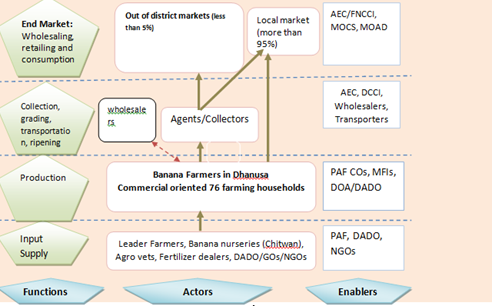
Banana is the potential high value commodity in Nepal and PAF has identified banana sub-sector value chain development in Dhanusa district using three community organizations for adopting banana Plantation in commercial scale. This study has objective to focus on value chain development analysis of banana in Dhanusa district but the production of the crop in PAF intervention area has just started and thus the general form of value chain considering the aggregate of major production areas was dealt here. The production and distribution process involves input supply/ service provision, production, transportation/collection, processing, packaging and marketing both for local, regional, national domestic as well as export market (in India). The required inputs are either supplied by local agro-vet, leader farmers (nursery) and fertilizer distributors or imported from India in Dhanusa.
Value chain Mapping of Banana has been developed using Focus Group Discussion (FGD) and review of literature available in Nepalese context [12, 13]. The mapping of banana sub-sector is presented in Figure 1. Enabling business environment, market chain actors and inputs/service providers details profile have been developed during market mapping of banana. Dhanusa district has high possibilities of agricultural commercialization because of suitable climate, favourable soil and infrastructural development. District Agricultural Development Office (DADO) has identified the potentiality of commercialization of banana in some areas with well-drained soil conditions. Bananas are cultivated more than 10 ha land in PAF Cos area in the district. Banana cultivation is mainly focused in Laxminiya Rural Municipality Ward No. 2 of Dhanusa. All banana producers have adopted the production in more 4 Katthas of land using own area as well as leased in. Banana plantation has just started to give yield from this year and they were receiving good market in the local city, Janakpur to sell banana fruits and whole miniature plant for religious purposes. The area allocated for banana production is relatively marginal with well availability of underground irrigation system and proper drainage. This area has good scope for further expansion of the production in commercial scale after facilitating the lease in of public and private land, credit availability, Insurance, strengthening of agrovets and sapling suppliers. The producers are relatively new to this business and they have realized intensive training on different production and market aspects to increase their efficiency in coming days.
Few collectors have initiated to approach banana producers to collect product and demand. This is because of small scale of their production in these initial days of production in study area. Collectors sold the product in Janakpur to the wholesalers with the margin of about 20-30%. Farmers are receiving about NRs. 200 price for per bunch of banana from collectors. With the expansion of production, producers have thought to register banana producing Cos in cooperative to facilitate input supply and marketing of the product in collective manner. Major banana wholesalers are found in Janakpur area and they receive the product mainly from India. About 60% of total trade of banana for wholsale comes from India and few of them have started to receive the product from PAF CO area.
Almost 100% of the initial production obtaining from PAF Cos was found absorbing in Janakpur area. It is religious Mithila region with well demand of the product and banana plants for different cultural functions like Chhat. During the peak period of harvest of banana, producers have thought to place temporary stall in anakpur, Dhaklebar and Janapur- Dhalkebar road corridor to sell the product directly to the consumers. Nevertheless, major cities of Koshi West Terai like Janakpur, Lahan, Birjung, Chapur and Gaur are the potential niche markets for the banana produced in Dhanusa. None of the banana actors and producers has initiated the banana processing and other value addition activities in the area except artificial ripening of the product in wholesalers’ level. There is good scope of opening banana restaurants, banana park with picnic spots and establishment of banana based small and medium enterprises for making banana chips, banana powder/flour and banana fibers.
Local agrovets, banana sapling producers in Chitwan, leader farmers, DADO and PAF are the major input suppliers in Dhanusa. Banana producers have received credit input from PAF channelized through respective COs and this is about NRs. 30000 per producer household. Banana producing leader farmers located at Chitwan are providing banana suckers/saplings and other technical services (in phone contact) to the farmers whereas DADO has been providing initial level of technical services to the farmers to solve production problems specially related to insect pest management. Besides credit input, PAF has also supported the farmers to establish the deep boring for irrigating banana crop. Local agrovets located at Janakpur are supplying the production inputs like fertilizers, pesticides, insecticides and technical consultation as well to the best of their expertise. Other organizations like DCCI, commercial banks, microfinance institutions, local NGOs and farmers group have planned to supply different inputs respective to their area of functioning with the initiation of this crop production through the assistance from PAF.
Different organizations and policies like PAF, DCCI, DADO, Banana Producers Association at national level, Government Polices like certification through Good Agriculture Practices (GAP), IPM adoption in banana farming, other certification scheme (organic, participatory, faire trade) as well as Agriculture Development Strategy (ADS, 20 years agriculture Vision) and infrastructure like storage facility, processing units, grading, labelling , value chain development of banana are the major enabling business environment actors in favour to banana farming and marketing. Local government units are also planning to support commercialization of high value cash crops like banana through input support, infrastructure provision, market promotion and awareness in these recent days. Banana producers in PAF area has also decided to form a Banana Producers’ association at local and district level to facilitate different production, marketing, processing and policy lobbying activities.
Analysis of Opportunities and Constraints
The SWOT analysis was carried out to explore the strength, weakness, opportunities and threats associate with production, marketing and value chain upgrading of vegetable sub-sector in PAF intervention area. The details of these aspects are presented in Table 1.
| Production | |
|---|---|
| Strengths | Weakness |
| Adequate underground irrigation facility, year round employment to own farm labour, potential of utilizing large scale abundant land in terai region, proper scope for integrating in to value added products, operating loan available from COs, opportunity for adopting intercropping and bund cropping, short cropping season, available inputs in nearby areas, good proportion of income from selling banana saplings in local producers and for religious purposes. | Poor knowledge of technical aspects, non- adoption of subsidized insurance about the insurance scheme, poor exposure to latest technologies like small machineries, small volume of production, lack of collective marketing, Poor access and interest on market information, lack of disease free seedlings at community level, inability of farmers to grade the product and value addition, non-adopting wind breaks. |
| Opportunities | Threats |
| Suitable climatic regime and soil condition for banana production in terai region, growing producers of tissue cultured banana saplings, increasing external and market economies of scale, availability of high yielding and disease resistant hybrid varieties, growing urbanization and purchasing power of the people, scope of heavy import substitution from India, banks, NGOs, INGOs and communication technologies, attracting youth including abroad migrated returnees. | Low productivity resulted high per unit cost of production, weather risk, price risk, land fragmentation due to rapid urbanization, risk of strike and political instability during peak harvesting season, unacceptable rural land as loan collateral, lack of value adding technologies in national and local context, lack of processing and storage, poor attraction of youth in farming enterprises, high risk of disease and insect incidence. |
| Marketing | |
| Strengths | Weakness |
| Commercial farmers concentrated in a production pockets facilitating collective marketing, increasing approach of traders and input suppliers in the producing locality, good trust between producers and traders regarding payment. | Inability to get reasonable price, variation in the quality of the product high transport cost for bulky product, poor bargaining power, sale of product in credit, insufficient market information, lack collective marketing, lack of collective marketing, lack of year round transportation facility and risk of on the way ripening during long transportation. |
| Opportunities | Threats |
| Fetch better price during festival period, availability of surplus domestic market, favourable national policies for promotion of marketing and transport, import substitution opportunity, possibility of adopting collective marketing, surplus production for establishment of value adding product from sorting poor grade, Potentiality for establishing banana based fiber processing plants. | Price fluctuation, Tough competition with Indian product arriving in lower price, high risk of ripening in distant transportation, inefficient market information system delivery mechanism, poor producer’s share in retail price, strike and road blockade, unregulated market system, poor linkage among marketing stakeholders, difficult to change ripening time in peak production season. |
| Value chain upgrading | |
| Strengths | Weakness |
| Good edapho-climatic condition, availability of COs and MFIs for micro credit, facilitating the production process through number of NGOs and INGOs, availability of latest production technologies including tissue culture lab in local market. | Manually operated high cost of production, haphazard us of pesticides, heterogeneous product quality and unacceptable land from rural areas as loan collateral, lack infrastructures for collection, storage and processing. |
| Opportunities | Threats |
| Scope of promoting mechanization in production and grading of the product to fetch better price, processing of surplus and poor grade product of peak season production; train agrovets, dealers, local technical cadres and middlemen; potential of increasing loan type and volume in banana sub-sector, reduction in the length of channel through collective marketing, increasing competition among transport companies. | Priority of lending sector in non-agricultural sectors, competition with international products in big markets and star hotels, Potentially high pesticide residue, high cost of production, poor networks among producers-enablers-service providers, involvement of outsiders middlemen in value chain activities. |
Table 1: SWOT analysis of production, marketing and upgrading of banana sub-sector.
Gender Integration in Value Chain Development
Nepal is predominantly an agricultural country and workforce in this sector is mainly women. Approximately 80% of the agriculture workforces are women due to out- migration of men to abroad for better job opportunities in the study areas. About 90% of PAF beneficiaries are from poorest of the poor whereas 80% CO members are women. About 78% of women and 28% of Dalit are in leadership position in PAF’ COs. In PAF pocket product intervention areas for enterprises development, about 65% CO members are women. Women often play important roles in value chain and play a key role in upgrading strategies. Gender inclusion in different stages of value chains were studied in FGDs and face to face interaction with the key persons and stakeholders in this study. It was found that about 80% of COs’ members are women and they are significant parts of decision making regarding the planning of activities in COs. Women were found to involve mainly in carrying and application of FYM, land clearing, transplantation and minor intercultural operations. It was found that banana production demand men labour more intensively than women and it was because of the stamina required for the operation of those field level activities like pit digging, earthing up, staking, re-standing of wind lodged plants, pesticide application and harvesting. Nepalese predominant Hindu norms banned the involvement of women in banana planting and harvesting. Farmers sell their product from farm gate to collectors and in the case of misuse of income receipt, women control over the income during the receipt from collector. Most of the decisions regarding the production and sale were made jointly in gender unbiased participatory manner at household level. In this context of more men labour requirement nature of the enterprise, the involvement of women can be more increased in grading, packing, labelling, processing, and opening of banana retail hub in highway corridors. Women participation in banana production is increasing however, there are still various factors limiting and constraining the involvement of women. Women involvement in banana groups is limited by various constraints such as lack of time, awareness, and knowledge of taking care of banana plantations and the belief that banana planting and harvesting are men’s activity.
Both men and women in general not restricted while accessing to the enabling factors at macro level as it could be reflected in terms of cultural settings, values and norms. General belief and value of male member’s domination in accessing to the enabling factors are slowly changing also in the favour of female members in the family due to feminization in agriculture sector. In comparison to men, women face higher disadvantages in terms of mobility, access to productive assets, and access to market information with the result that they find it difficult to access and maintain profitable market niches and capture a larger slice of income for the household. Good governance is essential in order to empower actors in the value chain. It is possible by assuring adequate access to basic production inputs, credit, capacity building, and market information among others. Summing up these discussions, the involvement of women can be empowered as chain actor, activity integrator, and chain partner and chain owner in value chain development of banana with effective intervention in capacity building and financing.
Conclusion and Recommendation
Banana farming is the emerging new farming and agribusiness sub-sector in Dhanusa district. This has made possible through the institutional, financial and technical intervention of PAF. The national trend of increase in area, production and productivity of banana is in increasing rate. This can support the import substitution of the product mainly arriving from India. The preparation and analysis of cost structure, value chain map and SWOT has shown that it is very potential and profitable subsector being supported by numbers of input suppliers, service providers and other enablers. In addition to these banana production and allied value addition activities are highly potential to generate surplus farm employment and income in eco-friendly manner.
Grounded on the empirical findings of the study, following recommendations are suggested.
- Provision of disease free suckers from tissue culture lab, increased adoption of insurance scheme and banned on fragmentation of agricultural land is essential for promoting commercialization of banana through-out the terai and siwalik region of Nepal.
- Latest technologies including high yielding varieties and mechanization are to be promoted for increasing cost competitiveness of domestic banana with imported ones from India.
- Agricultural support like trainings, access to credit, awareness programs and insurance should be provided to farmers for inspiring them to access institutional deprived sector loan facility.
- Documentation process and claim settlement process should be made easy by the non-life insurance companies.
- It can be recommended that youths should be integrated in commercial banana farming as better alternative for foreign employment.
- Further research on cross-comparison of banana production using different varieties and location should be carried out to assess the comparative advantage and relative efficiency,
- Further research on willingness to sell insurance scheme by non-life insurance companies on banana farmers.
- Educate farmers about agricultural credit with interest subsidy (only 5%) and advocate allocating such credit fund in the branches where farmers are too poor to obtain regular loans. Bank should not reject loans due to the remoteness of the collaterals that farmers are pledging to obtain loans. In order to minimize cost, Bank can use cooperative for collateral valuation and also timely repayment
- Where possible, bank should provide whole loans to the cooperative which will be retailed to farmers only
- All agricultural loans to be disbursed from cooperatives must be insured and the amount of premium (only 25% of the total premium amount) must be deducted from the loan approved
- Since PAF cooperative are weak and not yet ready for commercial loans, PAF can play role to guarantee commercial banks that want to offer wholesale loans to the PAF cooperative and this guarantee is only for one loan cycle or one year whichever is less.
References
-
Gautam DM, Dhakal DD (1994) Fruit and Plantation crops in Nepal. IAAS, Nepal.
-
Tiwari S, Thapa RB, Gautam DM, Shrestha SK (2006) Survey of banana stem weevil Odoiporus longicollis Oliv Coleoptera Curculionidae in Nepal. J Inst Agric Anim Sci 27: 127-131.
-
MoAD (2014) Agribusiness Promotion and Marketing Development Directorate.
-
CBS (2016) Statistical information on Nepalese Agriculture. Central Bureau of Statistics, Kathmandu, Nepal.
-
CBS (2011) Information on Agricultural Statistics. National Planning Commission.
-
CBS (2014) Statisitcal Information on Nepalese Agriculture. Central Bureau of Statistics, Kathmandu, Nepal.
-
Thakur RJ (2016) Impact of Agricultural Credit on Banana Production in Chitwan District. Agriculture and Forestry University, Rampur, Nepal.
-
MoAD (2015) Fourteenth Periodical Plan. National Planning Commission, Kathmandu, Nepal.
-
MoAD (2015) Krishi Diary. Agriculture Information and Communication Center, Lalitpur, Nepal.
-
MoAD (2015) Statisitical information on Nepalese agriculture. Agribusiness Promotion and Statistics Division, Singha Darbar, Kathmandu, Nepal.
-
MoAD (2017) Krishi Diary. Agriculture Information and Communication Center, Lalitpur, Nepal.
-
MoAD (2013) Statistical information on Nepalese agriculture. Agribusiness Promotion and Statitstics Division, Singha Darbar, Kathmandu, Nepal.
-
MoAD (2016) Statistical Information on Nepalese Agriculture. Agribusiness Promotion and Market Devlopment Directorate, Lalitpur, Nepal.
- The Role of Podocyte Apoptosis and the Involvement of SIRT1 in Diabetic Nephropathy
- Dealcoholization of Beer by Osmotic Distillation for the Beverage Industry
- Biopolymer-Based Edible Packaging- Biomaterials, Methods, and Applications in Food Industry: An Updated Review
- Influence of Bioprocessing Methods on 'China Rice' (Gawal R1), and Soyabean Supplementation on the Quality of Complementary Food
- Cassava (Manihot esculenta) Varietal Growth, Yield and Cyanide Content Performance in Three Sites in the South- Eastern Semi Arid Regions of Kenya
- Food Waste Treatment, Recycling, Management and Production of Value-Products-An Update on Methodologies and Current Trends