
Physico-Chemical, Mechanical, Microstructural, and Antioxidant Properties of Chickpea Protein-Based Composite Bioactive Film
Chickpea protein concentrate (CPC) was used in the preparation of edible bio-films. Glycerol and sorbitol, with a different ratios, were used as plasticizing agents. Physico-chemical, microstructure, and mechanical properties of CPC-based biofilms plasticized with glycerol (G100), sorbitol (S100), and a mix of glycerol and sorbitol (G50/S50) were investigated. G100 showed the highest hydrophilicity, solubility, and the lowest thickness compared to S100 and G50/S50. The mechanical properties analysis revealed that (G50/S50) possessed the highest elongation at break and tensile strength. All observed differences were attributed to the interactions between protein and plasticizer which were evaluated by FTIR. In addition, G100, S100, and G50/S50 films demonstrated high antioxidant activity.
Introduction
The improvement of biodegradable and/or alternative edible films to partly or substitute synthetic polymers gained an incessant research interest. Packaging materials based on biopolymers normally are produced from polysaccharides, proteins, lipids, or their blends and may also be useful as oxygen, aroma, moisture, and lipid barriers that improve the shelf life by reducing its deterioration [1]. Protein-based edible films are used as potential sources for synthetic packaging and have been characterized by many researchers. In this context, whey, soy, sesame, and casein protein have been widely used as substitutes in food Packaging [2, 3, 4, 5]. The structure, flexibility, and workability of films can be ameliorated with the addition of a plasticizer to the film-forming solutions. Plasticizers strongly expand and mollify the film structure and decrease cohesion within the film by it’s introducing between polymer molecular chains.
Polyols are usually employed as plasticizers. For example, glycerol and sorbitol have been used for the production and improving the mechanical properties of protein-based edible films [6]. Additionally, the modification of plasticizer type and concentration undoubtedly affected the ability of the films to fix water, subsequently, the films’ properties [7]. It should be noted that the formation of a good biopolymer films depends on its miscibility and compatibility, an appropriate amount for plasticization as well as its number of free hydrophilic hydroxyl groups [8, 9]. Nonetheless, there is a large interest to identify more resources as alternative materials in the production of edible films and occasion to reduce the utilization of plastics by the food industry. Chickpea seed (Cicer arietinum L.) has increased its importance as a crop worldwide owing to its characteristics. In fact, chickpea contains 20-25% protein and is widely used as a human food source. It is among the most economical origins of plant proteins [10]. Chickpea protein concentrates (CPC)
are normally prepared by isoelectric precipitation. CPC is very stable to heat and contains large quantities of arginine. This protein concentrate might be used in the food industry for its water-holding capacity and viscosity [10]. So far, no work reported using CPC for the formation of edible films for packaging applications and no reports are available on the effect of plasticizer type and concentration, on physico-chemical, barrier, optical and mechanical properties of the films based on CPC. To the best of our knowledge, this is the first research that discusses the use of CPC as the principal raw material to produce novel biodegradable edible films and the impact of the plasticizers (glycerol and sorbitol) on the physical, mechanical, and structural properties of these edible film.
**Materials and methods**
**Chemical Products**
Solvents used in this study were of analytical grade and all chemicals were purchased from Sigma Chemical Co. (St. Louis, MO, USA).
**Preparation of Films**
Protein extract powder was obtained by the method described by Ghribi, et al. [10]. To prepare film forming solutions, CPC was dissolved in distilled water to reach the final concentration of 60%. Different level of plasticizer was used (10 and 15%). The employed plasticizer was glycerol (100%), Sorbitol (100%), and a mixture of glycerol/sorbitol (50%/50%). The film forming solutions were incubated at 25°C for 30 min with gentle stirring. For all formulations, 20 mL of each solution was spread on a rimmed silicone resin plate, air-blown for 12 h, dried at a temperature of 60°C, and finally peeled off. The obtained films referred to as G100, S100, and G50/S50 were subjected to analyses.
**Characterization of CPC-Based Biofilms**
Moisture Content: The moisture content of CPC-based biofilms was evaluated by drying small pieces of G100, S100, and G50/S50 in a ventilated oven at 105°C until constant weight [11].
Water Activity: Water activity was measured at 25°C using a Novasina aw sprint TH-500 apparatus (Novasina, pfaffkon, Switzerland).
Biofilm Water Solubility: Dried pieces of G100, S100, and G50/S50 were submerged in 50 mL distilled water and shaken for 24 h in an incubator at 25 °C. The pieces were taken out and re-dried (105 °C for 24 h) to determine the weight of the dry matter. Film-water solubility (FS) was evaluated according to the following equation:
$$FS(\%) = \frac{Wi - Wf}{Wi \times 100}$$
Where Wi was the initial weight expressed as dry matter and Wf was the weight of the undissolved film.
Water Sorption Isotherms: Water sorption isotherms were obtained by the method of Eghbal, et al. [12]. Small film pieces (30 mm x 40 mm) were placed in pre-weighted cups equilibrated in hermetically sealed flasks. Silica gel or saturated salt solutions were used to maintain a constant relative humidity (RH) close to 0% (silica gel), 11% (LiCl), 33% (MgCl₂), 52% (Mg(NO₄)₂), 75% (NaCl), 86% (KCl), 97% (K₂SO₄), and 100% (dH₂O) at 25°C. The variation of weight was recorded during the incubation. When the equilibrium was reached, the film pieces were precisely weighted and the moisture content was evaluated.
Film Thickness: The thickness of each film was determined using a micrometer (Mitutoyo, Model ID-C112PM, Kawasaki, Japan). Ten random locations around each sample were used.
Surface Density: The film samples (4 x 4 cm) were weighed and divided by the area to calculate surface density.
Color: The color of film samples was determined using a Color Flex colorimeter (Konica Minolta CR5, Japan). CIE lightness ($L^*$), redness ($a^*$), and yellowness ($b^*$) were recorded.
Transparency: Pieces of each sample were directly inserted in a spectrophotometer (Shimadzu UVmini-1240, China). The transparency value was calculated using the following expression [13]:
$$Transparency = \frac{A600}{x}$$
Where A600 is the absorbance at 600 nm and x is film thickness (mm).
Microstructure: The Microstructure of the composite film was visualized at an accelerating voltage of 15.0 kV using a scanning Electron Microscope (SEM) (JSM-5400, JEOL, Tokyo, Japan). Scanning electron microscopy was carried out according to Bchir, et al. [14]. CPC biofilms were placed on a copper holder and coated with a fine gold layer using (fine coat, JFC-1100 E, Ion sputtering device, JEOL, Japan). Images were obtained at 500 and 2000-fold magnifications.
Fourier Transform Infrared Spectroscopy: FTIR spectra of the films prepared were determined using a Nicolet FTIR spectrometer equipped with an attenuated total reflection (ATR) accessory. The spectra were recorded from 50 to 4,000
cm$^{-1}$ with 32 scans and a resolution of 4 cm$^{-1}$. An IR Solution Software was used to determine both the baseline and the spectrum data.
**Mechanical Properties of CPC-Based Biofilms**
Tensile Strength (TS) and Elongation at Break (EAB) of CPC edible film were realized as described by Iwata, et al. [15] using the Universal Testing Machine (Lloyd Instrument, Hampshire, UK). The assay was determined in the controlled room (temperature = 25°C and RH = 50 ± 5%). The stretching rate was 1 mm/s. Young’s modulus was calculated from the slope of the initial linear portion of the force–deformation curve, as follows:
$$Y(Pa) = \frac{(Curve slope)}{(Film section)} \times Initial film length$$
The film section was: width x thickness
The tensile strength is defined as the ratio between the maximum stress (N) and the cross-sectional area (mm$^2$). The elongation at break was expressed as the percentage of the length of the extension to the initial length of the specimen.
**Antioxidant Activities of CPC Films**
For the antioxidant activity, the results were expressed as mmol equivalents of Vitamin C Equivalent per g of film, based on standard curves previously prepared for Vitamin C. The test was carried out in triplicate.
DPPH Free Radical-Scavenging Activity Assay: Composite films were cut into small pieces (m = 10 mg), immersed in 500 µl of ethanol-DPPH solution (0.02 mM), and incubated for 24 hours at room temperature in the dark with shaking.
The antioxidant activity of the film’s samples was measured in terms of radical scavenging ability, using the stable radical 2,2-diphenyl-1-picrylhydrazyl (DPPH) according to the method of Bersuder, et al. [16]. The inhibition percentage of the DPPH radical was calculated as follows:
$$\%Inhibition = \frac{[(Abscontrol + Absblank - Abssample)]}{Abscontrol} \times 100$$
Abscontrol: absorbance of the control reaction (containing all reagents except the sample);
Absblank: absorbance of blank containing the sample and ethanol;
Abssample: absorbance of the sample (with the DPPH solution).
Reducing Power Assay: The capacity of CPC films to reduce iron (III) ions was established according to the method of Yildirim, et al. [17]. Films were cut into pieces and immersed in phosphate buffer (0.2 mol/L, pH 6.6) and potassium ferricyanide (1%) (v/v). The mixtures were incubated for 3h at 50°C. 1 ml of each mixture was collected and trichloroacetic acid (10%) was added. The mixture was centrifuged for 10 min at 10,000 g. A volume (1.25 ml) of the supernatant solution was mixed with distilled water and ferric chloride (1%). The absorbance was measured at 700 nm after 10 min reaction time.
B-Carotene-Linoleate Bleaching Assay: The ability of G100, S100, and G50/S50 film to prohibit bleaching of $\beta$-carotene was evaluated according to Koleva, et al. 1 mg of $\beta$-carotene dissolved in chloroform (1 ml) was mixed with 400 µl Tween 40 and 20 µl linoleic acid. The chloroform was evaporated, then bidistilled water was added. Small pieces (m = 10 mg) of each CPC film were immersed in 2.5ml of the emulsion ($\beta$-carotene-linoleic acid). For the control tube, the sample was replaced with distilled water. The tubes were incubated at 50°C for 1 h. Thereafter, the absorbance was measured at 470 nm. The antioxidant activity (A) was calculated as follows:
$$A = 1 - \frac{(Asamplet = 0min - Asamplet = 180min)}{(Acontrolt = 0min - Acontrolt = 180min)} \times 100$$
Acontrolt = 0 min and Acontrolt = 180 min: is the absorbance of the control reaction at 0 min and 180 min, respectively.
Asamplet = 0 min and Asamplet = 180 min: is the absorbance of the sample at 0 min and 180 min, respectively.
**Statistical Analysis**
The statistical analyses were carried out with a Statistical software program SPSS V17.0, using ANOVA analysis. Differences were considered significant at $p < 0.05$. All tests were performed in triplicate and expressed as mean values ± standard deviation.
**Results and Discussion**
**Effect of Plasticizer’s Percentage on CPC-Based Biofilms**
The obtained CPC-based biofilms were observed after the drying step. It was remarked that film preparations without plasticizers were breakable and fissured on the casting plates. While preparations containing plasticizers had greater flexibility which was attributed to the compatibility between the polymers and the plasticizer in each film-forming formulation.
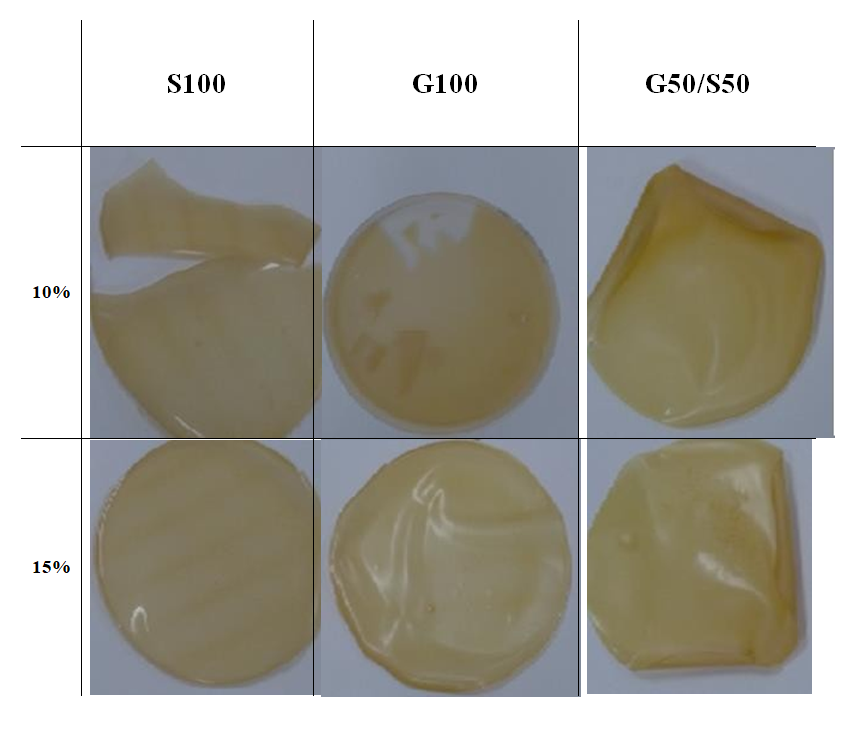
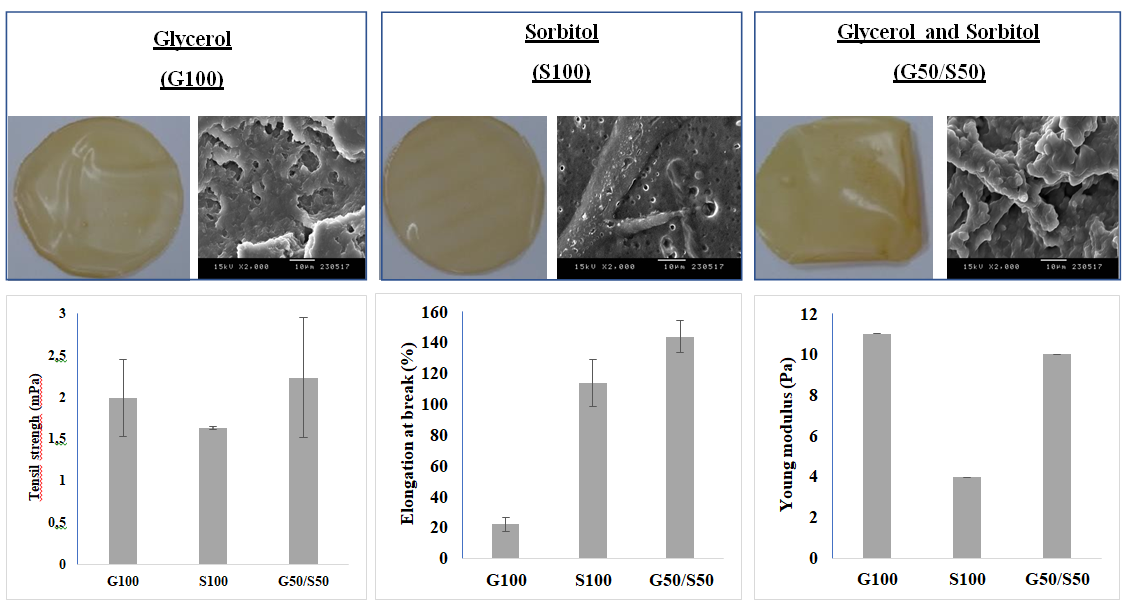
On the other hand, the percentage of plasticizers affected significantly the physical properties of obtained CPC-based biofilms. Preliminary experiments showed that for the concentrations of glycerol or sorbitol, used as plasticizers, lower than 15% (w/w), films were brittle and difficult to handle, however, for higher than 15% (w/w) concentrations of CPC, produced films were flexible but sticky (unremovable from the casting plates). Then, good film-forming solutions (not too gummy) were obtained using 15% (w/w) of plasticizer (glycerol (100%), Sorbitol (100%) or the mixture of glycerol/sorbitol (50%/50%) (Figure 1). G100, S100, and G50/S50 from CPC were transparent, homogeneous, and flexible with a slightly yellow color. CPC-based biofilm’s surfaces seemed smooth, without visible pores or cracks. The film side trimming of the casting plate was shiny, whereas the other was dull. This could be an indication of some phase separation occurring in the solution during drying [18]. Films were easily removed from the casting plates and kept for further analysis.
Characterization of CPC-Based Biofilms
Moisture and Water Activity: The water content has a significant effect on the functional properties of films since it could contribute to the plasticizing process. The water content of G100, S100, and G50/S50 was shown in Table 1. Results proved that the nature of the plasticizer did not significantly affect the water content of films (p < 0.05). The highest water content value was obtained for S100 and G100 (around 17 %) compared to G50/S50 film (14.8 %) pointing out a lack of water molecules in the film’s matrix. Findings showed that mixing the two types of plasticizers (glycerol and sorbitol) reduced the amount of water entrapped in the polymer chains decreasing the hydrogen bonds which is the main responsible for the increase of film hydrophobicity. The reduction of film water content can be correlated with the increase in film hydrophobicity due to protein-plasticizer interaction. The hydroxyl groups among plasticizer chains may promote (polymer – plasticizer) hydrogen bonds that substitute the (polymer–polymer) interactions in the composite films [19]. Water activity was in the range of 0.262 to 0.355. These values were lower than the minimum level at which microorganisms could grow (around 0.61). Higher water activity was reported for films prepared from gluten [20].
Water Sorption Isotherms and Biofilm Water Solubility: The resulting isotherms for studied edible films at 25 °C were presented in Figure 2. As we can see from the figure, all samples exhibited the same pattern. At low relative humidity (<40%), the quantity of water uptake was very little and increased exponentially at high RHs. G100 had the highest water uptake values reaching 196 g water/g of dry film, compared to S100 and G50/S50 biofilms attaining 158.5 and 105 g water/g dry film, respectively. This can be explained by the possible existence of interactions between the two biopolymers which could reduce the availability of active polar sites for water adsorption and diffusion of water molecules. Glycerol which is a small molecule can penetrate the intermolecular matrix, reducing the protein-protein interactions, therefore increasing segmental movements and the free volume. Consequently, water molecules diffuse more easily into the protein network [21]. This constation is in accordance with what has been discussed for the water content showing that the more hydrophilic biofilm (G100) having the highest moisture content could retain more easily water molecules.
| G100 | S100 | G50/S50 | |
|---|---|---|---|
| Water content (%) | 17.5 ± 0.15a | 16.63 ± 1.19a | 14.8 ± 0.13b |
| Water Activity | 0.262 ± 0.000a | 0.292 ± 0.002b | 0.355 ± 0.001c |
| Water solubility (%) | 80.50 ± 1.60a | 60 ± 2.3b | 52.1 ± 0.5c |
| Film thickness (µm) | 136.66 ± 5.70b | 173.33 ± 5.7a | 133.33 ± 5.7b |
| Surface Density (mg/cm2) | 0.09 ± 0.01a | 0.08 ± 0.02a | 0.02 ± 0.00b |
| Color l* | 76.50 ± 0.27a | 73.195 ± 0.095c | 75.765 ± 0.185a |
| a* | 1.89 ± 0.20c | 4.045 ± 0.065a | 2.27 ± 0.03b |
| b* | 31.25 ± 0.47b | 34.99 ± 0.34a | 30.765 ± 0.20c |
| Transparency | 14.25 ± 0.50b | 13.95 ± 0.23c | 15.56 ± 0.02a |
Table 1: Characterization of CPC-based biofilms.
a.b Different letters in the same column indicate significant differences (P ≤ 0.05). Table 1: Characterization of CPC-based biofilms.
![Figure 2: As we can see from the figure, all samples exhibited the same pattern. At low relative humidity (<40%), the quantity of water uptake was very little and increased exponentially at high RHs. G100 had the highest water uptake values reaching 196 g water/g of dry film, compared to S100 and G50/S50 biofilms attaining 158.5 and 105 g water/g dry film, respectively. This can be explained by the possible existence of interactions between the two biopolymers which could reduce the availability of active polar sites for water adsorption and diffusion of water molecules. Glycerol which is a small molecule can penetrate the intermolecular matrix, reducing the protein-protein interactions, therefore increasing segmental movements and the free volume. Consequently, water molecules diffuse more easily into the protein network [21]. This constation is in accordance with what has been discussed for the water content showing that the more hydrophilic biofilm (G100) having the highest moisture content could retain more easily water molecules.](/fulltextimages/11229/fig_2.png)
The intended solubility of a film depends on its application [22]. Solubility values of CPC-based biofilms are presented in Table 1. The solubility of composite films was about 80, 60, and 52% for G100, S100, and G50/S50, respectively (P < 0.05). The result obtained indicates that film prepared by G50/S50 mixture is the most resistant to solubilization explained by the physical interference that occurred after the entanglement of chickpea proteins chains in the film matrix. The higher solubility values of the G100 films obtained in our study could be attributed to the combined factors of the hydrophilic nature of CPC and plasticizer. Cuq, et al. [23] reported that the glycerol-plasticized films increase solubility and diminish the combination between biopolymer molecules of the composite film due to their hydrophilic nature, which results in creating more mobile regions with greater inter-chain distances. The increase in water solubility of the films matches with an improvement in hydrophobic and disulfide bindings as suggested by Damodaran [24]. Ahmadi, et al. [25] and Dick, et al. [21] reported the same behavior for edible composite films based on psyllium hydrocolloid and chia seed mucilage plasticized with glycerol, respectively. The high solubility could be beneficial in some applications, in ready-to-eat products, or as a carrier of bioactive compounds where the film could melt under preparation in boiling water [26].
Film Thickness and Surface Density: The basic role of each packaging consists of protecting goods from several types of alterations due to gas exchanges or the action of undesirable pests. Hence, the thickness of biofilms is a crucial criterion to guarantee such a role. Values of thickness were presented in Table 1. From the results, it is obvious that using the sorbitol alone as a plasticizer might give a thicker film having the highest value of thickness 173.33 µm, implying a higher space between chains among the biofilm as a result of a better dispersion of plasticizer. However, the presence of glycerol alone or with sorbitol reduces the thickness of CPC-based biofilms (136 and 133 for G100 and G50/S50, respectively). Findings could be explained by the fact that using a mixture of plasticizers strengthens the protein-protein interactions resulting in a less porous and less water-linked three- dimensional network, and thus a weaker film, which aligns with what has been discussed in the water content section.
Likewise, mixing two types of plasticizer affected significantly (p < 0.05) the surface density of produced edible biofilms. A reducing value was recorded when using sorbitol and glycerol in the film formation solution attaining 0.02 mg/cm² for G50/S50 against 0.09 and 0.08mg/cm² for G100 and S100, respectively. A reduced value of surface density is preferable for handling food products.
Color and transparency: CPC-based biofilms used as a food coat are the first attractive element for consumers. Hence, color attributes are considered one of the most important properties that could affect a consumer’s acceptability. Table 1 shows the values of the color coordinates (L*, a*, b*) and the transparency of the films. Sorbitol plasticized CPC-based biofilms had the highest a* and b* values among all obtained films (4.04 and 34.99, respectively). The presence of glycerol as a plasticizer raised the lightness (L*) from 73.19 for S100 to almost 76 for films plasticized either with glycerol alone or with a mixture of glycerol and sorbitol. However, the mixture of sorbitol and glycerol reduced significantly the yellowness of biofilms (p < 0.05) after being 34.99 and 31.25 for S100 and G100, respectively.
On the other hand, transparency was evaluated for all biofilm samples. Given that higher values of transparency imply more opacity [5], G50/S50 could be considered the most opaque film having the highest value of transparency (15.5%). Such value is lower than that reported by Sharma, et al. [5], for films made from sesame protein (17%). However, it exceeded the recorded value for whey protein films (3%) [18]. It should be noted that lower transparency could be of great interest as a barrier against the light deterioration of packed products.
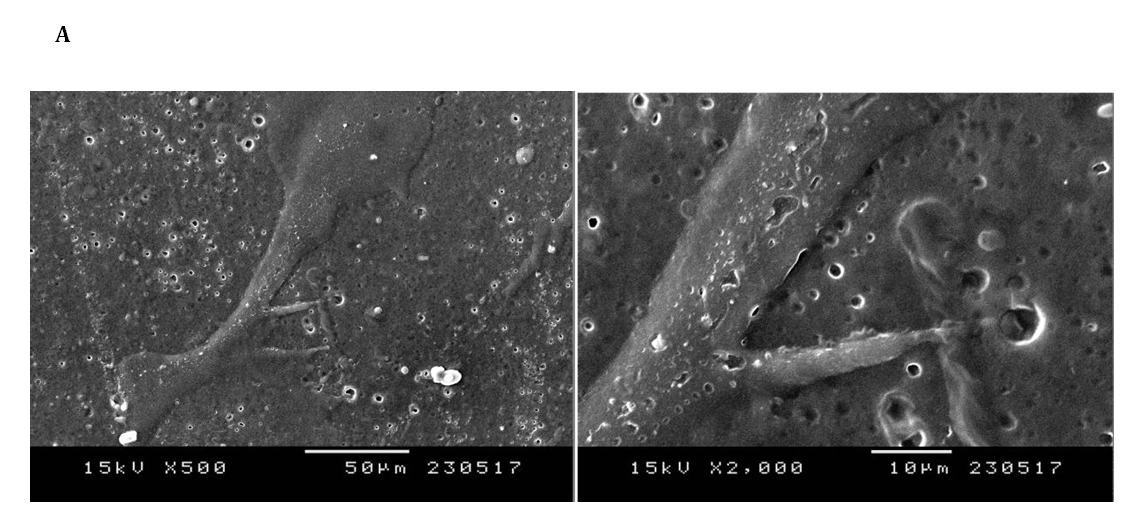
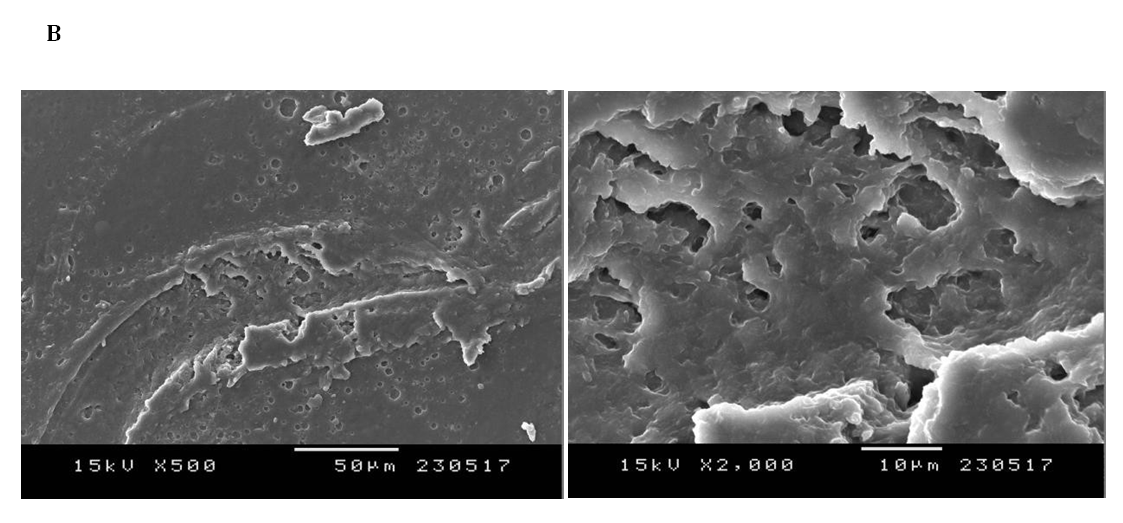
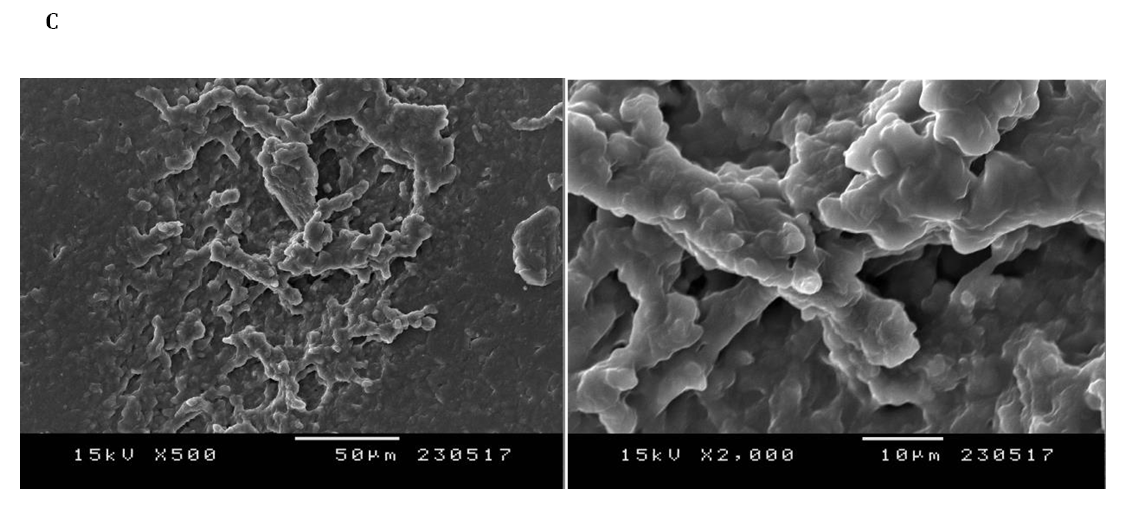
Microstructure: The effect of the nature and the ratio of used plasticizers on the microstructure of CPC-based biofilms was investigated using the scanning electron microscope. Microscopic views (Figure 3) showed relatively smooth surfaces with the presence of discontinuous zones and holes distributed along the network of CPC-based biofilms. These cavities are mainly present as a result of the preferential channels that take place during drying leading to the unfolding of the protein. As shown in the figure, changing the nature of plasticizers affected the microstructure of CPC-based biofilms. Several studies showed that heterogeneous internal structure film porosity was increased and nanoparticle voids and air pockets appeared throughout the cross-section of the film when the mixture of plasticizers was realized. Liu, et al. [27] showed that films with incorporated proteins were rough, dense, and brittle in appearance containing irregular particles.
FTIR spectroscopy: The FTIR spectra of composite CPC- based biofilms are shown in Figure 4. A major peak was located in the spectral range (i) 800-1150 cm-1 associated with bands of glycerol or sorbitol. A second peak (ii) 1200- 1250 cm-1 was attributed to the amide III band due to the interaction of N-H in-plane bending C-H vibrations. The next peak (iii) 1400-1550 cm-1 corresponded to the amide II band. Whereas, the peak located between (iv) 1600-1650 cm-1 represented the amide I band dominated by stretching vibrations of C=O and C-N groups. Finally, the last two peaks (v) 3840-3550 cm-1 (Amide A) and (vi) 3000-2100 cm-1 (Amide B) were due to N-H stretching in combination with hydrogen bonding. Amide I and amide II bands constitute the specific signal for the protein infrared spectrum and are sensitive towards their conformation.
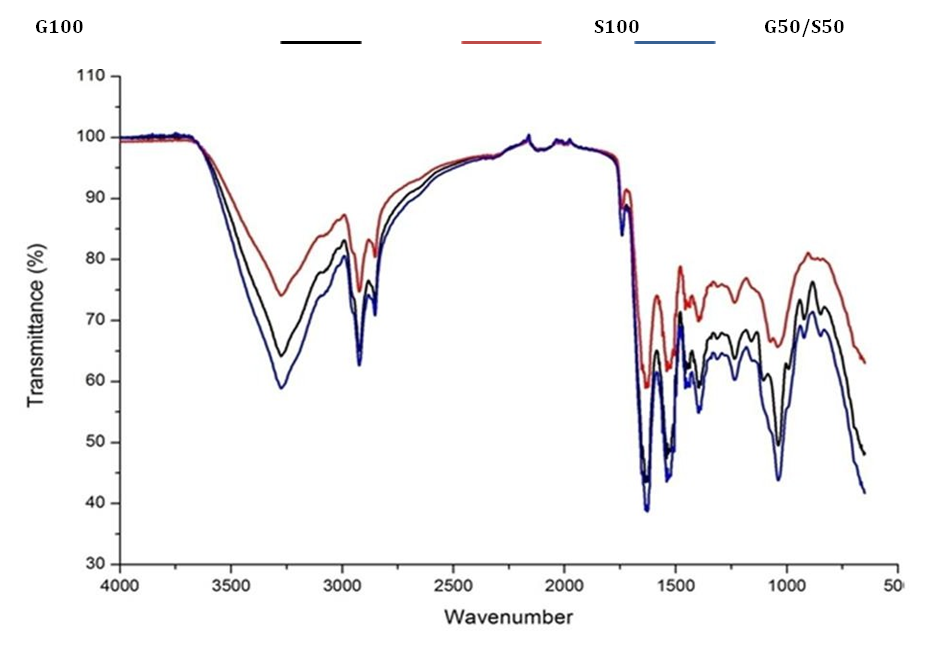
As depicted in Figure 4, it is obvious that the nature, as well as the ratio of plasticizer, affected the biofilm structure. Bands related to hydroxyl groups resulting from hydrogen bonds between protein’s chains and plasticizer, ranging between 2900 and 3500 cm-1, increased when adding glycerol to the plasticizing agent which is mainly due to its hydrophilic nature.
Mechanical Properties of CPC-Based Biofilms
CPC-based biofilms presented good mechanical properties in terms of tensile strength (TS), elongation at break (EAB), and Young modulus. As shown in Figure 5, among all the biofilms, S100 exhibited the lowest TS (1.63 mPa), followed by G100 (1.99 mPa) whereas G50/S50 was the strongest biofilm reaching 2.23 mPa (p < 0.05). For EAB, G50/S50 had the highest percentage (143.5 %) compared to S100 and G100 (113.5 and 22.28 %, respectively) (Figure 6). The obtained values were similar to that reported by Sharma, et al. [5] for sesame protein-based edible films and higher than those reported by Liu, et al. [28] for peanut protein films. Both properties showed that CPC-based biofilm is
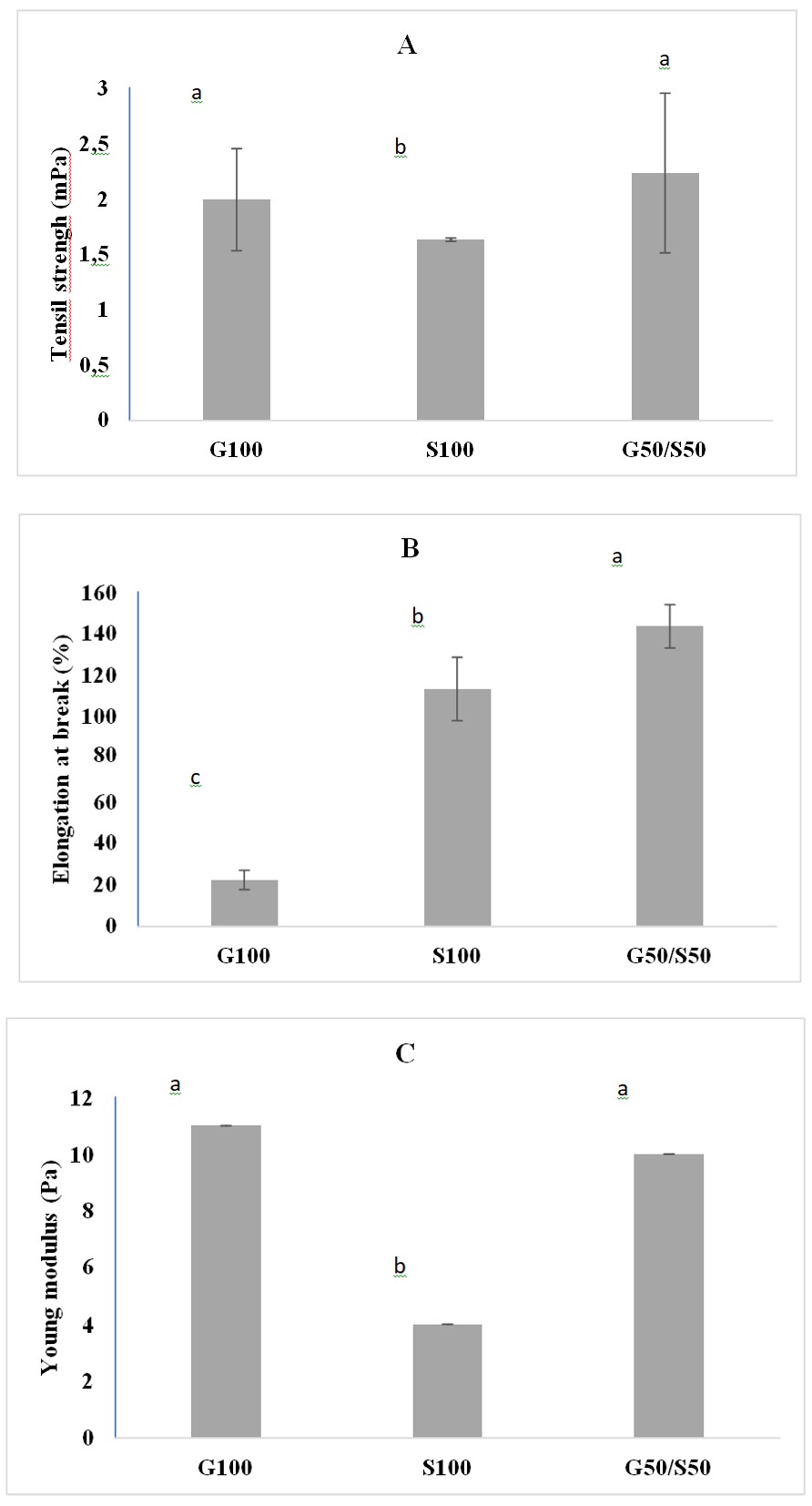
characterized by good resistance and extensibility and proved that G100 was mechanically the least deformable and that S100 was the least resistant. This could be explained by the fact that sorbitol increased the intermolecular spacing and reduced the intermolecular protein interactions. An increase in the TS and EAB (p< 0.05) was observed for the plasticizer mixture (G50/S50) implying a higher spatial distance and better mobility between polymer chains, which leads to more stretchable, flexible but less resistant films. The differences noted in the mechanical properties couldn’t be overcome, neither to relative humidity, as the films were previously equilibrated nor to the film thickness. In fact, according to the literature, mechanical properties are related to the film network, the intermolecular bonds, and the spatial distance between polymer chains [29]. Hence, all obtained results could be due to the protein-protein interactions caused by hydrophobic or electrostatic interactions interaction in blend or bilayer structures. The presence of protein in film forming solutions affected the self-adhesion of high polymers and the rate of matrix forming during the film preparations [5].
A: Tensile strength B: Elongation at break
C: Young modulus Figure 5: Mechanical properties of CPC-based biofilms: A: Tensile strength; B: Elongation at break; C: Young modulus.
Moreover, the addition of plasticizer is crucial to enhance flexibility and mobility and to reduce the brittleness of films, this could be reachable through its interaction with polymer chains and diminishing intermolecular forces among them. The increment in TS value is the result of the development of a denser matrix attributable to the interaction between both biopolymers after CPC addition. The mixture of plasticizers promotes greater cross-linking between protein-protein chains responsible for tight and compact protein networks [5].
Antioxidant Properties of CPC-Based Biofilms
Antioxidant packaging, a major category of active packaging, is very promising for extending food product shelf life. The antioxidant activities (Radical scavenging activity, Ferric reducing ability, β-Carotene Bleaching) of CPC edible films were investigated and shown in Table 2. The film based on sorbitol (S100) exhibited the highest DPPH radical scavenging capacity. Further, the activity of films decreased with increasing glycerol content, Antioxidant activities of G100 and G50/S50 films reached about 1.92 and 2.74 mmol Vit C /g dried films, respectively. The ability to reduce ferric ion (Fe3+) of glycerol film was higher than composite and sorbitol films (p<0.05). The decrease in antioxidant activity can be explained by the lower solubility of composite films. It was reported that the hydrophobic amino acids (valine and leucine), acidic amino acids (aspartic acid and glutamic acid), and sulfur-containing amino acids such as methionine enhanced reducing power [30]. In addition, the result of β-carotene bleaching activity shows that all edible films prevent β-carotene bleaching by donating hydrogen atoms to peroxyl radicals of linoleic acid with different degrees of activity. Films of CPC could react with free radicals to convert them to more stable products and terminate the radical chain reaction and so play the role of electron or hydrogen donors.
| G100 | S100 | G50/S50 | |
|---|---|---|---|
| Radical scavenging activity | 1.92 ± 0.04a | 5.98 ± 0.74b | 2.74 ± 0.44c |
| Ferric reducing ability | 6.755 ± 0.56a | 2.885 ± 0.035b | 4.21 ± 0.11c |
| β-Carotene Bleaching | 0.195 ± 0.005a | 0.345 ± 0.005b | 1.02 ± 0.03c |
Table 2: Antioxidant activity of CPC-based biofilms. Results were expressed as mmol equivalent _Vit C_ _g film_ a.b Different let
Highlights
- Physico-chemical and mechanical properties of CPC films were investigated.
- Plasticizer type and concentration affected mechanical properties.
- Structural properties showed interactions between protein and platicizer.
- Morphology study of films showed compact and heteregenous structure.
- High antioxidant activities monitored by β-carotene bleaching, DPPH radical-scavenging and reducing power activity.
Conclusion
In the present report, Films of Chickpea protein concentrates were successfully prepared and optimized. The percentage of plasticizers affected significantly the physical properties of obtained CPC-based biofilms. Film prepared with 6% protein concentration, and 15% plasticizer concentration exhibited overall better properties. Furthermore, Plasticizer nature and ratio affected all studied properties including physical, mechanical, and antioxidant characteristics. On one hand, the addition of glycerol to the plasticizing agent provided the obtained bio-films with higher hydrophilicity, better solubility, and lower thickness. Such properties could be of great interest to release bioactive compounds encapsulated in these edible bio-films. On the other hand, using both glycerol and sorbitol in film forming solution could generate the most adequate films having the best optical and mechanical properties, without altering the antioxidant effect of CPC protein. All observed differences could be attributed to the interactions between proteins, polymer chains, and plasticizers. Thus, edible CPC-based biofilms can be used for the packaging or coating applications of vegetables and fruits.
References
-
Kokoszka S, Debeaufort F, Hambleton A, Lenart A, Voilley A (2010) Protein and glycerol contents affect physico-chemical properties of soy protein isolate based edible films. Innovative Food Science and Emerging Technologies 11(3): 503-510.
-
Gennadios A, Weller CL, Testin RF (1993) Temperature effect on oxygen permeability of edible protein-based films. Journal of Food Science 58(1): 212-219.
-
Wittaya T (2008) Factors affecting the properties of edible film prepared from mung bean proteins. International Food Research Journal 15(2): 167-180.
-
Saglam D, Venema P, De Vries R, Shi J, Van der Linden E (2013) Concentrated whey protein particle dispersions: heat stability and rheological properties. Food Hydrocolloids 30(1): 100-109.
-
Sharma L, Singh C (2016) Sesame protein based edible films: Development and characterization. Food Hydrocolloids 61: 139-147.
-
Maran P, Sivakumar V, Sridhar R, Immanuel VP (2013) Development of model for mechanical properties of tapioca starch based edible films. Industrial Crops and Products 42: 159-168.
-
Farhan A, Hani NM (2017) Characterization of edible packaging films based on semirefined kappa- carrageenan plasticized with glycerol and sorbitol. Food Hydrocolloids 64: 48-58.
-
Jost V, Kobsik K, Schmid M, Noller K (2014) Influence of plasticiser on the barrier, mechanical and grease resistance properties of alginate cast films. Carbohydrats Polymers 110: 309-319.
-
Zhang P, Zhao Y, Shi Q (2016) Characterization of a novel edible film based on gum ghatti: effect of plasticizer type and concentration. Carbohydrates Polymer 153: 345- 355.
-
Ghribi AM, Gafsi IM, Blecker C, Danthine S, Attia H, et al. (2015) Effect of drying methods on physico-chemical and functional properties of chickpea protein concentrates. Journal of Food Engineering 165: 179-188.
-
Hosseini MH, Razavi SH, Mousavi MA (2009) Antimicrobial, physical and mechanical properties of chitosan-based films incorporated with thyme, clove and cinnamon essential oils. Journal of Food Processing and Preservation 33(6): 727-743.
-
Eghbal N, Yarmand MS, Mousavi M, Degraeve P, Oulahal N, et al. (2016) Complex coacervation for the development of composite edible films based on LM pectin and sodium caseinate. Carbohydrate Polymers 151: 947-956.
-
Han JH, Floros JD (1997) Casting antimicrobial packaging films and measuring their physical properties and antimicrobial activity. Journal of Plastic Film and Sheeting 13(4): 287-298.
-
Bchir B, Besbes S, Attia H, Blecker C (2011). Osmotic dehydration of pomegranate seeds (punica granatum l.): Effect of freezing pre-treatment. Journal of Food Process Engineering 35(3): 335-354.
-
Iwata KI, Ishizaki SH, Handa AK, Tanaka MU (2000) Preparation and characterization of edible films from fish water-soluble proteins. Fisheries Science 66(2): 372-378.
-
Bersuder P, Hole M, Smith G (1998) Antioxidants from a heated histidine-glucose model system. I : Investigation of the antioxidant role of histidine and isolation of antioxidants by high performance liquid chromatography. Journal of the American oil chemists society. 75(2): 181-187.
-
Yildirim A, Mavi A, Kara AA (2001) Determination of antioxidant and antimicrobial activities of Rumex crispus L. extracts. Journal of Agriculture and food Chemistry 49(8): 4083-4089.
-
Ramos OL, Reinas I, Silva SI, Fernandes JC, Cerqueira MA, et al. (2013). Effect of whey protein purity and glycerol content upon physical properties of edible films manufactured therefrom. Food Hydrocolloids 30 (1): 110-122.
-
Yang L, Paulson AT (2000) Mechanical and water vapor barrier properties of edible gellan films. Food Research International 33(7): 563-570.
-
Kumari M, Mahajan H, Joshi R, Gupta M (2017) Development and structural characterization of edible films for improving fruit quality. Food Packaging and Shelf Life 12: 42-50.
-
Dick M, Costa TMH, Gomaa A, Subirade M, Rios AO, et al. (2015) Edible film production from chia seed mucilage: Effect of glycerol concentration on its physicochemical and mechanical properties. Carbohydrate Polymers 130: 198-205.
-
Pelissari FM, Andrade-Mahecha MM, Sobral PJA, Menegalli FC (2013) Comparative study on the properties of flour and starch films of plantain bananas (Musa paradisiaca). Food Hydrocolloids, 30(2): 681-690.
-
Cuq B, Gontard N, Aymard C, Guilbert S (1997) Relative humidity and temperature effects on mechanical and water vapor barrier properties of myofibrillar protein- based films. Polymer Gels and Networks 5(1): 1-15.
-
Damodaran S (1996) Amino acids, peptides and proteins. In: Fennema OR, et al. (Eds.), Food Chemistry. 3rd (Edn.), Marcel Dekker, New York, pp: 321-429.
-
Ahmadi R, Kalbasi-Ashtari A, Oromiehie A, Yarmand MS, Jahandideh F (2012) Development and characterization of a novel biodegradable edible film obtained from psyllium seed (Plantago ovata Forsk). Journal of Food Engineering 109(4): 745-751.
-
Pitak N, Rakshit SK (2011) Physical and antimicrobial properties of banana flour/chitosan biodegradable and self-sealing films used for preserving fresh-cut vegetables. LWT-Food Science and Technology 44(10): 2310-2315.
-
Liu L, Liu CK, Fishman ML, Hicks KB (2007) Composite films from pectin and fish skin gelatin or soybean flour protein. Journal of Agriculture and Food Chemistry 55(6): 2349-2355.
-
Liu C, Tellez-Garay AM, Castell-Perez ME (2004) Physical and mechanical properties of peanut protein films. LWT- Food Science and Technology 37(7): 731-738.
-
Guidara M, Yaich H, Benelhadj S, Adjouman YD, Richel A, et al. (2020) Smart ulvan films responsive to stimuli of plasticizer and extraction condition in physico-chemical, optical, barrier and mechanical properties. International Journal of Biological Macromolecules 150: 714-726.
-
Ayed HB, Bardaa S, Moalla D, Jridi M, Maalej H, et al. (2015). Wound healing and in-vitro antioxidant activities of lipopeptides mixture produced by Bacillus mojavensis A21. Process Biochemistry 50(6): 1023-1030.
- The Role of Podocyte Apoptosis and the Involvement of SIRT1 in Diabetic Nephropathy
- Dealcoholization of Beer by Osmotic Distillation for the Beverage Industry
- Biopolymer-Based Edible Packaging- Biomaterials, Methods, and Applications in Food Industry: An Updated Review
- Influence of Bioprocessing Methods on 'China Rice' (Gawal R1), and Soyabean Supplementation on the Quality of Complementary Food
- Cassava (Manihot esculenta) Varietal Growth, Yield and Cyanide Content Performance in Three Sites in the South- Eastern Semi Arid Regions of Kenya
- Food Waste Treatment, Recycling, Management and Production of Value-Products-An Update on Methodologies and Current Trends