
The Impact of Climate Change on Food Production and Processing: A Review
It has been evident in recent years that climate change is an unavoidable phenomenon in many regions of the world and that it negatively affects food systems and agriculture, especially in African nations. Global temperature and precipitation changes are a result of climate change. Food supply chains, food ecosystems, and food systems in general are all significantly impacted by the environmental changes brought on by climate change. Along the food value chain, these changes have an impact on food production, storage, processing, marketing, availability, promotion, affordability, and quality. As a result, climate change has an impact on both global food security and people's income, particularly in developing nations where rain-fed agriculture is the predominant practice, making food systems extremely vulnerable to fluctuations in temperature and precipitation. The purpose of the narrative review was to assess the body of published research in order to comprehend how climate change affects food systems worldwide. Journals of Nature and Climate Change. According to the study, rising temperatures and rainfall have an impact on crop yields, food markets, food pricing, consumption trends, food insurance, and food availability and utilization. According to the analysis, all parties involved should enact pertinent laws about strategies for mitigating and adapting to climate change along various food value chains. This would help farmers meet the second sustainable development target, which is to end hunger, ensure food security, improve nutrition, and advance sustainable agriculture, by enabling them to grow enough food to feed the 9.8 billion people that are expected to exist by 2050.
Odeyemi TA¹, Ofoedum AF¹*, Ugwoezuonu JN¹, Iroagba LN¹ and Nwuka MU²
Keywords: Climate Change; Food Production; Food Processing; Storage; Food Security; Nutrition
Introduction
Over the past forty years, climate change has had a major impact on human health, food systems, and biodiversity worldwide. “Climate change is defined as a shift in the climate’s state that lasts for a long time, usually decades or more, and may be detected (for example, by statistical tests) by variations in the mean or variability of its attributes.
A food system includes all of the components (people, infrastructure, institutions, processes, inputs, and so on) and activities involved in the production, processing, distribution, preparation, and consumption of food as well as the complex socioeconomic and environmental results of these activities. Both climate change and food systems are impacted by each other. The two are connected and have a good or negative impact on one another. Food systems and climate change are interdependent and have simultaneous effects. The impact starts at the local level and then spreads to the national, regional, and ultimately global levels. To profit from the intricate system and lessen the effects of climate change, all stakeholders must work together to comprehend it. For the food and agriculture industries, inaction and delays in climate change adaptation and mitigation can have disastrous consequences. Social, political, economic, and environmental factors, as well as the individuals that make up the food chains, all have an impact on food systems. Producers, information providers, regulators and policy makers, employees in the fields of health, forestry, commerce, and finance, as well as businesses and customers, are all considered people. Fossil fuels are used in all industries for commercial food production and processing, which releases greenhouse gases that cause climate change. The bulk of GHGs originate from industrialised nations that control the majority of the food industries, which employ the greatest number of people in those nations. Similarly, emerging nations’ food processing industries generate a negligible portion of greenhouse gas emissions. According to research, 33% of greenhouse gas emissions worldwide are caused by agriculture, and climate change causes food shortages, which in turn raise prices by up to 226% in 2002. Climate change impacts the entire food value chain and vice versa, which has negative effects on people worldwide. Africa is the region most vulnerable to the effects of climate change.
The impact of climate changes on food systems and be look at based on two aspects:-
- food supply chains
- food environments Food environments encompass things like food availability and physical access, food affordability, food promotion and advertising, food quality and safety, and food supply chains, which include things like food production, storage and transportation, food processing and packaging, food retails, and food marketplaces. Although these activities and processes may have an impact on the climate, and the climate may have an impact on them, it is unclear how much of an impact one has on the other, which is why this review is necessary (Figure 1).
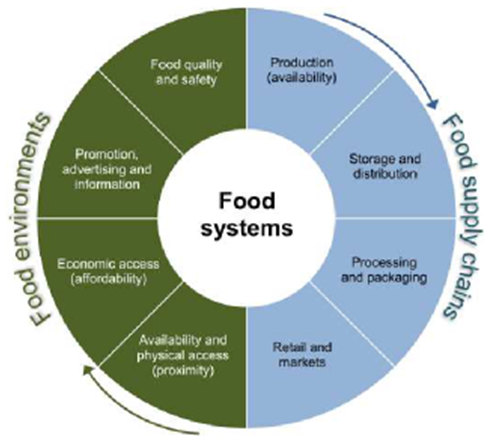
Climate Change and Reality
Similarly, an increase in extreme weather events has resulted in the loss of fertile area for agriculture and forestry as well as soil erosion from wind and flood. It is impossible to overstate the huge impact of climate change on food production, which is felt most keenly in emerging and least developed countries. Droughts and floods have been known to destroy pastures and crops that are already being grown on the fields. Flood and drought-related losses from 2004 to 2014 [1, 2]. Fisheries and agriculture are heavily reliant on the climate. In certain places, rising temperatures and carbon dioxide levels can boost agricultural output. Reality and Climate Change When modifications to the Earth’s climate system lead to new weather patterns that persist for a few decades or even millions of years, this is known as climate change. The frequency and intensity of extreme weather events, such as heat waves, droughts, floods, and new rainfall patterns, are impacted by climate change. Temperature increases have caused weeds, pests, and illnesses to spread more widely, some of which pose a harm to humans, plants, animals, and marine life. However, to achieve these advantages, increased demands for water availability, soil moisture, nutrients, and other factors must also be satisfied. Food safety may be at risk due to changes in the frequency and severity of drought and floods, which can pose serious risks to farmers and ranchers Furthermore, many fish and shellfish species’ ecological ranges are expected to shift due to increased water temperatures, potentially endangering ecosystems. Additionally, it may become more difficult to grow animals, fish, and produce food in the same locations and methods as in the past due to climate change [3] (Figure 2).
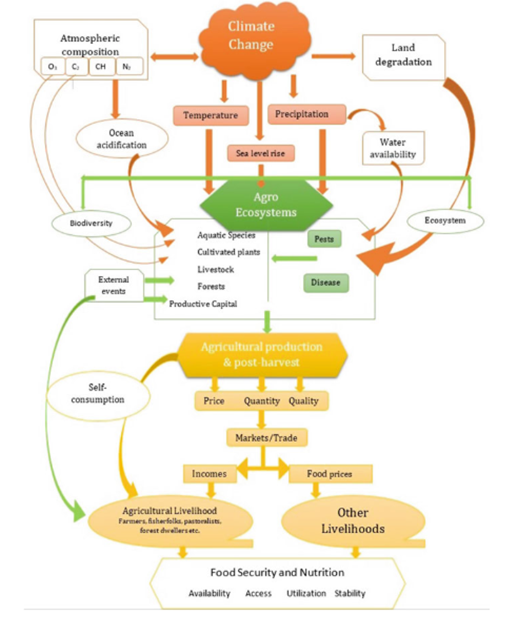
Global Impact of Climate Change on Food Systems
Global food systems are impacted by climate change. Food and food-related products are grown, harvested, processed, packaged, transported, marketed, consumed, and disposed of as part of food systems. The health and productivity of most crops are impacted by high average temperatures and inadequate rainfall. Since climate change knows no bounds, both wealthy and poor nations are impacted by global warming, albeit to differing degrees. According to reports, durum increased when the maximum and lowest temperatures rose by 1.45°C and 1.26°C, respectively, and when there was a 2.5mm rise in precipitation. Crop yields, especially those planted annually, will vary due to variations in rainfall and temperature trends; these variations will impact the ongoing availability of these crops [4, 5]. Climate change will increase the frequency of droughts and floods, which will negatively impact food supply and stability and ultimately food security. Since the majority of agricultural systems in these communities are rainfed, the timing and volume of rainfall over various seasons will thus have a negative impact on the food system in local communities [4]. Grain reserves are utilised to support food assistance programs for refugees and displaced people as well as to offset crop failures in catastrophe scenarios. Grain must be adequately stored or conserved in order to be held as reserves. Climate change-related increases in temperature and humidity make some places unsuitable for grain storage, necessitating the need for more financing to preserve or store them. Invariably because of the higher cost, the ability of many underdeveloped countries to maintain sufficient grain reserves is limited or grain reserves can be inadequate to respond to natural or human disaster [4, 6].
Impact of Climate Change and Food Production in Africa
Due to a lack of resources for adaptation and mitigation, the effects of climate change are more noticeable in poor nations than in wealthy ones. In addition to this, food systems in many poor nations, especially those in Africa, are extremely vulnerable to changes in temperature and rainfall due to the prevalence of rain-fed agriculture. Climate change influences farmers’ crop choices by substituting heat-tolerant millet, which yields lower profits for farmers, for high-yield crops like maize. This has a big impact on household income each year. Climate change was expected to reduce maize output, which would lower family incomes for stallholder farmers and worsen poverty. Insufficient and too much rain was reported to influence crop production due to increased diseases for various crops.
Climate Change, Food Processing and Packing
Industries handle the commercial processing and packaging of food. It has been estimated that 50% of greenhouse gas emissions come from food waste and related packaging. Due to a lack of funding, the majority of African nations employ non-biodegradable packing materials, which harm crop yield and water penetration by remaining in soil for decades. The lack of technology to digest, recycle, and reuse food waste combined with people’s pessimistic attitudes led to soil degradation and global warming. As a result, food security and productivity in Africa are compromised.
Climate Change Impact on Food Availability
The physical amounts of food produced, stored, processed, delivered, and traded determine food availability. Climate has an impact on food production, particularly in areas where climate change is affecting biochemical processes. Positive, negative, or even neutral impacts are possible. Different locations will suffer the effects of climate change differently depending on their location [7]. The greenhouse fertilization effect is advantageous in temperate locations because higher CO2 levels will promote plant growth and development, resulting in higher food yields. In crops with extremely high photosynthetic efficiency, this rise can reach 0–10%, but in crops with lesser efficiency, it can reach 10%–25%. It is assumed that under such circumstances, atmospheric CO2 concentrations will rise to 550 parts per million [8]. Some plants in temperate locations benefit from temperature increases of 1 to 3 degrees Celsius, while crops in tropical and seasonally dry regions suffer, particularly cereals that are already growing close to their ideal temperature range. However, when the mean temperature rises by more than 3 C, it has a detrimental effect on all crops [9]. Because the growth of feed crops is similarly hampered, such temperature increases will also have an indirect influence on cattle productivity [10]. The flow of heat between the animal and its surroundings is impacted by direct impacts, which are associated with exposure to sun radiation [11]. Given that many animal breeds cannot withstand high temperatures, this is crucial [11]. The livelihoods of about 180 million people who graze cattle on rangelands would be significantly impacted by the forage production from these areas in Africa, which is vulnerable to climate change [12]. Animal performance will be significantly impacted by the impacts of climate change on fodder quality, which is based on nutritional content and influences digestibility, the division of metabolised products in the digestive system, and animal consumption of forage. Since goats are the only domesticated animals with the flexible capacity to adjust to a changing environment more quickly than any other ruminant, it may be necessary to make some severe modifications to the farming system, such as switching from sheep and cattle to goats. Compared to other ruminants, goats are often less impacted by the severe hot, dry weather. Their browsing habit and the upper lips’ physical advantage account for a portion of their adaptability. Goats can therefore survive on a restricted diet, particularly in dry and semiarid areas [13]. Another benefit is that goats may lower their metabolic rates to preserve energy when there is a shortage of feed [14]. Therefore, they provide a continued supply of meat despite increases in temperature and frequencies of drought. Climate Change Impact on Food Utilization The term “food utilisation” describes how people consume food and how they might get essential nutrients from it. This includes the food’s nutritional value, its kind and preparation, and the societal perception of each item, which also influences whether and when it should be consumed. Knowledge on the food’s health and quality is also provided, as this determines whether there will be nutrient loss or if the food is less nutrient-dense or susceptible to food-borne illnesses [15]. How food is used is referred to as food utilisation. Food poverty reduces dietary diversity, which may result in a lack of nutrient-dense foods that are essential to a population’s balanced diet. Water shortages, drought, or labour from climate change and fluctuation might all be contributing factors to this shortage. Because it eventually affects income and the ability to buy a variety of foods, the influence of climate change on food utilisation is indirect Climate Change Adaptation: Implications for Food Security and Nutrition. The way the body uses food influences people’s nutritional status and determines how susceptible they are to illness. This is shown in the way that novel disease patterns brought about by various pests and vectors’ reactions to climate change have altered human health. Waterborne illnesses and disorders are on the rise in flood-prone areas due to climate change. This is because new illnesses may appear and insect and vector populations will proliferate, which might impact plant development and eventually the food chain. People’s physiological ability to get the nutrients they need from their diet will be impacted by the illnesses. Therefore, people might become nutritional food insecure despite the quantity of food being sufficient (FAO 2008). Learn how people might get essential nutrients from their diet. This includes the food’s nutritional value, its kind and preparation, and the societal perception of each item, which also influences whether and when it should be consumed. Knowledge on the food’s health and quality is also provided, as this determines whether there will be nutrient loss or if the food is less nutrient-dense or susceptible to food-borne illnesses [15]. Impact of Climate Change Adaptation on Food Security and Nutrition Changes in global rainfall patterns are a major consequence of climate change, with some implications for agriculture [4]. Depending on a number of variables, such as variations in temperature, precipitation, and humidity, climate change will have varying effects on agriculture [16]. Parts of Africa that rely on rainfall to grow food crops are home to a large portion of the world’s impoverished. Rainfall, evaporation, runoff, and soil moisture storage are the elements of the water balance that will alter as a result of climate change. This indicates that during such a growing season, the entire crop water need will not be met. More often than not, prolonged drought may lead to small and marginal farms failing, which can generate economic, political, and social upheaval (Table 1).
| Climate change | Impacts |
| Increase in average temperature | Reduced quantity and reliability of agricultural yield |
| Increase in average temperature | Increased heat stress in livestock |
| Increase in average temperature | Destruction of crops or lowering crop productivity |
| Increase in average temperature | Decline in certain fish stocks due to increased sea temperature |
| Change in amount of rainfall | Reduced water availability for crop and livestock |
| Change in amount of rainfall | Heavy reliance on irrigation |
| Change in amount of rainfall | Poor quality of crops due to deteriorating water quality |
| Change in amount of rainfall | Poor quality of crops due to deteriorating water quality |
| Increased severity of drought | Decreased crop yield |
| Increased severity of drought | Increased probability of fire |
| Increased intensity of extreme events | Soil erosion |
| Increased intensity of extreme events | Increased land degradation and desertification |
| Increased intensity of extreme events | Inability to cultivate land |
| Increased intensity of extreme events | Damage to crops and food stores |
Table 1: The impact of climate change on food security.
Climate Change Impact on the Spread of Plant and Animal Pests and Diseases
The usage of herbicides and fungicides can be impacted by climate change, as can seasonal patterns and the abundance of disease-causing organisms and vectors [17]. Geographical location and crop type will affect these responses. The usage of pesticides is anticipated to rise in the future due to climatic unpredictability [18]. However, the projected impacts of climate change on pesticide use vary depending on the crop type and geographic area.
Climate Change Adaptation and Mitigation
One strategy for addressing global climate change, often known as “climatic change” or “anthropogenic climate change,” is adaptation. The Intergovernmental Panel on Climate Change (IPCC) defines adaptation as a series of changes to the current or anticipated climate and the effects of those changes. The goal of adaptation is to manipulate advantageous possibilities within human systems or to lessen or prevent harm. Human contributions can occasionally improve responses to these changes and their effects [19]. While mitigation entails concerted efforts to cut long-term emissions of greenhouse gases, this calls for deliberate efforts in the human environmental system to modify behavioural patterns, lifestyles, and perceptions that can lower the risk to human lives and livelihoods [4]. On the other hand, mitigating climate change entails cutting greenhouse gas emissions, short-term coal sequestration and processing, and-above all-making infrastructure choices that lower risk by lowering long-term emissions. Primary production is the most significant aspect of the food system, even though the entire system contributes to greenhouse gas emissions. Producers, agribusinesses, and biodiversity managers must be incentivised to adopt climate change mitigation strategies [20, 21, 22, 23].
Challenges on the impact of climate change on food production and processing
• Variability in temperature and precipitation: Crop growth, production, and quality are all impacted by erratic weather patterns. • Water scarcity: Warmer temperatures cause changes in precipitation and higher evaporation, which in turn causes water shortages. • Degradation of the soil: Temperature variations and an increase in the frequency of extreme weather events have an impact on soil health. • Biodiversity loss: As ecosystems change due to climate change, there is a decrease in the variety of crops and animals. • Food price volatility: Price swings are caused by shocks to food systems brought on by climate change. • Concerns about food safety: Contamination and spoiling are more likely due to climate change.
Conclusion
At both the global and regional levels, climate change is a fact. Both the timing and the extent of the transition remain extremely varied and unknown. But it’s becoming increasingly evident how seriously climate change might affect every area of Africa’s economy. Vulnerability, exposure, and adaptive capacity all affect how well people and communities can adjust to climate change. This in turn has to do with their social and financial capital, including community cohesiveness and social networks. According to this assessment, much of the world’s climate is changing, mostly in terms of temperature and precipitation.
Recommendations
The inability of developing nations to adapt or lessen the effects of climate change on food value chains stems from their low financial and technological resources. The majority of homes have women who work in agriculture, while men and children wait to consume the food that the women have laboriously produced. The following suggestions were put forth.
- In every nation on the planet, food waste should be prevented at every stage of the food value chain. Since industrialised nations generate the majority of the world’s food, they ought to assist emerging nations by supplying them with food and preventing waste in order to improve food security in less developed nations.
- The economics and production of green food should be improved in all areas of food production. This would lessen the global impact of climate change by reducing emissions of important greenhouse gases such as CO2, nitrous oxide, and methane.
The future severity of climate change’s effects on food production will be largely determined by adaptation; as a result, taking into account new food sources, such as underutilized crops, can help increase the supply of food and nutrition. Therefore, in order to safeguard the arable land, an integrated policy strategy is required. To increase their agricultural yield, small-scale farmers in rural regions require more support. For forests to be used effectively to combat climate change, forest restoration should be promoted. Countries should expressly link their mitigation and adaptation efforts to their policy decisions on environmental sustainability in the agriculture sector on a global scale and wherever needed. To address the disparate impact that climate change may have on the various agricultural sectors, these policies have to be both anti-poor and comprehensive. The economic, institutional, and social effects of climate change should be taken into account when developing policies that would assist the world’s poor and vulnerable, particularly those based on gender, in building strong and resilient communities. Climate change-related disasters in agricultural communities necessitate prompt emergency relief assistance and all-inclusive facilities, including shelters, particularly in areas that raise animals. Initiatives that will provide people the chance to create stronger, more productive communities and cooperatives, which will increase their level of independence, are often a part of such advances. Climate change adaptation and mitigation plans must be developed and put into action using generally accepted procedures. Participation by impacted farming communities, impoverished organisations, and other disadvantaged groups as stakeholders must be permitted. Relevant indicators at the national and international levels should be created to guarantee the involvement of the poor and vulnerable; this might be accomplished by preserving gender-stratified data to forecast and ascertain the effects of climate change on them as well as their geographic regions. Additional suggestions include the necessity for fundamental research to expand knowledge and information, the reduction of institutional impediments, and the availability of appropriate technology and decision support tools.
Concurrent Interest
The authors have declared that they have no competing interests and the article has not been published in any other journal and no external funding source. Contributions of the Authors All the authors worked together to complete this review.
Funding Sources
No Funding Sources.
References
-
FAO (2015) The impact of natural hazards and disasters on agriculture and food security and nutrition: a call for action to build resilient livelihoods. Food and Agriculture Organization.
-
Brida AB, Owiyo T, Sokona Y (2013) Loss and damage from the double blow of flood and drought in Mozambique. Int J Glob Warming 5(4): 514-531.
-
Chen X (2015) Climate change: causes, impacts and adaptation. Project supported by Govenor State University Intellectual Life Grant, pp: 1-9.
-
Al W, Orki G, Clima O (2008) Climate change and food security: a framework document. FAO, Rome, Italy.
-
Ali F, Thaver I, Khan SA (2014) Assessment of dietary diversity and nutritional status of pregnant women in Islamabad, Pakistan. J Ayub Med Coll Abbottabad 26(4): 506-509.
-
Edame EG, Ekpenyong AB, Fonta WM, Duru EJC (2011) Climate change, food security and agricultural productivity in Africa: issues and policy directions. Int J Humanit Soc Sci 1(21): 205.
-
Leff B, Ramankutty N, Foley JA (2004) Geographic distribution of major crops across the world. Glob Biogeochem Cycles 18(1): GB1009.
-
Tubiello FN, Amthor JS, Boote KJ, Donatelli M, Easterling W, et al. (2007) Crop response to elevated CO2 and world food supply: a comment on Food for thought. Eur J Agron 26(3): 215-223.
-
FAO, United Nations, Rome IPCC (2007) The physical science basis. Contribution of working group I to the fourth assessment report of the Intergovernmental Panel on Climate Change. Cambridge University Press, Food and Agriculture Organization of the United Nations, Cambridge, UK, pp: 996.
-
Porter JR, Semenov MA (2005) Crop responses to climatic variation. Philos Trans R Soc B Biol Sci 360(1463): 2021- 2035.
-
Rust JM, Rust T (2013) Climate change and livestock production: A review with emphasis on Africa. S Afr J Anim Sci 43: 255-267.
-
Boone RB, Conant RT, Sircely J, Thornton PK, Herrero M (2018) Climate change impacts on selected global rangeland ecosystem services. Glob change Biol 24(3): 1382-1393.
-
Pragna P, Chauhan SS, Sejian V, Leury BJ, Dunshea FR (2018) Climate change and goat production: Enteric methane emission and its mitigation. Animals 8(12): 235.
-
Yadav B, Gynendra S, Verma AK, Dutta N, Sejian V (2013) Impact of heat stress on rumen functions. Vet World 6: 992-996.
-
FAO (2008) Climate change and food security: a framework document. Food and Agricultural Organization of United Nation, Rome, Italy.
-
Pitesky M, Gunasekara A, Cook C, Mitloehner F (2014) Adaptation of agricultural and food systems to a changing climate and increasing urbanization. Curr Sustain Renew Energy Rep 1: 43.
-
Boxall AB, Hardy A, Beulke S, Boucard T, Burgin L, et al. (2008) Impacts of climate change on indirect human exposure to pathogens and chemicals from agriculture. Environ Health Perspect 117(4): 508-514.
-
Chen CC, McCarl BA (2001) Pesticide usage as influenced by climate: a statistical investigation. Clim Chang 50(1- 2): 475-487.
-
IPCC (2014) Climate change 2014, impacts, adaptation, and vulnerability, Part A: global and sectorial aspects, working group II contribution to the fifth assessment report of the Intergovernmental Panel on Climate Change. Cambridge University Press, Cambridge, UK.
-
Food and Agriculture Organization (1996) Rome Declaration on world food security. FAO, Rome, Italy.
-
IPCC (2012) Managing the risks of extreme events and disasters to advance climate change adaptation. In: Stocker TF, et al., (Eds.), A Special Report of Working Groups I and II of the Intergovernmental Panel on Climate Change. Cambridge University Press, Cambridge, NY, USA.
-
Masipa TS (2017) The impact of climate change on food security in South Africa: current realities and challenges ahead. Jàmbá 9(1): 1-7.
-
Saunders DG, Pretorius ZA, Hovmøller MS (2019) Tackling the re-emergence of wheat stem rust in Western Europe. Commun Biol 2(1): 51.
- The Role of Podocyte Apoptosis and the Involvement of SIRT1 in Diabetic Nephropathy
- Dealcoholization of Beer by Osmotic Distillation for the Beverage Industry
- Biopolymer-Based Edible Packaging- Biomaterials, Methods, and Applications in Food Industry: An Updated Review
- Influence of Bioprocessing Methods on 'China Rice' (Gawal R1), and Soyabean Supplementation on the Quality of Complementary Food
- Cassava (Manihot esculenta) Varietal Growth, Yield and Cyanide Content Performance in Three Sites in the South- Eastern Semi Arid Regions of Kenya
- Food Waste Treatment, Recycling, Management and Production of Value-Products-An Update on Methodologies and Current Trends