
Hunger-Obesity Paradox: The 21st Century and the “Struggle for Survival” for Whole Populations
Charles Darwin accepted and described over 150 years ago in his masterwork "On the Origin of Species" the evolution laws of the "Struggle for Survival" and the "Survival of the Fittest".
Editorial
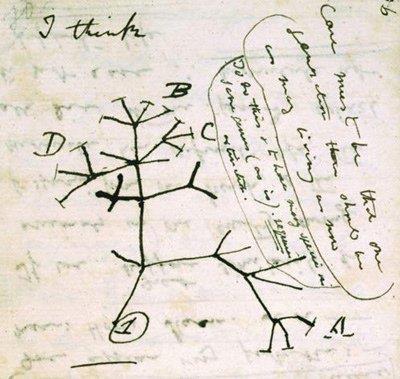
Charles Darwin accepted and described over 150 years ago in his masterwork "On the Origin of Species" the evolution laws of the "Struggle for Survival" and the "Survival of the Fittest". Evolution laws aimed at improving a species and to adapt to environmental factors that can be harsh and eliminate the "weak" unadjusted individual from a population. The environmental trigger for this elimination was often the supply of food. Charles Darwin also described how within such a population there was sufficient time to recover with better adapted species. His main support for this initial hypothesis were the finches he had collected on various islands of the Galapagos group of islands. He had caught several finches with different beak shapes (Figure 1A) on the different islands of the Galapagos Archipelago and his perception was that they came from a common ancestor. This formed the basis for his initial hypothesis for the "Tree of Life (TOL)", of which he carefully formulated his initial hypothesis as shown in Figure 1A "I think" (Figure 1B).
Hunger-Obesity Paradox: The 21st Century and the “Struggle for Survival” for Whole Populations Gastroenterol Hepatol Int J
Presently, “The Hunger-Obesity paradox” [2], exist at our planet and eliminates whole human populations in two or three generations which is completely anti- Darwinian thought. The present modern welfare diseases are related to abundant (unhealthy) food while Charles Darwin predicted in Chapter 111 "Struggle for Existence" the enormous growth of the world population and the amount of food as a limiting factor: "In looking at Nature, it is most necessary to keep the foregoing considerations always in mind - never forget that every single organic being around us may be said to be striving to the utmost to increase in numbers; that each lives by a struggle at some period in life; that heavy destruction inevitably falls either on the young or old, during each generation or at recurrent intervals. Lighten any check, mitigate the destruction ever so little, and the number of the species will almost increase to any amount ........ The amount of food for each species of course gives the extreme limit to which each can increase but Charles Darwin also accepted the "struggle for survival as a consequence to natural selection "(Chapter XIV" Recapitulation and Conclusion "of individuals where the forces of natural selection will eliminate on an individual level ...." These laws, tasks in the greatest sense, being Growth with Reproduction;
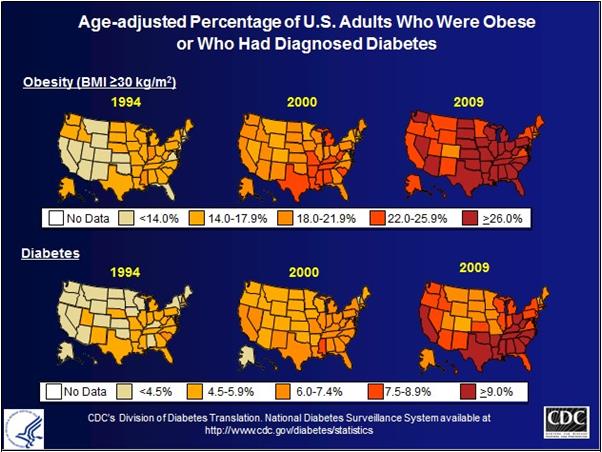
Presently, modern chronic welfare diseases like obesity, type 2 diabetes (T2DM) (Figure 2), cancer, mild- Alzheimer eliminate in one or two generations whole populations and are a burden for humanity -which are in most cases related to nutrition- and lead to an unhealthy population structure (Figure 3). The number of people with diabetes has risen from 108 million in 1980 to 422 million in 2014 [3]. It reached an epidemic rate in a developed country like the US [4]. For the US Zimmet, et al. [5] predicted that from the 17.7 million people in the US with T2DM in 2000 this number will rise until 30.3 million in 2030.
Inheritance which is almost implied by reproduction; Variability from the indirect and direct action of the external conditions of life, and from use and disuse; a Ratio of Increase so high to lead to a Struggle for Life, and as a consequence to Natural Selection, entailing Divergence of Character and the Extinction or less- improved forms. Thus, from the war of nature, from famine and death, the most exalted object which we are conceiving, namely, the production of the higher animals, directly follows. There is grandeur in this view of life, with its several powers".
Vincent van Ginneken. Hunger-Obesity Paradox: The 21st Century and the “Struggle for Survival” for Whole Populations. Gastroenterol Hepatol Int J 2019, 4(2): 000155.
Copyright© Vincent van Ginneken.
Also in the “new growth economies” like India [6] and China [7] a tremendous T2DM epidemic is expected. Diabetes is fast gaining the status of a potential epidemic in India with more than 62 million diabetic individuals currently diagnosed with the disease [8, 9]. In 2000, India (31.7 million) topped the world with the highest number of people with diabetes mellitus followed by China (20.8 million) with the United States (17.7 million) in second and third place respectively. The prevalence of diabetes is predicted to double globally from 171 million in 2000 to 366 million in 2030 with a maximum increase in India [10]. It is predicted that by 2030 diabetes mellitus may afflict up to 79.4 million individuals in India, while China (42.3 million) and the United States (30.3 million) will also see significant increases in those affected by the disease [11]. A possible explanation for this major IR/T2DM explosion for these two Asian countries were more than half of the world population lives is given via the “Fetal origin Hypothesis” Barker [12] or the “Foetal Origins of Mental Diseases” Hypothesis [13]. Total number of people withdiabetes is projected to rise from 171 million in 2000 to 366 million in 2030. The prevalence of diabetes ihigher in men than women, but there are more women with diabetes than men. The most important demographic change to diabetes prevalence across the world appears to be the increase in the proportion of people >65 years of age [10].
Charles Darwin could never have foreseen that in a world population of 7.6 billion people AD 2019 around one billion are" in the struggle for survival "because they are obese, one billion are acute starving (0 kcal / caput / day) [2], two billion are malnourished [2], around one billion are elderly (> 65 y), including one billion with dementia or mild-Alzheimer's disease van Ginneken [14] According to Barkers theory Barker [12], van Ginneken [13] chronic degenerative welfare diseases like Type-2 Diabetes or Cardiovascular Diseases or mental disorders are according to the "fetal origin hypothesis" more or less inherited towards the next generation.
Charles Darwin accepted the law of "the struggle for survival" for the individual but the current state of our planet with its current structure of the world population exceeds all laws in terms of "survival of the fittest" because entire population populations are eliminated in one or two generations due to modern chronic degenerative welfare diseases due to food surplus or as a result of extreme acute hunger [15].
![Figure 3: Example of an “unhealthy” population structure in Japan “from pyramid to kite”. This example can be a prediction of the future population structure of modern man at our planet [16].](/fulltextimages/4036/fig_3.png)
References
-
Darwin C (1859) On the Origin of Species [edited by Quammen D (2011)] Sterling Publishing, New York, pp: 544.
-
van Ginneken VJT (2011) Epidemiology of “Hunger in Vincent van Ginneken. Hunger-Obesity Paradox: The 21st Century and the “Struggle for Survival” for Whole Populations. Gastroenterol Hepatol Int J 2019, 4(2): 000155. the World”, the “Hunger-Obesity Paradox”; its Physiological and Endocrine mechanisms; Chapter 4: Biology of Starvation in Humans and other organisms. Editor: Todd C. Merkin, Nova Science Publishers, Inc. pp: 187-223.
-
WHO (2016) Global Report on Diabetes; pp: 88. Copyright© Vincent van Ginneken.
-
Mokdad AH, Ford ES, Bowman BA, Dietz WH, Vinicor F, et al. (2003) Prevalence of Obesity, diabetes, and Obesity-related health risk factors. JAMA 289(1): 76- 79.
-
Zimmet P, Alberti KG, Shaw J (2001) Global and societal implications of the diabetes epidemic. Nature 414(6865): 782-787.
-
Ramachandran A, Snehalatha C, Latha E, Vijay V, Viswanathan M (1997) Rising prevalence of NIDDM in an urban population in India. Diabetologia 40: 232- 237.
-
Pan XR, Yang WY, Li GW, Liu J (1997) Prevalence of diabetes and its risk factors in China, 1994. National Diabetes Prevention and Control Cooperative Group. Diabetes Care 20(11): 1664-1669.
-
Joshi SR, Parikh RM (2007) India - diabetes capital of the world: now heading towards hypertension. J Assoc Physicians India 55: 323-324.
-
Kumar A, Goel MK, Jain RB, Khanna P, Chaudhary V (2013) India towards diabetes control: Key issues. Australas Med J 6: 524-531. 2000 and projections for 2030. Diabetes Care 27(5): 1047-1053.
-
Kaveeshar SA, Cornwal J (2014) The current state of diabetes mellitus in India AMJ 7: 45-48.
-
Barker DJP (1995) Fetal origins of coronary heart disease. BMJ 311(6998): 171-174.
-
Van Ginneken V, Verheij E, Van der Greef J (2019) Foetal Origins of Mental Diseases” Hypothesis Explained by a MUFAs towards PUFAs Obstruction via the Enzyme Stearoyl CoA Desaturase (SCD) in Post- Mortem Human Brain. EC Psychology and Psychiatry 8.6(2019): 475-490.
-
Vincent van Ginneken (2017) Are there any Biomarkers of Aging? Biomarkers of the Brain. Biomed J Sci & Tech Res 1(1): 2017.
-
van Ginneken V, de Vries E (2016) Towards a Seaweed Based Economy: The Global Ten Billion People Issue at the Midst of the 21st Century. Journal of Fisheries Sciences 10(2): 001-011.
-
Vincent van Ginneken & Clemens Löwik (2018) Extension of the “Foetal Origin Hypothesis of Barker” towards the “Foetal Origin Hypothesis of Mental Diseases”, J Psychology and Mental Health Care. Vincent van Ginneken. Hunger-Obesity Paradox: The 21st Century and the “Struggle for Survival” for Whole Populations. Gastroenterol Hepatol Int J 2019, 4(2): 000155. Copyright© Vincent van Ginneken.
- Management of Gallbladder Perforations: A Review
- From The Mouth to the Gut: The Oral Microbiome's Role in Promoting Gastrointestinal Disease
- Case Report: Intraductal Papillary Mucinous Neoplasm (IPMN) Complicated by Portal Vein Plaquing and Biliary Obstruction Mimicking Pancreatic Metastatic Malignancy
- Management of Non-Cirrhotic Portal Hypertension during Pregnancy: A Review
- Effectiveness of Omeprazole versus Pantoprazole for Symptomatic Relief of Gastro-Esophageal Reflux Disease (GERD)/ Acid Peptic Disease (APD): A Real-World Evidence (RWE) Study
- Case of Splenic Infarction; A Rare Presentation of Complicated Enteric Fever in a Pediatric Patient