
Burglary Reveals the Murder- without Cadaver DNA Proves the Identity
Crime scene is the most important place in each act of crime. It is a base from where crime investigation starts and lot of clues might have found at such place. In a court, investigation agency has to prove that crime was happened at specific place and the physical evidences collected from that place prove the identity of suspected accuse and victim/deceased. It is based on the Locard’s principle which says that perpetrator leaves behind something at the crime scene and takes something from that scene with him. That’s why the crime scene visit of expert has more importance in heinous crimes. It is always beneficial to visit crime scene as early as possible. If act of crime is hidden for few days, then physical evidence may decompose or deteriorate. But if little bit of evidence found and collected carefully by forensic expert, it can be proven worthy in the court to give justice. In the case study discussed here, only tiny dry drops of blood and two partly burnt bone pieces were only evidence and were recovered after 24days later of the incident. These two physical evidences recovered from crime scene were the only key evidences for forensic analysis. After successful extraction of DNA from tiny blood and partly burnt bone pieces the identity of deceased was established by DNA profiling.
History of Crime
In Maharashtra, day to day, lots of burglary cases are recorded. In most of the cases, young youth are involved. Once, one crime is hidden, they do not have any fear to do the second. This makes them more courageous to do heinous crimes again and again. In present case, three young boys were caught by cops of local crime branch for the crime of burglary. One of them was below eighteen years. While doing investigation, police found a video in gallery of mobile phone of that minor suspected accuse which was showing burning footage. Even they took selfie with that burning scene. Selfie included two more arrant burglars. When officers enquire them the minor told true incident and it was shocking.
The person who was previously professor but due to addiction of alcohol he left his job. His family members also ignored him. He started going to nearby court and writing applications in legal matters of criminals. Two of the burglars caught in the above said crime came into contact with him. He started living with them at their residence but due to addiction of alcohol sometimes he became violent. He started frequently quarreling with them and one day he even abusively reviled their mother. Then they decided to kill him. One day, at midnight they brutally killed him in his room and with the help of petrol tried to burn his body inside that room, but due to large smoke formation, they frightened that neighbor’s may awake. Then they extinguished the fire and carried his body on the scooter to riverside where no one can easily notice. With the help of rubber tyre and petrol, they tried to burn him but body couldn’t completely cremate. They crushed remaining partly burnt body parts like skull and large bones with help of stone. Threw away few bone pieces in surrounding and remaining bone pieces in nearby river water.
They cleaned the floor and painted parts of wall inside the room where professor was killed. They did religious worship in that room also. Now it was a question, that why they crushed his bones and threw them at different places?
Those criminals already had knowledge that after murder if identity cannot be proved and body of deceased couldn’t obtain, then neither one can catches you nor can punish you. So they took all precautions to wash out all the possible evidences. They tried to dispose off body by burning and throwing away rest of unburnt bones so that no one can be suspicious of the place.
Visit to Crime Scene
Crime scene analysis is key step in every crime scene. There are six steps includes assessing, observing, documenting, searching, collecting and analyzing scene(1). When suspected accuse narrated the story of crime, it was already 24 days passed. Cops of crime branch asked the help of forensic science laboratory as suspected accuse took utmost care not to leave behind any evidence regarding the heinous crime and evidence should be needed to collect with proper scientific methods.
Searching of Crime Scene One
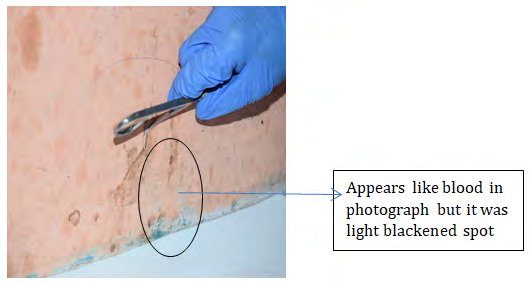
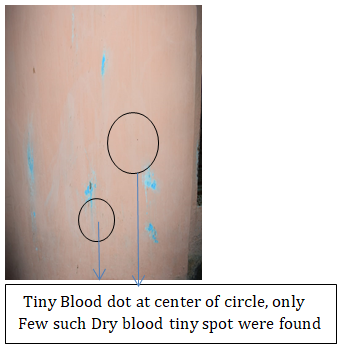
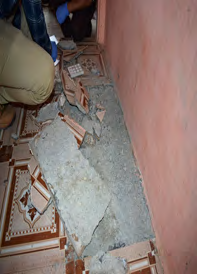
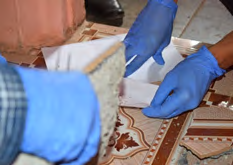
Team of forensic experts visited the crime scene to help the cops. It was evident that now crime scene search should perform in definite stages to establish the linkage theory [1] between deceased, accused and crime scene and the physical evidence. In lot of cases a trace of blood was found key evidence that proves involvement of accused [2]. Scene one was a locked room. After opening, it was divided into two different parts. Large one was hall type and small one was kitchen. There was middle opening door between them. It appeared that near the door, both side walls were newly painted. On the left wall of the hall, there was auspicious word written in Marathi with religious sign. This clearly indicated that just few days ago religious worship was done there. Floors were cleaned. In the kitchen, some part of the floor was blackened. That indicated that something was burnt there. Both the walls of kitchen, tiny red dots were found. The diameter of them was about 0.2 to 0.3mm. Scrapping of those spots was collected instead of swabbing because it was possibility of disturbance of the evidence on cotton swab. Small portion of scrapping was tested for blood using phenolphthalein reagent [3]. The test for blood was positive. Four samples of scrapings were collected.
Searching of Crime Scene Two
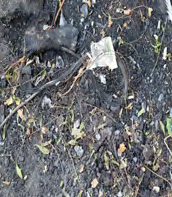
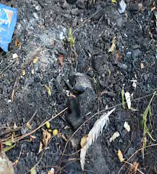
Forensic team was reached the crime scene two which was near riverside, somewhat away from scene one. No one was seen around 500 meters and it was 1.5 km away from residence. Below the Neem tree, it was appeared that something burned there few days ago. Suspected accuse provided information that this was the place where they burnt deceased. After careful observation, few totally burnt bone pieces were seen. Then along with police personnel, grid search [4] of surrounding crime scene was performed. Then fruitfully we found two partly burnt bone pieces.
Searching of Crime Scene Three
Later we moved towards the river side which was about 400 meters away from crime scene from the previous crime scene. According to suspected accuse, they threw some bone pieces in river water. Two swimmers searched below the water but only one burnt piece was found.
Analysis of Evidences in Forensic Laboratory
Investigation agency submitted the evidence at Regional Forensic Science Laboratory, Nashik. The samples were taken for DNA Profiling.
Extraction of DNA
Scrapping and powder of partly burnt bone pieces were taken for DNA extraction. For extraction of DNA from Scrapping 5 tiny pieces were taken for DNA extraction. In case of partly burnt bone pieces, the portion which is less burnt was selected; powder of that portion was taken for extraction.
The DNA extraction from blood and from bone done on Automate Express machine [5] using PrepFilerTM Express DNA extraction kit for blood and PrepFilerTM BTA
DNA extraction kit for bone. The PrepFilerTMForensic DNA extraction Kit (Applied Biosystems, Foster City, CA) are efficient for isolation of DNA from a variety of biological samples [6, 7]. Extracted DNA was checked for quantity.
Polymerase Chain Reaction
Master mix used for Polymerase Chain Reaction was- AmpF_I_STR PCR reaction mix: 10.5 µl AmpF_I_STR Primer Set: 5.5 µl Polymerase: 0.50 µl. Volume of Master mix used: 15 µl Volume of sample: 10 µl After PCR amplification Denaturation carried out using HiDiFormamide and Liz 600 size Standard.
Accurately quantified DNA was taken for amplification by Polymerase Chain Reaction Technique [8] using AmpF_l_STR®Identifiler® PCR amplification kit [9] on Veriti Thermal Cycler of Applied Biosystems. After PCR amplification, STR DNA profiling Genotyping was done using Short Tandem Repeat technique on Gene analyzer 3500 machine [10] successfully; DNA profiles were obtained from scrapping and bone pieces. Meanwhile blood of parents of deceased also received in the laboratory. The DNA profiling of blood samples was also done on Gene analyzer 3500 Machine.
| STR LOCUS | Genotype | ||||||
|---|---|---|---|---|---|---|---|
| Blood (Putative Mother) | Partly burnt bone piece (Crime Scene 2) | Partly burnt bone piece (Crime Scene2) | Scrapping (Crime Scene1) | Scrapping (Crime Scene 1) | Scrapping (Crime Scene1) | Blood Putative Father | |
| D8S1179 | 10,10 | 10,10 | 10,10 | 10,10 | 10,10 | 10,10 | 10,15 |
| D21S11 | 29,30 | 30,31.2 | 30,31.2 | 30,31.2 | 30,31.2 | 30,31.2 | 29,31.2 |
| D7S820 | 7,9 | 9,11 | 9,11 | 9,11 | 9,11 | 9,11 | 11,12 |
| CSF1PO | 10,11 | 11,12 | 11,12 | 111,2 | 11,12 | 11,12 | 12,12 |
| D3S1358 | 17,18 | 14,17 | 14,17 | 14,17 | 14,17 | 14,17 | 14,17 |
| THO1 | 6,8 | 8,9 | 8,9 | 8,9 | 8,9 | 8,9 | 9,9.3 |
| D13S317 | 11,12 | 11,12 | 11,12 | 11,12 | 11,12 | 11,12 | 11,11 |
| D16S539 | 11,12 | 11,12 | 11,12 | 11,2 | 11,12 | 11,2 | 10,11 |
| D2S1338 | 22,23 | 19,23 | 19,23 | 19,23 | 19,23 | 19,23 | 17,19 |
| D19S433 | 12,14.2 | 14,14.2 | 14,14.2 | 14,14.2 | 14,14.2 | 14,14.2 | 14,15 |
| WA | 16,17 | 14,16 | 14,16 | 14,16 | 14,16 | 14,16 | 14,18 |
| TPOX | 8,9 | 8,11 | 8,11 | 8,11 | 8,11 | 8,11 | 11,11 |
| D18S51 | 15,16 | 14,16 | 14,16 | 14,16 | 14,16 | 14,16 | 13,14 |
| AMELOGENIN | X,X | X,Y | X,Y | X,Y | X,Y | X,Y | X,Y |
| D5S818 | 11,12 | 12,13 | 12,13 | 12,13 | 12,13 | 12,13 | 11,13 |
| FGA | 22,23 | 20,23 | 20,23 | 20,23 | 20,23 | 20,23 | 20,21 |
Results
DNA profiles obtained from blood detected on scrapping and DNA profiles obtained from partly burnt bones were identical and from one and the same source of male origin.
The profiles were compared with claimant’s blood. It was revealed that the putative parents matched paternal and maternal alleles present in scrapping and partly burnt bone pieces.
DNA Profiles of different samples of two different crime scenes proved the sequence of crime the suspected accuse told. It also proved the identity of Deceased.
Conclusion
After the act of murder, though criminals took all the efforts to wipe out evidences from crime scene, the scientific and proper observation of spot irrespective of time period there might be some clues left behind and their careful collection is very important part of forensic expert. If blood is abundant at the crime scene, swabbing is beneficial but if tiny dried drops of blood are present, instead of swabbing scrapping method is preferential.
Above mentioned incident was took place 24 days ago but successful DNA profiles were obtained from partly burnt bones and very less amount of scrapping collected from crime scene. These profiles after comparing with parent’s his identity established. Here DNA technique helped to solve the crime and cop could register the crime of murder against criminals.
References
-
Henry CL, Palmbach T, Miller MT (2001) Henry Lee’s Crime Scene Handbook. 431.
-
Mahajan VB, Kharade AP, Kudekar DY, et al. A Jot of blood stain sends constable behind the Bars - Justice by DNA Profiling. Annals of clinical and Laboratory Research 7(2): 306.
-
Richard L (2008) Forensic Biology: Identification and DNA analysis of Biological Evidence.
-
Lee HC, Palmbach T, Miller MT (2001) Henry Lee’s Crime Scene Handbook. 126.
-
Liu JU, Zhong C, Lagace R, Harrold M, Dixon AB, et al. (2012) Automate Express TM Forensic DNA extraction system for the Extraction of Genomic DNA from Biological Samples. J Forensic Sci 57(4): 1022-1030.
-
Brevnov MG, Pawar HS, Mundt J, Calandro LM, Shewale JG (2009) Developmental validation of the PrepFiler Forensic DNA Extraction Kit for extraction of genomic DNA from biological samples. J Forensic Sci 54(3): 599- 607.
-
Brevnov MG, Mundt J, Benfield J, Treat-Clemons L, Kalusche G, et al. (2009) Automated extraction of DNA from forensic samples types using the PrepFiler Automated Forensic DNA Extracrtion Kit. JALA 14: 294- 302.
-
Raynolds R, Sensabaugh G, Blake E (1999) Analysis of Genetic Marker in forensic DNA samples using the polymerase Chain Reaction. Anal Chem 63(1): 2–15.
-
Applied Biosystems (2012) AmpF_l_STR®Identifiler® PCR amplification kit. User’s manual, Rev B Foster City, 4323291.
-
Applied Biosystems (2009) Applied Biosystems 3500/3500XL Genetic Analyzer User Guide. Faster City CA.
- Narcotics and Digital Forensics: Bridging Crimes in the Digital Age
- Ethics in Forensic Psychiatry: Principles, Dilemmas, and Human Rights
- Impact of Acute Stress on Attentional Orienting to Social Cues
- Head Injury and Intracranial Hemorrhage in Western Region of Libya
- A Forensic Study on Handedness: Examination of Handwriting Features in Right and Left Handed Writers
- Techniques for Latent Fingerprint Development Using Natural and Synthetic Powders: A Review