
Major Depression, Criminal Imputation and Expert Justification in the Causality of Suicide in the Workplace
A case of suicide carried out on a holiday (Sunday) at the workplace. While the widow and daughters defend that their situation of widowhood and orphanhood derive from an accident at work, the company and the insurer defend that there is no direct causal link between the suicide and the exercise of their work activity. Through the report of the technical labor inspection, it was possible to prove that said self-inflicted behavior presents a direct causal relationship; in addition, a forensic psychological expert report was provided for the case that accredited said connection. On the contrary, neither the company nor the insurer provided a psychological-psychiatric expert that could prove that said suicide had its origin in causes unrelated to the workplace, and the Judge ruled in favor of the widow and orphaned children
Introduction and Case
Psychological phenomena such as hopelessness, shame, a sense of worthlessness, and low self-esteem are key concepts in understanding suicide [1]. For Joiner, et al. [2] hopelessness is a fundamental psychological correlate of suicide. As stated in the judgment, the following are considered “proven facts”: “Mr. XXXXX provided services for a chemical company as the Factory Director. On a Sunday in the spring of 2020, at 10:20 p.m. the death of the Factory Director was certified at the place of work.
Through a resolution of the Social Security Institute, the widow of the deceased is granted the widow’s pension derived from a non-occupational accident; the minor daughters of the deceased are also granted orphan’s pensions derived from non-occupational accidents.
The plaintiff (widow and daughters of the deceased) filed prior administrative claims against the hasty resolutions, alleging the contingency of death and survival benefits.
On the contrary, and by resolution of the insurer, Mutua, the previous claims are dismissed, on the understanding that the facts constitute reckless negligence on the part of the deceased worker and cannot be considered as a direct relationship between the work and the suicide of the deceased.
Similarly, and according to statements made by a person in charge, the company was going through a difficult situation that was aggravated by the Covid-19 pandemic: investments were being canceled and a filing for collective layoffs had been negotiated that affected 29 employees. This situation worried and anguished the now deceased, because as the current Director indicates, “his main concern was his work, they were colleagues and friends and that is how they spoke about it.” To these we must add the existence of legal proceedings for toxic discharges related to the company in which the deceased figured as a defendant.
The procedure before the Court of Instruction stands out, which after a long administrative process was in the final stretch and the deceased was expecting a judgment to be issued (conviction by conformity of 2 years in prison). He points out that everyone in the factory was aware of how badly the Factory Director had suffered during all those years as a result of his imputation in the procedure and states that “everyone had passed by his office when they heard about the sentence and that they were expressly talking about this issue in February 2020.” On the other hand, it is indicated that between the months of XX and XX of 2020, new proceedings were instigated for contamination of water and wells and that, again in mid-XX of 2020, there was a new discharge of wastewater, leading to a visit by the police to the Factory Director’s office that eventually resulted in an administrative sanction.
It was stated that they were caused by a period of strong storms and that this situation made them see that the factory was not prepared to handle it. The Director affirmed, without a doubt, that he saw and knew that this whole situation distressed and worried him, but that he could never imagine to what extent it was affecting him. Lastly, the Factory Manager stated that at that time the deceased was the Factory Director, but that, by management decision, he had ceased to be the sole administrator of the company and among the duties of the Factory Director was going to the center when the factory was empty to check that everything was in order. The Factory Manager added that as part of his work, both previously the deceased and currently himself, have to be available and work seven days a week, except when the factory is stopped. For this reason, it was common (and part of his job) to go to the factory to check that everything was correct when there were no staff working, especially if there were storms or bad weather, such as the day the events occurred.
On Sunday, XX of XX, 2020, the Factory Director took his own life at the workplace.
In compliance with his functions as Factory Director, he went to check that everything was working correctly, since the factory was empty of workers and that Sunday was a rainy day.
Regarding how the events occurred, the Factory Manager stated that around 9 a.m. they observed a disconnection of the alarm and at around 9:45 p.m. he received a call from the Maintenance Manager notifying him that the wife of the Factory Director had called him, worried that her husband had gone to the factory in the morning and they hadn’t heard from him.
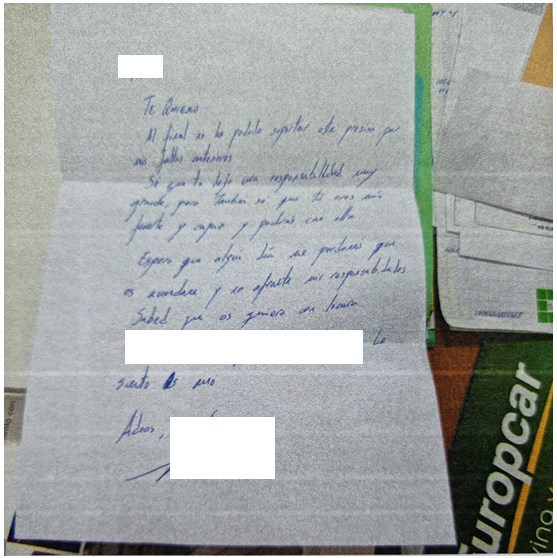
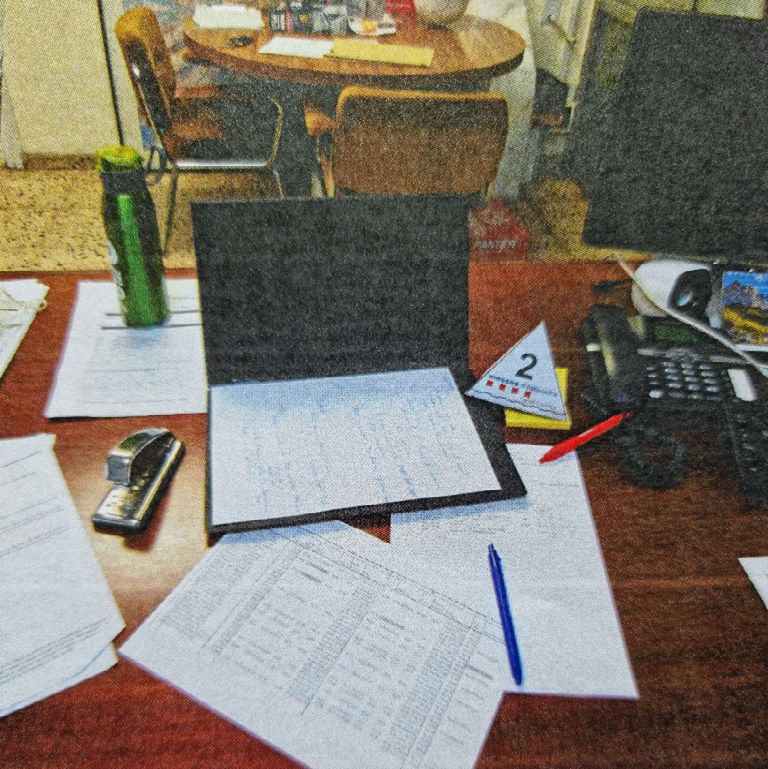
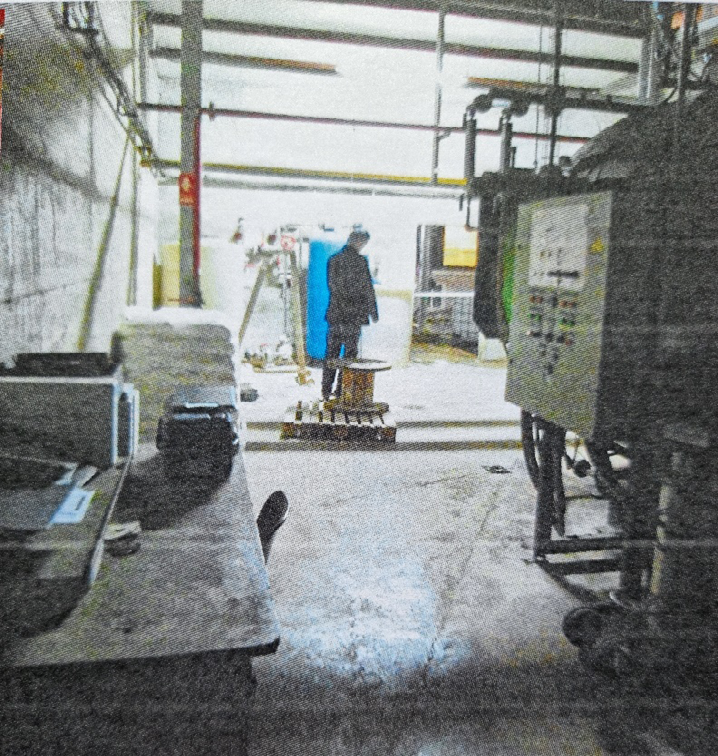
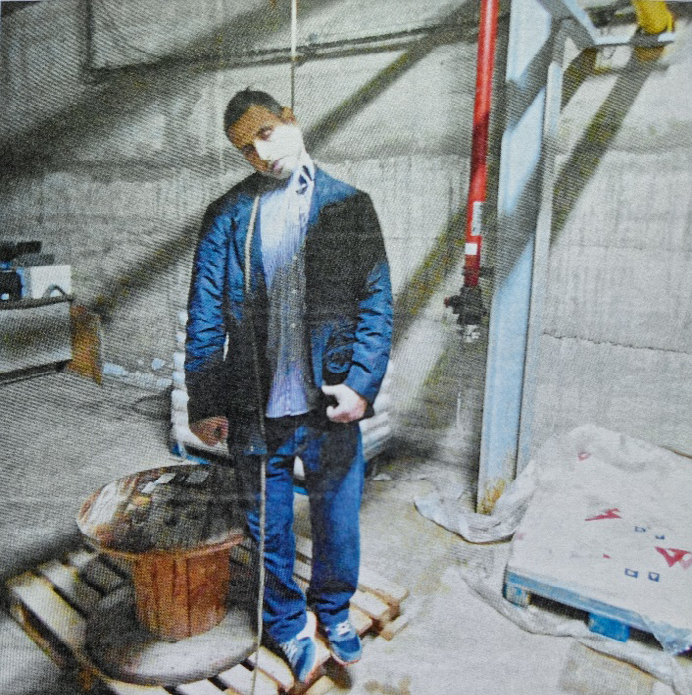
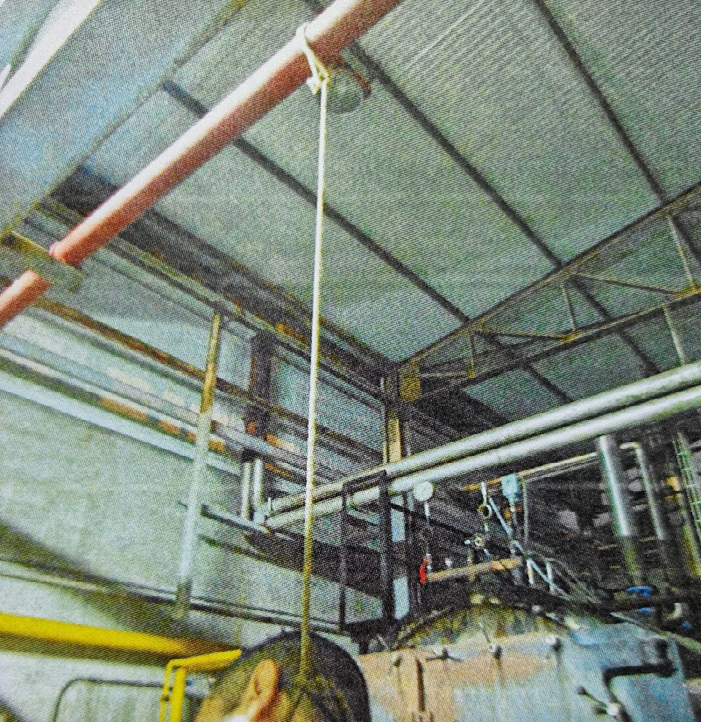
Accompanied by her father, she had gone to the workplace where they could see that his car was there, but the factory was closed and they could not enter. For this reason, they notified the maintenance manager, who opened the door and in the Factory Director’s office they found a personal letter addressed to his family, in which he said goodbye to them. In the Factory Manager’s laptop he had left another note with technical instructions about the job. Both notes are in the possession of the police. He commented “that he had made mistakes and that he could no longer bear it.” At that moment they notified the police and they accompanied them in an inspection of the factory. On a first search they were unable to find the Factory Director, but the location of the mobile phone that he had shared with his wife gave a signal from inside the factory. They did a second search and found his lifeless body in the boiler room.
The labor inspection report concludes that from the facts presented, it can be deduced that the Factory Director was immersed in a work environment that generated such tension and anguish that it seems to be the trigger that led him to the fatal decision to take his own life. The existence of a causal link between the business and work situation of the deceased and the act of taking his own life is observed, without prejudice, to the fact that no evidence can be provided that determines that there was an origin other than work for the mental disorder that led the employee to suicide. To these we must add that the suicide of the Factory Director took place in the workplace itself, while attending to his duties. It is when the event takes place outside of this area that it is considered necessary to prove that there is causality between the suicide and a previous labor conflict in order to qualify it as an occupational accident.” In the sentence, the Judge states the conclusion “that the deceased was immersed in a work environment that generated such tension and anguish that it was a sufficient trigger that led him to take his own life.” He added that “there is a causal link between the business and work situation of the deceased and the act of taking his own life, without there being provided by the co-defendants expert evidence or sufficient means admitted in law that would allow the determination of the existence of stressors other than those accrediting the intense work load with the existence of criminal legal proceedings against the subject in his duties as Factory Director and the stress and anguish due to decisions related to the situation of the pandemic.
In other words, there is no evidence of an origin other than work for the mental disorder that led the employee to suicide.
It cannot be ignored that the suicide of the Factory Director has taken place in the workplace itself and in the course of his duties during a visit to the workplace due to temporary situations and responsibilities attached to his job and especially with the background of problems with criminal labor proceedings for the existence of discharges and crimes against the environment.
Furthermore, the plaintiff provides a psychological expert examination of the deceased and of the circumstances (analysis of the existing documentary elements) that led to the drastic and unfortunate decision of the deceased; being concluded by the Doctor in Psychology that the sufficient causal reason that gave rise to the traumatic suicidal death

of the deceased was caused by work related problems within the framework of critical stress factors to which the deceased was critically subjected, being compatible that the modus operandi of committing suicide at the workplace - after going to work on a Sunday for professional responsibilities on a rainy day - was motivated by anxiety and anguish with labor- professional causality.
In short, it is appropriate to uphold the claim and declare that the death and survival benefits of the plaintiff (widow’s pension and 2 orphan’s pensions) derive from professional contingency.”
Photographic Report of the Suicide Scene
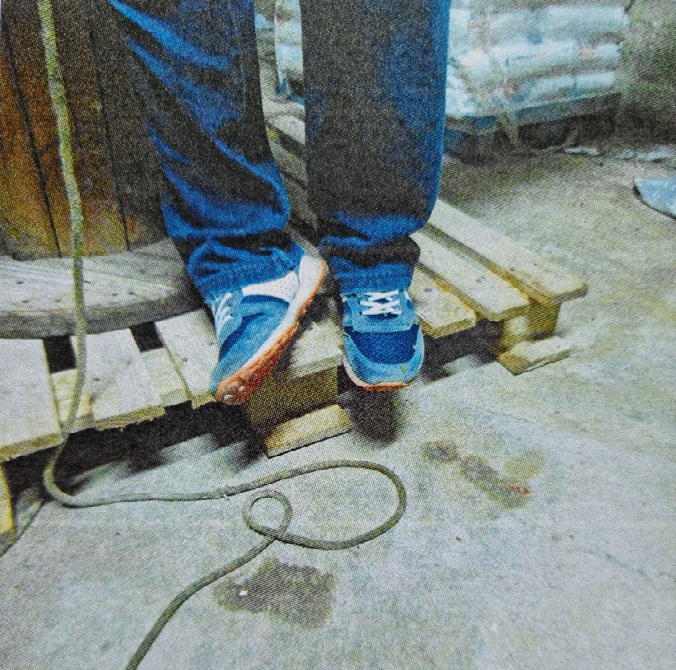
In order to understand the behavioral scope of the suicide, photographic material is included:

Methodology
In order to proceed with the issuance of the forensic expert report on the mental health status of the subject, the following documentation was analyzed: - Clinical. - Legal. - Photographic report of the suicide scene. - Suicide notes. - Forensic Medical Report. - Judicial and police record of the removal of the body. - Court records of the declaration of the wife and workers of the company. - Labor Inspection Report.
Discussion
From the data provided to the expert witnesses in mental health (psychological-psychiatric) and based on what was outlined in the judgment issued by the Judge, it was determined that the Director of the Factory died of a suicidal act by hanging himself at the company in which he worked, on a public holiday (Sunday). It should be noted that, in compliance with his duties as Factory Director, he went to the work place to check that everything was in proper working order even on a Sunday, since the factory was empty of workers and it was a rainy day.
In this sense, there is ample documentation that accredits the above, following the police, judicial and medical-forensic procedures carried out.
In general terms, although not always, but it is common, the suicidal act is accompanied by the writing of suicide letters or notes addressed to relatives, friends or medical or legal professionals. In the present case, there are two notes: one, of an intimate-personal nature, addressed to his wife, and another of a professional nature aimed at the managers of the company in which he dictated some guidelines specific to his technical specialty.
It should be noted that, prior to the tragic event (hanging and suicide), he found himself beset by a series of adverse psychosocial factors, such as the following: a. The subject of a juridical-legal procedure for which he was being investigated and charged with two alleged crimes in the ecological field (dumping of toxic substances). b. In the framework of the socio-sanitary crisis of the Pandemic caused by COVID-19, he would be affected by the economic consequences that this entailed in the business and labor spheres (a collective layoff was being contemplated as a consequence of said health crisis). c. Likewise, and to add to the two previously mentioned contexts, when the subject was about to accept a criminal agreement with the Prosecutor’s Office (with two years in prison for point a), he was made aware of the opening of new legal proceedings, an investigation for a new alleged crime against the environment (and for which he was being investigated again as a defendant). Said circumstance would entail a new lengthy judicial process and another possible future criminal sanction that would constitute recidivism, for which he would certainly enter in a penitentiary center; and, all this after trying by all means to avoid new potentially toxic discharges, without the company paying any attention to it.
All of the above is compatible and/or suggestive that the reason why the deceased committed suicide was directly caused by professional reasons. The whole set of psycho- emotional stress factors to which the subject was critically and acutely subjected is compatible with a trigger that led the iter criminis or modus operandi to the commission of the suicidal act in the workplace, which was the direct cause of his anxiety and anguish.
The role of the Forensic Psychology report reaches a special relevance in order to be able to prove in the Courtroom the scope of the psychological reality of the deceased and that the Legal operators are lacking in psychological and/ or psychiatric knowledge in order to justify the behavior pathology of the subject [3, 4, 5, 6].
Conclusion
The suicidal act can have its origin in an affectation of the mental state of the subject or in critical and acute stressful circumstances. This case describes a suicide committed on a holiday (Sunday) at the workplace. While the widow and daughters defend that their situation of widowhood and orphanhood derive from an accident at work, the company and the insurer maintain that there is no direct causal link between the suicide and his work activity. Through the report of the technical labor inspection, it was possible to prove that said suicidal behavior presents a direct causal relationship; in addition, a forensic psychological expert report was provided, which accredited said connection. On the contrary, neither the company nor the insurer provided a psychological-psychiatric expert that could prove that said suicide was due to causes unrelated to the workplace, and the Judge ruled in favor of the widow and orphaned children.
References
-
American Psychiatric Association (2003) Practice guideline for the assessment and treatment of patients with suicidal behaviors. Am J Psychiatry 160(11): 1-60.
-
Joiner TE, Brown JS, Wingate LR (2005) The psychology and neurobiology of suicidal behavior. Annu Rev Psychol 56: 287-314.
-
Shneidman E (1999) Perturbation and lethality: a psychological approach to assessment and intervention. In: Jacobs DG (Ed.), The Harvard Medical School guide to suicide assessment and intervention. San Francisco: Jossey-Bass, pp: 83-97.
-
Tiffon BN, González-Fernández J (2021) Desperation in Major Serious Depressive Disorders and Extended Suicide Risk: A Case of Double Filicide. Asean Journal of Psychiatry 22(S1): 1-5.
-
Tiffon BN (2022) Atlas of Forensic and Criminal Psychology. Taylor & Francis Group, CRC Press. New York. USA.
-
Tiffon BN, González-Fernández J (2022) Atlas Forense Gráfico-Psicométrico: Perspectivas de la Psicopatología Criminal y Forense. 25 casos forenses médico- psicopatológicos. Editorial Bosch. Barcelona.
- Forensic Implications of Adverse Drug Reactions in Schizophrenia A Case Series
- Narcotics and Digital Forensics: Bridging Crimes in the Digital Age
- Ethics in Forensic Psychiatry: Principles, Dilemmas, and Human Rights
- Impact of Acute Stress on Attentional Orienting to Social Cues
- Head Injury and Intracranial Hemorrhage in Western Region of Libya
- A Forensic Study on Handedness: Examination of Handwriting Features in Right and Left Handed Writers