
Obtaining Typeable STR Profile from Highly Decomposed and Mutilated Remains by Organic Extraction
Disaster victims were identified by routine DNA analysis involving standard autosomal, amelogenin, and Y-STR typing elsewhere. However, the remains of one of the victims that were received at the DNA Division of FSD, Chennai were in a highly decomposed and mutilated state, which proved difficult to analyze. A partial DNA profile could only be obtained for the remains using modern-day extraction protocols. The conventional organic extraction protocol is not preferred in routine analysis owing to the time constraint faced by DNA labs. Nevertheless, the organic extraction protocol enabled us to get an improved recovery of DNA, and that in turn paved the way for typeable DNA profiles. Hence, we advocate that the organic DNA extraction protocol, though laborious, can still be used for better results, from difficult samples and it outweighs the kit-based extraction procedure for analysis of degraded bone samples.
Case Report
The DNA Division of the Forensic Sciences Department (FSD), Chennai, and Tamil Nadu on average receives 200 cases involving bone specimens for human identification in a year. We present a case report that has thrown up a few challenges/problems. A cargo ship with 26 Indian nationals on board sank in the Pacific Ocean near the Philippines in October 2017 and 10 were found missing. The unidentified tiny bone present in a highly decomposed and mutilated state found on the shore of the Philippines was received at the DNA division for human identification.
Materials and Methods
We received a tiny bone sample from the remains of the decomposed body found in the Island city of the Philippines. Genomic DNA was extracted either using modern-day extraction procedures or the decalcification and organic extraction protocol and quantified using the Applied Biosystems.
Organic Based DNA Extraction
The bone sample was drilled using a drilling machine and the powder was ground well-using tissuelyzer. The ground bone powder was incubated with shaking at 4°C for 24 hours in 40 mL of 50 mM ethylenediamine tetraacetic acid [EDTA], pH = 7.5. Centrifuged at 10,000 rpm for 10 minutes and the supernatant was discarded and the pellet was added to 40
ml of 0.5 M EDTA, pH 7.5. The process was repeated over five days. Monitored the decalcification process by the addition of saturated ammonium oxalate solution to discarded supernatant. When the solution remained clear after the addition of ammonium oxalate, the decalcification process was stopped. Added 40ml of sterile distilled, deionized water agitated on a rotator for several minutes and then centrifuged at 10,000 rpm for 10 min in 5804R centrifuge and discarded the supernatant. Repeated the above step thrice. The pellet was incubated overnight at 56°C with 4 mL of DTT and 200 μl of Proteinase K. To this added 4 ml buffered phenol and kept on a rotator for 30 min. Centrifuged at 10,000 rpm for 30 min, at 10°C Aqueous layers were transferred to a fresh labeled 30ml tube. To this added 4 ml of buffered phenol and 2 ml chloroform: Isoamyl Alcohol (24: 1) mix. Kept on a rotator for 20 minutes. Contents were transferred to another labeled 30 ml tube. Centrifuged at 10,000 rpm for 20 minutes at 10°C. Aqueous layer transferred to fresh labeled 30ml tube. To this added 4 ml Chloroform: isoamyl alcohol (24: 1) mix. Kept on the shaker for 10 minutes. Contents were transferred to a fresh labeled 30 ml centrifuge tube. Centrifuged at 10,000 rpm for 10 minutes at 10°. Aqueous layer transferred to the sample reservoir of an amicon placed over a filtrate vial. Centrifuge at 7500G till all the solutions got filtered. Washed with TDW thrice with 1 ml each time. Amicon inverted over a retentate vial, 75μl of TE buffer was added and centrifuged at 1000 G for 2 min. The sample collected was kept at 56°C for 2 hours and then stored at - 20°C.
Quantification of DNA
Quantification was performed by 7500 Real-time polymerase chain reaction (PCR) using Quantifiler Duo DNA Quantification kit (Applied Biosystems) according to the manufactures recommendations. Duplicate reactions of controls and standards were carried out on a 7500 Real-time PCR system (Applied Biosystems). Data was collected and analyzed via Real-time PCR system analysis Software. Finally, 1 ng DNA was used for further use.
Polymerase Chain Reaction
Multiple amplification reactions targeting 15 specific short tandem repeat (STR) regions of DNA predominately applied in the forensic investigation were carried out in an ABI 9700 PCR using AmpFlSTR Identifiler Plus PCR Amplification kit for amelogenin locus and also 15 autosomal STR loci namely D8S1179, D21S11, D7S820, CSF1PO, D3S1358, TH01, D13S317, D16S539, D2S1338, D19S433, vWA, TPOX, D18S51, D5S818, and FGA. Briefly, 1 ng (5 µL) of quantified DNA was added to 7.5 µL of PCR amplification reaction mixture containing 5 µL of AmpFlSTR Identifiler plus master mix and 2.5 µL of AmpFlSTR Identifiler plus primer.
Amplification was carried out in MicroAmp Optical 96- well reaction plate (Applied Biosystems) in an ABI 9700 PCR with a gold-plated silver block (Applied Biosystems). Briefly, PCR cycling conditions were 95°C for 11 min, followed by 28 cycles of 94°C for 0.2 then at 59°C for 3 min, and a final extension at 60°C for 10 min. All amplification reactions were determined along with positive and negative controls. The amplified samples were kept at -20°C.
Capillary Electrophoresis and Data Analysis
Electrophoresis separation and STR typing of all PCR amplification products were analyzed using the 3130 × l Genetic Analyzer using the specified G5 variable binning modules (Applied Biosystems). Samples were cocktail by adding 1 µL of the PCR amplified product or allelic ladder to 11 µL of formamide-LIZ solution (10.7 µL of deionized Hi- Di formamide and 0.3 µL of GeneScan 500 LIZ size standard; Applied Biosystems) was added to each well.
Capillary electrophoresis was carried out with the injection voltage at 3 kV for 10 sec and electrokinetically at 15 kV for 1500 sec using performance-optimized polymer-4 (POP-4) with an oven temperature of 60°C. The 3130 xl Series Data Collection Software as well as GeneMapper ID-X software v1.5 (Applied Biosystems) were used to collect and analyze the retrieved data. Allele peaks were interpreted with a peak threshold of ≥ 50 relative fluorescence units (RFU) for all dyes. A final reading of STR alleles sample genotyping was performed by determining the number of repeats in allelic ladders. By comparison of the size of a sample’s alleles to size of alleles in allelic ladders for the same loci being tested in the sample, the STR genotyping was conducted.
Results and Discussion
Autosomal STRs are highly polymorphic, a wide range of repeat sequences have been identified, characterized, and demonstrated to be abundantly present in the human genome. These STR loci have become gold standard markers in human identification, parentage testing, and population genetics in the field of Forensic DNA typing [1, 2]. The generation of a DNA profile from skeletal remains is pivotal in the identification process of both mass disaster and human identification cases. Since bones are the only source of biological materials remaining after prolonged exposure to harsh environments. It is the most important technique for the identification of missing persons in disaster management, as specified by the Interpol Disaster Victim Identification Guide [3, 4]. In forensic science, human identification is the major objective in obtaining full profiles from the most challenging samples. A reliable extraction and purification method are therefore pivotal to forensic DNA laboratories that routinely encounter a variety of challenging samples. Application of modern-day DNA extraction procedure combined with an easy-to-follow protocol drastically decreases time and therefore is primarily preferred for analysis but occasionally fails to produce results with good quality. In such scenarios, conventional methods play a crucial role in producing DNA profile with potential quality. One such promising procedure is decalcification and organic extraction protocol [5, 6].
Partial Set Of DNA Profile by Modern-Day Extraction Procedure
Using Automated hands-on free extraction methods DNA was extracted and amplified using the AmpFlSTRidentifiler plus Primer Mix. Amplification products were analyzed with an Applied Biosystems 3130xl Genetic Analyzer. Results were analyzed using GeneMapper® ID software, version 1.4using 100RFU as the analysis threshold.
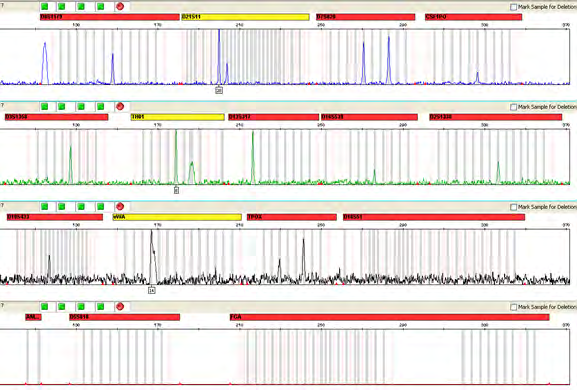
The following locations, the alleles at the 15 loci, were allele 14,15 for (D8S1179), allele 28,29 for (D21S11), allele 10,13 for (D7S820), allele 11, 12 for (CSF1PO) loci, allele 16,17 for (D3S1358), allele 6,8 for TH01 locus, allele 8,10 for D13S317 locus, allele 8,11 for (D16S539, TPOX) locus, allele 11 for D2S1338 locus, alleles 13,14for D19S433, and 14,16 for VWA locus, allele 12,15 for D18S51 locus, allele 10,11 for D5S818 locus, allele 19,24 for FGA locus, At amelogenin locus and its two possible genotypes X,Y obtained. Genotypes of all alleles of the STR loci expressed heterozygous repeats except D2S1338 are specific to a male individual. Collectively, these loci rendered greater discrimination potential for human identification and enhanced kinship analyses as requested by the Ministry of shipping.
Complete Set of Potential Typeable DNA Profile by Organic Extraction Procedure
After the unsuccessful amplification of the bone sample, we performed a manual procedure. Using the decalcification/ organic extraction method DNA was extracted and amplified using the AmpFlSTRidentifiler plus Primer Mix. Amplification products were analyzed with an Applied Biosystems 3130xl Genetic Analyzer. Results were analyzed using GeneMapper® ID software, a version 1.4using 100RFU as the analysis threshold.
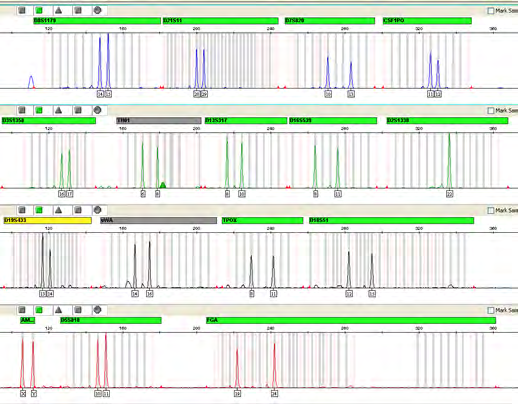
Hence the recovery of DNA from environmentally exposed skeletal remains is often complicated due to degraded and very low yield of extracted DNA and the presence of PCR inhibitors. However, reasonably specific techniques are required to obtain a typeable STR profile from the bone, particularly when the bones have been affected by external factors. It is vital to compare and document the uniqueness and efficiency of different DNA extraction procedures to decide on the most successful methods.
Conclusion
Genomic DNA extraction using decalcification and the organic extraction procedure resulted in a complete set of typeable STR profiles. Hence, we highly recommend that the organic DNA extraction protocol yet old-fashioned and laborious can still be an appropriate procedure for potential results. The prospective for analysis of conventional organic extraction outweighs the automated hands-on free kit-based extraction procedure for analysis of bone remains obtained from decomposed and mutilated bodies. As a result of DNA typing, the bereaved family members availed of all the life- term benefits.
Acknowledgment
The authors thank Forensic Sciences Department, Chennai for the support and encouragement.
References
-
Butler JM (2006) Genetics and genomics of short tandem repeat loci used in human identity testing. J. Forensic Sci 51(2): 253-265.
-
Gill P, Jeffreys AJ, Werrett DJ (1985) Forensic application of DNA ‘fingerprints’. Nature 318: 577-579.
-
Vagish LS, Vina RV, Leena KP (2018) DNA analysis in identifying mass disaster victims. International Journal of Forensic Medicine and Toxicological Sciences 3(3): 33-40.
-
Montelius K, Lindblom B (2012) DNA analysis in Disaster victim identification. Forensic Science Medicine and Pathology 8(2): 140-117.
-
Marshall PL, Stoljarova M, Schmedes SE, King JL, Budowle B (2014) A high volume extraction and purification method for recovering DNA from human bone. Forensic Science International Genetics 12: 155-160.
-
Kochl S, Niederstatter H, Parson W (2005) DNA extraction and quantitation of forensic samples using the phenol-chloroform method and real-time PCR. Methods in Molecular Biology 297: 13-30.
- Forensic Implications of Adverse Drug Reactions in Schizophrenia A Case Series
- Narcotics and Digital Forensics: Bridging Crimes in the Digital Age
- Ethics in Forensic Psychiatry: Principles, Dilemmas, and Human Rights
- Impact of Acute Stress on Attentional Orienting to Social Cues
- Head Injury and Intracranial Hemorrhage in Western Region of Libya
- A Forensic Study on Handedness: Examination of Handwriting Features in Right and Left Handed Writers