
Personal Identification through Lip Prints
Personal identification is one of the main aspects of criminal investigation. The study of lip prints known as cheiloscopy has helped to find and help in the identification of the perpetrators and victims. There is a need to study lip prints since according to the review of literature only mere studies are done over this topic. The present study focuses on different aspects of lip prints which includes the history and development of lip print patterns, various lip print patterns and its classifications, recording of the lip prints and the methods used in development of lip print patterns found in the crime scene. This descriptive paper inculcates the readers with a complete and brief knowledge about the lip prints and its importance as a tool for personal identification.v
Introduction
Identification in the medico legal sense refers to the determination of the individuality of the person. Over the years of time successful attempt of using patters of different prints of the parts of the human body for positive identification of the individuals have been made by various scientists all over the world [1]. One just unique print of discussion would be lip prints. Lip prints marks affirmative identification. The pattern of wrinkles on the lips has individual characteristics as fingerprints. The wrinkles on the lips has individual characteristics as fingerprints [2]. The wrinkles and grooves on the labial mucosa (called sulci labiorum) form a characteristic pattern called the lip prints [2]. “Cheiloscopy” is a forensic investigation technique that deals with identification of humans based on lips print pattern and traces. Cheiloscopy can be also defined as a method of identification of a person based on or science that deals with the characteristic arrangements of mucosal folds which forms distinct lines appearing on red part of the Essay lips. Lip prints are similar to fingerprints and foot prints in that the individual characteristics are used for identification. These prints are unique and do not change during the life of a person. It has been verified that they recover after undergoing alterations like trauma inflammation and diseases like herpes, and that the dispositions and forms of the furrows does not vary with the environmental factors. Studies have shown that the lip prints of parents and children and those of siblings have shown some similarities, which can help in establishing relationships to a limited extent. It has also been suggested that variations in patterns among males and females could help in sex determination.
Reddy LV [3] explained in detail about the lip prints in their research paper. They have mentioned that apart from identifying and evidential use, lip prints may also be used in detection and drawing conclusions, since it is the source of multiple criminalistic information. A lip print at the scene of a crime can be a basis for conclusions as to the character of the event, the number of the people involved, sexes, cosmetics used, habits, occupational traits, and the pathological changes of lips themselves. In the study the author has classified the lip prints from type I to type V and explained about each one of them in detail.
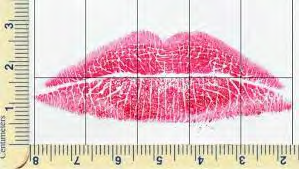
Cheiloscopy helps in identifying the humans based on the lips’ traces. The pattern of wrinkles on the lips has individual characteristics like fingerprints. The article written by Prabhu RV, et al. [4] reviews in detail the history, scope of cheiloscopy, and the use of lip prints in crime detection. The paper concludes by enlightening the readers with the fact that the possibilities to use the red part of lips to identify a human being are wider than it is commonly thought.
Chatra L, et al. [5] conducted the study to check for any peculiar lip patterns in relation to the sex of the individual and determined the most common lip patterns in the Indian population. The lip-print of selected population was analyzed and interpreted to determine the sex of individuals. The conclusion of the study was along with other traditional methods, cheiloscopy can also serve as very important tool in the identification of a person based on the characteristic arrangement of lines appearing on the red part of the lips.
Padmavathi BN, et al. [6] documented common patterns, as well as their variation in the study population, with objective of evaluating uniqueness of the lip print pattern among the study population.
Crime Detection through Lip Prints
As we know by now that lip prints are unique and so will not change during the life time of the person, the traces of lips should be looked for on cutlery and crockery items, on the window or door glass and on several cases photograph or letters. Further the lip prints being uniform throughout the life and characteristic of a person can be successfully used to verify the presence or absence of a person from the crime, provided there has been consumption of beverages, drinks, usage of cloth, tissues or napkin at the crime scene. Lip prints can also possibly be found alongside the teeth marks on any food particles or in cases of rape on the various surfaces of the skin on the victim or suspect if there was any defence tackle by the victim. Lip prints can most importantly found in cigarette buds which appears to be found in most of the crime scenes. These lip prints can be most frequently seen during murders, rapes and burglaries.
History and Evolution of Cheiloscopy
The existence of lip prints for identification came into picture in the early 20th century by various anthropologists. In 1902 the biological phenomenon of system of furrows was first noted by R. Fischer. In 1932, French Criminologist, Edmond Locard recommended the use of lip prints for identification. In 1950, Le Moyne Snyder, a Forensic expert suggested the various concepts of wrinkles in lips to identify people in his book which was titled as “Homicide Investigation”. In his book he stated that each lip prints have individual features which are very distinct from other individuals very similar to fingerprints. Therefore he is also termed as the “Father of Cheiloscopy”. In 1960, Dr Martin Santos projected that lip prints could be used for personal identification and further formulated a simple system to classify the lip prints into different groups. In 1961, world’s first research was done on lip prints. This research started after the lip traces were found on the glass door was found at the scene of murder. This further proved the usefulness of the lip prints as a tool of personal identification.
From 1950, two Japanese scientists Yasuo Tsuchihashi Y, et al. [7] and Kazuo Suzuki had been investigating the odontological relations between female lips and lipsticks. They devised that there was an individual specificity in the morphology of the lip grooves. In the period from 1968-1971 they studied the lip grooves extensively. They called these lip grooves sulci labiourum rubrorum. Furthermore in 1971 they also studied the uni-ovular twins and concluded that no two lip prints manifested the same patterns. In 1972 Mc Donell conducted a study between two identical twins and his study resulted in finding out that they have different lip prints even tough all other features look indistinguishable. It is due to their researches that it was established that lines on the red part of the human beings is unique and individualistic in nature and no two individuals can have similar lip prints just like fingerprints.
Classification
In 1967, Clauco Martin Santos, Professor of Forensic Dentistry at the Federal university of Rio de Janerio, Brazil, first Classified the lip print grooves into 2 major groups as given in the Figure 2. He further classified lips into different sizes like thin, medium, thick and mixed types.
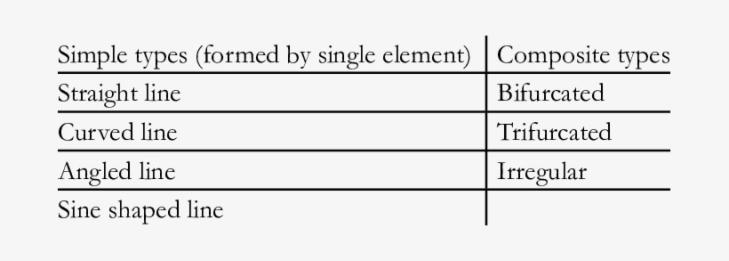
The next accepted classification of lip prints was given by was given by Yasuo Tsuchihashi Y, et al. [7] and Kazuo Suzuki in which they classified the lip prints based on the shape of the groove patterns. Their classification are the most widely used for the lip print identification in the present days because of its detailed classification for the recording of the same. The classification is such that the scientists have classified the lip prints into 6 different patterns which is given in the Figure 3. The pictorial representation of the classification is given in the Figure 4.

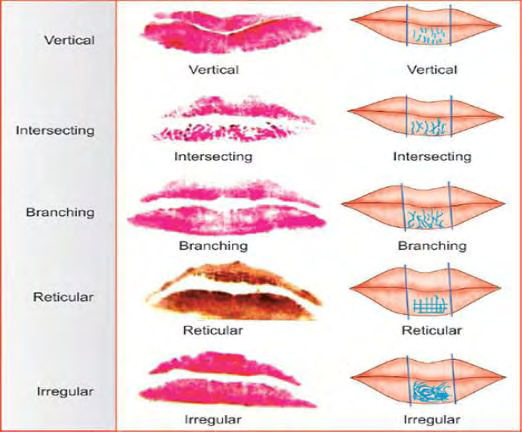
Figure 4: Yasuo Tsuchihashi and Kazuo Suzuki classification Renaud’s classification is yet another classification which was concluded by the scientist after studying more than 4000 lip print samples. According to this classification the lip prints are grouped into 10 different categories from type ‘a’ to type ‘j’. The different categories are mentioned in the Figures 5 and 6.
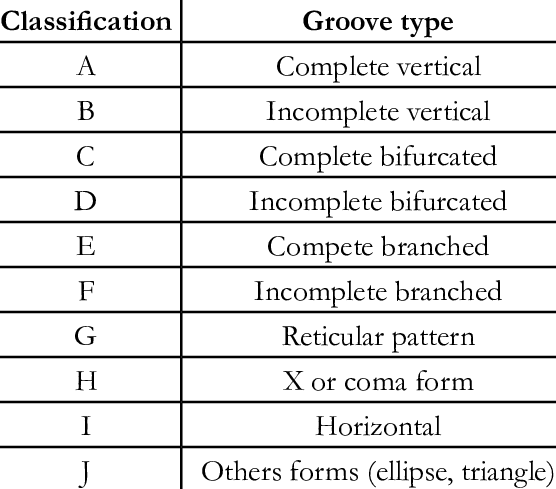
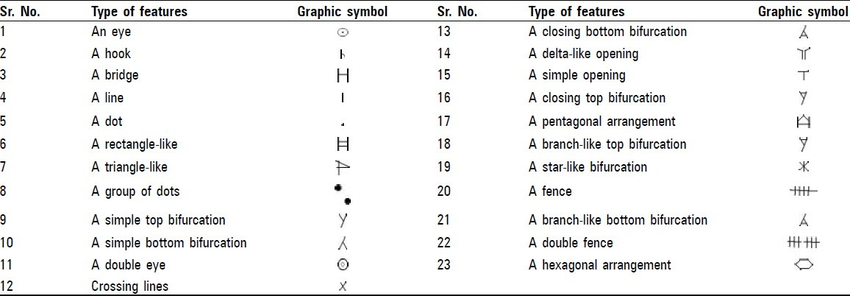
![Figure 6: Diagrammatic representation Renaud’s classification The Kasprzak JC [8] classification was given for the individual lip prints. The classification was based on all the individual characteristics found on the lip prints. The characteristics are given in the Figure 6.](/fulltextimages/9401/fig_6.png)
Recording Lip Print Samples
The method of collection of lip print samples are almost same and very hassle free. There are numerous ways in which the lip prints can be collected. The first easy way of collection would be photographing the suspect’s lips. On a non-porous even surface like a mirror they can be photographed, enlarged and edge tracings made of the furrows [9, 10, 11, 12, 13, 14, 15]. Putting lipstick or other suitable mediums on the lips and then the individuals asked to press his or her lips to a piece of paper or cellophane tape or similar surface. Lip prints can also be collected using a finger printer, preferably a roller finger printer. By having the subject impress his or her lips (without lipstick or any other medium) against a suitable surface and then processing these prints with either conventional finger print developing powder or with a magna brush and magnetic powder [15, 16, 17, 18, 19, 20, 21].
Development of Lip Prints
The development of the lip prints can occur either by the basic powder technique or the magna brush technique. The basic powder method is the most feasible and commonly used method of lip print development for the surface prints. Various powders are conveniently found for the same process. If the prints on the crime scenes are partially or fully visible then photography would be a suitable option for development of the evidences. The powders range from black, white, grey, silver, Bi-chromatic, fluorescent. The powders could be used to develop prints from any surfaces from glass, door, plates, glasses, cigarette buds, floors or any other surfaces. Any contrast powders could be selected based on the type and colour of the surface to be used for the print development.efforts are being made to develop more in the field of research of lip prints because of its importance being increasing slowly in the crime scene investigation [21, 22, 23, 24, 25, 26].
Conclusion
Lip prints like any other impressions are one of the important types of prints for the analysis from the crime. With ever increasing crime rates in the world lip print could considered as one more important type of impression.
References
-
Saraswathi TR, Mishra G, Ranganathan K (2009) Study of lip prints. Journal of forensic dental sciences 1(1): 28-31.
-
Sivapathasundharam B, Prakash PA, Sivakumar G (2001) Lip prints (cheiloscopy). Indian journal of dental research: official publication of Indian Society for Dental Research 12(4): 234-237.
-
Reddy LV (2011) Lip prints: An overview in forensic dentistry. Journal of Advanced Oral Research 2(1): 17- 22.
-
Prabhu RV, Dinkar AD, Prabhu VD (2010) Collection of lip prints as a forensic evidence at the crime scene--an insight. Journal of Oral Health Research 1(4): 129.
-
Chatra L, Peter T, Ahsan A (2016) Cheiloscopy. International Journal of Forensic Odontology 1(2): 48- 52.
-
Padmavathi BN, Makkad RS, Rajan SY, Kolli GK (2013) Gender determination using cheiloscopy. Journal of forensic dental sciences 5(2): 123-128.
-
Suzuki K, Tsuchiahashi Y (1971) A new attempt of personal identification by means of lip print. Canadian Society of Forensic Science Journal 4(4): 154-158.
-
Kasprzak JC (2000) Encyclopedia of forensic sciences. London: Academic Press 1: 358-361.
-
Ball J (2002) The current status of lip prints and their use for identification. The Journal of forensic odonto- stomatology 20(2): 43-46.
-
Dineshshankar J, Ganapathi N, Yoithapprabhunath TR, Maheswaran T, Kumar MS, et al. (2013) Lip prints: Role in forensic odontology. Journal of pharmacy & bioallied sciences 5(1): S95-S97.
-
Kannan S, Muthu K, Muthusamy S, Sidhu P (2015) Cheiloscopy-a vital tool in crime investigation. Int J Forensic Sci Pathol 3(3): 89-93.
-
Kasprzak J (1990) Possibilities of cheiloscopy. Forensic science international 46(1-2): 145-151.
-
Palakurthi N, Afroz S, Suri C, Chaitanya V, Narayen V (2015) Cheiloscopy: Scope in forensics, classification systems and limitations. JDSR 5(1): 48-53.
-
Patel S, AS M, Ramesh G, Sowmya GV (2010) A study of lip prints in relation to gender, family and blood group. International Journal of Oral & Maxillofacial Pathology 1(1): 4-7.
-
Prabhu RV, Dinkar AD, Prabhu VD, Rao PK (2012) Cheiloscopy: revisited. Journal of forensic dental sciences 4(1): 47-52.
-
Thomas CJ, Van Wyk CW (1988) The palatal rugae in an identification. The journal of forensic Odonto- stomatology 6(1): 21-27.
-
Utsuno H, Kanoh T, Tadokoro O, Inoue K (2005) Preliminary study of post mortem identification using lip prints. Forensic science international 149(2-3): 129- 132.
-
Verma Y, Einstein A, Gondhalekar R, Verma AK, George J, et al. (2015) A study of lip prints and its reliability as a forensic tool. National Journal of Maxillofacial Surgery 6(1): 25-30.
-
Williams TR (1991) Lip prints: Another means of identification. J Forensic Ident 41(3): 190-194.
-
Tsuchihashi Y (1974) Studies on personal identification by means of lip prints. Forensic Science 3(3): 233-248.
-
Kasprzak J (1990) Possibilities of cheiloscopy. Forensic science international 46(1-2): 145-151.
-
El Domiaty MA, Al-Gaidi SA, Elayat AA, Safwat MDE, Galal SA (2010) Morphological patterns of lip prints in Saudi Arabia at Almadinah Almonawarah province. Forensic science international 200(1-3): 179-e1-9.
-
Ambarkova V, Galić I, Vodanović M, Biočina-Lukenda D, Brkić H (2014) Dental age estimation using Demirjian and Willems methods: cross sectional study on children from the Former Yugoslav Republic of Macedonia. Forensic science international 234: 187-e1-7.
-
Sharma P, Saxena S, Rathod V (2009) Cheiloscopy: The study of lip prints in sex identification. Journal of forensic Dental sciences 1(1): 24-27.
-
Vahanwala SP, Parekh BK (2000) Study of lip prints as an aid to forensic methodology. Journal of Forensic Medicine and Toxicology 17(1): 12-18.
-
Caldas IM, Magalhaes T, Afonso A (2007) Establishing identity using cheiloscopy and palatoscopy. Forensic science international 165(1): 1-9.
- Forensic Implications of Adverse Drug Reactions in Schizophrenia A Case Series
- Narcotics and Digital Forensics: Bridging Crimes in the Digital Age
- Ethics in Forensic Psychiatry: Principles, Dilemmas, and Human Rights
- Impact of Acute Stress on Attentional Orienting to Social Cues
- Head Injury and Intracranial Hemorrhage in Western Region of Libya
- A Forensic Study on Handedness: Examination of Handwriting Features in Right and Left Handed Writers