
Abuse of Position as a Therapist in Continuous and Serial Sexual Abuse and Victims' Defenselessness
The literature and doctrine on psychopathology discusses the non-existence of a concrete and specific psychological profile of the sexual aggressor or abuser, be it adults or minors
Introduction
The literature and doctrine on psychopathology discusses the non-existence of a concrete and specific psychological profile of the sexual aggressor or abuser, be it adults or minors [1, 2, 3]. Cases belonging to this type of crime must be addressed individually. This is justified by the perpetrator’s own sexual conduct: sexual deviations and paraphilias are multiple and diverse, so it is necessary to act in a concrete and detailed manner in each expert evaluation. The establishment of the profile of the sexual aggressor is one of the most frequently asked questions in Forensic Psychopathology and, without a doubt, one of the most difficult to answer, although it can be said that there is no specific typology or pathology that conditions or generates this type of criminal behavior [4].
In serial sexual assaults, criminal behavior patterns are not a consistently reliable link between assaults [5]. Thus, while there is evidence from practiced studies indicating that when the victim resisted, the amount of pleasure experienced by the assailant-rapist was greater and the duration of the rape longer [6]. For Chopin J, et al. [6] people who committed stranger rapes and who developed some criminal experience in the modus operandi are also more likely to have developed an experience associated with a higher probability of avoiding police detection (i.e., forensic awareness strategies).
On the other hand, and since there are many survivors of sexual abuse and the behavioral responses are very diverse; however, and from religious leaders, they experience unique forms of trauma that require unique forms of treatment [7, 8].
For Safarik M [8], deciphering whether sexual behavior is at the service of non-sexual needs (eg, power, control, domination) or non-sexual behavior is serving sexual needs (torture) is a construction that many in psychiatry and criminology are quick to admit is extremely difficult to interpret.
The present case deals with a septuagenarian male who, before entering and serving a prison sentence from an initial judicial proceeding for assault and sexual abuse, worked as a Therapist.
According to complaints filed by four alleged victims, the person under investigation taking advantage of his professional status as a therapist had abused and sexually assaulted them over a long period of time, some of them being minors when they suffered said illicit conduct, reaching the majority of age during this time.
This article illustrates the proven facts according to the sentence issued by the Magistrate, the psychological profile obtained from the psychometric evaluation carried out, and the sentence ruling.
The Case
In relation to the criminal acts and as stated in the sentence, it was declared proven that:
The defendant was a friend of the family of Mrs. A, who he began to visit at the age of 14, under the excuse of giving her refresher classes and helping her with alternative relaxation techniques, establishing a close relationship of emotional dependency with her. The defendant called energy massages what were actually intimate touches with the purpose of satisfying his sexual desires. From the time A came of age and until she turned 23, he continued with these sexual practices, adding other types of conduct and requesting others to which A. did not agree. At the end of her university studies and for another six years, the accused, with the aim of fulfilling his libidinous desires and in an environment of dependence and psychological submission, carried out acts of digital and lingual penetration of the victim and subsequently, and under the same dominating circumstances, over another five years the erotic practices became full sexual acts. A. denounced these facts at the age of 35, when she learned that the defendant had been sentenced for similar acts in a Provincial Court.
The defendant met E.D. when she was a minor, 14 years old, at the municipal tennis courts where they both played, taking an interest in her hobby, indicating that he could help her improve her game, establishing a strong relationship from then on. From when she was 15 to 17, with the aim of satisfying his sexual desires, he began to perform relaxation techniques that consisted of massages of the entire body, including the genitals. This situation lasted until she was 17 years old, when E.D. had a motorcycle accident. During the 40 days that she was hospitalized, the defendant visited her and reproduced the massages with the purpose of violating the minor’s sexual rights. Upon leaving the hospital and during the year that the recovery lasted, the defendant went to her home, repeating the same massage routine described. When E.D. turned 18, the situation remained the same, with her going to the natural therapy center, where the massages and rubdowns continued, until, at the end of 2015, E.D. learned that the defendant had abused a friend of hers and she stopped going to his office. During all the years described, the defendant on occasions also asked E.D. to touch his genitals, which she occasionally agreed to, however, he never suggested that she perform fellatio on him, although she did touch the rest of his body, nor did he masturbate E.D. She denounced the events described in 2016 (at that time she was in her forties) after learning that the defendant had been convicted of similar events.
In October 2012, N., who at that time was in her thirties, went for the first time, advised by her co-worker, A., to the defendant’s consulting rooms, to get therapy and treatment for the consequences suffered as a result of a brain tumor, since she saw lights. During the first consultation, the defendant held an interview with N., in order to determine her ailments and the treatment she would need. From this first contact, the accused concluded that the patient was emotionally ill, and that he would help her with homeopathy and other natural therapies, so N. began to attend the center weekly, the subject creating a strong bond of emotional dependence. In the third consultation, the accused insisted that she touch him, while he touched her genitals with libidinous intention, through her trousers. After the first therapy sessions and at the persistence of the accused, N. agreed to touching and performing fellatio on the accused which, according to what she was told, were shock therapies to help heal her, these acts occurring over many months, beginning the process to eventually penetrate her vaginally, regularly, as part of the therapy. Until 2015, N. went to the defendant’s consulting rooms, reiterating the behaviors. As a result of these events, N. suffered from adjustment disorders, attending specific therapy by a private psychologist.
A minor, E., went to the natural therapy center on the advice of her mother and sister, for whom the homeopathy treatment with the defendant had been very useful, to treat typical problems of her age (complexes, rebellion...). After a few initial consultations in which the minor was accompanied by her older sister or her mother, when she came of age she began to attend the sessions alone, during which she had many conversations of a sexual nature with the accused, about her private life, of love, of her intimate relationships. In 2016, after a consultation, they went to dinner at a restaurant, and during the evening the defendant began to talk about prejudices, convincing E. that one way to free herself and grow emotionally was to show her body to others, manipulating her to go to the bathroom with him and take off her shirt and bra to show him her body. That same year, during a therapeutic session with the aim of satisfying his sexual appetite, the accused caressed her arms and legs, urging her to do the same to him, which E. did, overcome and blocked by the situation and the dominance that the accused exercised over her; then the defendant caressed her genitals and her breasts.
The accused was sentenced for the above facts as the author of two reiterated crimes of sexual abuse with penetration and two reiterated crimes of sexual abuse without penetration, without concurrence of circumstances modifying criminal responsibility.
Methodology
To analyze and study the case, the anamnesis was carried out at the prison where the evaluated person was admitted. Psychological tests were administered in order to evaluate and objectify his psychic state and the degree of his link to toxic substances, complemented with the reading and analysis of the documentation that was made available to the Experts.
In order to be able to objectively certify the clinical state of the mental health of the person evaluated, the MCMI-III (Millon’s Clinical Multiaxial Inventory-III, 2005) was administered, which consists of 175 items and is answered as True or False. To assess his basic personality traits (non-psychopathological), the 16 Personality Factors Questionnaire -16PF- Version 5 was administered, consisting of 185 items with 3 response alternatives.
Discussion
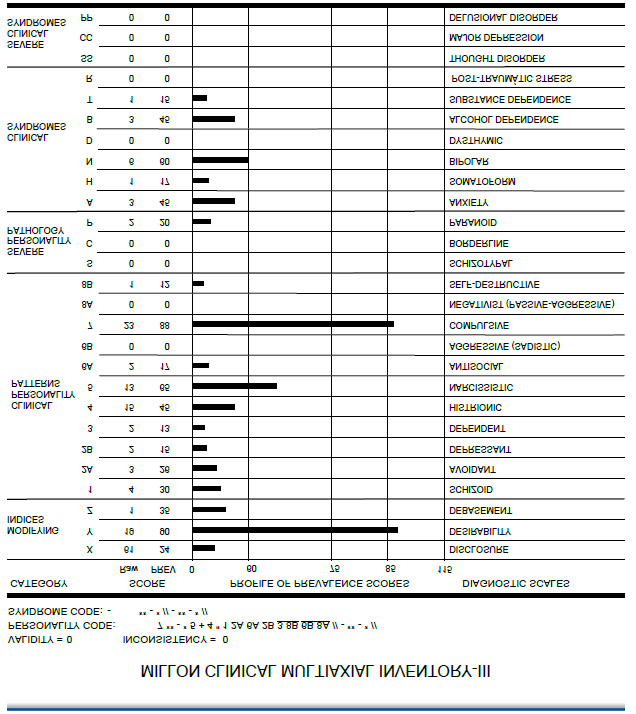
From the psychometric tests administered, an index of the validity scale belonging to the “Social Desirability” of the MCMI-III was observed with a PREV score = 90, which suggests that the informant has a tendency to offer a more socially desirable image.
From this, and given the clinical results of the psychological profile obtained, no scores suggest the existence of a serious or severe mental disorder, Personality Disorder, or any serious dysfunctional Personality traits. In other words, the scores suggest that the clinical profile and the personality profile of the person evaluated are within the parameters of statistical normality. Therefore, it is not appropriate to apply any clinical-psychopathological diagnosis.
Given the non-existence of psychopathologically based clinical-diagnostic criteria on the subject, no cognitive or affective disorder has been observed that could affect his judgment or abstract reasoning capacity, for which he would know the meaning or concept of benignity and malignity of the behaviors, as well as the illegality and/or antinormativity of these criminal acts and behaviors.
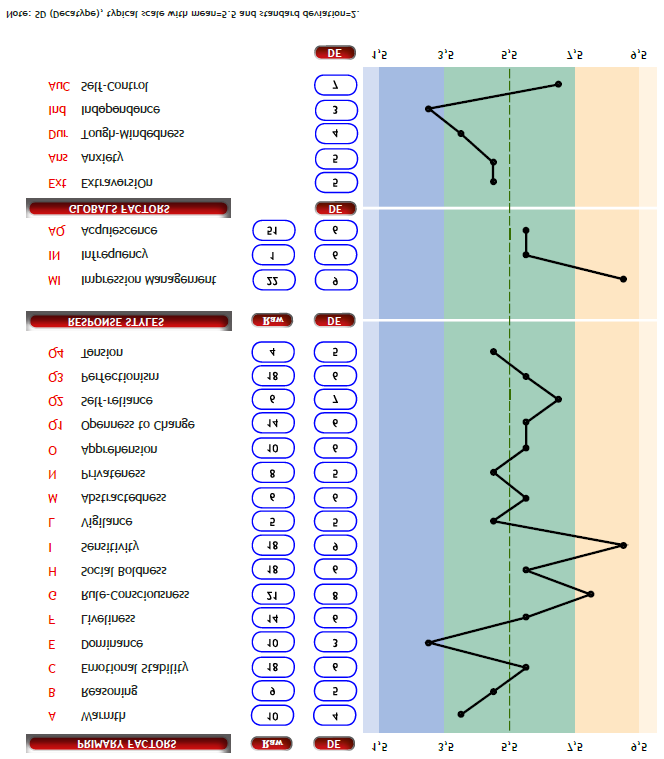
From the psychological personality test, 16PF-5, a statistically significant score is deduced in the scale of “Manipulation of the Image” with SD=9, which would suggest that the subject would have an intention to show a distorted profile and whose profile in the rest of the results obtained could present some alteration.
That said, a profile emerges that stands out for not being very dominant (SD=3), attentive to rules (SD=8), emotionally sensitive (SD=9) and dependent (SD=3).
With the results obtained from both tests, the legal classification of the type of criminal behavior perpetrated by the subject is paradoxical, since it lacks statistically and clinically significant scores that could suggest a potentially aggressive and/or hostile profile, at least in the sexual area (such as the “Aggressive-Sadistic” or “Antisocial” scales of the MCMI-III or 16PF-5), revealed in their basic personality traits.
Likewise, it should be noted that neither the psychological tests administered, nor any other tests in the Psychometric Market, measure or explore the pernicious psychological influence of a sect-type control that was cited by the other expert psychologists, who testified in the plenary act to the state of psychological defenselessness of the victims with regards to the abusive and sexually aggressive behavior of the subject [9, 10, 11, 12].
Conclusion
Current psychometric evaluation processes do not have sufficient power or considerable scope to assess a personality profile that defines or characterizes serial sexually abusive or aggressive behavior, and this is also due to the fact that there is no personality profile that is defined as such.
Although the psychopathological doctrine considers the existence of a pathologically impulsive behavior as a common denominator, it cannot be considered pathognomonic of these criminological acts at all.
Likewise, it should be noted that existing psychological tests in the Psychometric Market do not measure or explore the pernicious psychological influence of a sect-type control or sexual nature on possible and future victims, which could generate a state of psychological defenselessness with respect to abusive and sexually aggressive behavior.
References
-
Gonzalez Fernandez J (2018a) Manual of attention and expert assessment in sexual violence: Guide to good practices. pp: 682.
-
Tiffon BN (2018b) La credibilidad del testimonio en menores.
-
Fernández GJ (2020) Prólogo Médico-Forense. In: Tiffon BN, Bosch JM, et al. (Eds.), 3: 27-30.
-
Lovell R, Luminais M, Flannery DJ, Overman L, Huang D, et al., (2017) Offending patterns for serial sex offenders identified via the DNA testing of previously unsubmitted sexual assault kits. Journal of Criminal Justice 52: 68-78.
-
Hazelwood RR, Reboussin R, Warren JI (1989) Serial Rape: Correlates of Increased Aggression and the Relationship of Offender Pleasure to Victim Resistance. Journal of Interpersonal Violence 4(1): 65-78.
-
Chopin J, Paquette S, Beauregard E (2022) Is There an “Expert” Stranger Rapist?. Sexual Abuse 34(1); 78-105.
-
Schwirzer J (2021) The Impact of Servant Leadership on God Attachment in Survivors of Sexual Abuse by Clergy. Doctoral Dissertations and Projects, Liberty University, Lynchburg, VA.
-
Safarik M (2020) Atlas práctico-criminológico de psicometría forense Volumen III: Parafilias y agresiones sexuales de adultos.
-
Tiffon BN, GonzálezFernández J (2021) Psychopathological profile of a case of continued sexual offence of minors perpetrated by a teacher of religious education. ASEAN Journal of Psychiatry 22(9): 1-8.
-
Tiffon BN, González FJ (2021) Sexual sadism towards a minor and Diogenes Syndrome with the hiding of a cadaver. ASEAN Journal of Psychiatry 22(9): 1-8.
-
Tiffon BN (2022) Atlas of Forensic and Criminal Psychology. Taylor & Francis Group, CRC Press. New York, USA, pp: 206.
-
Tiffon BN, González FJ (2022) Atlas Forense Gráfico- Psicométrico: Perspectivas de la Psicopatología Criminal y Forense. 25 casos forenses médico-psicopatológicos. Editorial Bosch. Barcelona, pp: 1-57.
- Forensic Implications of Adverse Drug Reactions in Schizophrenia A Case Series
- Narcotics and Digital Forensics: Bridging Crimes in the Digital Age
- Ethics in Forensic Psychiatry: Principles, Dilemmas, and Human Rights
- Impact of Acute Stress on Attentional Orienting to Social Cues
- Head Injury and Intracranial Hemorrhage in Western Region of Libya
- A Forensic Study on Handedness: Examination of Handwriting Features in Right and Left Handed Writers