
Mapping the Labyrinth of Forensic Evidence in Suspected Arson Case
Arson crimes are associated with fire where establishment of crime depends on intent and motive together with circumstantial evidence making a challenging job for scene of crime investigators. The jumble of problems at arson crime location needs presence of mind during forensic examination keeping in view of sensitivity of the case. The importance of forensics to tract down crime exhibits and their struggle to save trace evidences in arson cases is decisive as often the scene of crime is visited by numerous people including individuals needed to douse the fire. It is therefore necessary to document and photograph the scene of crime. The various approaches to tackle the arson crime are widely known, documented and implemented by forensic scientists but still every crime scene is thought-provoking. This article draws attention towards well planned and structured arson crime committed to evade evidences and the challenges faced by forensic community to reveal scientific evidence. A complex case of charred body inside burnt car in a secluded street was examined by forensic scientist to unearth concrete evidences reproducible in court of law. The article concludes by discussing the challenges most notably around the arson debris, importance of surrounding evidences, pattern of fire and thus evaluating crime scene for joining the dots of evidence justifying the role of forensic science.
Introduction
Arson crimes are involvement of fire in violence amounting to approx. 2.1% of cases in India as per National Crime Records Bureau data [1]. Forensic experts routinely visit arson crime scenes to identify clue materials obliterated by culprits that assist in the investigation process and also enable to unveil truth behind the crime [2]. The crime evidence approach of forensic scientist needs special attention and critical surveillance as they may not be traced in original condition. According to Locard’s principle of exchange the scene of crime has trace evidence of crime committed person [3] essential to be deciphered by forensic investigator. Thus, the evidences witnessed and collected during crime scene investigation in arson cases are crucial evidences. In arson cases along with the physical evidences, circumstantial evidences too play a vital role as more than often the scene of crime is in burnt, semi burnt or in charred condition. The crime scene investigator under these circumstances struggle to identify the annihilated trace evidences mainly due to contamination or diluted or being washed away due to necessary fire safety measures.
In such conditions, evidences collected play a decisive role accordingly it must be scientifically supported by advanced photography. Crime scene photography provides a good insight into the scene of crime with all noticeable evidences more clearly and accurately visible to the forensic scientist for better interpretation [4]. It also captures the evidences in systematic manner which is reproducible in court of law. The evidence thus collected plays a crucial role in investigation process that at times guides the investigating agency in correct direction. Thus, arson crimes are bit mysterious, challenging and intriguing which create potential for forensic investigator. This article focuses on an arson crime where most of the evidence is obliterated by fire and discusses the problems that impede forensic investigation reach conclusion and how to forensic scientists overcame them.
Case History
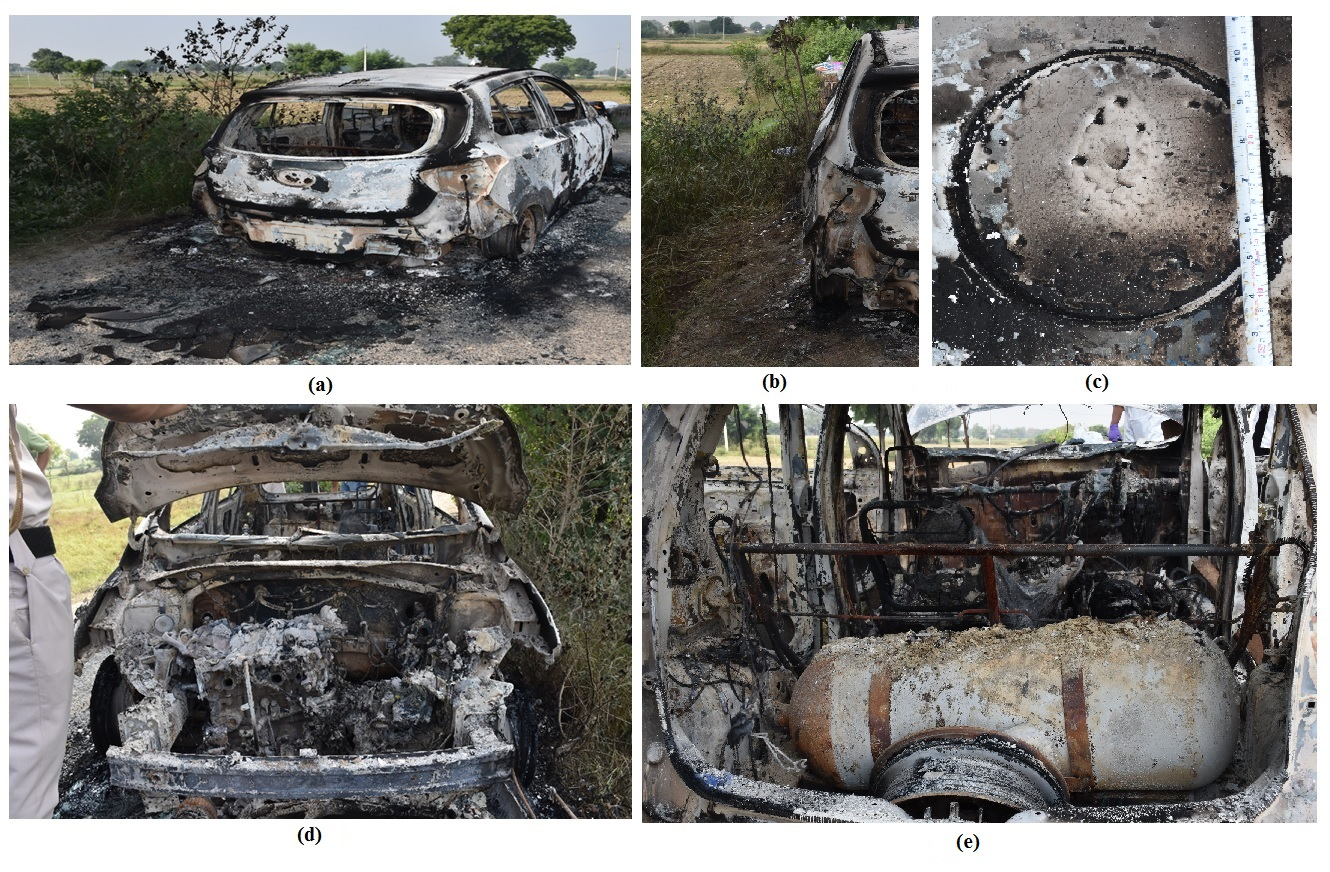
In September, 2022, on a secluded road in Delhi, a burnt car was found at early morning hours around 6:40 am, as informed by investigation agency (Figure 1a). No foul play was suspected by the police as it seemed that the car had hit an object on the road and caught fire where later it was discovered that the driver of the four-wheeler was burnt to death.
Observations
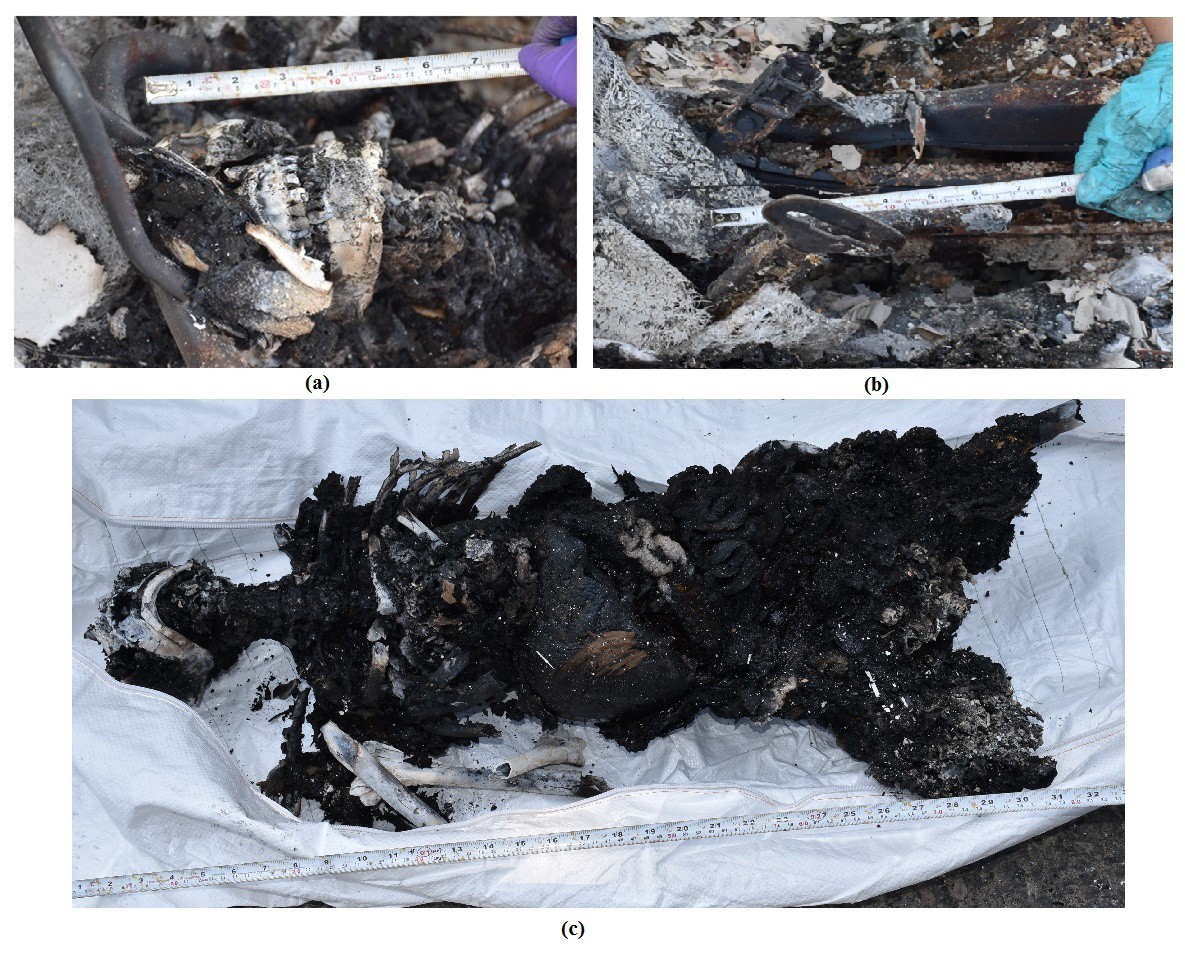
After visiting scene of crime, a charred human body was observed lying in supine position, on the driver’s seat, inside the car. Body was observed in driver’s seat in reclined position showing jaw lifted in upward condition (Figure 2a). Metallic part of seat belt was engaged with the buckle assembly, near the driver’s seat (Figure 2b) with hand brake lever in engaged condition. The car was completely burnt and only metallic frame of the vehicle being observed. Charred and burnt debris along with broken glass pieces were observed scattered all around the vehicle (Figure 1a).
Fuel tank lid and compressed natural gas (CNG) cylinder in the car were not damaged (Figures 1c & 1e). Heating pattern and effect of fire were seen on trees and plants near vehicle (Figure 1b). Smoke lines and soot depositions were observed on the exterior surface of car (Figure 1a).
Discussion
For any arson incident to initiate fire plays a vital role. Fire is a process of rapid oxidation and requires oxygen, fuel and heat [5]. Fire due to human negligence or error is quite common at the same time there is equal possibility of accidental fires. Damage and loss in both the conditions is extensive and irreversible.
Intentional fires are sometimes misinterpreted as accidental fires. Forensic investigation provides better understanding about fire dynamics and helps to identify better ways to detect, analyze and identify accelerants, flammable liquids and combustible materials. The investigation of arson cases has very low conviction rate underlying the reason for its prevalence in society mainly due to absence of clear profile of arsonist, sampling methods and chemical analysis of fire debris for residual accelerant. Numerous ignitable liquids are easily available that can be used to initiate the fire like gasoline, diesel, kerosene, paint thinners solvents etc. and their detection and identification in residual debris is difficult due to volatile nature of these compounds. Arson crimes are suspicious and the suspects walk free due to lack of evidence. The mentioned case is noteworthy as there was only victim in the car which was found in secluded street corner in early morning hours. As the car was in completely burnt condition, no traces of any inflammable substance could be ascertained either from inside the car or in nearby surroundings.
Charred body found in reclined condition though indicated person resting inside the car at the same time it declined the story of car being hit while driving. The belt strap tied to buckle assembly (Figure 2b) gives prominent evidence that one does not apply seat belt while resting or sleeping clearly indicating either the person was unconscious or probably not alive. Also, if the vehicle was parked in ON condition with all the glass windows closed, then possibility of carbon monoxide poisoning in such cases could not be ruled out [6, 7], but this is not the case here as the seat belt is unstrapped while in resting condition. Also, if the car catches fire from inside, the person seating inside the car will die due to suffocation from CO poisoning and thus will struggle to save life which cannot be done with seat belt attached. This further supports the fact that the person was not in condition to move or struggle or had any signs of life.
As the front portion of car from inside was in completely burnt condition no bead formation of copper wire was found, showing less possibility or no possibility of electric shot circuit (Figure 1e). Also the heating and burning pattern from both inside and outside the car does not suggest any electric short circuit. The burning patterns were more remarkable inside as compared to exterior portion of the car whereas exterior portions had heating pattern only. Several broken and melted pieces of window glass were scattered outside near the vehicle, suggesting heating effect from inside. No traces of keys were found attached below the handle.
On the basis of all observations covered during scene of crime examination no signs of explosion or blast could be ascertained. The undamaged condition of fuel tank and CNG cylinder (Figures 1c & 1e) in the same car which was so severely damaged to expose only metallic frame suggest either they were not put on fire or the intensity of fire near them were less or they were empty. One possibility of which arises is that the person inside the car may be unconscious or under the influence of any intoxicant or was murdered earlier and then the vehicle was put on fire.
Heating effect pattern seen on trees near car suggests that the fire had not remained for long time and the car was intentionally set on fire with some flammable substance to burn car completely and thus, a conclusion was reached that this is not an accidental arson case. There exists no physical evidence or alibi was recovered from inside or near the surroundings of car.
From the deep evaluation of observations mentioned, it was clearly suggesting that there is an accused in this arson case and it is not accidental incident of fire. The prime intention of the accused was to set fire mainly to annihilate the scientific evidence which could indicate criminal activity, correlate the cause of crime, identify the origin of fire and could recognize the victim. The accused was finally successful to complicate the investigation process. The forensic investigation gave fresh directions to investigating officer suggesting about the intentions of deliberately set homicide rather than accidental case of arson.
Conclusion
The case study identifies problems that impede criminal investigation. Role of scene of crime investigator in such unusual arson cases has significance and gives new direction to investigating authorities. The study well demonstrated the scientific perspectives and careful insight needed in scene of crime observations. The case was initially reported as arson due accident but later turned towards suspected homicide. A systematic investigation with documentation and photography is necessary in similar cases.
Arson crime cases emphasize the need for more efficient and rapid investigation as forensic examination impacts the judicial outcomes.
References
-
Accidental deaths & suicide in India Report 2021: National Crime Record Bureau, Ministry of Home Affairs, Govt of India.
-
Sharma M, Khajja BS, Sharma M, Jha S (2011) Study of suspected burning case: A homicide or a Suicide. Journal of Forensic Research 2(6): 1-3.
-
Sinha S, Goyal K, Sharma V (2020) Forensic Identification of Sindoor Stain on Cloth as Trace Evidence Analysis: A Case Study from Delhi, India. International Journal of Forensic Sciences 5(2): 1-5.
-
Robinson E (2009) Crime Scene Photography, In: 2nd (Edn.), Academic Press, Burlington, MA, USA, pp: 1-713.
-
Brannigan FL, Bright RG, Jason NH (1980) Fire Investigation Book, National Bureau of Standard Handbook 134, USA Govt, Washington DC, USA, pp: 1-187.
-
Jickells S, Negrusz A (2008) Clarke’s Analytical Forensic Toxicology, Pharmaceutical Press, London, UK, pp: 1-648.
-
Kimura K, Nagata T, Hara K, Kageura M (1988) Gasoline and Kerosene components in blood. Human Toxicology 7(4): 299-305.
- Narcotics and Digital Forensics: Bridging Crimes in the Digital Age
- Ethics in Forensic Psychiatry: Principles, Dilemmas, and Human Rights
- Impact of Acute Stress on Attentional Orienting to Social Cues
- Head Injury and Intracranial Hemorrhage in Western Region of Libya
- A Forensic Study on Handedness: Examination of Handwriting Features in Right and Left Handed Writers
- Techniques for Latent Fingerprint Development Using Natural and Synthetic Powders: A Review