
Separation of Methamphetamine from Dimethyl Sulfone by Solubility Differences and Identification, Confirmation by Raman Spectroscopy
Narcotic drug with addition of neutral substances is common practice in India. Paracetamol, phenacetin and lignocaine are commonly used for addition in narcotic drugs like heroin and cocaine. Dimethyl sulfone is a neutral substance used in methamphetamine hydrochloride. Methamphetamine is a stimulant popular in the illicit drug market known as ice drug. The pure crystalline Methamphetamine and Dimethyl sulfone easily detected and identified by Raman spectroscopy. However, mixed Raman spectra was obtained from powdered sample. The identification of methamphetamine in Raman Spectra, was done by dissolving methamphetamine hydrochloride dissolving in methanol and precipitated in ether, dimethyl sulfone remains in methanol -ether mixture. Raman spectra of precipitated drugs confirm the methamphetamine. Solubility differences in the two solvents made separation easy and Raman spectroscopy confirms the presence of methamphetamine hydrochloride and dimethyl sulfone.
Introduction
All opiates have a long history of mixing neutral substances by drug traffickers. In India, Mumbai, the forensic analysis of heroin samples seized most of the samples mixed with paracetamol and caffeine [1].
Paracetamol is a pain relief drug easily available without a doctor’s prescription in any pharmacy. In a few cases, it is found that, Alprazolam a depressant drug added in heroin sample which falls under NDPS act 1985. Despite strict legal provisions, the illegal business of narcotic drugs has been growing day by day and in recent 5 years the increase of narcotic cases has widely increased. But with the increase in the number of cases, the increase in adulterated drugs is also seen in a lot of street samples. In 2015, Mephedrone, a simulant drug added in NDPS Act 1985 is widely seen in narcotic seizures, as soon as its seizure increases a pure sample was adulterated with Aijnomoto a Chinese salt whose appearance is quite similar to Mephedrone [2]. Phenacetin is another popular adulterant in Cocaine sample [3]. On the other hand, similar to this scenario, Methamphetamine another popular stimulant with a famous street name ‘ice drug’ is adulterated with Dimethyl Sulfone, a dietary supplement and it is a common cutting agent for ice drug as its appearance is similar to Methamphetamine hydrochloride. Due to addition of neutral substances identification of samples is not an easy task and forensic experts have to perform a different test to rule out the possibility of said drug. However, the identification of such adulterant, cutting agents and place of seizure, accused or organization involved in crime, such detail profiling of crime can help to establish evidence to track down the criminal organization or traffickers involved in synthetic drug preparation [4]. Detailed analysis of street samples can throw light on a new designer drug that is not controlled in the drug market and is used as a narcotic drug of abuse by a drug cartel to escape from the law, such new psychoactive substances can be included in controlled substances by further study and its illegal use as a drug of abuse can be controlled by legal provisions [5].
Raman Spectroscopy is an easy and reliable technique for different types of drugs. It is a non-destructive technique and for a pure sample there is no special pre-treatment is required hence sample is unchanged [6, 7], and substituted cathinone has been also easily differentiated by Raman spectroscopy [8]. Raman spectroscopy can be successfully employed for narcotic drug identification, even this technique gives the idea of an adulterated sample.
Methodology
Dimethyl sulfone and Methamphetamine hydrochloride both are easily soluble in methanol however in ether its vice versa, dimethyl sulfone is soluble but Methamphetamine hydrochloride is practically insoluble. This solubility similarity and difference in different solvents made their separation from mixture easy. Methamphetamine hydrochloride can be precipitated in ether from methanol.
| Model of Raman Spectrophotometer | Renishaw, Invia Raman Microscope |
|---|---|
| Laser Source | 785 nm Edge |
| Laser Power | 10% |
| Lens Power | 20X |
| Beam Path | Grating |
| Acquisitions: | 10 |
| Accumulations | 1 |
Table 1: Values of Model of Raman Spectrophotometer and Renishaw, Invia Raman Microscope in Different Paths.
Examination Parameters
A sample previously analysed by Mass spectroscopy shows the presence of Dimethyl sulfone and methamphetamine was taken and scanned. Raman shifts are recorded. From this mixed sample after homogenous mixing, weighed accurately 500 mg of sample from the whole sample and transfer to a clean test tube of about 25ml capacity then 4ml Methanol was added to it and shaken thoroughly to dissolve completely. Then 16ml of ether was added to this test tube and white precipitation took place in the test tube. This precipitate is filtered through whatman filter paper no.1, and the residue remained on the filter paper is kept overnight at room temperature for drying. On the second day dried sample was taken and scanned on a Raman spectrophotometer. Along with this, we scanned the reference sample of Dimethyl sulfone, and Methamphetamine Hydrochloride as well. All the Raman frequencies (Raman shift/cm-1) of respective samples are recorded in (Table 2).


Results and Discussion
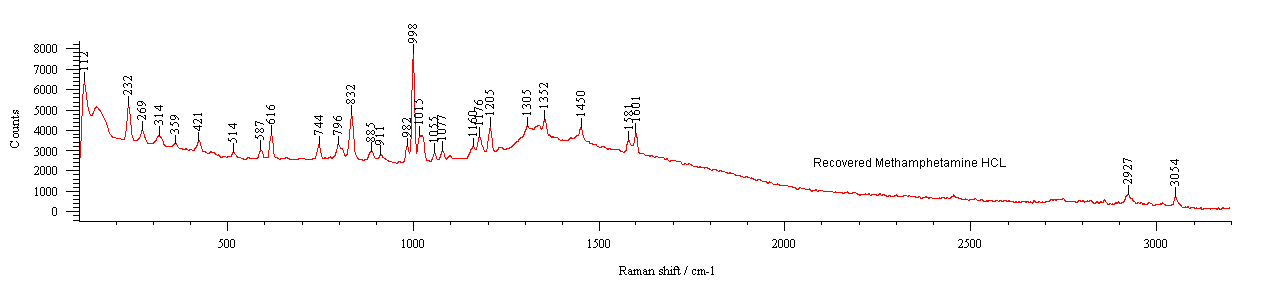
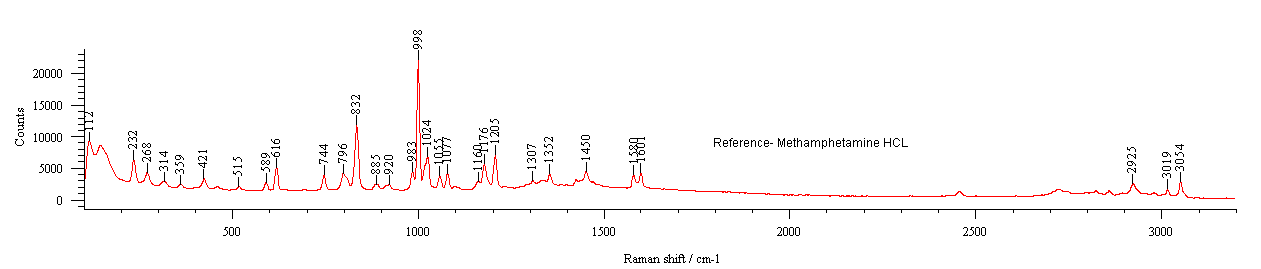
Mixed sample shows Raman frequencies of both compound, Methamphetamine hydrochloride and Dimethyl sulfone (Figure 1). when this spectrum compared with Raman spectra of Methamphetamine hydrochloride, characteristic Raman frequency 616nm, 832nm, 998nm, ,1205nm, 1580nm, 1601 nm (Figure 4) in the sample, it gives the idea that sample might contains Methamphetamine and other adulterant. While other Raman frequencies with remarkable presence in the sample are 459nm, 491nm, 696nm, 766nm, 1116nm and 1448 nm which corresponds to dimethyl sulfone (Figures 1 & 3). After precipitation in ether; the separated and dried sample gives spectra which shows absence of Raman frequencies corresponds to Dimethyl sulfone and the spectra is matched with reference spectra of Methamphetamine this confirms presence of Methamphetamine hydrochloride (Figures 3 & 4). All results are tabulated in (Table 2).
| Sr .no. | Raman shift/ cm-1 of Mixed Sample | Raman shift/ cm-1 of reference Dimethyl Sulfone | Raman shift/cm-1 of Recovered Methamphetamine Hydrochloride | Raman shift/cm-1 of reference Methamphetamine Hydrochloride |
|---|---|---|---|---|
| 1 | 232 | - | 232 | 232 |
| 2 | 269 | - | 269 | 268 |
| 3 | 288 | 288 | - | - |
| 4 | 317 | 319 | 314 | 314 |
| 5 | 359 | 386 | 359 | 359 |
| 6 | 421 | - | 421 | 421 |
| 7 | 459 | 459 | - | - |
| 8 | 491 | 491 | - | - |
| 9 | 515 | - | 514 | 515 |
| 10 | 588 | - | 587 | 589 |
| 11 | 616 | - | 616 | 616 |
| 12 | 697 | 697 | - | - |
| 13 | 744 | - | 744 | 744 |
| 14 | 766 | 766 | - | - |
| 15 | 796 | - | 796 | 796 |
| 16 | 831 | - | 832 | 832 |
| 17 | 882 | 954 | 885 | 885 |
| 18 | 909 | - | 911 | 920 |
| 19 | 982 | - | 982 | 983 |
| 20 | 998 | - | 998 | 998 |
| 21 | 1014 | 1007 | 1015 | 1024 |
| 22 | 1055 | - | 1055 | 1055 |
| 23 | 1077 | - | 1077 | 1077 |
| 24 | 1116 | 1116 | - | - |
| 25 | 1157 | - | 1160 | 1160 |
| 26 | 1176 | - | 1176 | 1176 |
| 27 | 1205 | - | 1205 | 1205 |
| 28 | 1231 | 1264 | - | - |
| 29 | 1306 | - | 1305 | 1307 |
| 30 | 1352 | - | 1352 | 1352 |
| 31 | 1399 | 1400 | - | - |
| 32 | 1448 | 1447 | 1450 | 1450 |
| 33 | 1580 | - | 1581 | 1580 |
| 34 | 1600 | - | 1601 | 1601 |
| 35 | 2932 | 2934 | 2927 | 2925 |
| 36 | 3015 | 3016 | - | 3019 |
| 37 | 3054 | - | 3054 | 3054 |
Table 2: Raman Shift/Cm-1 of Mixed Sample, Dimethyl Sulfone, Methamphetamine Hydrochloride and Methamphetamine Hydrochloride.
Conclusion
Raman spectroscopy is an accurate technique for identification of narcotic drugs, even if sample is adulterated with other substances and if it is Raman active, a powdered sample give the idea of mixture and possible narcotic drugs in the sample. It can be successfully employed for such street samples which are adulterated with different either neutral substances or hazardous pharmaceutical preparation like paracetamol, Lidocaine. Raman spectroscopy is valuable technique for confirmation and identification of narcotic drugs even in mixture and if a sample is separated from mixture, a very small sample quantity is required for Raman spectroscopy to the confirmation of a narcotic drug in adulterated sample.
Acknowledgement
We would like to express our deepest gratitude to Director General (Legal & Technical) Shri. Sandip Bishnoi, for his guidance and support throughout the work.
References
-
(2019) United nations Office of Drug and crime, World Drug Report; United Nations Publication: Vienna.
-
Kudekar DY, Kudale AS, Oberoi RK, Kulkarni RR, Chutke NL (2016) Unusual Detection of Monosodium Glutamate as an adulterant in Mephedrone Sample: Confirmation by Raman Spectroscopy and Composition by simple Solubility Differences. Chemical Science Transactions 5(2): 488-492.
-
Maldner AO, Botelho ED, Zacca JJ, Melo RCA, Costa JL, et al. (2016) Chemical Profiling of Street Cocaine from different Brazilian Regions. J Braz Chem Soc 27(4): 719- 726
-
Broseus J, Baechler S, Gentile N, Essevia P (2016) Chemical Profiling: A tool to decipher the Structure and Organisation of illicit Drug Markets: An 8-year study in Western Switzerland. Forensic Sci Int 266: 18-28.
-
Brandt SD, King LA, Evans-Brown M (2014) The new drug phenomenon. Drug Testing and Analysis 6(7-8): 587-597.
-
Izake EL (2010) Forensic and homeland security applications of Modern Portable Raman Spectroscopy. Forensic Sci Int 202(1-3): 1-8.
-
De Oliveira Penidoand CAF, Tavares Pacheco MT, Lednev IK, Silveira Jr L (2016) Raman Spectroscopy in forensic analysis: Identification of Cocaine and other illegal Drug of Abuse. Journal of Raman Spectroscopy 47(1): 28-38.
-
Christle R, Horan E, Fox J, Donnell CO, Byrne HJ, et al. (2014) Discrimination of cathinone regioisomers, sold as ‘legal high ‘, by Raman Spectroscopy. Drug Testing and Analysis 6(7-8): 651-657.
- Forensic Implications of Adverse Drug Reactions in Schizophrenia A Case Series
- Narcotics and Digital Forensics: Bridging Crimes in the Digital Age
- Ethics in Forensic Psychiatry: Principles, Dilemmas, and Human Rights
- Impact of Acute Stress on Attentional Orienting to Social Cues
- Head Injury and Intracranial Hemorrhage in Western Region of Libya
- A Forensic Study on Handedness: Examination of Handwriting Features in Right and Left Handed Writers