
Forensic Evaluation and Testing of Existing Site Conditions Related to a Personal Injury Claim
During the construction of an order fulfillment center located in Colorado, a jobsite worker claimed he was injured when he touched a handrail installed at a staircase shortly after the pipe welding operation was complete. In addition to a burn to the hand, the worker also alleged injuries to his back due to jerking quickly to withdraw his hand from the rail and twisting his body in a manner that aggravated his lower back. After the incident, the claimant filed a lawsuit alleging negligence for the welder’s failure to adequately demarcate and restrict access to the hot work area. A forensic engineering company was hired to re-create and analyze the site conditions, review the information provided, and determine to a reasonable degree of engineering probability the validity of the claimant’s allegations in relation to the potential for temperature ranges likely at the time of the accident.
Introduction and Background
In April 2018, a large online retail developer was in the process of constructing an order fulfillment center in Colorado. The retailer hired a general contractor (GC) to manage the construction of the facility, including engaging with and managing subcontractors. The GC engaged a specialty subcontractor to provide specific steel fabrication and welding services. Included in this subcontractor’s work was the fabrication and welding of handrails for staircases at the new facility. The alleged incident occurred shortly after the subcontractor had completed welding operations on a small section of handrail located at the top of an interior stairway leading to the third floor of the new order fulfillment center.
Reportedly, an employee of another non-related subcontractor who was also working at the site walked up the stairs after the welding operations were completed and the area had been cleaned up. This gentleman grasped the rail for support, reportedly experienced a hot sensation, and allegedly burned the palm of his left hand despite reportedly wearing mechanic’s gloves at the time. Although this worker initially reported that the only part of his person involved in the incident was his left hand, he later reported that because he jerked upon touching the handrail, he aggravated the middle of his lower back, which tightened up after he got to the top of the stairs. As a result of these alleged injuries, the worker eventually filed a lawsuit alleging negligence on the welder’s part for failure to adequately demarcate and restrict access to the area where the handrail was located.
The welder reported that this work area had been cleared and cleaned, and that the work piece had cooled. The welder therefore disputed the claim that the temperature of the rail remained high enough at the time of the alleged incident to cause injury and stated that the railing could not have caused the injuries alleged by the claimant. To determine within a reasonable degree of engineering probability whether the temperature of the rail could have remained sufficiently high to cause the alleged injuries from the time of completion of welding to the time of the alleged injury, a forensic engineering firm (Engineer) was engaged to re-create the site conditions and determine and document the rate of cooling of the rail after cessation of the welding operations, measured generally as a function of heat dissipation over time. The testing and analysis were conducted to aid in determining the validity of the claimant’s allegations.
In evaluating the validity of the claim, the Engineer reviewed the provided documentation to ascertain key elements about the site conditions and the welding operations performed on the day of the incident. The Engineer also reviewed the claimant’s incident report, which summarized the details of the alleged injury, and directly interviewed the subcontractor’s foreman responsible for the welding operations on the day of the incident. As part of the project file, the Engineer also reviewed interview transcripts and conducted additional interviews with the welder and other personnel from the welding subcontractor’s firm. The intent of these efforts was to determine the welding subcontractor’s standard procedures, the existing site conditions, and the identities of the workers and the site safety supervisor on duty for the welding operations on the day of the incident.
Contractor Responsibilities
Contractors inherently perform jobs that involve risk, and governing bodies, industry associations, and the decisionmakers in companies that perform such work must endeavor to reduce the potential for such inherent risk by developing and publishing safety protocols, and implementing and enforcing safety programs. The claimant’s expert report cited references from multiple sources for guidance regarding jobsite safety for welding operations; however, these references did not differentiate between in-duty activities and after-duty activities. Among the documentation and references from the noted sources available for the Engineer’s review in the project file were the subcontract between the GC and the welding subcontractor, the American Welding Society’s Safety & Health Fact Sheet Number 7, the National Ag Safety Database website, the Tube & Pipe Journal, and multiple OSHA guidance documents.
After reviewing the aforementioned information sources, the Engineer noted that the guidance documentation provided by each was predicated on the assumption that a hazardous condition exists; in this case, “hot work,” or a condition capable of causing serious burns or other injury. These resources generally reference the understanding of the need for burn protection, which assumes, as its foundation, that the condition is, in fact, capable of posing a burn hazard. Additionally, numerous references are made to the act of marking hot work pieces or areas due to the associated burn hazard. In this case, the claimant’s expert assumed, without justification or substantiation, that because welding had been recently performed on the handrail in question, that it, at the time of the claimant’s incident, remained hot enough to inflict a burn that could have resulted in the injuries and damages that the claimant alleged. The foremost conclusion that the claimant’s injuries were caused as a result of grabbing the handrail (with a glove on his hand), which resulted in a burn, presupposes that the handrail remained at a temperature capable of causing a resulting burn severe enough to warrant the claimant’s reaction. The Engineer questioned whether the conclusion that the hot work was sufficient to result in the hazard was correct and truly supported by facts.
Test Design
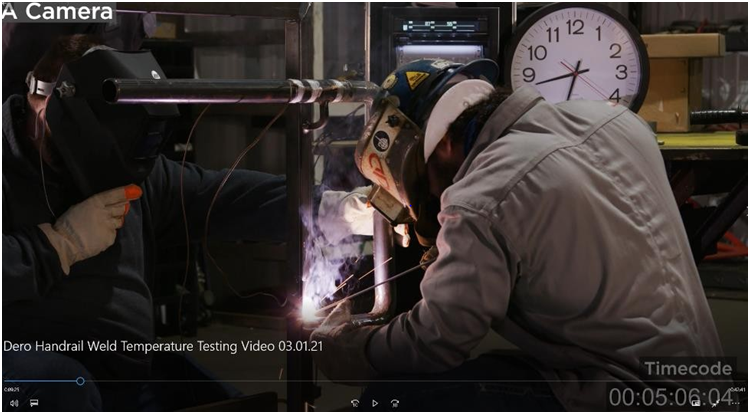
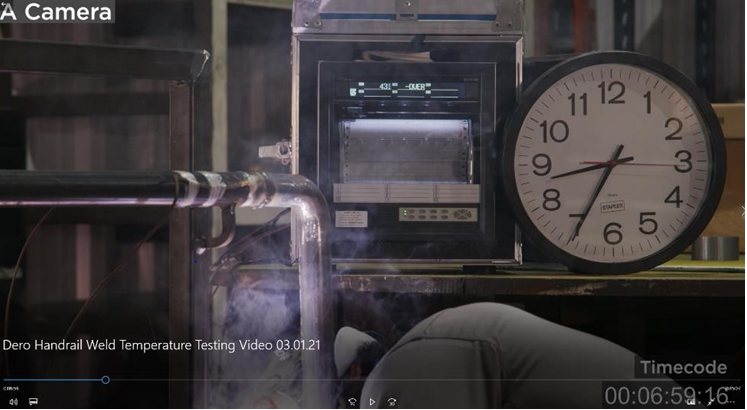
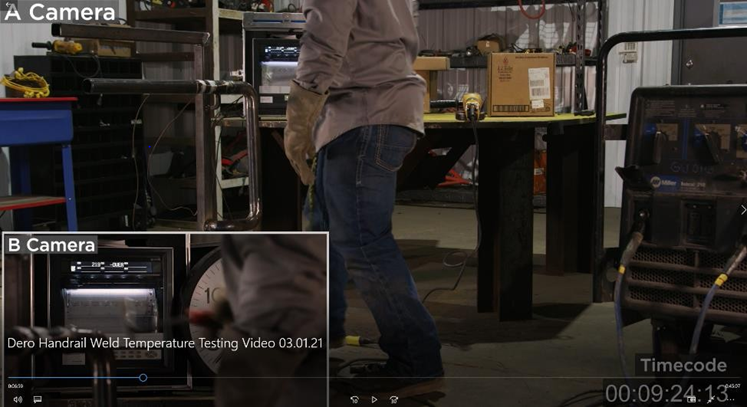
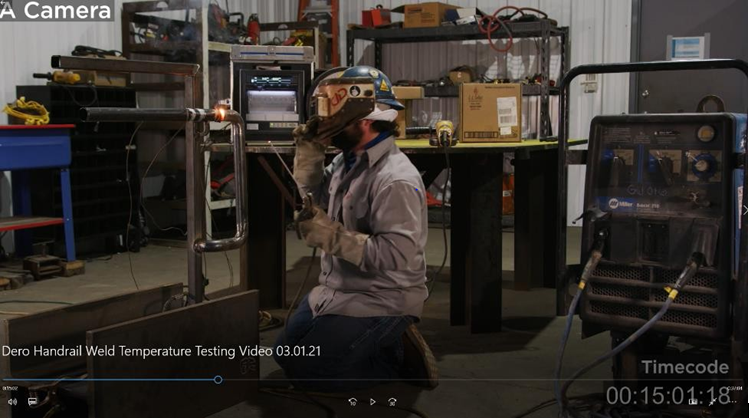
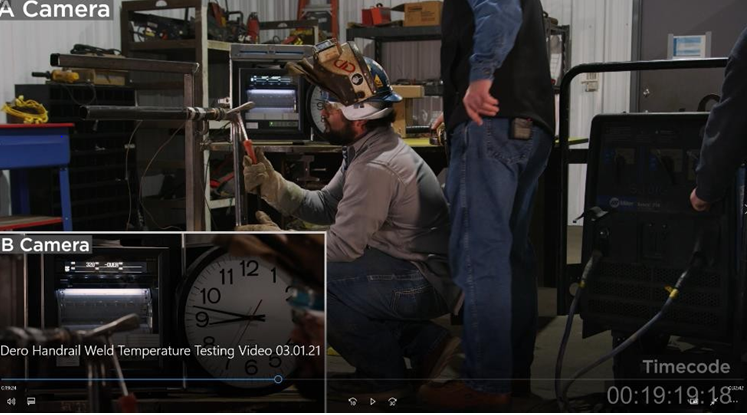
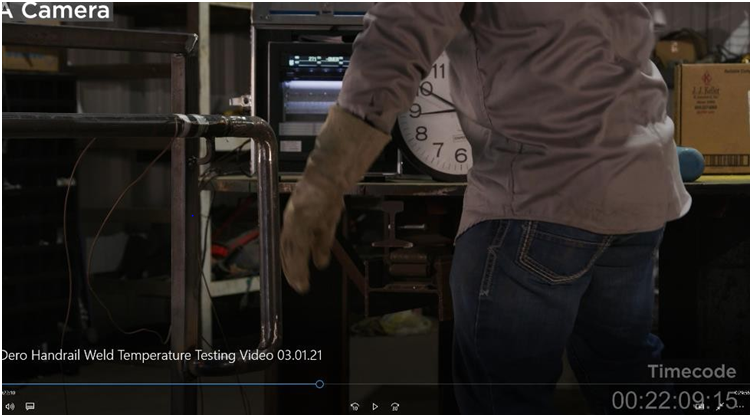
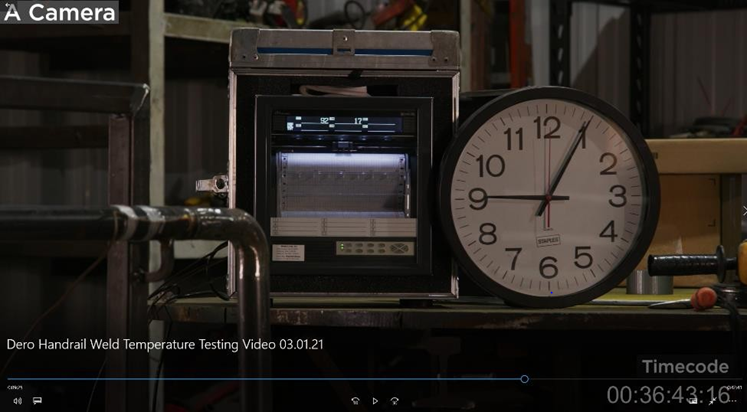
To determine the validity of the claim, the Engineer worked with the company that performed the welding operations to prepare a test setting. This involved creating a mockup of an exemplar handrail, in similar site conditions, with the same team that was involved in the specific site work to which the alleged injury was attributed, to recreate the situation at the time of the incident. With input and assistance from the welding foreman from the original jobsite, the test was set up to generally re-create the conditions and sequencing of the alleged incident. To recreate the conditions on the date of the alleged incident, the same welding operation was performed on the exemplar handrail. The test was conducted in a controlled setting and video recorded in order to determine the rate of cooling of the weld by measuring and recording the temperature of the handrail in five-minute increments for a period of 30-minutes after the weld was completed Due to Covid-related issues, only limited access to the welding operation was provided; therefore, live video streams from multiple angles were used to allow the forensic evaluation and to provide a video record of the procedure. The test setup was also retained to preserve the work for evidentiary needs.
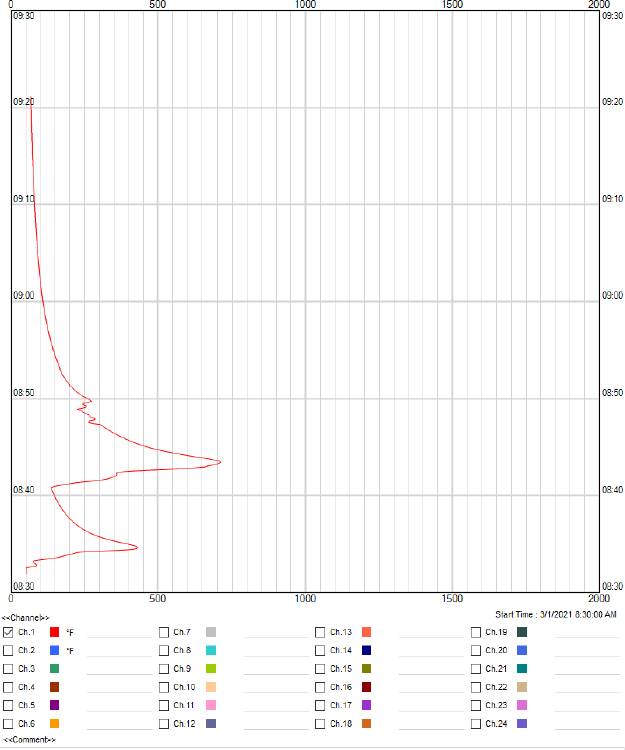
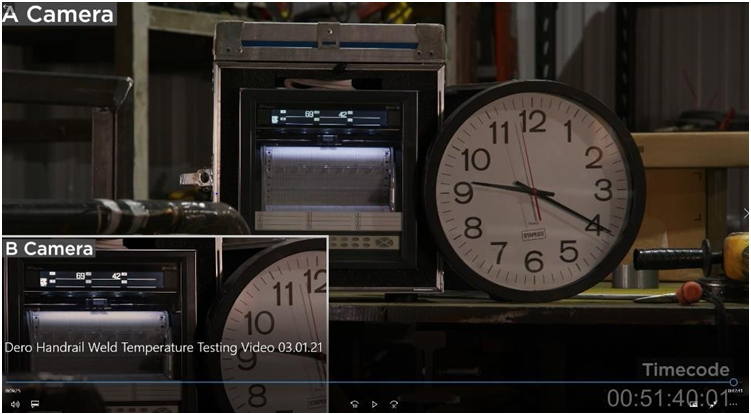
The welding for the test was performed using a Miller® Bobcat 250 welding machine with a Miller® load bank, the same equipment used at the construction site. The test weld was carried out to replicate the standard operating procedures. The welders first performed a tack weld to hold the railing in place prior to the full welding process. The welder then performed the first welding pass at 83-amps, which involved welding the top of the handrail return and then the bottom of the handrail return. A four-minute intermission was taken to allow the welding equipment to reach 88-amps, and then the welds were created again starting at the top and then moving to the bottom. A representative from an independent testing company measured the temperature using a thermocouple set near the weld location and provided a certificate of calibration of the equipment (Table 1) as well as a handrail weld temperature monitoring chart (Figure 2) [1] to the Engineer.
| CERTIFICATE OF CALIBRATION | |||
|---|---|---|---|
| Equipment: | Recorder | Brand: | Chino |
| Model Number: | AH-4700-NOO | Serial Number: | R4-0152A0067 |
| Input Type: | K | Range: | 00/20000 F |
| Calibration Date: | 9/1/2020 | Due Date: | 9/1/2021 |
| Test Equipment Used | |||
| Manufacturer: | Fluke | Calibration Date: | 8/20/2020 |
| Model Number: | 714 | Serial Number: | 3574357 |
| Certificate #: | 11068 | Accuracy: | (+/-1^0) |
| Input | Found | Left | Accuracy |
| 2000 | 2000 | 2000 | +/-2 DEG F |
| 4000 | 4000 | 4000 | +/-2 DEG F |
| 6000 | 6000 | 6000 | +/-2 DEG F |
| 8000 | 8000 | 8000 | +/-2 DEG F |
| 10000 | 10000 | 10000 | +/-2 DEG F |
| 12000 | 12000 | 12000 | +/-2 DEG F |
| 14000 | 14000 | 14000 | +/-2 DEG F |
| 16000 | 16000 | 16000 | +/-2 DEG F |
| 18000 | 18000 | 18000 | +/-2 DEG F |
| 20000 | 20000 | 20000 | +/-2 DEG F |
Test Results
At the start of the tack weld, the ambient temperature in the room was 83-degrees Fahrenheit and the surface temperature of the metal rail was 51-degrees Fahrenheit. See (Figures 2-9) for video stills showing testing details.
Test Summary
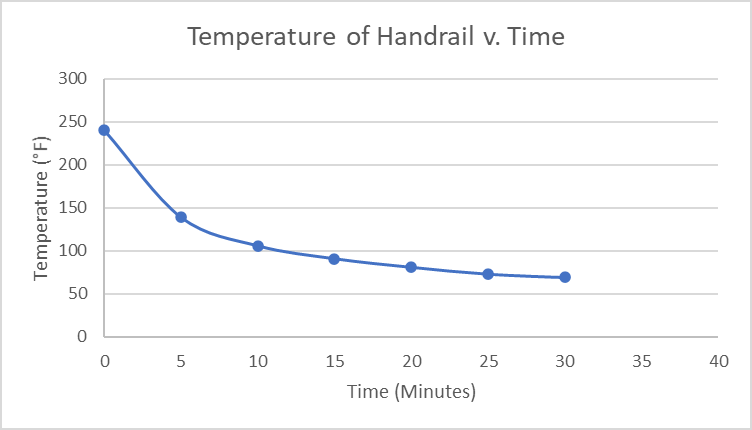
The test results demonstrated that there was fairly rapid reduction in temperature (thermal response) of the handrail after completion of the weld. Immediately after the weld was completed, the handrail temperature measured 240-degrees Fahrenheit, and within five minutes, the handrail had cooled by more than 100-degrees. Figure 10 outlines the continued decrease in temperature of the handrail over time. By 25 minutes post-weld, the temperature of the handrail had dropped to 73-degrees Fahrenheit, at which time one of the test administrators placed his bare hand on the handrail and reported he felt no heat at all. Considering studies conducted to determine skin damage due to high temperatures, the test administrator’s perception was, in fact, reasonable. By the 30-minute mark post-weld, the handrail had cooled to 69-degrees Fahrenheit, which is essentially ambient room temperature, and the test was complete.
Analysis of Burns
The temperature at which burning of skin occurs when in contact with a hot object is clearly established by the engineering and science community. The American Burn Association states that at a temperature of 120-degrees Fahrenheit, it would take five minutes of continuous contact for a third-degree burn to occur [2], and at 100-degrees Fahrenheit, there is no risk of burning as this is a safe temperature for full body exposure (bathing). Table 2 from the American Burn Association’s Scald Injury Prevention Educator’s Guide illustrates the relationship between water temperature and the time it would take for a third- degree burn to occur.
| Water Temperature | Time for a Third Degree Burn to Occur | |
|---|---|---|
| 155°F | 68°C | 1 Second |
| 148°F | 64°C | 2 Seconds |
| 140°F | 60°C | 5 Seconds |
| 133°F | 56°C | 15 Seconds |
| 127°F | 52°C | 1 Minute |
| 124°F | 51°C | 3 Minutes |
| 120°F | 48°C | 5 Minutes |
| 100°F | 37°C | Safe Temperature for Bathing |
Table 2: Time and Temperature Relationship to Severe Burns Table.
Likewise, ASTM International states that at or below a temperature of 111-degrees Fahrenheit, no burn injury will occur to human tissue that comes into contact with an object of the same temperature [3] as shown in (Table 3).
| Sensation | Skin Color | Tissue Temperature | Process | Injury | |
| Numbness | White | Deg. C | Deg. F | Protein Coagulation | Irreversible |
| Numbness | Mottled Red and White | 72 | 162 | ||
| 68 | Thermal Inactivation of Tissue Contents | Possibility Reversible | |||
| 64 | Thermal Inactivation of Tissue Contents | Possibility Reversible | |||
| 60 | 140 | Thermal Inactivation of Tissue Contents | Possibility Reversible | ||
| Maximum Pain | Bright Red | 56 | Thermal Inactivation of Tissue Contents | Reversible | |
| Severe Pain | Light Red | 52 | Thermal Inactivation of Tissue Contents | Reversible | |
| Threshold Pain | 48 | Thermal Inactivation of Tissue Contents | Reversible | ||
| 44 | 111 | ||||
| Hot | |||||
| Wram | Flushed | 40 | |||
| 36 | |||||
| 93 | Normal Metabolism |
Table 3: Thermal Sensations and Associated Effects through a Range of Temperatures Compatible with Tissue Life.
Further studies such as those conducted by the Centre for Thermal Insulation Studies at the Cranfield Institute of Technology also provide documentation regarding the comfort temperature range for human skin. Per these studies, a burning sensation is experienced at 43-degrees Celsius (109.4-degrees Fahrenheit) and increases to a threshold of pain at 45-degrees Celsius (113-degrees Fahrenheit). The Centre for Thermal Insulation Studies also states that a “safe touch” temperature for steel lies within a range of 17-degrees Celsius (62.6-degrees Fahrenheit) to 46-degrees Celsius (114.8-degrees Fahrenheit) [4]. Table 4 shows the safe touch temperatures of some common materials, including steel, which was the material of the subject handrail.
| Material | Thermal Penetration Coefficient at 300 C ( JS -1/2 + m -2 K-1) | Safe-Touch Temperatures (0C) | |
|---|---|---|---|
| Lower | Upper | ||
| Foamed Polyurethane (Rigid) | 30 | 1 | 80 |
| Expanded Polystyrene | 30 | 1 | 80 |
| Mineral-wool Blanket | 65 | 1 | 80 |
| Cotton Cloth | 79 | 1 | 80 |
| Cork Board | 137 | 1 | 80 |
| Balsa Wood | 153 | 1 | 80 |
| Light Fibre-Board | 190 | 1 | 80 |
| Paper | 352 | 1 | 80 |
| Light Plaster | 374 | 1 | 80 |
| Gypsum Board | 385 | 1 | 79 |
| Oak Wood | 499 | 1 | 72 |
| Solid Plastics | 617 | 1 | 67 |
| Rubber | 625 | 1 | 66 |
| Aerated Concrete | 751 | 2 | 63 |
| Asbestos-Cement Board | 847 | 3 | 61 |
| Common Brick | 1070 | 6 | 58 |
| Sand-Plaster | 1080 | 7 | 57 |
| Asphalt Felt | 1190 | 8 | 56 |
| Glass | 1420 | 9 | 54 |
| Dry Earth | 1630 | 10 | 53 |
| Fibrebrick | 1760 | 11 | 52 |
| Steel | 12600 | 17 | 46 |
| Aluminum | 22300 | 18 | 45 |
The reported threshold of pain for a person in relation to contact burns being 111-degrees Fahrenheit is further verified in the “Hazardous Heat” article published by the National Fire Protection Association [5], which states and illustrates (Figure 11) the following: • “A person’s skin exposed to heat radiation reacts by perspiring and increasing blood flow to the “hot” area. Pain is felt when the [normal 37°C (98.4°F)] skin temperature rises to just above 44°C (111°F) over a depth of 0.1 millimeter. Pain and injury continue whilst the temperature remains above 44°C. Such that at 50°C the injury rate is ~100 times that at 44°C.”
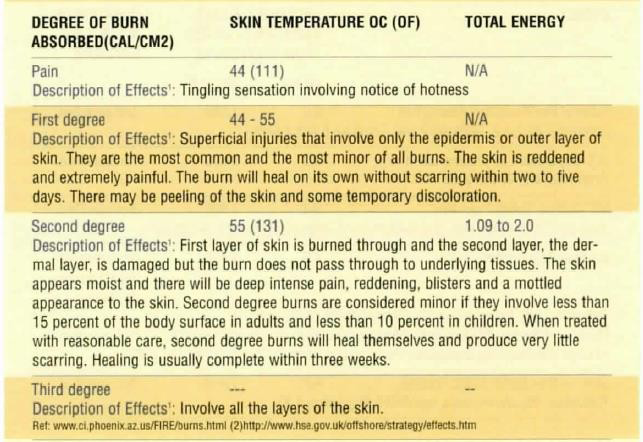
Thus, based on the measured rate of cooling of the handrail and weld, and the elapsed time between completion of the welding operation and the claimant’s incident, it is unlikely that the temperature would have remained above the burn threshold as the claimant alleges. This determination is based on the timing of the work, demobilization, cleanup, and site access time.
In addition to the effects of temperature of the hot object, the contact time of the skin with a hot object also plays a role in determining whether a burn has occurred. The Occupational Safety Institute of Industrial Injuries Insurance Institutes establishes two essential factors when determining if a burn to the skin occurred: the temperature of the object and the duration of contact with the object [6]. The Occupational Safety Institute of Industrial Injuries Insurance Institutes explains that for accidental contact with a hot object, a duration of contact should be assumed for a period of four seconds.
Analysis
The claimant’s forensic expert provided an opinion in its report that the “Welding can result in metal components being heated to a couple thousand degrees Fahrenheit, and therefore pose a significant burn hazard.” Based on the forensic analysis performed by the Engineer hired on behalf of the welder, this statement could be clearly refuted, and the opinion of the claimant’s expert was found to be without merit. In fact, the testing verified that the maximum temperature of the metal rail within an inch or so of the weld was found to be only 711-degrees Fahrenheit during the welding operation. At the specific location of the weld, the temperature would have been near 1000-degrees Fahrenheit; however, within a small distance away from that point, the heat would have dissipated through conduction and radiation.
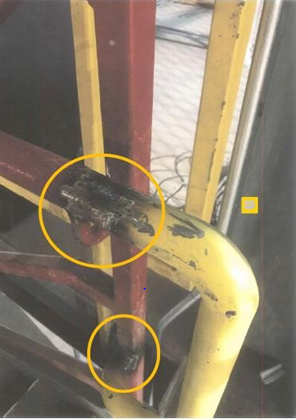
The claimant’s expert failed to state exactly where on the rail the claimant’s hand made contact and how much time had elapsed after the welding operation was completed, thus further discrediting the hypothesis. As the distance along the rail from the weld increases, the temperature decreases substantially due to the conduction of heat from high heat areas to the portion of the rail at ambient temperature. Figure 16 shows the locations of the welded areas. As shown in Figure 12, there would be no direct access to the lower rail weld location due to the bar configuration; therefore, the testing conducted accurately positioned the thermocouples within the vicinity of the weld on the top of the top handrail, but not on the weld itself.
The incident was reported as occurring at 1:40 pm, which is consistent with the timeline of the completion of the welding operations, cleanup of the area, and the time for repositioning of the equipment to the next work area, as provided by statements from the welder and the foreman at the jobsite. At or around 1:40 pm on the day of the alleged incident, as confirmed by the test results, the handrail would not have been at a temperature capable of causing a resultant burn injury. This is substantiated by the fact that during the remainder of the period following the welding and cleanup (approximately 30 to 40 minutes), the welding crew did not come into contact with or see the claimant in the area of the handrail. Therefore, the claimant must have come into contact with the handrail a minimum of 30 minutes after completion of the welding operations. Per the results of the test, the approximate temperature of the handrail 30 minutes post-weld would have been near ambient room temperature and well below the established burn threshold of 111 to 113-degrees Fahrenheit. Additionally, since the claimant was wearing mechanic’s gloves at the time of the alleged burn, the gloves would have provided further protection if, in fact, the handrail surface had still been hot.
The welder, welding supervisor, and site safety supervisor all met with the claimant at the location of the handrail after he reported the incident and the alleged burn to his hand. The site safety supervisor stated that when she arrived, none of the welding subcontractor’s tools or equipment were present in the area.
The welder also witnessed that the claimant was wearing gloves at the time and that the gloves showed no evidence of a burn or any markings consistent with a burn. The claimant removed his glove and allowed the welder to observe his hand. The welder noted there was no evidence of a burn or any related injury to the claimant’s hand. At this meeting, the claimant made no mention of any fall or additional injuries. The welder witnessed the claimant walking normally and with no signs of pain or discomfort to his back. The forensic report was limited to the temperature issues associated with the skin damage reported and would not have included any evaluation of back or other injuries due to the claimant’s natural reaction in response to contact with the handrail.
The site safety supervisor reported that the claimant’s alleged burn did not require any treatment or first aid, which was reiterated in the incident accident investigation form. Additionally, the photograph of the claimant’s hand (Figure 13) that was included as part of the incident report showed no visible signs of injury or burn, further validating the findings of the tests on the exemplar handrail.
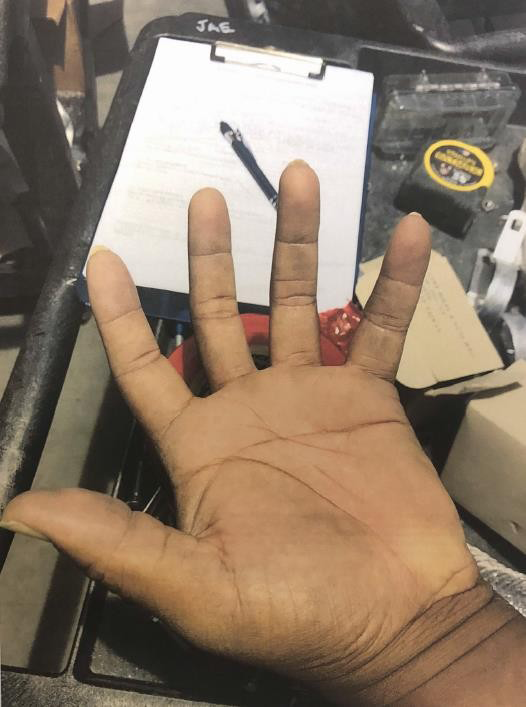
It should also be noted that the physician who performed the physical examination advised the claimant that returning to regular duty on the same day was acceptable after the incident and made no mention of a burn injury to the left hand in the diagnosis as alleged. Subsequently, the site safety supervisor stated in the interview that the claimant returned to work the same day and continued to work without limitation for a few more days after the incident.
The incident report and “witness” statement both relied solely on the accounts of the claimant’s supervisor at the time of the alleged incident. It should be noted that the claimant’s supervisor reportedly was not present at the time of the alleged incident and had no firsthand knowledge, but rather simply restated what the claimant had reported in order to complete both the incident report and “witness” statement documents. Likewise, the site safety supervisor also confirmed in her interview that the incident report she authored was based solely on the reports of the claimant and his supervisor, and that she simply “relayed” what had been stated to her. For the purpose of establishing a standard of care, it should be noted that if the associated work pieces or areas would not have remained at a temperature that would be considered hot work, then accordingly, there would be no duty to mark such pieces or areas as they would not constitute a burn hazard. Based on the facts of this case, that is the scenario that the Engineer was presented with. At the time the injury was alleged, there did not exist a condition that would have necessitated signage to warn of a burn hazard; therefore, no duty to provide signage existed.
It should also be noted that prior to the reported incident, the claimant had knowledge of the hot work area and had actually requested access to the staircase at an earlier time during welding operations but had been denied. Consequently, the claimant was clearly aware that welding operations had been conducted. However, at the time of the alleged incident, the welding work had been concluded, the work area had been demobilized, and, as shown by the Engineer’s re-creation of the scene, sufficient time had passed to allow thermal cooling of the hot work.
The claimant’s expert report cited incident reports completed by a third-party safety company as justification for the necessity of having a sign present to warn of the hot surface or an individual present to prevent others from coming into contact with the hot surface. However, the incident reports were based solely on the claimant’s statements and opinions regarding the alleged cause of his injuries. The claimant’s expert did not provide any objective criteria nor investigate conditions present at the time of the incident. The report’s conclusions relied solely on the claimant’s account of the incident without any engineering judgment, calculation, or objective criteria, which created a false narrative.
Conclusion
Based on review of the reviewed documentation and references, the results of the re-created weld test, and an application of the facts that have been substantiated regarding the incident and alleged burn, it is unlikely that the claimant suffered a burn on his left hand due to either the temperature of the handrail at the time of the reported contact or the duration of the contact with the handrail, especially if the claimant was wearing a glove.
The Engineer hired in this case concluded that the welder’s actions met the standard of care for ensuring that the site safety requirements were met after the welding operations were conducted, and that the site conditions were acceptable and not conducive to creating a burn hazard as alleged by the claimant. The welder did take reasonable safety precautions with respect to the performance of the welding operations and did sufficiently comply with regulations in accordance with the subcontract agreement. The claimant’s expert failed to establish with any factual basis that a burn hazard existed at the time of the incident and provided no credible evidence in support of that contention other than the claimant’s assertion of a burn injury and the subsequent determination of fault as a direct consequence of the hot work.
After review of all project documents and the results of the testing, the Engineer was able to state within a reasonable degree of engineering probability that at the time of the alleged incident, the handrail in question was not at a temperature that was capable of burning human skin.
References
-
(2020) Applied Inspection Systems, Inc., “Certificate of Calibration”.
-
(2017) American Burn Association, “Scald Injury Prevention Educator’s Guide,”.
-
(2014) ASTM International, “C1055 – 03 Standard Guide for Heated System Surface Conditions that Produce Contact Burn Injuries,” Reapproved.
-
Probert SD, Giani S (1976) Acceptable Temperatures for Surfaces in Brief Contact with Human Skin. Applied Energy 2(4): 241-247.
-
Raj PK (2006) Hazardous Heat. The National Fire Protection Association, NFPA Journal.
-
Siekmann H (1989) Technical Note | Determination of maximum temperatures that can be tolerated on contact with hot surfaces. Applied Ergonomics 20(4): 313-317.
- Forensic Implications of Adverse Drug Reactions in Schizophrenia A Case Series
- Narcotics and Digital Forensics: Bridging Crimes in the Digital Age
- Ethics in Forensic Psychiatry: Principles, Dilemmas, and Human Rights
- Impact of Acute Stress on Attentional Orienting to Social Cues
- Head Injury and Intracranial Hemorrhage in Western Region of Libya
- A Forensic Study on Handedness: Examination of Handwriting Features in Right and Left Handed Writers