
Virtual Experiments in Forensic Sciences
Given that it is not practical to collide several vehicles to try to repeat the damage pattern of a damaged vehicle, just as it is not possible to set fire to several industrial warehouses to analyze the pattern of fire behavior inside a warehouse where the origin of the fire, the forensic expert must have contemporary techniques that allow him to carry out non-invasive experimentation with the aim of repeating the conditions in which an event occurred. In this paper, the fundamentals of mathematical modeling of forensic phenomena are presented, as well as some examples of virtual experimentation applications used in judicialized cases.
Introduction
Mathematics has been a vital tool in most technical and scientific disciplines, and forensic sciences are no exception, since they tend to blend with other disciplines, both social and natural sciences, and in those that seek support in order to reach the truth about the facts investigated, as well as about their causes, for which they must have the arguments and evidence that prove the veracity of their hypotheses. Therefore, you must have a form of reasoning that allows you to make a logical concatenation of ideas that lead you to clarify the facts [1], and that is exactly where mathematics comes in.
Mathematics is considered the language of science , which from the outset insinuates the strengths and scope that it has when applied to technical issues, as well as serves to develop logical and systematic thinking and reasoning, very useful for those of us dedicated to forensic sciences [2].
Mathematics, through virtual experiments, help the forensic investigator to reproduce a phenomenon (a fire, a ballistic trajectory, a vehicle collision, among others) and experiment with various parameters until the result observed in reality is achieved, which allows you to get to the truth in a non-invasive way. Virtual experiments are based on simulation, which is a numerical technique for conducting experiments in a virtual environment. These experiments involve certain kinds of mathematical and logical relationships.
Although the previous lines clearly indicate the justification for looking at mathematics if we dedicate ourselves to forensic sciences, another reason may be that these, being sciences, must have experimentation as their central axis, which is complicates phenomena of forensic interest, since these by their nature are irreproducible, for example, the burning of a warehouse is not reproducible since it is not practical to set fire to other warehouses until we manage to repeat the pattern of the fire, the same happens with a homicide or a traffic collision, so the non-invasive alternative we have in this matter are virtual experiments.
Finally, we can say that virtual experiments are software environments that mimic a real situation of interest, pose a research question, and then invite the user to collect associated data that, when statistically analyzed, sheds light on the research question [3]. The application of scientific modeling consists in the replacement of the phenomenon studied in nature by its mathematical image (mathematical, conceptual or scientific modeling) in cases in which this cognitive object is unfeasible, expensive or too risky [4]. This mathematical model is implemented with logical and numerical algorithms in a computer, which allows studying the qualities of the original process studied. This way of discovering nature combines several advantages: by working with the mathematical model and not with the natural phenomenon, the study is carried out relatively quickly and at low cost; Likewise, its state properties can be studied, characterized and predicted, at this point it is known as theoretical advantage and at the same time the numerical algorithms allow, relying on the computing power of computers, to verify and contrast the qualities of the phenomenon studied with real data, directly measured; this is known as experimental advantage [5]. Relying on the computing power of computers, verify and contrast the qualities of the phenomenon studied with real data, directly measured; this is known as experimental advantage [5]. Relying on the computing power of computers, verify and contrast the qualities of the phenomenon studied with real data, directly measured; this is known as experimental advantage [5].
This paper presents some real cases where the importance of virtual experiments applied to forensic investigation is exposed and which, when prosecuted, have had probative value, as well as briefly describing the physical- mathematical structure within the numerical models that they function as the core of virtual experiments.
Development
Numerically modeling forensic phenomena requires two basic elements; the meshing and the equations that describe the physical (or chemical or biological) behavior of the phenomenon. As far as meshing is concerned, this is intended to create the geometric conditions of the space where the event is taking place.
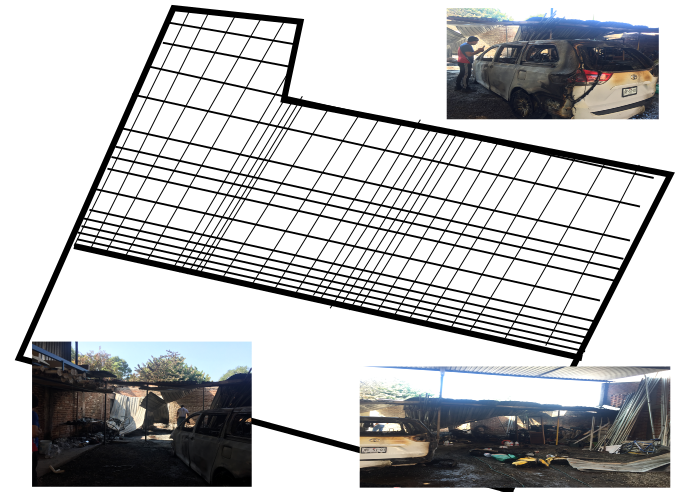
For example, if our case study is a fire inside a warehouse, our mesh must adjust to the size of the affected area in a three-dimensional way (height, width and length), however, it must also adjust to the distribution and shape of the objects inside the warehouse that served as fuel for the fire, since the material from which these objects are made, as well as their distribution within the warehouse and storage configuration, are vital to understanding the behavior of fire in the fire, for what must be carried out the necessary interviews that allow us to have clarity about what combustible materials were within the affected area, as well as their distribution within it. Another characteristic that the mesh must have is that it allows us to go from 3D spaces to 2D spaces (Figure 1).
Another characteristic of meshing is that it must be able to be much more flexible and adaptive, since the surfaces to be modeled are not always as geometrically uniform as the rectangle formed by the walls of a warehouse. An example of the above is, suppose the 3D modeling of the brain or a skull. In the latter case, the meshing method must be supported by additional techniques that allow the reconstruction of complex geometries [6] (Figure 2).
![Figure 2: On the Left, Representation of the 3D Modeling of a Skull from Tomographies [7], on the Right, Adaptation of the Meshing of the Skull, as Well as Its Subsequent Smoothing for Presentation Purposes Before the Judge [8].](/fulltextimages/10661/fig_2.png)
Now, meshing does not mean reinventing the black thread, since there are known alternatives that we can adapt to forensic models, as is the case of one that stands out for its adaptability and ease of use, and is known as Arakawa-type mesh-C.
The strength of the Arakawa type-C mesh is that it provides an adaptive mesh, three-dimensional and with triangular geometry, which reduces the modeling estimation error (yes, numerical models, like any calculation or measurement have uncertainty errors and confidence values to be determined). The Arakawa grid system describes different ways of representing and calculating orthogonal physical quantities (especially quantities related to velocity and mass) on rectangular grids used for physical models, and in particular the Arakawa “stepped” C-grid further separates the evaluation of vector quantities compared to the other Arakawa grids. For example, Instead of evaluating the east-west (u) and north-south (v) velocity components at the center of the grid (important when working with fire or injury), one could evaluate the u components at the centers of the grids. left and right faces of the grid (which helps us to reduce the error in the calculations), and the v components at the centers of the upper and lower faces of the grid [9]. Another advantage of using this type of meshing is that it is perfectly concatenated with the Finite Difference method, which consists of an approximation of the partial derivatives by algebraic expressions with the values of the dependent variable in a limited number of selected points. one could evaluate the u components at the centers of the left and right faces of the grid (which helps us to reduce the error in the calculations), and the v components at the centers of the upper and lower faces of the grid [9]. Another advantage of using this type of meshing is that it is perfectly concatenated with the Finite Difference method, which consists of an approximation of the partial derivatives by algebraic expressions with the values of the dependent variable in a limited number of selected points. one could evaluate the u components at the centers of the left and right faces of the grid (which helps us to reduce the error in the calculations), and the v components at the centers of the upper and lower faces of the grid [9]. Another advantage of using this type of meshing is that it is perfectly concatenated with the Finite Difference method, which consists of an approximation of the partial derivatives by algebraic expressions with the values of the dependent variable in a limited number of selected points.
In this case, a problem governed by an equation of order n in partial derivatives with the following form is considered:
[ ] Ln U f =
Where one works in a two-dimensional (2D) space, and where the boundary conditions are given by the walls of the area to be analyzed (for example, in the case of the warehouse they correspond to the walls of the same), and which is established in its general form as:
[ ] 1 Ln U g − =
On the other hand, Ln and Ln-1 are linear operators in partial derivatives of order n and n-1 respectively, while f and g are two functions of a physical nature, which allows discretizing the two-dimensional domain of the study area in a finite number of nodes. with which the location of elements of interest can be represented (burned materials, deformations in the sheet of a vehicle, injuries to a person, among others).
The second important element, and perhaps the one that requires the greatest expertise on the part of the expert who performs the modeling, is the one that refers to the collection of equations that describe the physical behavior of the study phenomenon. The foregoing is based on the fact that nature has a mathematical behavior, so that any physical, biological or chemical process can be expressed to a greater or lesser extent in terms of equations. This is true, however, because it is true, it does not mean that it is possible in practice, since natural phenomena (as well as crimes) are multifactorial, so modeling a forensic phenomenon considering absolutely all its variables ends up in an endless tangle. of equations that would require non-existent computing power to be able to solve them.
For example, one of the various equations that serve to model the behavior of fire under certain conditions is the diffusion-advection-reaction equation, from which the values associated with the speed of the advective field (field of fire) are obtained. The indicated equation has the form:
( ) ( ) ( ) / . . ', t U f r t ϕ ϕ σϕ µ ϕ ∂ ∂+ ∇ + −∇ ∇ =
and where r’ denotes a unit vector and U(r’,t) represents the velocity of the advective field that in this particular model is responsible for heat transport, and for which the continuity equation ∇ ⋅ is assumed to hold. U = 0.
The result of solving this equation and applying it to the case of a fire generates a thermal matrix that evolves over time, showing the behavior of the fire with respect to a point of origin of said fire (Figure 3).
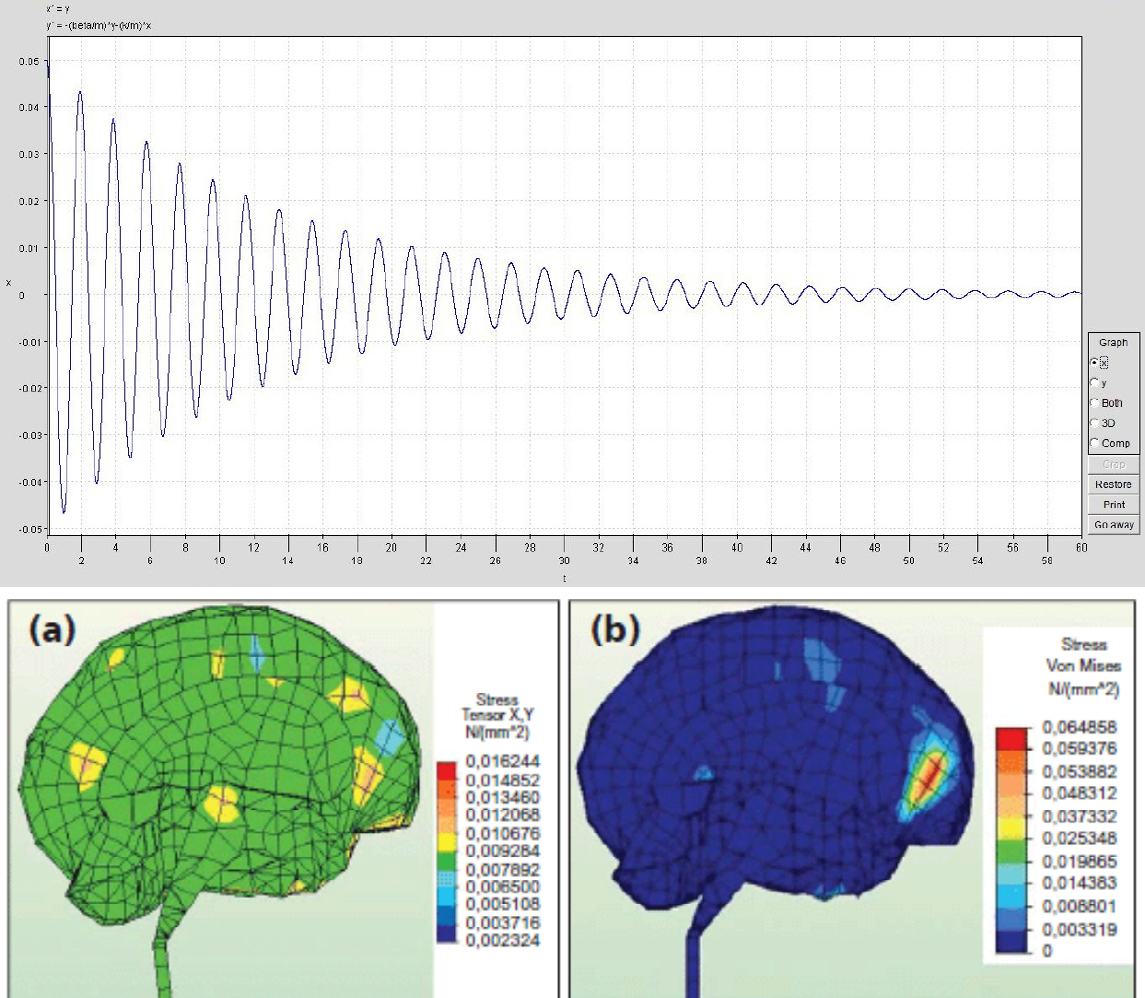
The case of death of a minor who is torn between a fall out of bed or shaken baby syndrome can be modeled through Newton’s Laws. In this case, we can simplify the model to the movement of the encephalic mass within the cranial cavity when it is shaken (shaken child syndrome) or when receiving an impact with a solid (the possible blow of the child to the head when hitting the ground). In this particular case, a horizontal or vertical acceleration or deceleration of the brain can also cause lesions, especially in critical places such as the junction of the spinal cord with the brain or that of the meningeal arteries and the brain parenchyma, producing a stradural hematoma [10]. In a violent shake the brain inside the vault has only one degree of freedom on the x axis, F kx = − where k is a constant that in the brain would be worth approximately 3.8 being above the k value for water (3.1)
and below the k value for honey (4.7) [11, 12, 13], and x is the direction of movement it cannot be larger than the diameter of the cranial vault.
Applying Newton’s second Law in the direction of movement of the brain mass, we have that in its differential form it would be:
0 mx kx + = With what, when solving it, the solution is obtained that demonstrates the values of the force that the encephalic mass of the minor received from the walls of the cranial cavity when being shaken. The results of the model can be compared with the lesions found in said brain mass in reality, which will help to discern whether the death of this minor was caused by a violent jolt or by the blow produced by a fall from a bed (Figure 4).
Conclusions
The forensic study requires the sum of an endless number of different tools, which have the common objective of clarifying a crime or crime. These tools, whether they come from the natural sciences or the social sciences, must be based on solid and systematized methods that allow any expert, based on the same analysis data, through experimentation to reach the same conclusions, however, Sometimes, despite having the ideal data to carry out a correct experimentation, it becomes impractical due to its nature and cost.
The foregoing can be resolved if we apply virtual experimentation derived from numerical models, since this allows us to repeat the experiments as many times as necessary, with which we will be able to rule out hypothesis after hypothesis until reaching a final conclusion that is derived from reasoning and logical demonstrations. That reinforce what was said.
Numerical modeling is an experimental alternative for forensic sciences, which by its nature commonly faces unrepeatable phenomena (the death of a person, a vehicle collision, a fire, among others) and therefore limits the possibilities. Experiments of the experts in charge of the study of these facts. Finally, we must not forget that the ultimate objective of any expert opinion is to arrive at a truth, which is achieved by discarding or validating hypotheses and since it is always established that this is achieved using the scientific method, in which experimentation is indicated as One of its main axes, the forensic scientist must have robust alternatives for this to be true, and numerical modeling is perhaps his best option.
References
-
Gómez, RA and Flores, SA (2017) Forensic mathematics: genesis of a subject. Latin American Act of Educational Mathematics Chapter 2, Proposal for teaching mathematics. Autonomous University of Coahuila, Mexico.
-
Bombal GF (2009) Mathematics and science. Rev R Acad Science exact Phys Nat (Eng) X Program for the Promotion of Scientific and Technological Culture. 103(2): 279-295.
-
Darius PL, Portier KM, Schrevens E (2007) Virtual experiments and their use in teaching experimental design. International Statistical Review 75(3): 281-294.
-
Serrano S, Araujo S, Palacios NP (2010) Numerical- computational models: their atmospheric and seismic application Universitas. Journal of Social and Human Sciences 12: 155-165.
-
Domínguez E (2009) Mathematical modeling: an introduction to the method. Pontifical Javeriana University, Bogota.
-
Ruíz AE (2017) Modeling of skull fracture under impact conditions, Degree Thesis. Faculty of Engineering. National Autonomous University of Mexico, Mexico.
-
Ramírez E (2007) Development of a hydromechanical model for the prediction of bone properties through finite element packaging. Master’s Thesis. Faculty of Engineering, National Autonomous University of Mexico, Mexico.
-
Gavidia G, Martín-Landrove M, Cerrolaza M (2010) Computational anatomy: an improved methodology based on medical images for the generation of 3D models. Central University of Caracas, Venezuela.
-
Arakawa A, Lamb VR (1977) Computational design of the basic dynamical processes of the UCLA general circulation model. Methods in Computational Physics: Advances in Research and Applications 17: 173-265.
-
Mendoza A (2017) Study of the mechanical properties of the bone system, Doctoral Thesis. National university of Colombia, Faculty of Engineering, Colombia.
-
Escalante MJ, Laguna CJ, Gómez AJ, Calderón RC (2016) Analysis of the viscous damping coefficient in a mass- spring-damper system using PPLANE and GEOGEBRA. Mexican Journal of Physics 62: 66-72.
-
Mireles LO (2020) Virtual experiments on fire. Skopein: Justice in the hands of Science. 8(21): 2346-9307.
-
Naylor TH, Balintfy JL, Burdick DS, Chu K (2002) Computer simulation techniques. Ed. Limusa-Wiley pp: 363.
- Forensic Implications of Adverse Drug Reactions in Schizophrenia A Case Series
- Narcotics and Digital Forensics: Bridging Crimes in the Digital Age
- Ethics in Forensic Psychiatry: Principles, Dilemmas, and Human Rights
- Impact of Acute Stress on Attentional Orienting to Social Cues
- Head Injury and Intracranial Hemorrhage in Western Region of Libya
- A Forensic Study on Handedness: Examination of Handwriting Features in Right and Left Handed Writers