
Forensic Characterization of Nacre (Mother of Pearl) by pXRF and DRIFTS Analysis
This study aimed to develop non-destructive methodology to distinguish natural nacre (Mother of Pearl) from synthetic imitations, a task of growing importance due to increased demand and illegal trade. The research employed two key analytical techniques: portable X-ray fluorescence (pXRF) and diffuse reflectance infrared Fourier transform spectroscopy (DRIFTS). Natural mollusk shells (n=50) and commercial synthetic Mother of Pearl products (n=18) were analyzed. The pXRF results revealed that natural nacre and crafted nacre – composite materials containing synthetic and natural nacre parts – had higher relative concentrations of calcium (Ca) and strontium (Sr), with a distinct Ca/Sr ratio. In contrast, artificial samples lacked these elements and had a higher percentage of light elements (LE), indicating an organic, polymer-based composition. DRIFTS analysis characterized the molecular structure. Natural nacre spectra consistently showed peaks characteristic of aragonite, a crystalline form of calcium carbonate. While the synthetic samples, including the crafted nacre composites, displayed spectra consistent with polymers like epoxy resin and acrylic. The findings confirmed that a combination of visual inspection for iridescence, pXRF elemental analysis, and DRIFTS analysis provides a robust approach for differentiating natural nacre from synthetic look-alikes. This method can assist in monitoring and combating the illegal trade of mollusk shells.
Abbreviations
pXRF: Portable X-Ray Fluorescence; DRIFTS: Diffuse Reflectance Infrared Fourier Transform Spectroscopy; LE: Light Elements; MOP: Mother of Pearl.
Introduction
Nacre, found in some species of mollusks, is the colorful naturally occurring substance containing both inorganic and organic components. Also known as Mother of Pearl (MOP), this complex material is comprised of 95% by weight of the inorganic mineral calcium carbonate and displays a variety of iridescent colors, making nacre desirable and valuable [1]. Nacre is commonly used in jewelry, buttons, and as inlays in various items, from wooden string instruments to knife handles [2].
Iridescence in Nacre
Nacre’s iridescent, color-changing appearance is a form of structural coloration caused by the interaction of light with a mollusks unique layered structure of protein and calcium carbonate; this is an example of diffraction and thin- film interference, similar to soap bubbles or oil slicks [1, 3, 4]. The iridescent, rainbow-like colors of nacre also appear to separate into their constituent spectral components on close visual evaluation, a phenomenon that could be attributed to dispersion [5]. Sun J, et al. [6] reviewed the development
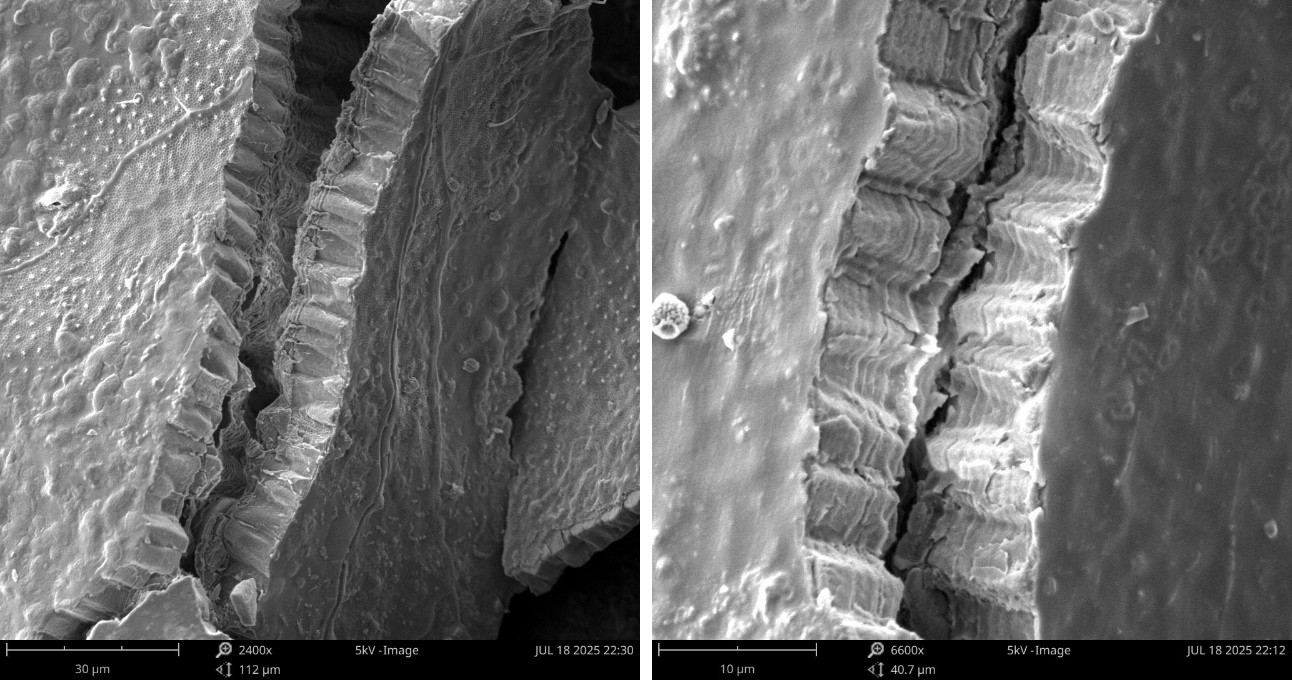
of the carbonate crystal layers and Madhav D, et. al. [1] discussed how incident light interacts with the structure of nacre to display the color shifts generated by the surface. Individual calcium carbonate crystals act as “bricks” that are held together by an organic matrix “mortar” that accounts for the remaining 5 wt.% of the shell and includes components such as polysaccharides and glycoproteins [7].
The hierarchical architecture of nacre is complex with varying spacing, crystal thickness, and orientation of the grooves and indentations of the crystal carbonate structure creating grating; this grating interacts with light resulting in the multi-color luster typical of nacre [1, 3, 4, 6]. We observed this intricate crystalline structure that is characteristic of nacre in a Pteria sp. (winged oyster) shell using a Phenom XL Desktop Scanning Electron Microscope (Nanoscience Instruments, Inc., Phoenix, AZ, USA) (Figure 1).
Visually the nacre layer disperses the light causing an iridescent glow or luminosity. Tan TL, et. al. [3] and Liu Y, et. al. [4] have described this phenomenon in abalone and pearl oyster shells where a crystal grating, produced by the calcium carbonate, creates structural rainbow-like colors from the interaction with incident light. Synthetically manufactured Mother of Pearl look-alike materials often reflect the incident light to produce a shiny effect (e.g., glitter), but this phenomenon is based on refraction and reflection of light [8]. Other manufactured materials use polymers which display iridescence by employing thinly grated surface features that successfully create structural color, mimicking MOP iridescence. However, these polymers do not contain calcium carbonate [8, 9, 10, 11]. Although some iridescent imitations can be transparent and film-like, pigments, shimmery flakes, and stains have frequently been observed to also be incorporated in the synthetic material [8, 10, 11]. Some manufacturers indicated that nacre, or MOP, products could be synthesized by taking small flakes of natural nacre and mixing them with either acrylic or glue to produce thin sheets or scales [12, 13], this approach produces a substance we refer to herein as “crafted nacre”.
Nacre in Trade
Limited research conducted by Chand S, et. al. [2] between 2010 and 2013, to study tourist purchasing habits in Fiji, estimated that MOP shell products contributed approximately 2.73 million USD to the local community [14]. Commercial online marketplaces such as Amazon® and Etsy© that sell natural MOP products and inlay materials do not always list the species name [15, 16]. This could affect the ability to successfully monitor trade and can lead importers and exporters to circumvent applicable tariffs.
Government agencies monitoring artisanal fishing activities, such as the harvesting of nacre products, are nearly non-existent. There is also evidence of under-declaring export volumes, as well as unreported and illegal trade [17, 18]. Accurate monitoring of species in trade ensures population stability for ecosystem viability, recreational use, and commercial fishing demands. An example of overfishing of pinto abalone occurred in Washington state from 1980 to 1992, and although commercial fishing was never permitted, local authorities authorized recreational harvesting through “daily take” and size limits [19]. An estimated 40,000 abalone were harvested yearly from combined recreational and illegal fishing; however, a single poacher admitted to taking upwards of 40,000 abalones to sell to restaurants, locally and overseas, mainly from pinto abalone herds during spawning season [19, 20]. This kind of behavior drastically reduced the population to near extinction [19, 20].
Employing a non-destructive analytical technique such as portable x-ray fluorescence spectrometry (pXRF) is useful in determining natural nacre. The portable XRF offers the ability for elemental analysis to be conducted in situ as well as the capability to analyze larger items that cannot fit into the chamber of typical micro-XRF systems like the EDAX, Orbis (AMETEK, Inc., Pleasanton, CA, USA) [21]. The objective of this study was to assess the ability of a portable XRF system to differentiate natural nacre from synthetic or imitation Mother of Pearl products employing elemental analysis. Additionally, we examined MOP and synthetic materials using diffuse reflectance infrared Fourier transform spectroscopy (DRIFTS) which allows for the identification of synthetic polymers used in look-alike MOP items.
Materials and Method
Reference Materials and Samples
Natural mollusk shells (n=50), including samples of Haliotis spp. (abalone), Pteria spp. (winged oyster), and Pinctada spp. (oyster), that displayed natural nacre were analyzed. The shells were from multiple geographic locations including Mexico, Australia, the Philippines, and the United States of America (Table 1).
| Species | Number of Specimens | Geographic Source | Common Name |
|---|---|---|---|
| Haliotis corrugata | 5 | California, United States | Pink abalone |
| Haliotis corrugata | 2 | Ensenada, Mexico | Pink abalone |
| Haliotis corrugata | 1 | N/A | Pink abalone |
| Haliotis cracherodii | 1 | California, United States | Black abalone |
| Haliotis fulgens | 1 | Ensenada, Mexico | Green abalone |
| Haliotis kamtschatkana | 1 | Alaska, United States | Pinto abalone |
| Haliotis kamtschatkana | 2 | California, United States | Pinto abalone |
| Haliotis ovina | 1 | Philippines | Sheep’s ear abalone |
| Haliotis rubra | 2 | Sydney, Australia | Blacklip abalone |
| Haliotis rufescens | 8 | California, United States | Red abalone |
| Haliotis rufescens | 4 | N/A | Red abalone |
| Haliotis sp. | 4 | N/A | Abalone |
| Haliotis wallalensis | 2 | California, United States | Flat abalone |
| Isognomon isognomon | 2 | Queensland, Australia | Wader tree oyster |
| Malleus albus | 1 | Cebu, Philippines | White hammer oyster |
| Pinctada mazatlantica | 1 | Baja California Sur, Mexico | Pearl oyster |
| Pinctada mazatlantica | 3 | Guaymas, Mexico | Pearl oyster |
| Pteria sterna | 1 | Baja California Sur, Mexico | Pacific winged oyster |
| Pteria sterna | 4 | La Paz, Mexico | Pacific winged oyster |
| Pteria sterna | 1 | Puerto Vallerta, Mexico | Pacific winged oyster |
| Pteria tarentina | 2 | Philippines, Samar | Winged oyster |
| Pteria sp. | 1 | Manila Bay, Philippines | Oyster |
Table 1: Summary of natural nacre shell specimens tested and their geographical origins.
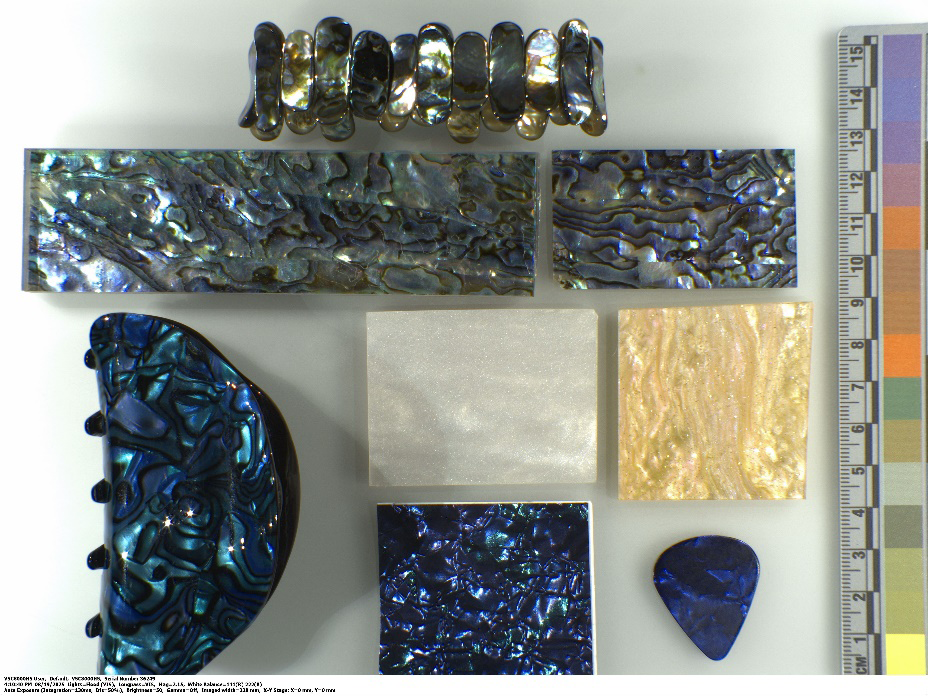
Elephant ivory specimens (n=11), Loxodonta spp. & Elephas maximus, and walrus ivory specimens (n=12), Odobenus rosmarus, were chosen to be used as controls for determining the daily accuracy of the pXRF because of their high calcium content [22, 23] and the ease with which the pXRF can detect this element. All shells and ivory are housed in the U.S. National Fish & Wildlife Forensic Laboratory (Ashland, OR) morphology collection. Synthetic MOP samples (n=18) and crafted nacre samples (n=2) were obtained from commercial sources and are summarized in Table 2 and Figure 2. Other artificial specimens were claimed by the manufacturer to be made of materials ranging from acrylic (polymethyl methacrylate or PMMA) to paint or adhesive (Table 2 and Figure 2).
| Specimen Description | Source | Claimed to Contain | Iridescence? | Reference |
|---|---|---|---|---|
| Acrylic blank craft sheets | Delvie’s Plastic, Maker Stock, Etsy | Polymethyl methacrylate (acrylic) | Absent | [24]-[26] |
| Acrylic craft paint | Craft store | Titanium dioxide, Talc | Absent | [27] |
| Guitar pick | Amazon® | Celluloid | Absent | [28] |
| Crafted nacre, scale slab inlays | Amazon® | Natural nacre, acrylic, glue | Present | [12]-[13] |
| Nail lacquer | Drug store | Nitrocellulose | Absent | [29]-[31] |
| Sticker adhesive veneer imitation abalone | Amazon® | Not declared | Absent | [32]-[33] |
| Plastic hair clip | Amazon® | Not declared | Absent | [34] |
Table 2: Summary of commercial synthetic specimens tested and their results after visual inspection confirmation for iridescence.
Visual Inspection for Iridescence
The presence of iridescence was determined by visual inspection via Video Spectral Comparator (VSC) 8000/ HS (Foster + Freeman Ltd., Evesham, Worcestershire, UK), utilizing a flood light and with a polarizing filter.
Portable XRF
Analysis of all samples listed in Table 1 and Table 2 were performed using a SciAps X-50 portable pXRF (SciAps Inc., Andover, MA, USA) featuring a Silicon Diode detector (SDD detector). Data was collected using Mining mode for quantitative determination of elemental composition using the following acquisition settings: exposure time of 30 seconds, the x-ray voltage set to 40 KeV and the current set to 32.4 µA. The diameter of the pXRF aperture is approximately 7mm. A set of five measurements per sample were collected from different locations, the flattest area of the sample surface was utilized for each measurement. No mechanical or solvent cleaning was performed on any of the samples prior to analysis.
Diffuse Reflectance Infrared Fourier Transform Spectroscopy (DRIFTS) Analysis
Natural nacre shell specimens (n=5) and all the commercial synthetic specimens listed in Table 2 were analyzed using DRIFTS following the procedure described by Espinoza EO, et. al. [35] employing the Nicolet Nexus Smart Collector™ sample holder of the Nicolet iS50 FTIR (OMNIC v.9 software, Thermo Fisher Scientific Inc., Madison, WI, USA). Each DRIFTS spectrum collected consisted of 80 scans at a resolution of 4 nm that resulted in data spacing of 0.482 cm-1 with autogain, the 80 scans from one location were averaged to create each spectrum. Each item was sampled by sanding with 320 grit silicon carbide collection discs. The DRIFTS spectra of the commercial synthetic specimens were identified using a spectral match against a commercial polymer library and an in-house wildlife library containing appropriate refence spectra using OMNIC version 9 software (Thermo Fisher Scientific Inc., Madison, WI, USA).
Results
Presence of Iridescence
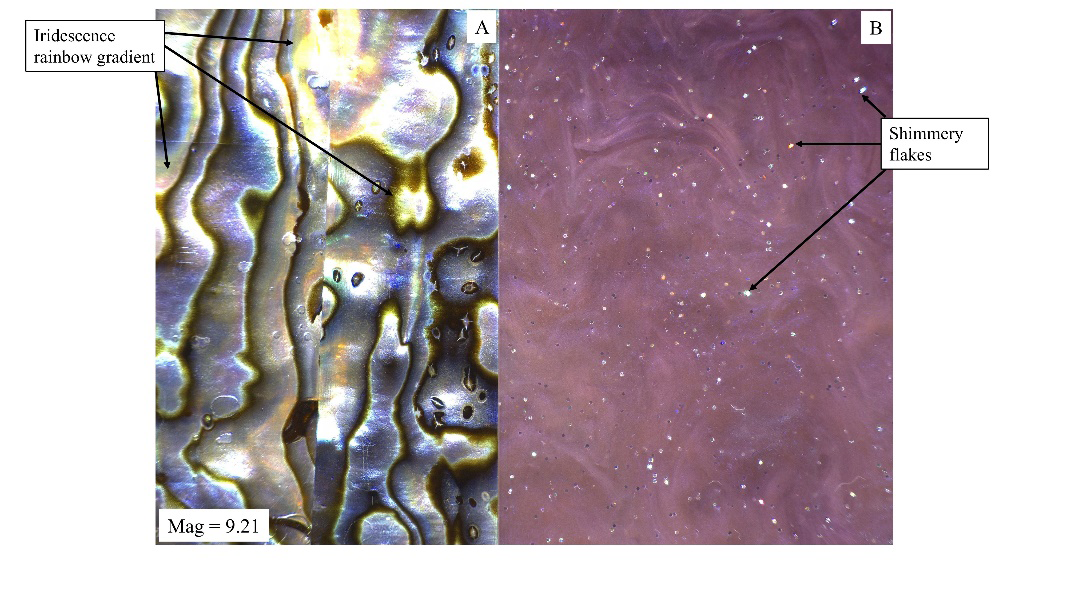
Visual examination revealed the presence or absence of iridescence (Table 2). Iridescence was observed as a rainbow- like gradient that had a lustrous, luminosity (Figure 3A). In contrast, especially under polarized light, items that did not have iridescence were perceived as appearing dull and were nearly colorless (Figure 3B). Some items contained reflective or shimmery flakes in an attempt to mimic an iridescence from a distance, but they lacked the structural coloration in the form of rainbow-like colors that occur in natural nacre.
Portable XRF Analysis
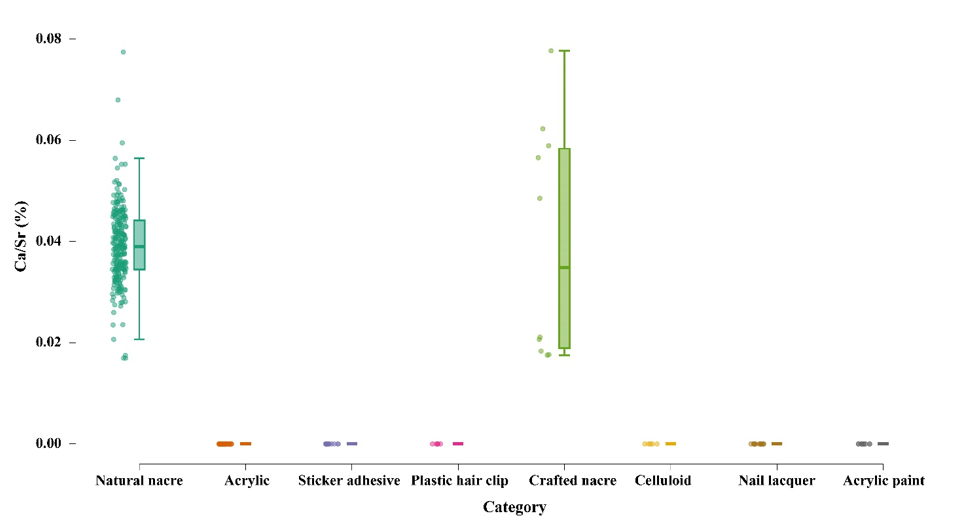
Portable XRF (pXRF) elemental analysis of the samples is summarized in Table 3. The natural nacre shell samples, and the two composite crafted nacre samples revealed higher relative concentrations of calcium (Ca) and strontium (Sr), and the results are shown graphically in Figure 4 and Figure 5. Giliken DP, et al. [36] showed that Ca/Sr ratios are strong indicators of biological control in marine aragonitic shells, and we have estimated these ratios for the samples analyzed. The calculated ratio of all the samples in this set is shown in Figure 6.
| Specimen | Number of Specimens | LE (%) | Calcium (%) | Strontium (%) | Calcium to Strontium Ratio (%) | Other Elements Detected |
|---|---|---|---|---|---|---|
| Acrylic | 6 | 96.56 - 99.22 | None Detected | None Detected | None Detected | Titanium, lead |
| Acrylic paint | 2 | 55.89 - 76.32 | 31.17 - 42.57 | None Detected | None Detected | Titanium |
| Celluloid | 1 | 87.12 - 87.49 | None Detected | None Detected | None Detected | Iron |
| Nail lacquer | 3 | 91.78 - 95.79 | None Detected | None Detected | None Detected | Titanium, manganese |
| Crafted nacre | 2 | 26.83 - 50.06 | 49.67 - 71.93 | 0.09 - 0.32 | 0.02 - 0.08 | None Detected |
| Natural nacre | 50 | 9.80 - 55.37 | 44.57 - 89.92 | 0.06 – 0.47 | 0.02 - 0.08 | None Detected |
| Sticker adhesive | 3 | 72.76 - 86.47 | None Detected | None Detected | None Detected | Titanium, zinc |
| Plastic hair clip | 1 | 99.45 - 99.72 | None Detected | None Detected | None Detected | None Detected |
Table 3: Elemental results by pXRF for natural nacre and synthetic specimens.
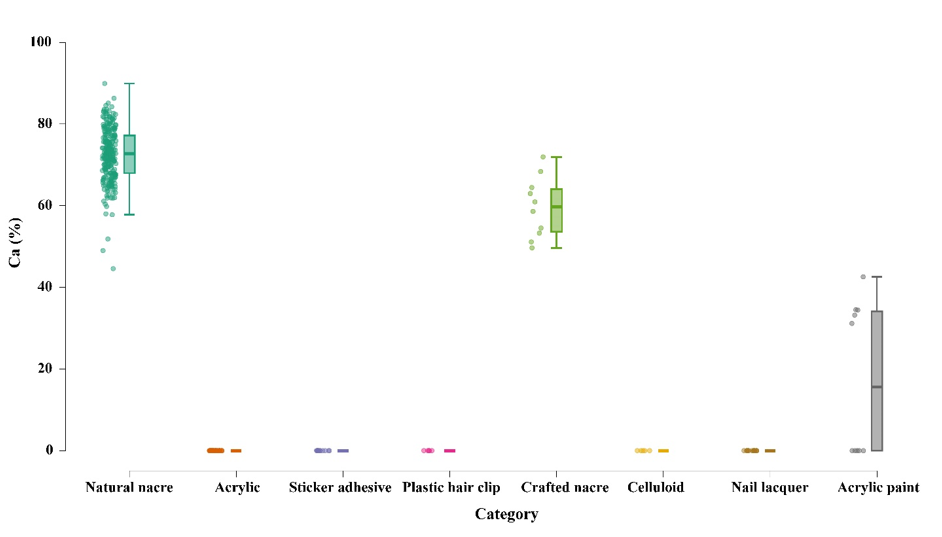
![Figure 5: Giliken DP, et al. [36] showed that Ca/Sr ratios are strong indicators of biological control in marine aragonitic shells, and we have estimated these ratios for the samples analyzed. The calculated ratio of all the samples in this set is shown in Figure 6.](/fulltextimages/14003/fig_5.png)
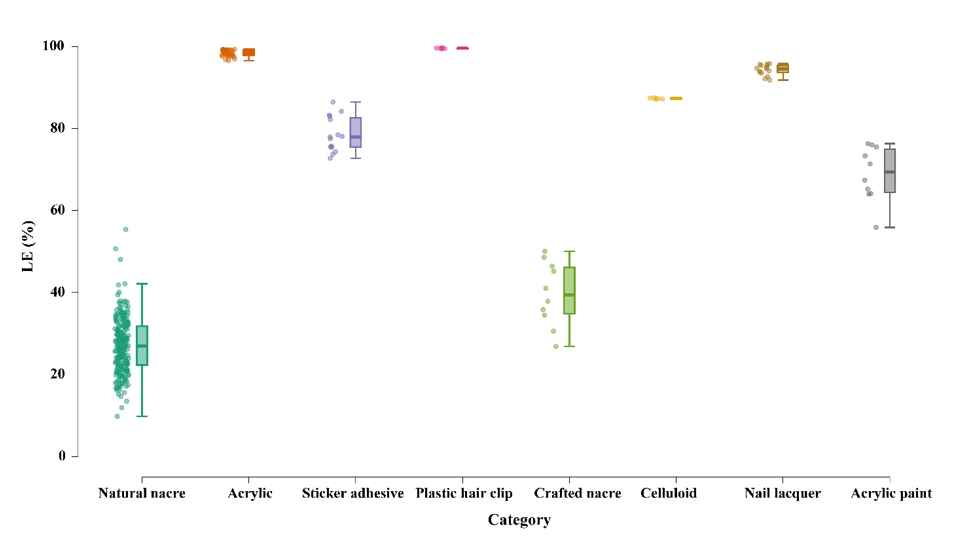
The pXRF software can estimate the cumulative percentage of light elements (LE), atomic number <16, present in a sample. The relative concentration of LE is estimated from the intensity associated with Bremsstrahlung background intensity [37]. This phenomenon occurs due to the low energy emitted from LE being reabsorbed into the sample matrix or detector itself and scattered into the background (Bremsstrahlung) radiation [37, 38]. The graphical ploy of the LE percentage associated with the samples tested is shown in Figure 7 and it is important to note that synthetic polymers, which are primarily composed of low-Z elements (e.g., C, H, N, O) exhibited the highest LE percentages (Figure 7).
Diffuse Reflectance Infrared Fourier Transform Spectroscopy (DRIFTS) Analysis
DRIFTS analysis was done by collecting spectra from reference nacre shell specimens (n = 5) (three specimens of Haliotis rufescens; one specimen of Haliotis kamtschatkana; and one specimen of Pteria sterna), commercial synthetic specimens (n = 18), and crafted nacre (n = 2). The DRIFTS spectra of the tested samples are shown in Figure 8 and includes the averaged spectrum (n = 5) collected from five nacre specimens as well as the spectrum from one synthetic acrylic (PMMA) sample and of one crafted nacre composite sample consisting of a combination of both nacre and synthetic polymer.
The spectrum associated with the natural nacre (Figure 8A) shows a broad peak at 1420 cm-1, a unique peak 1085 cm-
1, a band stretch at 870-848 cm-1, and doublet peaks between 699 and 716 cm-1 that may be characteristic of calcium carbonate, specifically in the form of aragonite [39, 42]. Other distinguishing bands include a peak at 2926 cm-1, a lower intensity peak at 2853 cm-1, and a group of peaks at 1790 cm-1 and 1645 cm-1 that may be attributed to bond stretches and vibrations of the organic matrix [39, 42]. In contrast, the acrylic (PMMA) spectrum is distinct from the spectrum of the natural nacre where the peaks associated with aragonite are absent (Figure 8B). The acrylic (PMMA) spectrum also showcased a set of peaks that may suggest an organic moiety between ~3066 cm-1 and 2800 cm-1; a C=O bond stretch or vibration peak at 1745 cm-1, and possible unique peaks suggesting C-C-O bond presence at ~1246 cm-1 and ~1200 – 1155 cm-1.
DRIFTS analysis of the crafted nacre showed the spectrum to be like that of a variety of polymers and inconsistent with the reference spectra of nacre-producing mollusks. As previously stated, the manufacturer of the crafted nacre claimed that this material was a mixture of synthetic polymer and natural nacre flakes, and the DRIFTS analysis confirms that the spectrum was consistent with reference spectra of epoxy resin (Table 4). When comparing the spectrum of the crafted nacre (Figure 8C) to the natural nacre and acrylic (PMMA) spectra (Figure 8A and 8B), characteristic peaks and band stretches of esters that were seen in the acrylic spectrum are also observed in the crafted nacre spectrum. A small set of peaks that likely are associated with organic moieties are seen at 3018 cm-1 – 2800 cm-1 in the crafted nacre spectrum similar to the acrylic (PMMA) sample. Additionally, an ester element is also seen in the crafted nacre sample with peaks at 1745 cm-1, 1254 cm-1, and ~1116 cm-1.
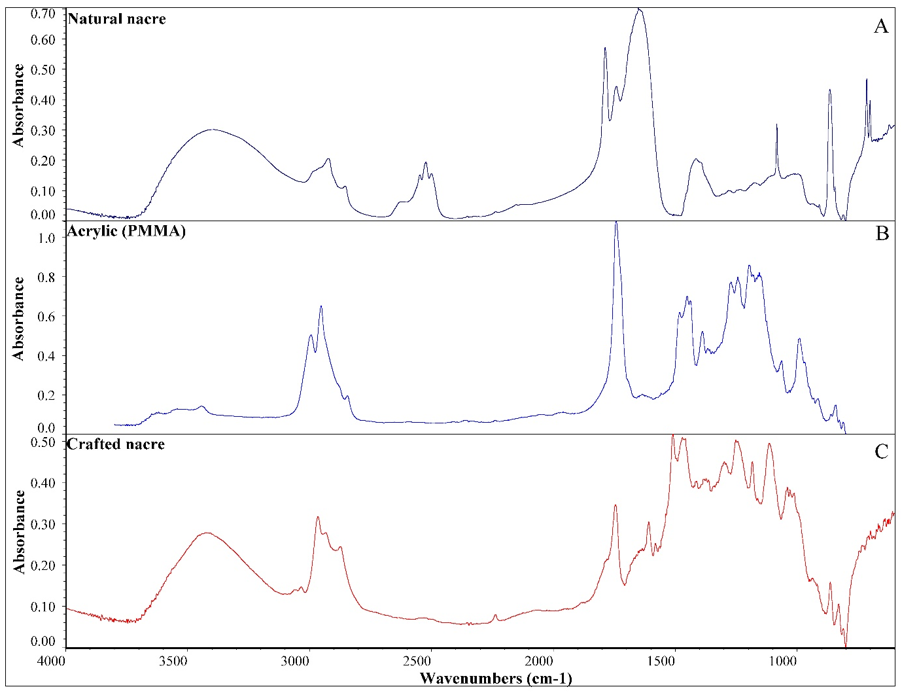
Figure 8: Natural nacre averaged DRIFT spectra of nacre shell (n = 5) specimens including one Haliotis kamtschatkana (pinto abalone), three specimens of Haliotis rufescens (red abalone), and one Pteria sterna (Pacific winged oyster) (A). The DRIFT spectrum of acrylic (PMMA) (B) and crafted nacre (C) are inconsistent with the natural nacre averaged spectrum.
| Specimen | Library Search Match |
|---|---|
| Acrylic | Poly(methyl methacrylate) or PMMA |
| Acrylic paint | Vinyl ester, poly(vinyl propionate:acrylate) |
| Celluloid | N-Vinylpyrrolidone (60%)/vinyl acetate copolymer |
| Nail lacquer | Nitrocellulose, poly(vinyl propionate:acrylate) |
| Crafted nacre | Epoxy resin ester, epoxy resin |
| Sticker adhesive | Polyester terephthalate, tributyl citrate |
| Plastic Hair Clip | Alkyd resin |
Table 4: Summary of DRIFTS library search results for synthetic specimens.
Discussion
The SciAps pXRF proved to be a useful tool to characterize the elemental composition of samples in this study. Results were acquired within minutes, requiring minimal data processing and could be used to determine relative percentage of elements in the sample matrix. Using pXRF we analyzed reference mollusk samples and have characterized the relative concentration of Ca, Sr and LEs, which are shown in Table 3 and in Figures 4 through Figure 7. The evaluation of nacre look-alike products indicated that only the crafted nacre products, which were claimed to be produced with natural nacre components, could not be excluded based on elemental analysis. All other samples had statistically different relative percentages of Ca, Sr and the LEs which allowed for their separation. The ratio of Ca/Sr displayed in Figure 6 enhanced the distinctiveness of the specimens that contained mollusk components. The crafted nacre, when visually inspected, appeared to contain a synthetic plastic component mixed with natural Mother of Pearl components and the elemental analysis profile found these samples to be indistinguishable from natural nacre shells.
Graphical representation of the pXRF LE percentage estimate (e.g., C, H, O, N) is visualized in Figure 7 and is a useful parameter to infer the possible presence of organic components. Curiously, the mollusk samples and the crafted nacre exhibited similar concentrations of the LEs. The organic source in the mollusk samples is surrounding all surfaces of the calcium carbonate crystals of the nacre, while in the crafted nacre the organic source is a manufactured polymer.
Analysis employing DRIFTS was useful to determine the molecular structure of organic compounds. Natural nacre is a combination of organic and inorganic elements and molecules, and the DRIFTS analysis could characterize the functional groups associated with it. An averaged spectrum of natural nacre from five mollusks – consisting of three species – is shown in Figure 8A. Sun J, et al. [6] and Macías-Sánchez E, et. al. [7] reported that nacre is composed of calcium carbonate crystals (95 wt%) and other organic molecules including proteins. Dauphin Y, et. al. [39], Santana P, et al. [42], and Tan TL, et. al. [3], reported that the calcium carbonate present in nacre has the crystal structure of aragonite and the band stretches seen in DRIFTS spectra in this study were consistent with the published literature. Shown in Figure 8A, the characteristic peaks that are associated with aragonite are observed at 1420 cm-1, a second peak at 1085 cm-1, a band stretch at 870-848 cm-1, and doublet peaks between 699 and 716 cm-1.
The spectra of two look-alike manufactured products which imitate Mother of Pearl are also shown in Figure 8. The acrylic (PMMA) sample (Figure 8B) is stated to be made of a synthetic polymer, while the crafted nacre sample (Figure 8C), was declared to be a blend of synthetic materials with natural nacre scales. For both of these look-alike materials, the strong peaks between ~3066 cm-1 and 2800 cm-1 likely accounts for the C-H bond behavior typical of polymers [43]. Other peaks observed in these manufactured materials are likely associated with esters (1745 cm-1, ~1254 cm-1 – 1240 cm-1, and ~1155 cm-1 – 1030 cm-1) [43, 44]. In conclusion, a simple visual examination of the spectra shown in Figure 8 is useful to distinguish between natural nacre and manufactured synthetic look-alike materials.
To summarize, to determine if a material was naturally produced from a mollusk, it must exhibit iridescence and contain nacre. Therefore, the criteria used in this study to determine if a material is naturally occurring nacre are as follows: • Is the material iridescent? This addresses the intrinsic physical properties of nacre which disperses incident light into colors of the visible spectrum. Non-iridescent material is excluded from further analyses.
• Does the material contain calcium and strontium? What is the LE percentage? This addresses the anatomical features of nacre which is aragonite-based (e.g., calcium carbonate) 1. pXRF analysis reveals the relative concentration of calcium and strontium. 2. DRIFTS analysis infers the presence of aragonite and excludes synthetically manufactured look-alikes. 3. Comparison of these analytes against known reference samples of natural nacre is essential for a robust conclusion.
In our experience manufactured synthetic materials produced to imitate Mother of Pearl do not meet all of these criteria.
Conclusion
This study demonstrates that a trifurcated approach – combining visual, elemental, and organic analyses – is the most effective method for distinguishing natural nacre from synthetic imitations. This approach employs 1) visually confirming the presence of the unique iridescent sheen of nacre, 2) elemental analysis by pXRF, and 3) utilizing DRIFTS to characterize the organic components present.
Given the prevalence of synthetic, nacre-like finishes, we have shown that DRIFTS analysis alone can reveal the presence of a synthetic polymer. However, when more complex samples, such as crafted nacre, require analysis, it was beneficial to employ both pXRF and DRIFTS analysis. This combined approach revealed a composite material containing both natural nacre and a synthetic polymer, a finding that aligned with the manufacturer’s claims.
Legal
The findings and conclusions in this article are those of the authors and do not necessarily represent the views of the U.S. Fish and Wildlife Service.
Acknowledgements
The authors thank Wildlife Inspector Catherine Yasuda (U.S. Fish and Wildlife Service) for donating the nacre shell specimens, Forensic Chemist Erin McClure-Price (U.S. Forest Service) for peer review, and Interlibrary Loans Coordinator John Fisher (U.S. Fish and Wildlife Service, National Conservation Training Center) for providing technical documents.
References
-
Natural mollusk shells (n=50), including samples of _Haliotis_ spp. (abalone), _Pteria_ spp. (winged oyster), and _Pinctada_ spp. (oyster), that displayed natural nacre were analyzed. The shells were from multiple geographic locations including Mexico, Australia, the Philippines, and the United States of America (Table 1). [INLINE_TABLE:2:0] [INLINE_TABLE:3:0] Table 1: Summary of natural nacre shell specimens tested and their geographical origins. Elephant ivory specimens (n=11), _Loxodonta_ spp. & _Elephas maximus_, and walrus ivory specimens (n=12), _Odobenus rosmarus_, were chosen to be used as controls for determining the daily accuracy of the pXRF because of their high calcium content [22,23] and the ease with which the pXRF can detect this element. All shells and ivory are housed in the U.S. National Fish & Wildlife Forensic Laboratory (Ashland, OR) morphology collection. Synthetic MOP samples (n=18) and crafted nacre samples (n=2) were obtained from commercial sources and are summarized in Table 2 and Figure 2. Other artificial specimens were claimed by the manufacturer to be made of materials ranging from acrylic (polymethyl methacrylate or PMMA) to paint or adhesive (Table 2 and Figure 2). [INLINE_TABLE:3:1] Table 2: Summary of commercial synthetic specimens tested and their results after visual inspection confirmation for iridescence. [INLINE_FIGURE:3:0] Figure 2: Various samples of crafted nacre (a composite of natural nacre parts with organic polymer-based materials) and artificial imitations of nacre that were tested.
- Forensic Implications of Adverse Drug Reactions in Schizophrenia A Case Series
- Narcotics and Digital Forensics: Bridging Crimes in the Digital Age
- Ethics in Forensic Psychiatry: Principles, Dilemmas, and Human Rights
- Impact of Acute Stress on Attentional Orienting to Social Cues
- Head Injury and Intracranial Hemorrhage in Western Region of Libya
- A Forensic Study on Handedness: Examination of Handwriting Features in Right and Left Handed Writers