
Management of Congenital Melanocytic Naevus (CMN) of the Lower Pole of the Breast Causing Secondary Tuberous Breast Deformity (TBD)- A Case Report and Review of Literature: Congenital Melanocytic Naevus &Tuberous Breast Deformity
A 19-year-old woman was referred with a congenital melanocytic naevus (CMN) involving the lower pole of her right breast, combined with features of tuberous breast deformity (TBD) and breastasymmetry. Staged correction of the breast asymmetry was planned. The first stage involved recruitment of her right upper abdominal skin, in a reverse abdominoplasty manner, to address the lower pole skin deficiency. Extensive radial release of the constriction bands across the original IMF (inframammary fold), and circum-areolar mastopexy were performed. A sub-glandular breast implant was inserted. Four weeks later, she presented with minor inframammary wound breakdown. Washout and removal of the implant, combined with breast parenchymal tissue rearrangement was performed. We performed her planned second stage 3 months later in the form of; a right vertical pattern mastopexy, lipofilling and revision of the reverse abdominoplasty to adjust the nipple and IMF position. The remaining CMN was excised and resurfaced with a full thickness skin graft from the contralateral mastopexy. The leathery quality of CMN makes the achievement of correcting the breast deformity impossible without its excision. This combination of CMN and TBD makes management of these cases more challenging than manging each on its own. To the best of our knowledge, this is the first case report of the effect of moderate CMN on the breast and its development.
Introduction
Congenital melanocytic naevi (CMN) are accumulations of melanocytes of neuroectodermal origin in ectopic locations. Its position is determined in utero, hence most appear in the first six months of life [1]. Tuberous breast deformity (TBD) is a congenital abnormality of the breast cause by impaired connective tissue growth during puberty. Depending on the stage of deformity, the appropriate surgical treatment is individualised for the patient [2]. There has yet to be any published literature associating CMN and breast asymmetry or tuberous breast deformity (TBD). We hereby highlight the implications of a CMN of the female breast on the breast growth and producing features of TBD and significant breast asymmetry.
Case Report
A 19-year-old female patient was referred to the author with CMN and TBD. The CMN involved the lower pole of her right breast with features of grade II Von Heimberg TBD (Figure 1). After counselling, a staged surgical approach was adopted, as the patient was not keen on more invasive surgeries such as thoracodorsal artery perforator flap or free transverse upper gracilis flaps to reconstruct the lower pole. The current IMF and the ideal symmetrical IMF were marked, to estimate the amount of skin deficiency of the right breast lower pole, and to lower the IMF (Figure
2). The new IMF was reconstructed by a modified reverse abdominoplasty technique utilising progressive tension barbed sutures. Doughnut circum-areolar mastopexy was performed along with extensive radial scoring to release the constriction bands along the original IMF (Figure 3). A generous superior dermo-glandular pedicle was preserved, with minimal inferior undermining. A 155cc anatomical sub- glandular implant was inserted, to improve the projection of the deficient lower pole . The patient was discharged the following day. Histology report confirmed CMN.
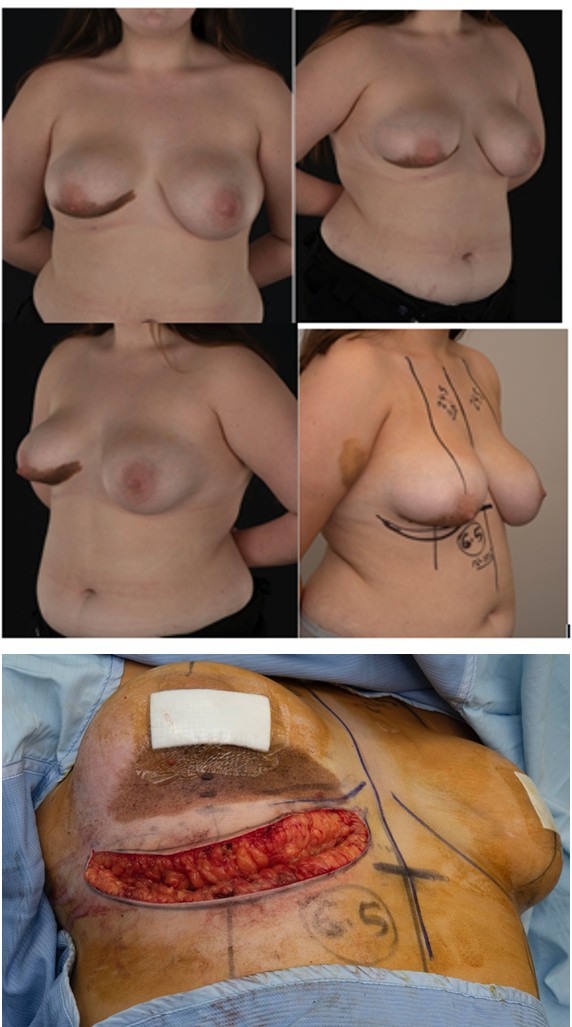
Figure 1(a-d): Congenital Melanocytic Naevus overlying the entirety of the lower pole of the right breast and features of grade II Von Heimberg Tuberous breast deformity. Regnault grade I ptosis with concurrent pseudoptosis on the left breast.
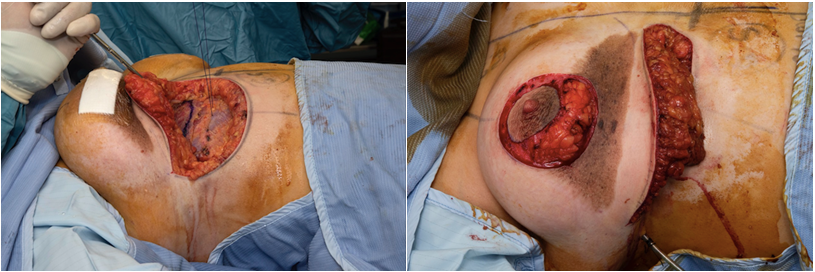
A minor IMF wound break down and some serous discharge 4 weeks later prompted a decision to remove the implant, which also failed to improve the contour of the lower pole. Upon explantation, breast parenchymal tissue rearrangement was carried out using Puckett’s technique; A glandular flap was “unfurled” and the apex fixed onto the IMF, correcting the lower pole tissue hypoplasia [3].
The planned second stage took place 3 months later. A vertical pattern mastopexy was performed on the right breast, mobilising the nipple areola complex superiorly by 2cm on a superior dermoglandular pedicle. A Wise pattern
Discussion
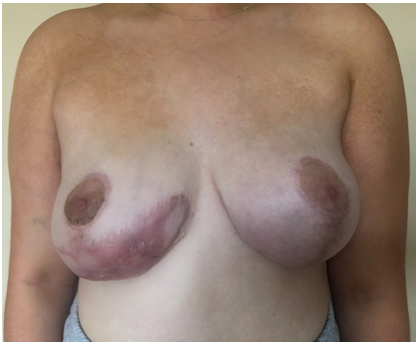
In CMN, nevus cells are disseminated into the deep dermis and can involve the subcutaneous tissues. Its depth of involvement is speculated to be proportional to its overall size [4]. Nevus cells are commonly involved in appendages and collagen in the reticular dermis, leading to reduced skin elasticity. Giant CMN that involve the limbs can result in hypoplastic abnormalities by the replacement of subcutaneous tissues with melanocytes [5]. This could explain for the hypoplastic lower pole of the patient’s right breast. In this case, the leathery nature of that naevus mastopexy was performed on the left side. The reverse abdominoplasty was revised using 2.0 ethibond sutures. 130cc of processed fat was utilised for lipomodelling of the right breast. The leathery CMN skin hindered the achievement of a good contour of the lower pole. Hence, the CMN was excised. A skin graft (FTSG) was harvested from the resected left mastopexy skin. Despite losing 10% of the FTSG, the wounds achieved good healing. A satisfactory outcome was accomplished for the shape, contour and symmetry of her breasts and the patient was very satisfied with the result (Figure 4).
prevented the contouring of the lower pole despite the radial scoring and importing extra skin. In hindsight, that decision of excising the CMN should have been taken earlier on, in planning. The hallmark features of tuberous breast disease are parenchymal hypoplasia, constricted breast base, deficiency of the inferior breast skin and superior malposition of the infra-mammary fold. Von Heimberg, et al. [2] classified tuberous breast deformities into four categories. Grade II TBD shows hypoplasia of the lower lateral and medial quadrants with sufficient subareolar skin. TBD could be treated with breast augmentation, tissue redistribution and recruitment of additional skin for the deficient sub-areolar region. Different techniques of local tissue rearrangement and local breast flaps have been proposed [6, 7]. The Puckett’s technique, adopted by the surgeon, involves the dissection of the breast parenchyma initially along the inferior aspect of the breast then detaching it posteriorly from the pectoral fascia. A centrally/inferiorly based flap is “unfurled” and fixed onto the IMF, increasing the lower pole volume. An implant can be inserted for added volume [7]. Lipofilling is another reliable technique to improve breast contour, but when used alone would requires several treatments [8]. This was also used as an adjunct to improve the lower pole contour in this case.
Conclusion
When managing CMN of the female breast, one has to appreciate the lack of pliability of the CMN skin. This makes it impossible to achieve the proper contour of the lower pole, despite addressing the skin deficiency and the constriction bands. A thorough patient counselling and advice of staged reconstruction are key points in the management of these cases. A systematic combination of techniques have proven successful. In hindsight, the excision of the CMN and resurfacing with a FTSG should have been performed in the first stage.
References
-
Zayour M, Lazova R (2011) Congenital melanocytic nevi. Clin Lab Med 31(2): 267-280.
-
Heimburg DV, Exner K, Kruft S, Lemperle G (1996) The tuberous breast deformity: classification and treatment. Br J Plast Surg 49(6): 339-345.
-
Puckett CL, Concannon MJ (1990) Augmenting the narrow-based breast: The unfurling technique to prevent the double-bubble deformity. Aesthetic Plastic Surgery 14(1): 15-19.
-
Saida T (2006) Histogenesis of congenital and acquired melanocytic nevi: a unifying concept. Am J Dermatopathol 28(4): 377-339.
-
Maldonado RR, Tamayo L, Laterza AM, Duran C (1992) Giant pigmented nevi: clinical, histopathologic, and therapeutic considerations. J Pediatr 120(6): 906-911.
-
Galych SP, Dabizha OY, Kostenko AA, Gomolyako IV, Samko KA, et al. (2016) Surgical Treatment of Tubular Breast Type II. Plast Reconstr Surg Glob Open 4(10): e1024.
-
Brown MH, Somogyi RB (2015) Surgical Strategies in the Correction of the Tuberous Breast. Clin Plast Surg 42(4): 531-549.
-
Delay E, Sinna R, Ho Quoc C (2013) Tuberous Breast Correction by Fat Grafting. Aesthetic Surgery Journal 33(4): 522-528.
- Reconstruction of Nasal Defect Using a Local Flap Based in the Nanoperforants Concept: A Case Report
- Transplant Tourism in Japan: Insights from Nationwide Surveys and Emerging Ethical Challenges
- The Challenge of Peritoneal Vaginoplasty in Transgender Women: Review Literature and Personal Perspectives
- Algorithmic Paternalism: Autonomy Versus Automation
- Dermatoscopy in Gorlin Syndrome: Avoiding the Disfigurement in Patients
- How Artificial Intelligence is Ushering in a New Era of Innovation in General and Plastic Surgery: A Short Communication