
The Tip Nose
Introduction: Rhinoplasty is a widely performed surgical procedure in plastic surgery. The development of knowledge regarding the anatomy of the nose represents one of the most refined aspects of plastic surgery education. A thorough understanding of each patient's nasal anatomy is crucial for achieving longer-lasting results. Therefore, knowledge of the nasal tip and its treatment is essential for the successful execution of rhinoplasty. The objective of this study is to describe the techniques used to treat the nasal tip. Discussion: The approach to the nasal tip is complex, involving both structural and aesthetic considerations. Various techniques are employed in the treatment of this region, including cartilage reduction, cartilage preservation, the use of specific sutures to shape the tip, and the use of cartilage to provide support. These techniques aim to improve function, prevent retraction, and enhance the definition of the nasal tip. Conclusion: This study outlines some of the most commonly used techniques in contemporary rhinoplasty, whether utilizing an open, closed, or hybrid approach. It is imperative for surgeons to be acquainted with these techniques and apply them based on individual indications for treating the nasal tip.
Introduction
Rhinoplasty is a surgical procedure widely performed in plastic surgery. In 2017 alone, according to ISAPS, around 877,254 rhinoplasties were performed worldwide [1], marking an 11% increase in reported surgeries compared to the previous year.
The development of knowledge of nasal anatomy is a highly refined aspect of plastic surgery, demanding dedication, studies, and visual technical experience for an Conceptual Paper adequate understanding of the structures and ligaments providing support and ensuring good physiology for respiratory function [2, 3].
Considered by some as a technical and intellectual challenge, nasal surgery presents a continuous learning curve, from the early stages of development to the most experienced surgeons. Knowledge of each patient’s nasal anatomy is crucial for achieving lasting results, emphasizing the significance of understanding the nasal tip and its treatment in successful rhinoplasty.
The objective of this study is to describe the techniques used to treat the nasal tip.
Alar Cartilages
Trim
Cephalic trim reduces the width of the cartilaginous frameworks, facilitating cephalic rotation of the lower lateral cartilage. It involves separating the lower lateral cartilages from the upper lateral cartilages and trimming them [4]. The piece of cartilage can be used to reinforce the lower cartilage using a turn alar flap [5].
Suture
The treatment of the shape and projection of the lower cartilage is significantly reinforced with sutures. Techniques such as reducing the flare of lateral crura and decreasing tip fullness with transdomal sutures, medial crural sutures, and interdomal sutures are employed by Gruber, et al. [6, 7, 8]. The transdomal suture is a horizontal mattress suture placed through the lateral and medial aspects of the domes. The medial crural suture corrects medial crura asymmetries, reduces flaring, and narrows the width of the columella. The interdomal suture is a horizontal mattress suture between domal segments.
Grafts
Septal Extension
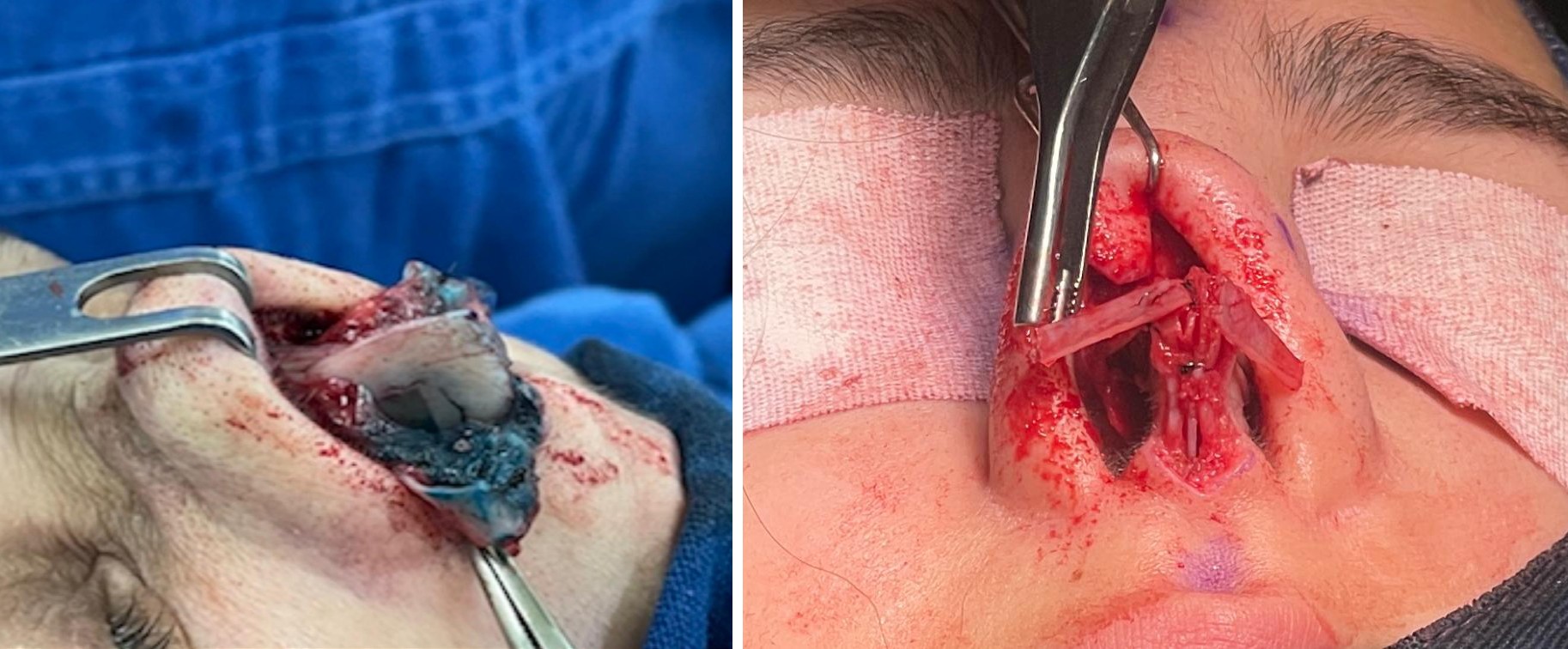
Graft This graft precisely controls tip rotation and projection [9, 10]. Projection is determined by the height of the graft, and rotation is designed to define the tip. Understanding this graft and its fixation requires using a four-point suture technique to control tip rotation. In this technique, a piece of cartilage can be used to fill the external space and straighten the columella (Figure 1) (Septal Extension Graft).
Floating Graft
(Goldman Graft) Described by Goldman, this graft is used to improve the columellar profile or correct the hidden columella [11].
Onlay Graft
The Pech tip onlay graft is used to increase tip projection and adjust tip rotation [12].
Shield Graft Used to define the columellar profile or correct the hidden columella, it is known as the Sheen Shield [13].
Columellar Graft
Described in 1932 by Eitner, et al. [14] this graft is inserted between the middle crura to support the tip [14, 15].
Alar Articulated Rim Graft (AARG)
This articulated graft is used to provide support and definition to the tip, improving nasal function [16, 17] (Figure 2).
Figure: 2 Alar Articulated Rim Graft (AARG). Alar Rim Grafts
The alar rim graft is useful for preventing alar retraction, creating a smooth transition of the alar rim [18].
Lateral Strut Grafts
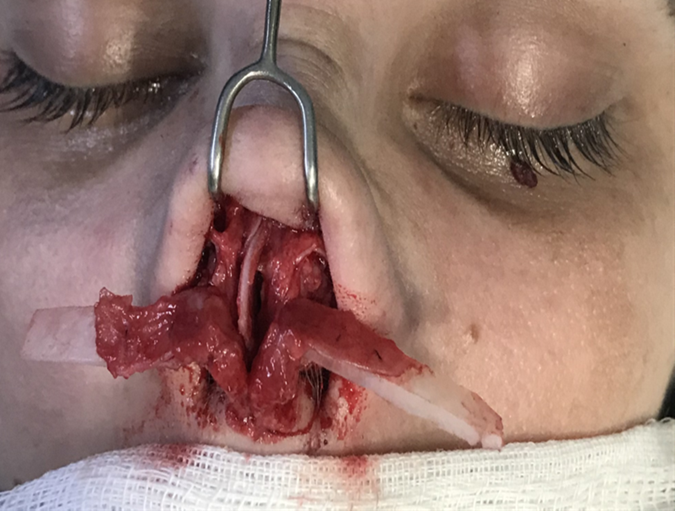
This lateral crural strut, known as the Gunther graft, is used to provide support, correct alar retraction, and reorient the flattening of lateral crural cartilages [19] (Figure 3) (Ghunter Strut).
Alar Batten Onlay Graft
This graft is used to fill the point of maximal lateral wall collapse or supra-alar pinching [20].
Discussion
The nasal tip is a functional and aesthetic structure playing a crucial role in rhinoplasty. Its delicacy and definition contribute to elegance and beauty, making it a significant factor in forming a first impression due to the central location of the nose on the face. The approach to alar cartilage has evolved over the years, emphasizing preservation. Contemporary techniques aim to conserve as much cartilage as possible, using minimal portions and relying on the cartilage itself for reinforcement while preserving connections with the upper lateral cartilage [21]. Sutures play a fundamental role in defining the tip and preserving structures, improving the overall shape and support of the nasal tip. They are adaptable for use in both open and closed rhinoplasty techniques. Tip support grafts increasingly favor the use of the septal extension graft, which has demonstrated superiority in terms of tip control and rotation compared to the columellar strut [22]. Tip grafts located more superficially are suitable for thinner skin, whereas in thick skin, they preserve the natural structure of the nose. Alar region grafts contribute to improved support, definition, and prevention of alar retractions, making them a good practice in modern rhinoplasty.
Conclusion
This study highlights some of the most commonly used techniques in contemporary rhinoplasty, encompassing open, closed, or hybrid approaches. Surgeons must be well- versed in these techniques and tailor their use based on individual indications for nasal tip treatment.
References
-
(ISAPS) International Society of Aesthetic Plastic Surgery.
-
Yeolekar A, Qadri H (2018) The learning curve in surgical practice and its applicability to rhinoplasty. Indian J Otolaryngol Head Neck Surg 70(1): 38-42.
-
Crosara PF, Nunes FB, Rodrigues DS, Figueiredo ARP, Becker HMG, et al. (2017) Rhinoplasty complications and reoperations: Systematic review. Int Arch Otorhinolaryngol 21(1): 97-101.
-
Sieber DA, Rohrich RJ (2017) Finesse in Nasal Tip Refinement. Plastic and Reconstructive Surgery 140(2): 277e-286e.
-
Murakami CS, Barrera JE, Most SP (2009) Preserving structural integrity of the alar cartilage in aesthetic rhinoplasty using a cephalic turn-in flap. Arch Facial Plast Surg 11(2): 126-128.
-
Gruber RP, Chang E, Buchanan E (2010) Suture techniques in rhinoplasty. Clin Plast Surg 37(2): 231- 243.
-
Duron JB, Noel W, Nguyen PS, Jallut Y, Aiach G (2014) Tip sutures. Ann Chir Plast Esthet 59(6): 461-466.
-
Vuyk HD (1995) Suture tip plasty. Rhinology 33(1): 30- 38.
-
Rohrich RJ, Chamata ES, Alleyne B, Bellamy JL (2022) Versatility of the Fixed-Mobile Septal Extension Graft for Nasal Tip Reshaping. Plast Reconstr Surg 149(6): 1350- 1356.
-
Rohrich RJ, Savetsky IL, Avashia YJ (2020) The Role of the Septal Extension Graft. Plast Reconstr Surg Glob Open 8(5): e2710.
-
Bottini DJ, Gentile P, Donfrancesco A, Fiumara L, Cervelli V (2008) Augmentation rhinoplasty with autologous grafts. Aesthetic Plast Surg 32(1): 136-142.
-
Peck GC (1983) The onlay graft for nasal tip projection. Plast Reconstr Surg 71(1): 27-39.
-
Sheen JH (1993) Tip graft: a 20-year retrospective. Plast Reconstr Surg 91(1): 48-63.
-
Eitner E (1932) In: Kosmetische O (Ed.), Springer J, Vienna, Austria, Europe.
-
Martino C, Salzano FA, Martino D, Ralli M, Salzano G, et al. (2023) Y-Columellar Strut Graft: A Method for Reconstructing the Nasal Tip in Primary and Revision Rhinoplasty. Plast Reconstr Surg 151(4): 609e-613e.
-
Toriumi DM (2006) New concepts in nasal tip contouring. Arch Facial Plast Surg 8(3): 156-185.
-
Goodrich JL, Wong BJF (2016) Optimizing the soft tissue triangle, alar margin furrow, and alar ridge aesthetics: analysis and use of the articulate alar rim graft. Facial Plast Surg 32(6): 646-655.
-
Rohrich RJ, Raniere J Jr, Ha RY (2002) The alar contour graft: correction and prevention of alar rim deformities in rhinoplasty. Plast Reconstr Surg 109(7): 2495-2505.
-
Gunter JP, Friedman RM (1997) Lateral crural strut graft: technique and clinical applications in rhinoplasty. Plast Reconstr Surg 99(4): 943-952.
-
Ansari K, Asaria J, Hilger P, Adamson PA (2008) Grafts and implants in rhinoplasty— techniques and long-term results. Oper Tech Otolaryngol 19: 42-58.
-
Daniel RK, Kosins AM (2020) Current Trends in Preservation Rhinoplasty. Aesthet Surg J Open Forum 2(1): ojaa003.
-
Bellamy JL, Rohrich RJ (2023) Superiority of the Septal Extension Graft over the Columellar Strut Graft in Primary Rhinoplasty: Improved Long-Term Tip Stability. Plastic and Reconstructive Surgery 152(2): 332-339.
- Reconstruction of Nasal Defect Using a Local Flap Based in the Nanoperforants Concept: A Case Report
- Transplant Tourism in Japan: Insights from Nationwide Surveys and Emerging Ethical Challenges
- The Challenge of Peritoneal Vaginoplasty in Transgender Women: Review Literature and Personal Perspectives
- Algorithmic Paternalism: Autonomy Versus Automation
- Dermatoscopy in Gorlin Syndrome: Avoiding the Disfigurement in Patients
- How Artificial Intelligence is Ushering in a New Era of Innovation in General and Plastic Surgery: A Short Communication