
Interactive Effects of Breed, Physiological Conditions and Topography on Grazing Behaviour and Distribution of Dairy Cattle at Mpwapwa
The study was carried out at Mpwapwa Livestock Training Agency (LITA) Dairy unit during dry season to examine the interactive effect of dairy cattle breeds and their physiological condition on grazing behaviour and the influence of topographical features on grazing distribution. The experimental design involved 2x3 factorial arrangements with two factors; breed (Friesian, Ayrshire and Jersey) and physiological status (dry, weaners and lactating). Focal observation method was used by three trained observers to examine focal animals for four days consecutively. Field survey techniques were used for recoding different signs of animals’ movement from upper-land and lowland. It was revealed that the time spent for foraging was inversely proportion to the time spent for rumination; grazing being higher for Friesian and Ayrshire breeds and significantly lower for Jersey breed. Interestingly, lactating cows had significantly lower feeding rate which was associated with concentrate supplementation. More studies are recommended not only to determine the impacts of supplementation on production levels but also economic implication of supplementation. Moreover, Friesian and Jersey displayed higher feeding rate at weaning stage and drying-off period respectively which implies the complex interrelationship between genomic characteristics and physiology of animals and thus calls for indepth studies. Nevertheless, a preferential choice of grazing animals in lowland has ecological implication by increasing grazing pressure on lowland pastures. Appropriated range management practices such as proper stocking rate, water point distribution and pasture improvement are recommended. Further studies are also recommended to examine nutritional composition and seasonal variation in forage resources.
Introduction
Livestock production in semi-arid rangelands which is the large proportion of Mpwapwa grazing land is limited not only by scarcity of forage but also the challenges related to foraging ability due to variations in animals’ breed and physiology. Foraging for many animals is energetically demanding activity constrained by genetic and environmental factors. Although, some individuals might naturally be exhibited with higher foraging ability, but physiological status and morphology can significantly shaped their foraging behaviour [1]. Diet selection, does not only depend on availability and nature of feed offered, but also the genetic and metabolic requirements which is the functional of physiological condition of animals [2]. To the large extent, diet selection defines the biological make up of animals. Besides, the selectivity nature of animals, grazing ruminants are continuously searching not only for high quality diet but also large portions to satisfy their nutritional and metabolic requirements. Although, dairy cows are characterized by relatively higher nutritional requirements, there is limited information on how different breeds and changes in physiological status can affect their grazing behaviour. Understanding behavioural responses of dairy cattle of different breeds with varying physiological conditions is crucial for planning the appropriate range resources utilization.
A large population of cattle (95%) raised in Tanzania is native breed (Tanzania Short Horn Zebu) with low genetic potential as evidenced by low growth rate, low mature weight, low calving interval and yield [3, 4]. Between 1970s’ and 1990s, exotic breeds (Friesian, Jersey and Ayrshire) were imported to Mpwapwa Livestock Research Institute to improve milk production, however, the target of producing 2,300 kg of milk per 305 day lactation has not been realized [5, 6]. Even the efforts of crossing between local breed and exotic breed were reported to under-perform in terms of milk and carcass yield [5]. While the efforts to improve genetic potential were unsuccessfully at Mpwapwa, little information is known on the foraging ability of these imported exotic breeds subjected to different environmental factors. Although, genetic attributes are considered to have strong influence on foraging ability, but environmental factors coupled to physiological condition of animals can significantly determine the foraging behaviour of animals.
Dairy cattle production in Mpwapwa Livestock Research Institute (TALIRI) and Livestock Training Agency (LITA) depend entirely on low quality natural pastures. The grazing land is characterized with high temporal variations in forage availability and quality, being very low during dry season [6]. In addition to temporal variation in available forage resources, spatially, the area is characterized with rough topography which limits the accessibility and thus selection ability of grazing animals. Planning for efficiency utilization of forage resources in Mpwapwa, considering its spatio-temporal variations, understanding of breed effects and their physiological condition is imperative. Limited information is available in the study area on how the three exotic breed (Friesian, Jersey and Ayrshire) respond on natural pasture. Nevertheless, the influence of variation in their physiological status (being dry, lactating or warner) on grazing behaviour is less documented. The current study, i) examined the interactive effect of dairy cattle breed and their physiological condition on grazing behaviour on natural pastures and ii) influence of topography on grazing distribution.
Materials and Methods
Description of Study Area
The study was carried out at Mpwapwa Livestock Training Agency (LITA) Dairy Unit adjacent to the Mpwapwa Livestock Research Institute farm. The study area is typically semi-arid with an average rainfall of 660 mm per annum [6]. The mean daily temperature is 26 °C, with the minimum temperature in August (13.8 °C) and maximum temperature in November (30.2 °C) [6]. The grazing land is dominated by natural pastures consisting mainly of Hyparrhenia spps, Brachiaria brizantha, Cynodon dactylon, Chloris gayana, Cenchrus ciliaris Heteropogon contortus, and Panicum maximum. Although, vegetation composition is considered suitable for livestock grazing especially during rainy season, but both availability and quality of these pastures decline tremendously during dry season. Topographically, the study area is located in rough terrain covered by more than 60% rock hills (here refers as upper-hland) and less than 40% valleys (lowland) with seasonal rivers.
Study Design and Data Collection
The study was carried out at Mpwapwa Livestock Training Agency (LITA) dairy unit at the mid of dry season, September 2017. The experimental design involved 2x3 factorial arrangements with two factors (breed and physiological status) and each factor had three levels. Three breeds of exotic dairy cows were studied namely; Friesian, Jersey and Ayrshire with three different variations in their physiological status being; Dry, Weaners and Lactating animals. Nine focal animals were selected, (3 Friesian, 3 Jersey and 3 Ayrshire) three from each category of physiological condition (Dry, Weaners and lactating). Selected animals were neither separated from their respective group nor received different treatments; rather were ear-tagged for easier identification in the field. The three groups (dry, weaners and lactating) were herded in the field separately by different herders but were grazing in the same area from 7:00 am to 2:00 pm. However, before released to the field the lactating dairy cows were normally supplemented with high energy concentrate and after returning from the field during milking time. Although amount of supplements were calculated based on body weight and milk yield, but approximately each animals received 4 kg per day (2 kg in the morning and other 2 kg during milking).
The study used focal observation approach as described by Martin and Bateson, whereas three observers followed the selected focal animals in the field for four days consecutively [7]. Observers were trained one week before field work and were accustomed to grazing animals for another week prior to data collection. One experienced observer was allocated in each group for recording behavioural responses displayed by focal animals. From each group three focal animals were selected for observation, one per breed (1 Friesian; 1 Jersey and 1 Ayrshire). Observations were carried out for 5 minutes intervals before observer switched to another focal animal. The observation cycles proceeded until each focal animal attained 12 observation bouts. The parameters recorded includes the time (in second) spent for different activities such as grazing, browsing, walking, ruminating and idling. In this context, animal was considered idling when either standing or lying without feeding or ruminating. Other behaviours responses such as grooming, scratching, defecating and urinating were all grouped as others. Observers also recorded the number of patches visited and number of bites per 5 minutes interval.
For grazing distribution, ground observation was done using field survey techniques such as line transects and quadrat approaches for recoding different signs of animals’ movement. Two distinct grazing lands (Upper- land and Lowland) were identified based on their topographical features which were hypothesized to affect grazing distribution. The Upper-land was located at approximately 1,200 m and more above sea level while the lowland area was located at approximately less than 800 m above sea level. From each grazing land, five transect lines were established from the base line (the road dividing the two areas). The length of transect lines were approximately 500 m long and the distance from one transect line to next was 200 m apart. Along each transect line; five sampling points were marked at the interval of 100m using (1x 1 m) quadrat point where data were recorded within the marked points. Parameters recorded include, the number of dungs, hooves, bites, trails and signs of urination.
Data Analysis
Behavioural data were subjected to Analysis of Variance (ANOVA) using proc mixed model of SAS (2004). Prior to statistical analysis the distribution of data were tested using Anderson-Darling test of Goodness-of-Fit (at 5%) and found to be normally distributed (P 0.05). Breed of animals and physiological status were treated as fixed main effects while observers and days were considered as random effects in the model. Two-way interaction of breed and physiological status of dairy cattle on grazing behaviour were analysed. Treatment differences were separated using the Least Squares Difference (LSD) as described by Montgomery [8]. For spatial distribution of animals the General Linear Model of SAS was used to analyse the main of topography of grazing distribution [9].
Results
Results on behavioural responses of different breeds of animals and their physiological status are presented in table 1. Significant variations were noted in almost all behavioural responses across breed and physiological condition of animals. Generally, all breeds spent more than 50% of their total time in the field for grazing. While, both Ayrshire and Friesian spent similar amount of time grazing, Jersey found to spend relatively fewer seconds grazing and much of their time were spent for rumination (Table 1a). Surprisingly, Friesian animals were noted to be more idling and docile group in the field compared to other breeds.
Physiological conditions of animals were also noted to influence the behavioural responses of foraging animals in the field as presented in Table 1b. Regardless of breed, all lactating animals were observed to spent significantly little amount of time feeding (grazing and browsing) compared to those which dried and weaners. This group spent much of time in the field for ruminating and in several cases were noted to be idle. Of all three physiological categories, dry group spent significantly more time grazing followed by weaners. Interestingly, weaners were noted to spend more time walking from one patch to next searching for more palatable patches.
| Grazing | Browsing | Walking | Ruminating | Idling | Others | |||||||||||||
|---|---|---|---|---|---|---|---|---|---|---|---|---|---|---|---|---|---|---|
| Breed | Ayrshire | 159.54a | 0.51b | 21.13b | 67.73b | 14.02b | 37.06a | |||||||||||
| Friesian | 155.22a | 6.26a | 24.30a | 0.01c | 100.90a | 27.46b | ||||||||||||
| Jersey | 128.84b | 6.42a | 17.24b | 103.30a | 13.92b | 30.20b | ||||||||||||
| SE | 35.36 | 1.7 | 13.73 | 3.9 | 12.44 | 14.72 |
Table 1: Significant variations were noted in almost all behavioural responses across breed and physiological condition of animal
Table 1a: The main fixed effects of breeds on grazing behaviour of dairy cattle.
| Grazing | Browsing | Walking | Ruminating | Idling | Others | ||||||||||||||
|---|---|---|---|---|---|---|---|---|---|---|---|---|---|---|---|---|---|---|---|
| Physiological status | Dry | 220.29a | 4.32b | 8.82c | 0.13b | 9.86c | 56.42a | ||||||||||||
| Lactating | 24.17c | 0.13c | 14.57b | 158.02a | 97.66a | 5.43c | |||||||||||||
| Weaners | 199.14b | 8.73a | 39.27a | 0.01b | 19.91b | 33.97b | |||||||||||||
| SE | 7.43 | 1.55 | 4.53 | 8.96 | 9.73 | 4.94 |
Table 1b: Effects of physiological condition of animals on grazing behaviors of dairy cattle.
condition of animals (Table 2). For example, the young weaning Friesian spent more than three folds time grazing in the field compared to the same breed when they are lactating. Although lactating animals spent relatively less time feeding in the field, but lactating Friesian had slightly higher time grazing compared to their counterpart groups (Ayrshire and Jersey). Generally all experimental animals spent less time browsing, but there were significant interactive variations whereas; young weaning Jersey displayed significant higher time browsing compared to others.
whereas only lactating animals were found to ruminant in the field. It was noted that time spent for rumination was inversely proportion to the time spent for feeding; the more the time animals spend for feeding the less the time spent for rumination. However, within lactating animals, Friesian had relatively spent less time rumination compared to Ayrshire and Jersey. In some cases, lactating group was observed being more idling; sleeping or standing without feeding or ruminating. Some animals like dry Jersey were noted spending more time performing other behavioural activities such as courtship behaviour, running and fighting.
The physiological conditions of animals rather than breed found to have significant effects on rumination Physiological condition Breed Grazing Browsing walking ruminating idling others Dry Lactating weaners Ayrshire 227.84 ±12.27b 0.00 ±2.63e
$$ \begin{array}{l} 5. 6 2 \pm 7. 6 9 c 0. 0 0 \pm 1 5. 2 1 d 1 5. 8 5 \pm 1 6. 5 1 c 5 0. 6 7 \pm 8. 3 8 b \\ 0. 0 0 \pm 1 5. 0 6 d 1. 6 8 \pm 1 7. 0 1 d 2 1. 0 4 \pm 0. 7 0 \\ \end{array} $$
Friesian 235.60 ±12.79b 10.13 ±2.74b 21.39 ±8.02b
$$ \begin{array}{l} 0. 0 0 \pm 1 5. 8 6 d 1. 6 2 \pm 1 7. 2 1 d 3 1. 2 4 \pm 8. 7 3 c \\ 0. 0 0 \pm 1 5. 5 2 d 1 0. 1 2 \pm 1 6. 0 5 0. 6 0 3 \pm 0. 5 5 \\ \end{array} $$
Jersey 197.91 ±12.52c 3.04 ±2.68c
$$ 0. 0 0 \pm 7. 8 5 c 0. 0 0 \pm 1 5. 5 2 d 1 2. 1 2 \pm 1 6. 8 5 c 8 6. 9 2 \pm 8. 5 5 a $$ Ayrshire 4.68 ±12.27f 0.00 ±2.63e 9.16 ±7.69c 223.80 ±15.21a 59.40 ±16.51b 2.96 ±8.38d Friesian 70.78 ±12.79e 0.17 ±2.74e 27.56 ±8.02b 85.26 ±15.86c 112.17 ±17.21a 4.04 ±8.73d Jersey 0.00 ±12.52f 0.00 ±2.68e 7.62 ±7.85c 162.62 ±15.52b 120.00 ±16.85a 9.75 ±8.55d Ayrshire 210.08 ±12.52b 1.66 ±2.63d 47.12 ±7.69a
$$ \begin{array}{l} 1 0 2. 0 2 \pm 1 5. 3 2 b \\ 0. 0 0 \pm 1 5. 2 1 d \\ 2 0. 0 4 \pm 1 6. 5 1 c \\ 2 1. 0 8 \pm 8. 3 8 c \\ 0. 0 0 \pm 1 6. 5 1 d \\ 0. 6 7 \pm 1 6. 0 1 d \\ 1 4. 6 7 \pm 0. 7 0 \\ \end{array} $$
Friesian 264.04 ±12.52a 0.00 ±2.74e 20.62 ±8.02b
$$ \begin{array}{l} 0. 0 0 \pm 1 5. 8 6 d 0. 6 7 \pm 1 7. 2 1 d 1 4. 6 7 \pm 8. 7 3 c \\ 0. 0 0 \pm 1 5. 8 6 d 0. 6 7 \pm 1 7. 2 1 d 1 4. 6 7 \pm 8. 7 3 c \\ \end{array} $$
Jersey 123.29 ±12.52d 24.54 ±2.68a 50.08 ±7.85a
$$ 0. 0 0 \pm 1 5. 5 2 \mathrm {d} \quad 3 9. 0 4 \pm 1 6. 8 5 \mathrm {b} \quad 6 3. 0 4 \pm 8. 5 5 \mathrm {b} $$
- NB: Different letters within the column indicate significant difference at 5% level.
Table 3: Interactive effects of breeds and physiological condition of animals on behavioural responses.
The field evidences through observation of different animals’ signs indicated that the distribution of grazing animals was skewed toward lowland than upper-land. Among the signs observed were cow dungs, number of hooves per unit area, bites, sign of urination and number of trails. Except bites and urination, all signs indicate significant higher values in the lowland compared to upper-land. For example, number of dungs and trails were almost double in the lowland compared to upper-land whereas, number of hooves were five folds in the lowland. Surprisingly, the mean numbers of bites were significant higher in the upper-land compared to lowland.
| Dungs | Hooves | Bites | Sign of Urine | Trails | |
| Lowland | 17.66±4.81 | 50.30±11.74 | 17.39±3.10 | 0.36±0.16 | 2.08±0.32 |
| Upper-land | 9.52±6.81 | 10.28±16.61 | 26.72±4.39 | 0.48±0.23 | 1.28±0.45 |
| Significance at 5% | ** | *** | ** | NS | ** |
Table 4: Different signs of animals’ distribution from both upper-land and lowland.
NB: NS = None significance, (α = ≤ 0.01) and * (α = ≤ 0.001). Table 3: Different signs of animals’ distribution from both upper-land and lowland.
Discussion
Genetic differences among grazing animals can be reflected by variation in grazing behaviour across different breeds which are developed over long term behavioural adaptations. Significant differences in grazing and rumination rates displayed by Friesian, Ayrshire and Jersey may imply variations in selectivity and digestibility efficiency among different breeds. Interestingly, the time spent for grazing was inversely proportion to the time spent for rumination. Friesian and Ayrshire tended to spend relatively higher amount of time grazing with respective less time for rumination in the field. On the contrary, Jersey that displayed significant less time grazing had spent more than 100% and 32% time ruminating compared to Ayrshire and Friesian respectively. This is grazing pattern indicates that inherent specific idiosyncrasies, are most important factor in determining grazing behavior of animals. York, highlighted that, although physiological mechanism contribute to shaping behavior of grazing animals, but to the large extent feeding behavior is subject to control by animals’ individuality [10].
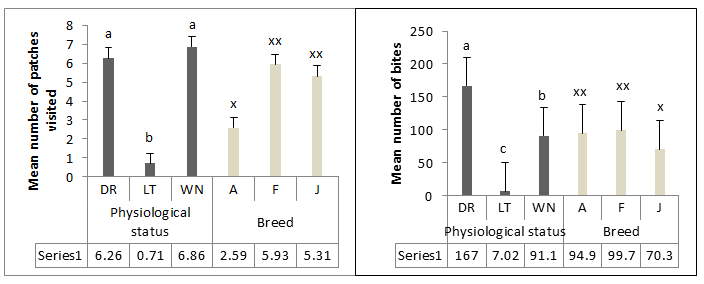
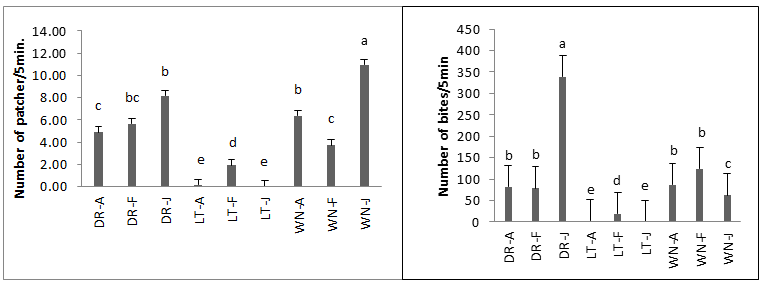
Surprisingly, Jersey were noted to be relatively slower grazers using less time grazing where most of their time in the field were used for rumination. High rumination rate probably was used to facilitate effective digestion and efficiency assimilation of available nutrients ingested. Slow grazers are said to be highly selective; select less fibrous diet, feed on readily available fast growing and nutritious plants and efficiency in digestion [11, 12]. On the other hand, high grazing rate as displayed by Friesian and Ayrshire (that spent substantial amount of time grazing in the field) is considered as grazing strategies that maximize intake rate during day time and spare resting time (most likely at night) for rumination. Rook explained that, less selective animals tend to maximize Regardless of breed effects, the main fixed effect of physiological condition of studied animals revealed that, lactating animals had spent significantly less time feeding (8% of total time grazing and browsing) in the field. They spent much of their time in the field ruminating (52% of their total time) or idling (32% of total time). This is attributed mainly with concentrated supplementation as lactating dairy cows were supplemented with high energy concentrate before released to the field and during milking time. Krysl and Hess postulated that, concentrate supplementation disrupt the normal grazing pattern of animal and thus can adversely affect forage intake in the field [15]. The current findings were in line with those of Bovoletas and others who noted significant reduction in grazing time and herbage intake as results of concentrate supplementation [14]. It was reported elsewhere that, when supplemental concentrates were increased from 2kg/day to 8kg/day, the grazing time decreased by approximately 1.5 hours/day [15]. The similar pattern has been noted in the current study, where lactating animals were supplanted about 4kg/day and their grazing time reduced to 8% of total time spent in the field. In addition, lactating animals visited relatively fewer numbers of patches and had significantly lower number of bites per five minutes which implies low herbage intake in the field since the daily herbage intake is considered as a functional of grazing time and biting rate. Although, Gibb and others couldn’t establish effects of different levels of concentrate supplementation on feed intake, but the authors cautioned that, supplementation may considerably reduce the benefits with regard to production efficiency in condition where high herbage intake might otherwise be achieved [16].
The current study also revealed interaction effects of breed and physiological condition of grazing animals. For example, it was observed that, Friesian when they are at weaning stage tends to spent significantly more time grazing compared to other interactive groups. High grazing time could be adaptation or strategy to maximum feed intake using few quality patches to satisfy their nutritional requirements. Friesians were noted to have low Feed Conversion Efficiency (FCE) and therefore increasing dry matter intake (DMI) could probably be one of the coping strategies for satisfying their nutritional requirements [17]. Similarly, Jersey breed at dry stage, were noted to have significant higher bite rates which most likely associated with their genomic regions and feeding experiences. Although, dairy cows during drying period tend to have relatively low nutritional requirements, but other factors such as inherent individual characteristics and spatial memory can increase the intake rates. Spatial memory as results of post-ingestive feedback mechanism and learning process are important factors determined forage intake in the field [18, 19].
Grazing distribution is a major concern in range management because un-even distribution of grazing animals may results into poor efficiency utilization of range resources. Evidence from field data suggests that, topography was one of the important factors affecting grazing distribution resulting into grazing heterogeneity between the two landscapes; upper-land and lowland. Significant higher accumulation of dungs and relatively large numbers of hooves and trials in the lowland present grazing preference and thus pressure over pasture in the lowland compared to upper-land. These findings concurred with the views of Adler and others who suggested that, cattle are strategically selective animals, choosing among large patches in the easy land compared to hilly land [20]. Decision on selection of grazing sites is controlled by previous knowledge on vegetation consumed and spatial memory of potential accessible sites [2]. Surprisingly, bite rates were significantly higher in the upper-land compared to lowland the fact that was not expected. Variation in vegetation types and season can probably explains the observed disparities, since in the upper-land the fresh browses species were predominant and thus were easy to identify the bites compared to lowland which was dominated by dried grasses during dry season that hindered identification of bites.
Conclusion
The study examined the interactive effect of dairy cattle breed and their physiological condition on grazing behaviour on natural pastures and the influence of topography on grazing distribution. Generally it was observed that the time spent for foraging was inversely proportion to the time spent for rumination; grazing being higher for Friesian and Ayrshire breeds and significantly lower for Jersey breed, the fact that was largely associated with individual specific inherent characteristics. Surprisingly, lactating animals with higher nutritional requirements spent significantly lower amount of time feeding with relatively low bite rates in the field compared dried and weaned animals. Low forage intake by lactating animals was associated with concentrate supplementation that was offered to this group before released to the pasture and during milking time. In the absence of information on cost of concentrate supplementation, it is not possible to state whether lactating animals should be supplemented in expense of forage intake reduction.
Studies are needed not only to determine the impacts of supplementation on production levels but also economic implication of supplementation. Moreover, interaction of breeds and physiological conditions of animals was highly significant and clearly displayed by higher feeding rate for Friesian when they are at weaning stage and Jersey at drying-off period. This implies that, there is a complex interrelationship between genomic characteristics and physiology of animals on nutritional requirements and feeding responses that need in-depth studies. Nevertheless, preferential choices of grazing animals in lowland area has ecological implication as animals may exerts more pressure on lowland pastures and thus cause severe degradation of range resources. Appropriated range management practices such as proper stocking rate, water point distribution and pasture improvement is recommended. Further studies on nutritional composition and seasonal variation in quality and availability of forage resources in the study area are recommended.
Acknowledgement
The author is highly acknowledging the management of the Livestock Training Agency in Mpwpwa for providing permission to accomplish this study in their Dairy Unit. This study would not be possible without contribution of BSc. Range Management third year’s students from Sokoine University of Agriculture, in the academic year 2017/2018 who played their decisive roles during data collection.
References
-
Yap KN, Kim OR, Harris KC, Williams TD (2017) Physiological effects of increased foraging effort in a small passerine. J Exp Biol 220(22): 4282-4291.
-
Bozinovic F, Rio CM (1996) Animals eat what they should not: why do they reject our foraging models? Revista Chilena de Historia Natural 69_:_ 15-20.
-
Mtengeti EJ, Phiri EC, Urio NA, Mhando DG, Mvena Z, et al. (2008) Forage availability and its quality in the dry season on smallholder dairy farms in Tanzania. Acta Agriculturae Scand Section A 58(4): 196-204.
-
Mruttu H, Ndomba C, Nandonde S, Nigussie BK (2016) Animal genetics strategy and vision for Tanzania. Nairobi, Kenya: Tanzania Ministry of Agriculture, Livestock and Fisheries and International Livestock Research Institute (ILRI), pp: 1-23.
-
Msalya G, Lutatenekwa D, Chenyambuga SW (2017) Possibilities of Utilizing Biotechnology to Improve Animal and Animal Feeds Productivity in Tanzania- Review of Past Efforts and Available Opportunities. Journal of Dairy, Veterinary & Animal Research 5(5): 161-167.
-
Chawala A, Banos G, Komwihangilo D, Peters A, Chagunda M (2017) Phenotypic and genetic parameters for selected production and reproduction traits of Mpwapwa cattle in low-input production systems. South African Journal of Animal Science 47(3): 307-319.
-
Martin P, Bateson P (2007) Measuring Behavior: An Introductory Guide. 3rd (Edn.), Cambridge University Press, New York, USA.
-
Montgomery DC (2001) Design and analysis of experiments. International Student Version, Wiley Inc., New York, USA.
-
SAS (2004) SAS/STAT_._ User's guide. SAS Institute Inc., Cary, NC, USA.
-
York RA (2017) The genetic landscape of animal behavior. BioRxiv, pp: 1-28.
-
Hambright KD, Hairston NG, Schaffner WR, Howarth RW (2007) Grazer control of nitrogen fixation: synergisms in the feeding ecology of two freshwater crustaceans. Fundamental and Applied Limnology 170(2): 89-101.
-
Korpinen S, Jormalainen V, Ikonen J (2008) Selective consumption and facilitation by mesograzers in adult and colonizing macroalgal assemblages. Marine Biology 154(5): 787-794.
-
Rook AJ, Dumont B, Isselstein J, Osoro K, WallisDeVries MF, et al. (2004) Matching type of livestock to desired biodiversity outcomes in pastures-a review. Biological Conservation 119(2): 137-150.
-
Bovolenta S, Sacca E, Corti M, Villa D (2005) Effect of supplement level on herbage intake and feeding behaviour of Italian Brown cows grazing on Alpine pasture. Italian Journal of Animal Science 4 (2): 197- 199.
-
Krysl LJ, Hess BW (1993) Influence of Supplementation on Behavior of Grazing Cattle. J Anim Sci 71(9): 2546-2555.
-
Gibb MJ, Huckle CA, Nuthall R (2002) Effects of level of concentrate supplementation on grazing behaviour and performance by lactating dairy cows grazing continuously stocked grass swards. Animal Science 74(2): 319-335.
-
Mackle TR, Parr CR, Stakelum GK, Bryant AM, MacMillan KL (1996) Feed conversion efficiency, daily pasture intake and milk production of primiparous Friesian and Jersey cows calved at two different live-weights. New Zealand Journal of Agricultural Research 39(3): 357-370.
-
Baumont R, Prache S, Meuret M, Morand-Fehr P (2000) How forage characteristics influence behaviour and intake in small ruminants: a review. Livestock Production Science 64(1):15-28.
-
Decruyenaere V, Buldgen A, Stilmant D (2009) Factors affecting intake by grazing ruminants and related quantification methods: a review. Biotechnolog Agron Soc Environ 13(4): 559-573.
-
Adler PB, Raff DA, Lauenroth WK (2001) The effect of grazing on the spatial heterogeneity of vegetation. Oecologia 128(4): 465-479.
- In Situ Evaluation of the Anthelmintic Effect of the Aqueous Extract of Syzygium aromaticum (L) Merr and Perry on Bovine Strongyles
- Successful in Vitro Embryo Production with Oocytes Aspirated from Live White-Tailed Deer (Odocoileus Virginianus Texanus) Donors under Captivity in Northeast Mexico
- Bangladeshi Finches with their Evolutionary Thoughts (Aves: Passeriformes)
- Note on the Survival Status of Przewalski’s Horse, Equus ferus przewalskii (Perissodactyla: Equidae)
- In-Situ and Ex-Situ Protection of White-Breasted Waterhen (Amaurornis Phoenicurus) (Pennant, 1769) (Aves: Rallidae)
- Meat Examination in the Laboratory, the Acceptability and the Human Health