
Empirical Study of Dragonfly, Neurobasis Chinesis as Ecological Indicator in the Freshwater Streams of Keeriparai Forest Eco System of Kanyakumari District, Tamil Nadu
This paper focuses on the dragonfly Neurobasis chinesis, which belongs to Odonate family, and their existence determines the health of an eco-system. The Nerobasis chinesis is also called as gossamer, due to the coloration of their wings. The study of Neurobasis chinesis dragonfly was initiated in the tail-end hill ranges of the Western Ghats, viz., Kanyakumari District (Keeriparai Forest Range). The altitude of the hills ranges from 100 m – 2695 m covered by evergreen forests. Major emphasis was given to observe the Neurobasis chinesis dragon fly, from various breeding habitats, viz., slow flowing streams, spring pool and rocky pool. The occurrence of Neurobasis chinesis dragon fly was observed against water quality and abundance of plants. We could only see a trend towards Neurobasis chinesis dragonfly occurring in fresh water streams at particular altitude in abundance. Neurobasis chinesis dragonfly species richness therefore appears to be positively associated with vascular plants they feed in fresh water habitat and also unpolluted water steams.
Introduction
The Keeriparai Forest Range lies at the southernmost tip of Western Ghats, between 8.3931° N, 77.4099° in Kanyakumari District, Tamil Nadu (Figure 1). The high degree of endemism in Keeriparai forest is due to a combination of factors such as, elevation, inaccessibility, high rainfall and micro climate [1]. This hill range covers an area of about 5432.72 Km and is a home for about 2000 species of flowering plants including about 150 strict endemic species [2].
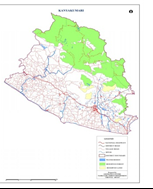
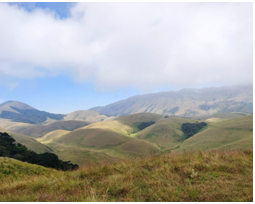
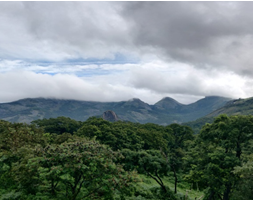
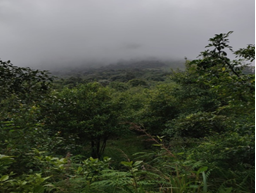
The geological formations are mostly of Archaean age represented by gneisses and granites. Rivers and stream beds consist of alluvial sandy soil. This forest receives 3000 mm rainfall spreading over a period of 7-8 months. Forest has varied range of habitats, from low elevation rubber and clove cultivations, dry teak forest to shrub and Deciduous forests to Tropical evergreen forests and high elevation grasslands called the Mountain Roof Top Forests (MRTFs) (Figure 2). Fresh waters streams, canals and pools are found along the course of the Keeriparai Forest Range. As rubber cultivation is predominant in this area, the monoculture exhausted the soil and needed a lot of pesticides and fertilizers. This would have caused soil and water pollution that gives negative consequences to the natural environment [3]. In this eco system, because of their size and interesting behavior, dragonflies and damselflies are considered to be the most charismatic of all aquatic insects (Figure 3).
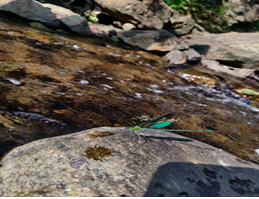
In the invertebrate world of Odonates, Neurobasis chinesis is always considered an ecological indicator to study the eco system. The male will have abdomen of size 45-50 mm, hind wings of 32-38 mm with eyes blackish brown above and bluish white below [4]. The legs are dark bronze with white outer stripe, rounded wings at tips with forewings transparent, tinted with pale yellowish green with emerald green venation. The hind wings are opaque, two thirds iridescent green or peacock blue. Apical half is blackish brown with violet reflections and green iridescent veins. Underside of hind wings will be uniformly blackish brown with dull golden reflections. The abdomen will be iridescent green above and on side and underside will be black. The 9th and 10th segments are whitish in the abdomen (Figure 4).
The female will have will have abdomen of length 44- 50mm, hind wings of length 36-40 mm. Eyes will be brownish above and yellowish below [4]. The thorax and legs are similar to that of males. The wings are transparent and amber colored. All wings have a round creamy white central opaque spot on the edge of the wing. Wing spot is absent in forewings and creamy white in hind wings. The abdomen is dull iridescent green above and black below. Green metallic stripe on sides in all segments Bordered with black (Figure 5).
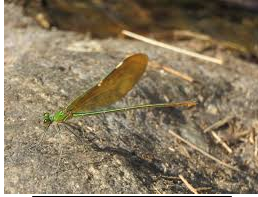
The habitat of Neurobasis chinesis is found between 500 - 1200 m altitudes. It perches on emergent boulders and fallen logs in streams. The bright green dorsal iridescence of the hind wings of Neurobasis chinesis males, very rare in Odonata, is known to play a significant role in their courtship behavior [5]. Female laid eggs on submerged decaying logs in streams during south west monsoon. The flight season is from May to November (Figure 6).
Materials and Methods
Study Area
The study was conducted in the Keeriparai Forest Range 29 km2, a part of Agasthiyamalai 8.23 Latitude and 77.50 Longitude located in the southern end of Western Ghats. Geologically, the rocks are granitoid gneiss and the terrain is undulating [6].
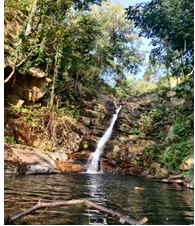
The mean annual ambient temperature in the evergreen forest is 22.5oC (range 15–30oC). The mean annual rainfall is about 3,000 mm from the southwest monsoon (May–August) and northeast monsoons (October–December) [7].The type of vegetation varies along the elevation gradient. The foothills harbor rubber plantations up to an altitude of 200 m. Dry teak, composed of stunted, thin-poled teak (Tectona grandis), and rubber plantations occurs between 200 and 850 m, wet evergreen forest from 920 to 1,500 m, beyond which high-altitude Mountain Roof Top Forests (MRTFs) occupy (Figure 7).
Data Collection
Species survey: The abundance of Neurobasis chinesis dragonfly species is directly proportional to the vascular plants they feed in fresh water habitat due to unpolluted water steams, emphasis the ecological indicator of the richness of the forest eco system. The observation of Neurobasis chinesis was carried out between 9:00 and 15:00 hrs. Which correspond to the period of greatest activity [8]. A span of 29 kms was surveyed from December 2021 to March 2022. In order to determine the abundance and species richness, the Neurobasis chinesis were observed along streams, canals and pools as transect walk around 29 sq.kms within the forest range at 100 to 800 meter altitude. Data analysis: To explore the abundance of Neurobasis chinesis, environment analysis of water quality and richness of plants along the fresh water systems were considered as main parameters. As unpolluted water is the main source for the growth of vascular plants on which Neurobasis chinesis feeds. Hence for water analysis, simple parameters of pH, COD and BOD were analyzed to determine the water quality. For vegetation, the types of plants found along the streams and also the moss and likens varieties on the rocks in streams were analyzed to find the abundance of Neurobasis chinesis. These parameters were considered to validate the hypothesis of Neurobasis chinesis as an Ecological Indicator to assess the richness of the eco system in Keeriparai Forest Range of Kanyakumari District.
Observations and Analysis
The water samples were tested for the pH value to assess the acidity/alkaline nature of the stream water at different altitudes. The details of the analysis are given below (Table 1).
It is clear from the table there is no change in the pH value, as there is no water pollution by any fertilizers used for enriching the soil for plantation of rubber crops. Also the water bodies are not used as a dumping ground for plastics or other household wastes.
| pH | |
|---|---|
| 100 | 7.1 |
| 300 | 7 |
| 500 | 7 |
| 700 | 7 |
| 900 | 7 |
Table 1: pH values of stream water at different altitudes.
The Biochemical Oxygen Demand (BOD) level of stream water is being tested and the details are given below (Table 2).
| BOD (mg/l) | |
|---|---|
| 100 | 0.8 |
| 300 | 0.7 |
| 500 | 0.7 |
| 700 | 0.7 |
| 900 | 0.7 |
Table 2: The Biochemical Oxygen Demand level of stream water.
From the table 2, it is clear that no domestic waste is being discharged in the river stream. Even though there are workers involved in estate plantations they are aware of protecting the eco system.
The Chemical Oxygen Demand (COD) level of stream water at different altitudes was analyzed and the details are given below (Table 3).
| COD (mg/l) | |
|---|---|
| 100 | 18.42 |
| 300 | 17.71 |
| 500 | 17.71 |
| 700 | 17.71 |
| 900 | 17.71 |
Table 3: The Chemical Oxygen Demand level of stream water.
Commercial crops like rubber and clove are cultivated in the forest range. As it is monoculture, there is a threat of fertilizers to be used that will pollute the water system. Also cleaning of rubber containers will also change the COD level of water. But from our analysis there is no pollution of water bodies.
The Western Ghats harbor about 320 species of ferns and fern allies with more species diversity in the southern part [9]. The major families of pteridophytes found in the Western Ghats are Aspleniaceae, Polypodiaceae, Thelypteridaceae, Selaginellaceae, Pteridaceae, etc. Whereas on the generic level, maximum diversity is observed in the genus Asplenium, Selaginella, Pteris, Athyrium, Diplazium, etc. In the Keeriparai Forest Range, the habitat of the pteridophytes consists of microclimatic conditions with special preference for moist and shady places. As ferns need moist environment, along the course of stream water, plenty of ferns are observed near the banks and also on rock crevices.
Due to frequent rainfall in this region (3000 mm on an average), there is water flow in the stream throughout the year which is the favorable condition for the survival of fern varieties. Hence the growth of ferns along the streams provide good source of food for Neurobasis chinesis throughout the year which is unique in this eco system.
Results and Discussion
From our study, it is clear that the occurrence Neurobasis chinesis in the altitude of 700 to 900 meters in the Keeriparai range is strong evidence that the fresh water stream is not polluted. Cash crops like rubber and clove are cultivated that need fertilizer’s to enrich the soil. Our analysis of water samples revealed that the stream water is not polluted. Our observations and discussions revealed that the farmers use natural biomass to make the soil fertile. The forest dwellers use the stream water for drinking purpose and hence they avoid washing clothes or discharging domestic wastes in the stream water. No chemical pollution is found in the stream as the farmers wash rubber sheets and latex containers away from the stream water. As Keeriparai Range comes under Protected Area, tourism is not allowed and there is no evidence of plastic wastes or debris near the stream. Hence our study reveals that the farmers and forest dwellers are aware of managing the eco system with their traditional knowledge, as Neurobasis chinesis is found in this forest range that serves as an Ecological Indicator for the richness of Western Ghats in Kanyakumari District.
References
-
Narasimham D, Erwin JS (2017) Database of Agasthiyamalai Biosphere Reserve, Report submitted to Department of Forest, Tamil Nadu.
-
Gopalan R, Henry AN (2000) Endemic Plants of India- Endemics of Agasthiyamalai Hills. Bishen Singh Ma- hendrapal Singh publications, Dehradun, India.
-
Panda BK, Sarkat S (2020) Environment Impact of Rubber Plantation: Ecological Vs. Economical Perspective. Asian Jr of Microbiol Biotech Env Sc 22(4): 657-661.
-
Vukusic P, Wootton RJ, Sambles JR (2004) Remarkable iridescence in the hindwings of the damselfly Neurobasis chinensis. Proc R Soc 271(1539): 595-601.
-
Gunther A, Hilfert Reuppel D (2014) Reproductive Behavior and the system of signaling in Neurobasis Chinesis (Odonata Calopterygidae-a kinematic analysis. International Journal of Odonatology 17(1): 31-52.
-
Giriraj A, Murthy MSR, Ramesh BR (2009) A method for assessing evergreen habitats using phytodiversity and geospatial techniques in tropical rain forests of Southern Western Ghats (India). Ecological Research 24(4): 749- 760.
-
Pascal JP (1988) Wet Evergreen Forest of the Western Ghats of India: Ecology, Structure, floristic composition and succession. Institut Francais De Pondicherry pp: 345.
-
Corbet PS (1999) Dragonflies: Behaviour and Ecology of Odonata. International Journal of Freshwater Entomology 23(1): 83.
-
Sumesh D, Subash Chandran MD, Ramachandra TV (2009) Pteridophytes of Western Ghats, Biodiversity Documentation and Taxonomy. Narendra Publishing House, India.
- In Situ Evaluation of the Anthelmintic Effect of the Aqueous Extract of Syzygium aromaticum (L) Merr and Perry on Bovine Strongyles
- Successful in Vitro Embryo Production with Oocytes Aspirated from Live White-Tailed Deer (Odocoileus Virginianus Texanus) Donors under Captivity in Northeast Mexico
- Bangladeshi Finches with their Evolutionary Thoughts (Aves: Passeriformes)
- Note on the Survival Status of Przewalski’s Horse, Equus ferus przewalskii (Perissodactyla: Equidae)
- In-Situ and Ex-Situ Protection of White-Breasted Waterhen (Amaurornis Phoenicurus) (Pennant, 1769) (Aves: Rallidae)
- Meat Examination in the Laboratory, the Acceptability and the Human Health