
Antiviral Agents and Biological Preparations for Agriculture Based on Artificial Glycan-Glycolipid Complexes
On the way of development of antiviral agents for agriculture, artificial glycan-glycolipid complexes (GGC) were created from glucan, which was the component of mycelium of basidiomicotafungi Ganoderma adspersum (Schulzer) Donk. Other constituents are extracellular glucouronoxylomannan of basidiomicota fungi Tre-mella mesenteric Ritz. Fr., mannan from Candida maltosa cells. Ramnolipid of Pseudomonas sp. PS-17 is used as a compound agent, аnd GGC fractions (liposomes and supernatant) have an inhibit in gactivity against virus of tabacum mosaic (VТM) of datura (Datura stramonium (L.) and tabacum (Nicotiana tabacum L.) plants up-sensitive to this virus. Under by the treatment of soybean (Glycine max (L.) Merr.) Seeds bio formulations, the plant resistance to mosaic virus infections (diseases) and the reflection of leaf light spectra, which characterized of chlorophill sunder field conditions, are increased. Using the electron microscope method of investigation, the structures of microcenoses as well as liposoms were found out in the near-root plant zone, which indicates on the lack of impact to the processes of plant-rhyzospheric microorganism’s interactions. The investigation has shown that pre-sowing bacterization by Brady rhizobium japonicum UCM B-6018 in combination with GGC-3 preparation promotes the crop increase in field experiments.
Introduction
Plant viruses are quite common and are extremely harmful. Therefore, the need to prevent viral diseases is quite obvious and economically justified. It is especially important to solve this problem given the intensification of modern agriculture, the predominance of monoculture and the use of high doses of mineral fertilizers and pesticides in crop production. The development of plant protection products against pathogens often encounters the problem of overcoming the side effects of drugs, one of the most important of which is their phytotoxicity. This problem, in our opinion, can be solved by using complex drugs based on substances of biological origin, as well as live cultures of symbiotic microorganisms that can positively affect the metabolic processes of plants. In this sense, the tuber bacteria of the family Rhizobiaceae are interesting, which help to increase the productivity of legumes.
Bacteria and higher fungi are known to produce a number of biologically active substances, among which researchers are of particular interest to glycans and glycolipids that have antiviral, antimicrobial and antitumor properties. We have recently found an increase in the biological activity of these substances in the case of their combined use on plants, which may be due to different mechanisms of action of the ingredients of the studied complexes on pathogens and host plants [1].
On the other hand, it is known that rhizobias, in particular Bradyrhizobium japonicum, are able to induce the formation of bubbles in the partner, in which the process of fixing atmospheric nitrogen, and, consequently, improve the nitrogen nutrition of legumes. On the basis of B. japonicum UСM B-6018 created an inoculant that has a positive effect not only on yield but also on the structure and metabolic activity of the rhizosphere microbiocenosis of soybeans [2, 3]. In this regard, it was important to determine the effect of our glycan- glycolipid complexes (GGC), the components of which, in our opinion, may play an important role in the adhesion and metabolic activity of symbiotic bacteria, the formation of soy- rhizobial symbiosis and soybean productivity. In connection with the above, we aimed to study the effect of the developed glycan-glycolipid complexes (GGC) on the development and susceptibility of soybean plants to viral infection, as well as the effectiveness of legume-rhizobial systems.
Objective
soybean nodule bacteria Bradyrhizobium japonicum UKM B-6018, soybean plants (Glycine max (L.) Merr.) Variety Angelica, tobacco mosaic virus (TMV), strain U1, cultured in the cells of the hypersensitive mutant tobacco (Nicotiana tabacum L.) of the Immune 580 variety, Datura stramonium L. hypersensitive to TMV and Immune 580 tobacco. Artificial HGCs were investigated, including: glucan from the mycelium of the basidiomycete fungus Ganoderma adspersum (Schulzer) Donk, extracellular glucuronoxylomanan (GCM) of the basidiomycete fungus Tremella mesenterica Ritz. Fr., mannan from Candida maltosa cells, culture fluid Pseudomonas sp. PS- 17. Glycans and glycolipids were obtained according to the methods described earlier [4, 5]. Supramolecular structures of the liposome type from the listed substances were formed according to the method [6] with some modifications related to the selection of the ratios of interacting substances and the conditions of their composition. Concentrations of ingredients were selected on the basis of preliminary testing of their activity against TMV and safety against tobacco and soybean seedlings [1, 4].
The following GGCs were investigated (in parentheses indicate the concentration of the ingredient, g / l):
GGC-1: GCM T.mesenterica (2) + rhamnolipid Pseudomonas sp. (0.1); GGC-2: mannan C. maltosa (0.5) + rhamnolipid Pseudomonas sp. (0.1); GGC-3: glycan G. adspersum (0.5) + rhamnolipid Pseudomonas sp. (0.1); GGC-4: GCM (0.7) + mannan (0.17) + glycan (0.17) + rhamnolipid Pseudomonas sp. (0.1).
Evaluation of Antiviral Activity of GGC
Determination of antiviral activity of GGC (in vitro and in vivo) was performed on plants of datura (Datura stramonium (L.)) and tobacco (Nicotiana tabacum (L.)). To pre-evaluate the antiviral activity of the obtained GGC and individual fractions in vitro, their aqueous solutions in various concentrations (0.01-1 mg / ml) were added to the suspension of TMV (10 μg / ml), incubated for 30 min and infected the left halves of D. stramonium leaves., the right halves were infected with the virus in the same concentration without GHA. Inductive properties of HGC in vivo were studied on tobacco plants of the Immune 580 variety according to the methods described earlier [4].
Vegetation and Field Research with Soybeans
Soybeans were grown in a greenhouse under natural light and temperature conditions; soil moisture was maintained at 60% of total moisture content. Field experiments were conducted in the research field of the Institute of Microbiology and Virology of the National Academy of Sciences of Ukraine. Morphological and functional parameters of plants were determined in the phase of three true leaves, virus infestation - in the phases of budding and blooming.
Soybean Seed Treatment
GGCs and their fractions (liposomes and supernatant remaining after separation of the liposomal fraction of the drug by centrifugation at 10,000 g, 15-20 min) were used at the stage of pre-sowing treatment of soybean seeds of Angelica variety alone and in combination with soybean rhizobia seeds pre-treated with GGC. Soaking the seeds with aqueous solutions of GGC in the above concentrations and / or less than 10 times lasted 8-10 hours. For the preparation of the inoculant B. japonicum UСM B-6018 was grown on circular shakers (220 rpm) at 26-28 ° C for 96 h in a liquid; mannitol-yeast medium of this composition, g / l: mannitol - 10.0; of yeast extract-2.0; calcium gluconate-1.5; K2HPO4-,5; MgSO4·7H2O-0,2; NaCl-0,1; FeCl3·6H2O-0,01; Ph 7,2. A bacterial load of 108cells per seed was appliedin variants with pre-treatment and without treatment of GGC, in the control variant the seeds were treated with water. After treatment, the seeds were air dried and sown in the soil. Phenological
observations of plants, the development of symptoms of viral damage, as well as determined the presence and location of GGC, their elements and microorganisms in the soil.
Ecological and Physiological Research
For the study of microorganisms and HGC, 1–5 cm polyethylene terephthalate (PET) films were placed in the soil of the root zone, and they were placed along the main soybean root. The films were previously sterilized with ethanol. Exposure was performed for 10 days in order to obtain on PET films fouling by microbial association. After removal, the PET film was fixed in glutaraldehyde and osmium tetroxide vapor, polymerized in a mixture of epoxy resins, cut on a LKB microtome (Sweden) and analyzed using a JEOL JEM-1400 transmission electron microscope. We studied 10 fields of view in five sections of the biofilm at a distance of 1 mm from each other. The morphofunctional organization of the photosynthetic apparatus of soybeans was studied according to the method described earlier [3]. The results of counting necrosis caused by TMV on tobacco and datura leaves, the number of affected soybean plants and yield indicators of the latter were subjected to statistical processing according to well-known parametric criteria for the reliability of differences in experiments and control [4].
Results and Discussion
The GGC formed by us looked like opalescents, sometimes weakly colored aqueous emulsions, stable when stored at room and low (from +2°C) temperatures and when diluted with water (pH 6.0-6.5). In the light microscope, the obtained structures had the form of balls with a size of 0.1 to 2 μm. The degree of incorporation of glycans into the GGC varied within 20-25% of the total amount of polysaccharide, the bulk of which remained in aqueous solution (medium). Laboratory data have shown that both fractions of GGC are antivirally active (Figure 1a). Slightly lower values of inhibition of the infectivity of TMV by the liposome fraction (2) compared with the supernatant (1) are apparently due to the fact that the proportion of glycan «included» in liposomes compared to that remaining free in the environment is 4-5 times lower. However, the glycan in liposomes may be more active than free due to better delivery to targets. Therefore, in subsequent experiments to test the biological activity of GGC, we used total preparations containing bound glycan in liposomes and free glycan in the supernatant (GGC-3, GGC-4). GGC-3 and GGC-4 were tested by us as inducers of resistance of tobacco plants to TMV and proved to be effective protective agents (Figure 1b). Their antiviral activity against TMV was manifested for 7 days and provided 40-70% protection of plants from experimental infection.
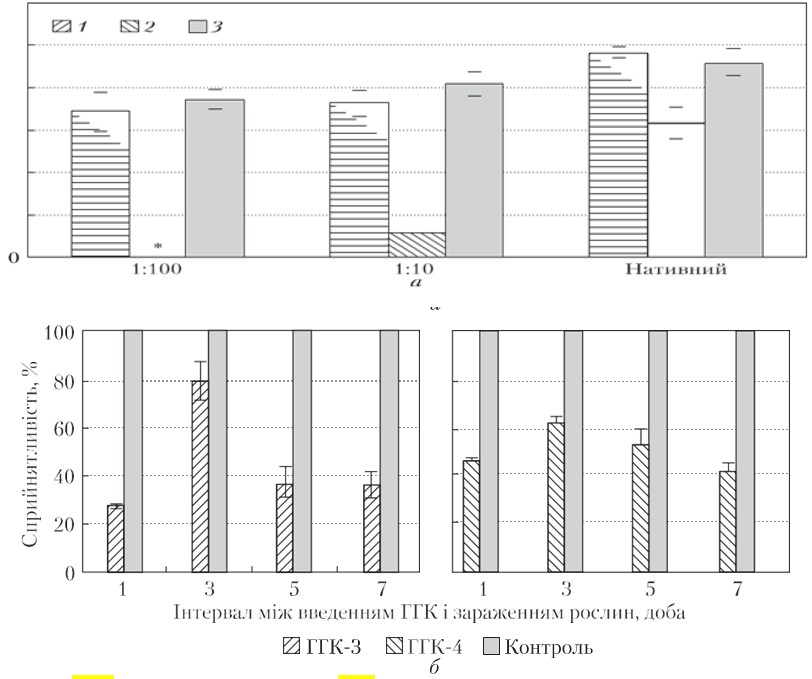
Figure 1a: Efficacy of GHC on TMV: Suppression of infectious TMV on datura plants by adding GGK-3 (3) and its fractions to the inoculum, % of control (1 - supernatant; 2 - liposomes), * suppression of TMV did not happen.
Figure 1b: Efficacy of GHC on TMV: Resistance to TMV infection induced by GGK-3 and GGK-4 in immune 580 tobacco plants hypersensitive to this virus, GGK concentration - 1 g / l.
As mentioned above, the tested GGCs contained glycans in liposomes and free glycans in the supernatant that were not part of the liposomes. It was found that both components of GGC-3 had a positive effect on the growth and productivity of soybeans, with a more significant effect on plant growth was exerted by the liposomal fraction, and the increase in yield-the supernatant (Table 1).
| Indicator | Control | GGC-3 | Faction GGC-3 | |
|---|---|---|---|---|
| Liposomes | Supernatant | |||
| Plant height (budding stage) cm% | 32,9+0,3 100 | 42,8+0,2 119,2** | 53,7+0,3 163,2*** | 46,80,4 142,2** |
| Weight of beans g/ plants. % | 4,6+0,2 100 | 4,8+0,3 104,4 | 5,0+1,0 119,0* | 6,1+0,5 145,2** |
Table 1: The effect of GGC-3 and its fractions on the growth and yield of Angelica soybean plants under pre-showing seed treatmen
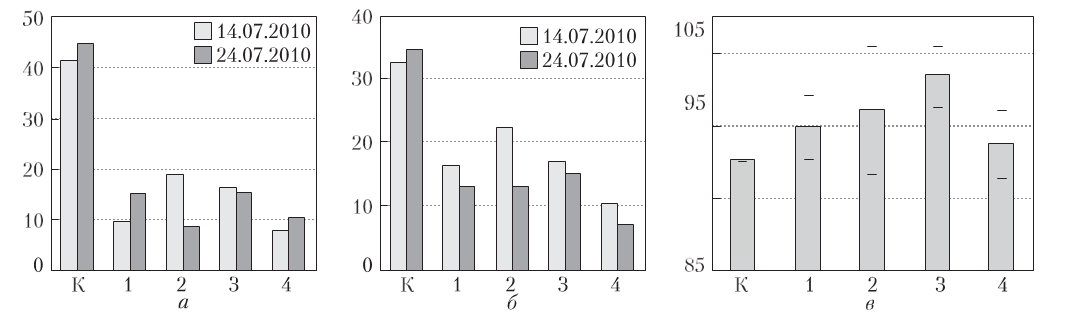
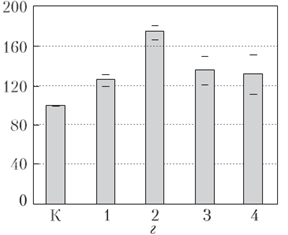
Pre-sowing treatment of seeds helped to increase the resistance of soybeans to viral infection in the field (Figure 2a, 2b). Moreover, in the variants with GGC treatment, a higher yield was obtained: the weight of beans in the experimental variants was 5–12%, and the seeds were 20–70% higher than in the control (Figure 2c, 2d). In field experiments, we found a positive effect of the combined use of GGC-3 and inoculant on the formation of the photosynthetic apparatus of soybeans. The combined use of GGC-3 with a microbial preparation significantly affected the morphological and physiological characteristics of the leaf blade of the fourth soybean leaf (Table 2).
| Leaf Area, mm² | The Thickness of the Mesophile, μm | The Thickness of the Palisade Layer, μm | Coefficient of palisade | |
|---|---|---|---|---|
| Control (water) | 13546+116 | 123,83+6,24 | 105,54+5,21 | 0,15 |
| Supernatant | 13549+117 | 130,17+7,25 | 104,73+5,28 | 0,20 |
| Liposomes | 13417+116 | 131,19+8,26 | 109,26+7.23 | 0,17 |
| Rizobin | 21828+148 | 142,35+5,69 | 101,09+7,88 | 0,29 |
| Rizobin + liposomes | 22625+144 | 187,54+6,23 | 101,80+5,86 | 0,45 |
Table 2: Changes in the mesophyll of the leaf of soybean variety angelica under the actin of fractions GGC-3 and inoculant. Note:
The largest area of the leaf blade, as well as the thickness of the mesophile layer was found in the variant of seed treatment with rhizobia and liposomal fraction GGC-3. The main photosynthetic function of leaf mesophyll is performed by cellspalisade mesophile, and the degree of its differentiation characterizes the coefficient of palisade, which is calculated by the ratio of the difference between the thickness of the mesophile and the palisade layer to the thickness of the mesophile. According to our data, the thickness of the palisade layer did not differ significantly in all experimental variants, and the value of the palisade coefficient was greater than the control. The highest coefficient was found in the variant of the combined action of the inoculant and the liposomal fraction of GGC-3 (Table 2).
It is known that the periods of maximum differentiation of the characteristics of light reflection spectra by plant leaves depend on the phases of vegetation, which are decisive for the formation of plant productivity [7, 8].
This figure was higher in the experimental variants than in the control. The increase of light reflection maxima at the indicated wavelengths was recorded in the spectrograms of plant leaves in the case of seed bacterization and, especially, in the variant of combined seed treatment with liposomal fraction GGС-3 and Rizobin.
According to the results of the analysis of panoramic images of the soybean rhizosphere using the method of fouling biofilms and electron microscopy, small soil particles were identified 2–5 μm in size in the form of globular aggregates permeated with pores and capillaries (Figure 3). Microorganisms were located singly or in small colonies (20- 100 cells each). The density of microcolonies was highest in the variant with inoculation (Figure 3a). In the variant with pre-treatment of seeds with liposomal fraction GGK- 3 (Figure 3b) in the rhizosphere soil observed individual spherical structures such as liposomes (17%) and their complexes with bacteria (10%) or microcolonies (21%), and also-autonomously in the capillaries (52%).
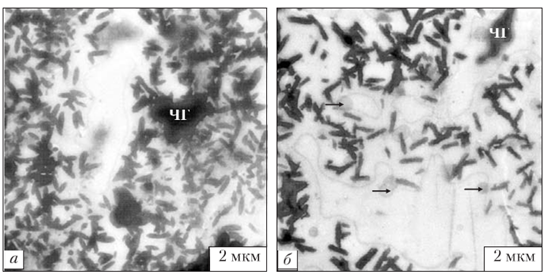
Figure 3: Panoramic image of the microbiocenosis of the soybean rhizosphere under the conditions of inoculation of Brady rhizobium Japonicum UKM B-6018: a- without treatment (control); b- with pre-treatment of seeds with liposomal fraction GGC-3. Electron transmission microscopy (JEOL JEM-1400); SP (CHG) - soil particles, arrows indicate liposomes.
Thus, the combined use of GGC-3 with a microbial preparation significantly affected the morphophysiological characteristics of the soybean leaf blade. The largest leaf area, as well as the thickness of the mesophile layer was found in the case of seed treatment with inoculant and liposomal fraction GGC-3. Combining biological products containing soybean microsymbiont bacteria with artificial soybeans helps to increase the resistance of soybean plants to phytopathogenic viruses and increase the effectiveness of soybean-rhizobial symbiosis. In this way, in our opinion, the latest effective means of plant protection against viral diseases can be created as an important component in the overall system of increasing the productivity of legumes.
References
-
Kovalenko OG, Kirichenko AM, Shepelevich VV, Karpenko OV, Vildanova-Martchyshin RI, et al. (2008) Visnyk KNU Ser Biol 51: 35-77.
-
Tytova LV, Brovko IS, Kizilova AK, Kravchenko IK, Iutynska GA (2013) Effect of Complex Microbial Inoculants on the Number and Diversity of Rhizospheric Microorganisms and the Yield of Soybean. Int J Microbiol Res 4(3): 267-
-
Adamchuk-Chala NI,Tytova LV, Iutynska GO (2014) Microbiology and biotechnology 3: 40-48.
-
Kovalenko OG, Polishchuk ON, Wasser SP (2009) Virus Resistance Induced by Glucuronoxylomannan Isolated from Submerged Cultivated Yeast-like Cell Biomass of Medicinal Yellow Brain Mushroom Tremella mesenterica Ritz.: Fr. (Heterobasidiomycetes) in Hypersensitive Host PlantsInt. J Med Mushrooms 11(2): 199-205.
-
Karpenko OV, Pokin’broda TY, Makitra RG, Palchikova OY (2015) Zh Obshchey Khimii 12: 2011-2015 (in Russian).
-
Ishigami Y, Gama Y, Nagahora H, Hongu T, Yama-guchi M (1990) Rhamnolipid liposomes patent.
-
Bratchenko IA, Vorob’eva EV, Zaharov VP, Tymchenko PE, Kotova SP, et al. (2007) Digest of Samara’s scientific centre of Russian academy of Science 9(3): 620-625(in Russian).
-
Shadchina ТМ (2001) Scientific bases of remotemonitoring of grain crops state, Kiev, Phytosociocentre (in Ukraine).
- In Situ Evaluation of the Anthelmintic Effect of the Aqueous Extract of Syzygium aromaticum (L) Merr and Perry on Bovine Strongyles
- Successful in Vitro Embryo Production with Oocytes Aspirated from Live White-Tailed Deer (Odocoileus Virginianus Texanus) Donors under Captivity in Northeast Mexico
- Bangladeshi Finches with their Evolutionary Thoughts (Aves: Passeriformes)
- Note on the Survival Status of Przewalski’s Horse, Equus ferus przewalskii (Perissodactyla: Equidae)
- In-Situ and Ex-Situ Protection of White-Breasted Waterhen (Amaurornis Phoenicurus) (Pennant, 1769) (Aves: Rallidae)
- Meat Examination in the Laboratory, the Acceptability and the Human Health