
The Workers of the Ant Myrmica sabuleti can Learn and Use a Sequence of Four Odors to Navigate between Nest and Food Site
The ant Myrmica sabuleti uses essentially odors for navigating. It has also several skills which presume that it could learn, memorize a sequence of odors and afterwards use it for navigating. By training (operative conditioning) then testing forager workers, we demonstrate that these ants are able to soon learn and memorize a sequence of four odors, i.e., thyme, lavender, basilica, and orange zest, linearly set during training between the nest entrance and the food site, and a simple additional experiment showed that the trained ants effectively used the learned sequence of odors for moving between the nest and the food. Moreover, as workers of this ant can associate odors with the time of the day during which they perceive them, they should be able to use a memorized sequence of odors at appropriate time periods in order to optimize a safe navigation. As this ant is known to use visual cues, odometry, area marking, and deposition of the trail pheromone to navigate, it is also liable to combine these strategies with that of following odor sequences.
Introduction
Workers of the ant Myrmica sabuleti Meinert, 1861 use essentially odors for foraging. They use visual cues only in the absence of odors [1]. Although their eyes are of small size [2], and provide a subtended angle of 5° 12’ [3], they can distinguish different numbers, shapes and orientations of cues [4], as well as colors [5], even under low light intensity [6]. This ant species lives chiefly in areas containing odorous plants, in contrast to other Myrmica species [7]. The workers of M. sabuleti can soon acquire olfactory conditioning, though rapidly losing it after the removal of the cues [8].
The workers of the ant M. sabuleti detains many skills, among others numerical ones, and a few of them concern odors. For example, they can add and subtract odors [9], and can associate odors with the time period of the day during which they were perceived [10]. They can also guess the following element of an increasing or a decreasing arithmetic or geometric sequence, being thus able to perceive and memorize a sequence [11, 12]. They can later on apply what they have acquired through operant conditioning [13].
On the basis of the biology and the cognitive abilities of M. sabuleti, we wondered if workers of this species could learn and remind a sequence of odors, and use this memorized sequence for navigating. The present work aimed thus to examine if they detain the ability to memorize an odorous sequence and thereafter if they use this skill for finding their way while foraging. Hereunder we first summarize some useful information about navigation in ants.
Ants forage by using their trail and area marking pheromones, as well as visual cues, visual landmarks, path integration, odometry, and environmental odors [14, 15, 16, 17, 18]. The use of memorized visual cues for foraging could be explained thanks to two ‘models’, the snapshot and the sketchmap systems described by Chameron [19] and summarized in Passera and Aron [20]. Ants can also use visual cues located in the canopy [21], celestial cues [22, 23], and polarized light [24]. The ability to learn, memorize and use sequences of visual cues has been demonstrated in Gigantiops destructor [25]. Path integration is also one of the ants’ foraging strategies [26, 27], generally helped by an exploratory search in the nearby area [28]. Odometry can also be used together with other foraging systems [29, 30]. The use of odors as complementary cues has also, but not frequently, been observed [31, 32]. The ants’ use of odors for navigating is thus not frequent, but the use of sequences of visual cues has already been observed. It was thus of interest to examine if an ant such as M. sabuleti, which relies essentially on odors for finding its way, can learn, memorize and use a sequence of odors. The aim of the present study was thus to investigate the potential ability of the workers of the ant M. sabuleti to forage by using a memorized sequence of four olfactory cues.
Materials and Methods
Collection and Maintenance of Ants
The experiments were made on two colonies of Myrmica sabuleti Meinert, 1861 collected in September 2022 from an abandoned quarry located in the Aise valley (Ardenne, Belgium) at 49°48’40’’ N latitude and 5°15’22” E longitude. Each colony contained a queen, brood, and about 600 workers. In the laboratory, these colonies were maintained in artificial nests made of one glass tube half-filled with water, a cotton-plug separating the ants from the water. The tube nest of each colony was placed in a tray (34 cm x 23 cm x 4 cm) which inner sides have been covered with talc. The tray served as a foraging area. Food was placed in it, and the ants were also trained in it. Sugared water was permanently provided in a small glass tube plugged with cotton, and pieces of mealworms were delivered three times per week on a glass-slide. Food was located at about 12 cm away from the nest entrance during the ants’ training (Figures 1 & 2). Temperature was maintained at 20° ± 2° C. Humidity was about 80% and remained constant over the course of the experimentation. The lighting had a constant intensity of 330 lux while experimenting and caring of the ants; during the other time periods, it varied between 330 and 110 lux. Electromagnetism had an intensity of 2 µWm2. These conditions are suitable to M. sabuleti. The ants are here often named workers or foragers or nestmates as do researchers on social insects.
The Four Olfactory Cues
The four used odors were those of thyme, lavender, basilica, and orange zests. For each of them, small pieces of the plant, fruit, or peel were inserted in small glass tubes (diameter: 0.8 cm, length: 4.0 cm) plugged with a light cotton ball (Figures 1 & 2). Two identical series of four tubes, each tube of a series containing one of the four odors, were arranged in the same order and in parallel on each side of the pathway connecting the nest entrance to the food (Figures 1 & 2, Upper parts). The same number of new tubes, never used before, containing in the same order or not these odors, was used to test the ants (Figures 1 & 2, Lower parts). The experimental work lasting six days, only the orange zests had to be renewed every two days.
Training
For each two colonies, two ordered sequences of ‘thyme, lavender, basilica, and orange zest’ odors were set between the nest entrance and the food site, one on the left and a second on the right of a virtual line connecting nest and food (Figures 1 & 2, Upper parts), the two sequences being approximately 5 cm apart. The ants so underwent operant conditioning, the rewards being the food and the nest entrance. The ants of each colony were in this manner conditioned during three consecutive days during which the ants moving in the area between the two provided sequences of four odors were punctually counted four times per day, i.e., twice during the day and twice during the night. For each colony, the mean of the four daily counts was established, and finally, the average of these 3 daily means was calculated (Table 1). This allowed checking if the ants had the opportunity to duly perceive the four provided odors. The ants’ training was thereafter continued while testing their learning and memorization of a sequence of four odors was conducted during three following days, as explained below. One week after this experiment, the ants were again trained in order to make an additional observation, i.e., to see if they adequately use the learned sequence of odors.
Testing the Learning and Memorization of a Sequence of Four Odors
This is schematized in (Figure 1, Lower part), and two photos of it can be seen in Figure 2, lower part. The
numerical results are given in Table 1, lower part. While training continued, the ants were tested on each of the three following days in a separate tray (30 cm x 15 cm x 4 cm), each colony being tested in its own tray. Inside of a tray, two sequences of four odors were deposited, one on the left, the other about 5 cm away on the right, one of the two sequences being the correct one (i.e., that in the order presented during training), the other sequence being a wrong one (i.e., with the odors being in another order). For colony A, the wrong sequence was ‘lavender, thyme, orange zest, basilica’ and was set along the left border of the tray; for colony B, the wrong sequence was ‘basilica, orange zest, thyme, lavender’ and was set along the right border of the tray. In each tray, a thin line was pencil drawn in order to delimitate the middle of the area lying between the two sequences of four odors, the ‘correct’ and the ‘wrong’ one. To conduct each of the three successive tests, for each colony, 25 ants were first transferred into a cup and then placed together in their test tray, at the head of the median line between the two odor sequences, i.e., at the start of these sequences, the ants perceiving them just as they should have done when they went out of their nest during training. Then the ants sighted in each of the two areas separated by the pencil-drawn line (one of the areas lying on the side of the ‘correct’ sequence, the other on the side of the ‘wrong’ sequence) were counted twenty times during ten minutes. For each of the three testing days and each colony, the total number of ants sighted on the side of the ‘correct’ sequence were compared to the total number sighted on the side of the ‘wrong’ sequence by using the binomial test [33] where the proportion of cases expected for each side is P = Q = 0.5. Moreover, the proportions of ants having visited the ‘correct’ and the ‘wrong’ sequence were established for each of the three tests and are reported in the text.
Examining the Ability of Ants to Navigate through the use of a Learned Odor Sequence
A week after the end of the previous experience, the ants were again trained in order to examine if they effectively can travel from the nest to a food site by following a sequence of odors that they had previously learned. The ants were thus again trained to two identical sequences of four odors, (i.e., arranged in the same order) and located as they were during the training process of the previous experience. Twenty four hours after such training, the odors and the food were removed and two new series of odors as well as two new food sites were used. The two series of odors were one with the odors in the ‘correct’ order and the other one with the odors in the ‘wrong’ order. They were laid so that, although both led to the nest entrance, they diverged at the opposite end, which led for each to its own food site. These two food sites, of identical composition, were located in the opposite left and right corners of the foraging area. This setting up constitutes the start of the testing. The ants moving along each of the two series of four ordered odors as well as eventually reaching so the food site and returning to the nest were counted 20 times over 10 minutes. The two series of counted numbers were compared as those obtained during the former experiment. Testing was not continued any longer because once reaching the food corresponding to the ‘correct’ odor sequence, some ants could, by following the edge of the tray, reach the opposite food site located at the end of the ‘wrong’ sequence and, returning to the nest along this ‘wrong’ sequence, they should ultimately learn it as a correct one. Results are given in the text, and photos are shown in Figure 3.
Figure 1: Experimental design used for examining if the workers of the ant M. sabuleti can learn and use a sequence of four odors for navigating. Upper part: the ants were trained in their foraging area to two identical (correct) sequences set between the nest and the food. Lower part: after three days, while training continued, they were tested, in a separate tray, in front of a correct and a wrong sequence, the correct one being on one side for colony A and on the other side for colony B. Photos can be seen in Figure 2; results are summarized in Table 1 and detailed in the text.
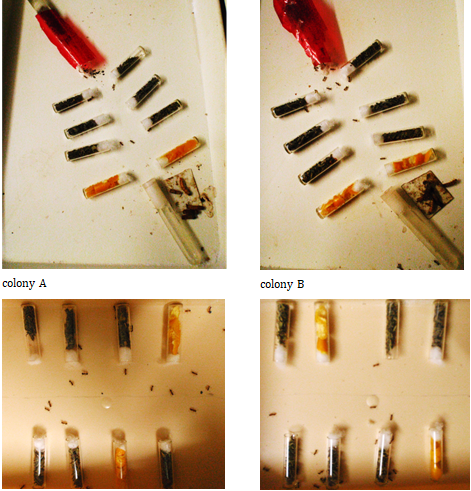
Figure 2: Experiments made on colonies A and B to know if ants can learn and use a sequence of four odors. Upper part: training to the ‘correct’ sequence set between the nest and the food. Lower part: testing in front of a correct and a wrong sequence (the correct sequence is visible in the top of the picture for colony A and in the bottom of the picture for colony B). The ants walked more on the side of the correct than on the side of the wrong sequence.
Results
Training
Meanly, 4.08 ants of colony A and 7.00 ants of colony B were seen walking along the two provided sequences of odors (Table 1). Since the learning process lasted three days, the ants had the opportunity to perceive and memorize the sequence through operant conditioning.
Testing the Learning and Memorization of a Sequence of Four Odors
The numerical results are given in Table 2. During the first test, the 25 tested ants of colony A made 183 visits to the correct sequence and 116 visits to the wrong sequence, while those of colony B made 243 and 30 visits to the correct and the wrong sequence respectively. This corresponded to a total of 74.48% (n = 426) of the visits for the correct sequence and 25.52% (146) of the visits for the wrong sequence. Note that the ants of colony B better responded than ants of colony A, what agreed with the fact that more of them had been seen along the sequence during training (Table 1). In the course of the second test, the numbers of ants’ visits were, for colony A, 331 correct ones and 102 wrong ones, and for colony B, 325 correct ones and 44 wrong ones. This leaded to a total of 81.80% (656) of the visits to the correct sequence of odors, and 18.20% (146) of the visits to the wrong sequence of odors. Note also that the numbers of correct responses increased from the first to the second test. When the third test was performed, the ants of colony A went 259 times along the correct sequence and 63 times along the wrong one, while the ants of colony B went 335 times along the correct sequence and 26 times along the wrong one. There were thus 86.97% (594) of correct responses and 13.03% (89) of wrong ones, a score still higher than the previous one. For each testing day and for each colony, a binomial test gives P < 0.0001. Consequently, the workers of the ant species M. sabuleti could learn and memorize a sequence of four different odors.
| Training | Mean number of ants sighted between the two sequences of odors | |
|---|---|---|
| Colony A | Colony B | |
| Day 1 | 4.25 | 6.75 |
| Day 2 | 4.75 | 6 |
| Day 3 | 3.25 | 8.25 |
| mean | 4.08 | 7 |
Table 1: Average number of ants seen during training along an ordered sequence of 4 odors (thyme, lavender, basilica, orange zest
| Testing | Number of ants sighted along the correct vs the wrong sequence of odors | |
|---|---|---|
| Colony A | Colony B | |
| Day 4 | 183 vs 116 | 243 vs 30 |
| Day 5 | 331 vs 102 | 325 vs 44 |
| Day6 | 259 vs 63 | 335 vs 26 |
Table 2: During testing in a separate tray, a correct and a wrong sequence were presented (Figures 1 and 2, lower parts). The ant
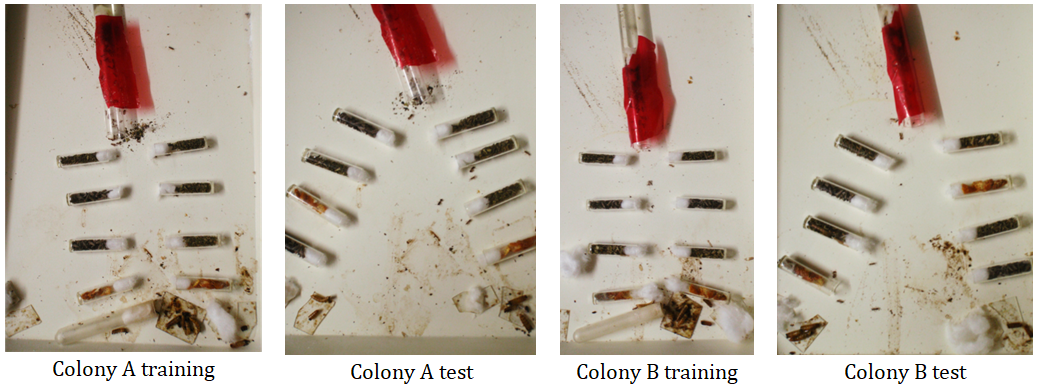
Figure 3: Views on the use of a learned odor sequence for navigating. Trained to recognize a given sequence of odors and then confronted with this ‘correct’ and an ‘incorrect’ sequence, each of these two sequences having been placed between the nest and a food source, the ants walked from the nest entrance to food, and vice-versa, along the ‘correct’ sequence and not the ‘wrong’ one. They thus used a learned sequence of odors to navigate.
Discussion
On the basis of what is known of the biology of Myrmica sabuleti and on the foraging abilities of other ant species, we checked if the former ant species can learn and memorize a sequence of four odors that could be used for navigating between nest and food. We found that, in less than three days, they could memorize such a sequence, their performance increasing over their training, reaching about 87% in six days. In addition, we showed that they effectively used the learned sequence of odors for navigating between their nest and food. Moreover, since they can associate odors with the time of the day during which they perceived them [10], they should be able to use a learned odor sequence for navigating in the wild during the time period when the environmental conditions are suitable and the exposure to predation is minimalized.
M. sabuleti workers can also use visual cues in the absence of odor [34], can use odometry [35], can expect the next localization of food [36], and detain an efficient recruitment system to food [37]. At the start of the studies on ants’ navigation it was not obvious that ants often use at the same time several navigation systems, what optimizes their foraging, e.g., their food collection and their coming back to the nest, transporting corpses to the cemeteries and relocating their nest. Nowadays, this simultaneous use of multiple navigational strategies has been observed, described and analyzed, for instance in desert ants which use in parallel several systems of navigation [38]. It has been explained in clear words by Freas and Schultheiss: ants integrate different navigational cues, and use them according to different strategies what allows them adapting their foraging tasks to the environment and the available cues [39]. The latter reference is a mini review, and the references therein perfectly summarize what is nowadays known about ants’ navigation.
Finally, the most common cumulative use is that of visual and olfactory cues, what has been obviously demonstrated in the desert ant Cataglyphis fortis. These ants use visual and olfactory cues to return to the nest and benefit from combining the use of these two kinds of cue [32]. What also often occurs is the use of odometry and another system, such as path integration improved by sum-compass, an observation once more made in the ant Cataglyphis fortis [40]. In addition, this species uses visual cues and route memories, the latter system not suppressing the former ones. All this allows the ants, with regard to their foraging activity, to make an efficient decision each time adapted to the colony’s food demand and to the environmental circumstances [40].
Conclusion
The present work showed that the workers of the ant Myrmica sabuleti can memorize a sequence of four odors and use it for navigating between nest and a food site. Since they can associate odors with the time period of the day during which they perceive them, they, moreover, should be able to use a memorized sequence of odors at appropriate time periods in order to optimize a safe navigation. M. sabuleti workers are also able to use simultaneously several foraging systems as they not only can use odorous cues, but also visual ones, area marking, trail pheromone laying, odometry, and maybe the memory of previous runs for efficiently navigating. Navigating using a sequence of odors is a method that enters the current way of thinking about the complexity of navigation in ants. Using at the same time several systems of navigation optimize foraging and adapts it to the needs of the colony and to environmental circumstances.
Conflict of Interest
We affirm having no conflict of interest.
Funding
This research did not receive any funding.
References
-
Cammaerts MC, Rachidi Z (2009) Olfactory conditioning and use of visual and odorous elements for movement in the ant _Myrmica sabuleti_ (Hymenoptera: Formicidae). Myrmecological news 12: 117-127.
-
Rachidi Z, Cammaerts MC, Debeir O (2008) Morphometric study of the eye of three species of _Myrmica_ (Formicidae). Belgian Journal of Entomology 10: 81-91.
-
Cammaerts MC (2004) Some characteristics of the visual perception of the ant _Myrmica sabuleti_. Physiological Entomology 29(5): 472-482.
-
Cammaerts MC (2008) Visual discrimination of cues differing as for their number of elements, their shape or their orientation, by the ant _Myrmica sabuleti_. Biologia 63: 1169-1180.
-
Cammaerts MC (2007) Colour vision in the ant _Myrmica_ _sabuleti_ Meinert, 1861 (Hymenoptera: Formicidae). Myrmecological News 10: 41-50.
-
Cammaerts MC, Cammaerts D (2009) Light thresholds for colour vision in the workers of the ant _Myrmica_ _sabuleti (_Hymenoptera: Formicidae)_._ Belgian Journal of Zoology 139(1): 40-49.
-
Cammaerts MC, Cammaerts D (2014) Comparative outlook over three _Myrmica_ species’ biotopes and foragers’ know-how. Biologia 69(8): 1051-1058.
-
Cammaerts MC, Rachidi Z, Cammaerts D (2011) Collective operant conditioning and circadian rhythms in the ant _Myrmica sabuleti_ (Hymenoptera, Formicidae). Bulletin of the Belgian Royal Society of Entomology 147: 142-154.
-
Cammaerts MC, Cammaerts R (2020) Ants’ capability of adding and subtracting odors. International Journal of Biology 12(1): 1-13.
-
Cammaerts MC, Cammaerts R (2022) Ants’ capability of associating odors with time periods of the day. Journal of Ethology 41: 79-89.
-
Cammaerts MC, Cammaerts R (2021) Ants can anticipate the following quantity in an arithmetic sequence. Behavioral Sciences 11(2).
-
Cammaerts MC, Cammaerts R (2021) Ants can expect the size of the next element of a geometric sequence of increasing or decreasing shapes, only if this sequence is present. International Journal of Biology 13(2): 37-48.
-
Cammaerts MC, Cammaerts R (2018) Can ants apply what they acquired through operant conditioning. International Journal of Biology 10(4): 16-22.
-
Fresneau D (1985) Individual foraging and path fidelity in a ponerine ant. Insectes Sociaux 32: 109-116.
-
Fourcassié V, Henriques A, Fontella C (1999) Route fidelity and spatial orientation in the ant _Dinoponera_ _gigantea_ (Hymenoptera, Formicidae) in a primary forest: a preliminary study. Sociobiology 34(3): 505-524.
-
Salo O, Rosengren R (2001) Memory of location and site recognition in the ant _Formica uralensis_ (Hymenoptera: Formicidae). Ethology 107(8): 737-752.
-
Harris RA, Ibarra NHD, Graham P, Collett TS (2005) Ant navigation: priming of visual route memories. Nature 438(7066): 302.
-
Harris RA, Graham P, Collett TS (2007) Visual cues for the retrieval of landmark memories in navigating wood ants. Current Biology 17(2): 93-102.
-
Chameron S (1999) Apprentissage et représentation des informations spatiales chez la fourni _Cataglyphis cursor_ (Hymenoptera, Formicidae). PhD thesis, Toulouse.
-
Passera L, Aron S (2005) Les Fourmis: Comportement, Organisation Sociale et Évolution. Les Presses Scientifiques du CNRC, Ottawa, Canada.
-
Salo O (1998) Canopy orientation in the ant _Formica_ _polyctena_ and retention of the memory image as a function of time and temperature. Proceedings of the 13th Int. IUSSI Congress, Adelaide, pp: 410.
-
Wehner R (1997) The ant’s celestial compass system: spectral and polarization channels. In: Leher M (Ed.), Orientation and Communication in Arthropods, Birkhaüser Verlag, Basel, Europe, pp: 145-185.
-
Schwarz S, Albert L, Wystrach A, Cheng K (2011) Ocelli contribute to the encoding of celestial compass information in the Australian desert ant _Melophorus_ _bagoti._ Journal of Experimental Biology 214: 901-906.
-
Schwarz S, Cheng K (2010) Visual discrimination, sequential learning and memory retrieval in the Australian desert ant _Melophorus bagoti._ Animal cognition 14: 861-870.
-
Wehner R (2003) Desert ant navigation: how miniature brains solve complex tasks. Journal of Comparative Physiology 189(8): 579-588.
-
Macquart D, Beugnon G (2007) Apprentissage d’une règle visiomotrice de déplacement chez la formicine néotropicale _Gigantiops destructor._ Colloque de la Section Française de l’IUSSI, Toulouse.
-
Narendra A (2007) Homing strategies of the Australian desert ant _Melophorus bagoti_ I. Proportional path- integration takes the ant half-way home. Journal of Experimental Biology 210: 1798-1803.
-
Narendra A (2007) Homing strategies of the Australian desert ant _Melophorus bagoti_ II. Interaction of the path integrator with visual cue information. Journal of Experimental Biology 210: 1804-1812.
-
Wittinger M, Wehner R, Wolf H (2006) The ant odometer: Stepping on stilts and stumps. _Science_ 312(5782): 1965- 1967.
-
Schultheiss P, Cheng K (2011) Finding the nest: inbound searching behaviour in the Australian desert ant, _Melophorus bagoti._ Animal Behaviour 81(5): 1031-1038.
-
Steck K, Hansson BS, Knaden M (2009) Smells like home: Desert ants, _Cataglyphis fortis_, use olfactory landmarks to pinpoint the nest. Frontiers in Zoology 6(5).
-
Steck K, Hansson BS, Knaden M (2011) Desert ants benefit from combining visual and olfactory landmarks. Journal of Experimental Biology 214: 1307-1312.
-
Siegel S, Castellan (1989) Nonparametric Statistics for the Behavioural Sciences. McGraw-Hill Book Company, Singapore, pp: 396.
-
Cammaerts MC, Lambert A (2009) Maze negotiation by a Myrmicine ant (Hymenoptera: Formicidae). Myrmecological News 12: 41-49.
-
Cammaerts MC (2005) How do workers of the ant _Myrmica sabuleti_ (Hymenoptera, Formicidae) estimate the distance they walk? Belgian Journal of Entomology 7: 87-98.
-
Cammaerts MC, Cammaerts R (2016) Spatial expectation of food location in an ant on basis of previous food locations (Hymenoptera, Formicidae). Journal of Ethology 35(1): 83-91.
-
Cammaerts MC, Cammaerts R (1980) Food recruitment strategies of the ants _Myrmica sabuleti_ and _Myrmica_ _ruginodis_. Behavioural Processes 5(3): 251-270.
-
Wehner R, Hoinville T, Cruser H, Cheng T (2016) Steering intermediate courses: desert ants combine information from various navigational routines. Journal of Comparative Physiology 202: 459-472.
-
Freas CA, Schultheiss P (2018) How to navigate in different environments and situations: lessons from ants. Frontiers in Psychology 9(841).
-
Collett M (2012) How navigational guidance systems are combined in a desert ant. Current Biology 22(10): 927- 932.
- In Situ Evaluation of the Anthelmintic Effect of the Aqueous Extract of Syzygium aromaticum (L) Merr and Perry on Bovine Strongyles
- Successful in Vitro Embryo Production with Oocytes Aspirated from Live White-Tailed Deer (Odocoileus Virginianus Texanus) Donors under Captivity in Northeast Mexico
- Bangladeshi Finches with their Evolutionary Thoughts (Aves: Passeriformes)
- Note on the Survival Status of Przewalski’s Horse, Equus ferus przewalskii (Perissodactyla: Equidae)
- In-Situ and Ex-Situ Protection of White-Breasted Waterhen (Amaurornis Phoenicurus) (Pennant, 1769) (Aves: Rallidae)
- Meat Examination in the Laboratory, the Acceptability and the Human Health