
Perception of Environmental Risks of Phytosanitary Products in the Market Gardening in Douvar Municipality of Mokolo (Far North Region of Cameroon)
Peri-urban market gardening plays an important role in the supply of fresh vegetables in the town of Mokolo (Far North, Cameroon) and its surroundings. This activity is concentrated around the dam supplying drinking water to the Mokolo city. To fight against pests and increase their yield, market gardeners’ resort to pesticides, with the risks they often ignore. The objective of this study is to assess the perception of risks and effects linked to the use of plant protection products on human health and the environment in particular. The study was made through a survey and was carried out among 88 market gardeners using survey sheets. The results obtained show that in the locality of Douvar, market gardening is more practiced by young people under 35 years old. They also use plant protection products which are dangerous for human health and the environment. Market gardeners use 13 different types of pesticides with a dominance of insecticides (60.92%). The survey also showed that 100% of farmers agree that the use of pesticides leads to good yields and also eradicated insects and disease. However, the decision to carry out phytosanitary treatments and the timing of treatment are often conditioned by the availability of the product and the presence of the attack. The majority of market gardeners (83%) are not educated and therefore do not have a good knowledge on the application rates and the frequencies of treatment of crops.
Introduction
Population growth and rapid urbanization pose challenges for food supply and employment. To face these challenges, the poor and rich populations of cities are turning to urban and peri-urban agriculture, in particular market gardening which increasingly contributes to the food supply of cities, especially for vegetables [1, 2]. Urban and peri-urban agriculture is one of the solutions proposed and recommended by the United Nations (UN) and the United Nations Food and Agriculture Fund (FAO) to have food security needs and challenges of urbanization and peri-urbanization, particularly in cities in so-called poor countries. This activity is a source of income and serves to supply the local market with perishable products. Market gardeners support thousands of people in African cities [3].
However, they have to deal with insect pests which destroy their productions. To fight against crop enemies, improve yields, achieve the required standards and economically viable production levels, market gardeners’ resort to the use of phytosanitary products according to Ahouangninou, et al. Donafologo [4, 5]. The use of pesticides by small African farmers has become systematic for a better yield of vegetable crops. The commercial issue may explain the fact that, market gardeners practice such intensive crop protection to control pests and increase the productivity of their farms. In West Africa, particularly in Benin, Senegal, Côte d’Ivoire, as well as in Burkina Faso [4, 6], studies have shown the importance of pesticides chemicals in the control of vegetable pests. But the use of these pesticides, despite their usefulness, in pest control, is not without consequences on the health of farmers and consumers, as well as on the environment [6]. The purpose of this work is to assess the perception of environmental risks in the market gardening area of Douvar.
Methodology
Presentation of the Study Area
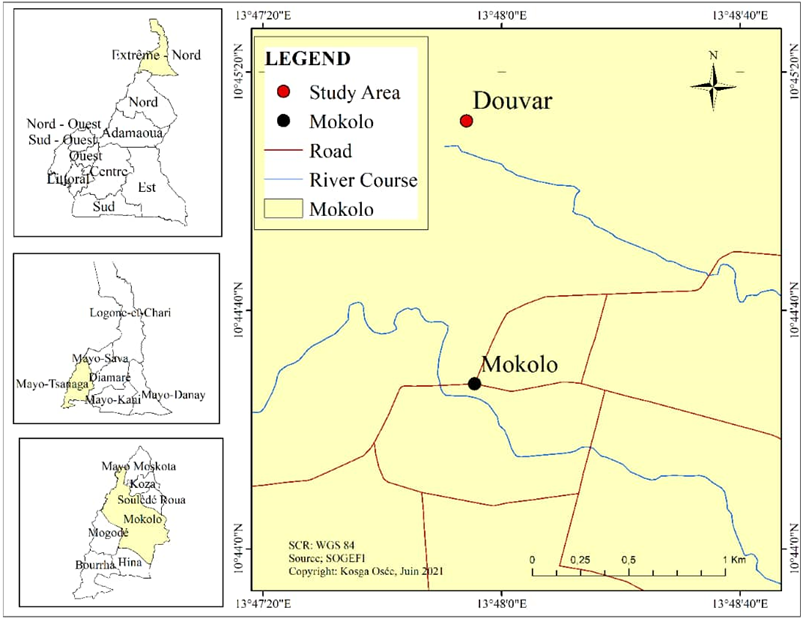
The present study was carried out in the municipality of Mokolo more precisely in the locality of Douvar (Figure 1). It is an agricultural area and the use of phytosanitary products in the area is more accentued, the used for market gardening is located near the watercourse supplying the dam with drinking water in the said city.
Investigation
A survey was carried out among 88 market gardeners aged between 15 and 65, owners or tenants, operating family or individual agricultural plot and chosen at random. The survey study took place between April and May 2021. Open and closed questionnaires relating to socio-demographic data, knowledge of agriculture and phytosanitary products, the conditions of application of pesticides and the perception of environmental risks a been filled with the respondents.
Data Analysis
The survey data was processed and analyzed with Sphinx Millenium 2013 software, which generated descriptive statistics.
Results and Discussion
The Socio-Demographic Characteristics of Market Gardeners
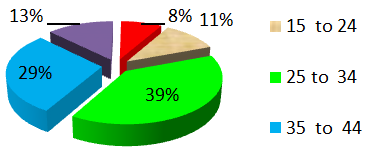
Age of market gardeners: The results of the surveys shows that, in the locality covered by the study, the age from 25 to 34 years old records the highest percentage means 39% of the total population surveyed. On the other hand, the least represented age is over 55 with only 8% market gardeners (Figure 2). This observation could be explained by the fact that, market gardening mobilizes a predominantly young population. This result corroborates that described by Diop [7].
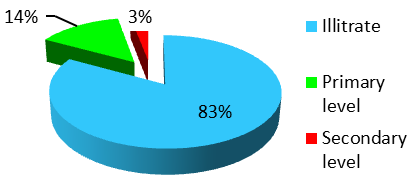
Level of education of market gardeners: The results of the surveys showed that the 83% of market gardeners had no education level, and the illiterates followed by 14% of market gardeners who only completed primary school. only 3% of market gardener went to secondary school (Figure 3). However, as a result of this investigation, none of the market gardeners surveyed had a higher education qualification. This observation was also made by Diakalia, et al. [8] among tomato producers in Burkina Faso.
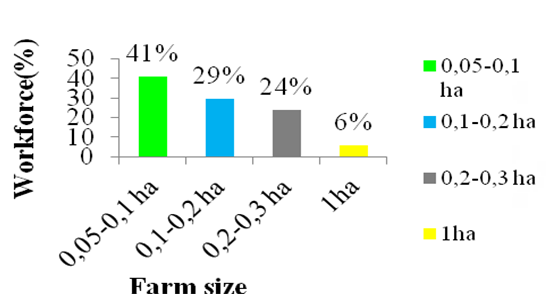
Cultivated area: According to the survey results, the majority of market gardeners (41%) cultivate an area between 0.05-1 ha, compared to 29% of respondents who are in the range 0.1-0.2 ha. On the other hand, 24% of respondents cultivate an area of between 0.2-0.3 ha and 6% operates an area of 1 ha (figure 4). Thus we can say that the market gardeners in our study area operate small areas. This is in accordance with the work of Ahouangninou [9] and Ouattara [10]. These authors had shown respectively that market gardeners in southern Benin and urban areas in Houét province (Burkina Faso) cultivated on small areas.
Speculations produced and pests encountered over the entire study site, the results of the surveys showed that 18 types of crops are cultivated by market gardeners, including black nightshade, sorrel (Folléré) and carrot were the most frequent crops during the dry season. The peppers, parsley, celery and basil, lettuce, tomatoes and eggplant were also produced. Finally, certain crops such as potatoes, cabbage, onions, chili peppers, green beans, cucumbers, leeks and okra are also produced. The strong cultivation of black nightshade and sorrel is explained by the high demand for these vegetables in the market. And we know high demand means high production which implies an increase in the use of phytosanitary products in an abusive manner. In fact, the massive use of pesticides can have serious repercussions (teratogenicity, neurotoxicity, reprotoxicity and carcinogenicity) on health. Farmers, consumers and the quality of the environment because the toxicity of these agricultural inputs has been demonstrated by several toxicological and eco-toxicological studies [11, 12]. Pest attacks are a limiting factor for production. Five (5) crop enemies have been reported by growers as pests of their crops: these are mainly caterpillars, mildews, aphids, termites, thrips, white flies, locusts and powdery mildew. Similar results were obtained by Ibrahimou in 2018 [13] at Meskine market gardeners.
Pest management practices: All the producers interviewed used pesticides, in particular insecticides and herbicides (Table 1). Among the range of products identified, five had insecticidal activity, five had herbicidal activity. The trade name Kannon insecticide is the most widely used by market gardeners. The insecticide formulations were either pyrethroid-based mixtures, generally associated with an organophosphorus compound, recommended in cotton cultivation but not in market gardening. These results are in agreement with those of Ahouangninou, et al. [4]. The use of insecticides could no doubt be explained by the fact that vegetable crops are constantly attacked by pest insects. Regarding the place of supply, the majority of producers (70%) bought pesticide formulations repackaged by retailers in small bottles (25 centilitres,), while 20% of farmers bought their pesticides packaged in the original vials from wholesalers. To prevent pest attacks, each of the producers carried out systematic treatments according to a schedule of their own. About 64% of growers made 3 insecticide treatments per week, but 33% of them made 1 to 2 applications per week. Less than 3% of producers only made 4 treatments per week.
| Trade Name | Active Ingredient | Number of Times Cited | Family | |
|---|---|---|---|---|
| Insecticides | Prime Force 1000 G/L EC | Dichlorvos 1000 g/l EC | 15 | Organophosphorus |
| Insecticides | More stronger 45SC | Thimethoxam+Lambda-cyhalothrine 30g/+15g/l | 8 | Pyréthrinoïdes |
| Insecticides | Rocket | Chlorpyrifos 20% EC | 5 | Organophosphorus |
| Insecticides | Kannon 90EC | Lambda-cyhalothrine+Imidacloprid 60g/l+ 30g/l | 24 | Pyréthrinoïdes |
| Insecticides | K-Optimal 45 EC | Acetamipride 20 g/l + | 8 | Néonicotinoïde+ |
| Herbicides | Roundup | Lambdacyhalothrine 25g/l) Glyphosate | 5 | Pyréthrinoïde Phosphanoglycine |
| Herbicides | Glyphader 750 SG | Glyphosate 750 g/kg | 6 | Phosphanoglycyn |
| Herbicides | Callitraz 90W | Atrazine 900 g/kg | 6 | Triazines |
| Herbicides | Dino 800wg | Diuron 800g/kg | 6 | Urées |
| Herbicides | Cot Ultra 757 WDG | Glyphosate 757 g/kg | 5 | Phosphanoglycyn |
Table 1: Pesticides used by market gardeners.
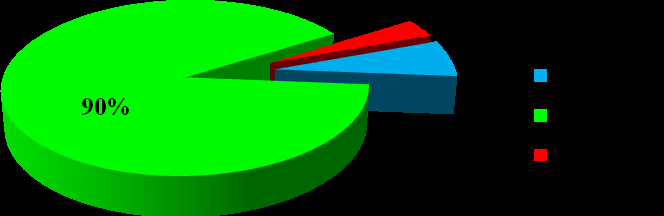
Pesticide application conditions: According to the survey results, 91% of growers used backpack sprayers for pesticide application, while 9% used hand-held sprayers. Similar results have been reported in Ghana by Ntow, et al. [14] with regard to the preparation of insecticidal porridge. Various instruments are used by market gardeners using the products. The majority of market gardeners, 90% measure the products using stoppers or caps, 7% use bottles of phytosanitary products and 3% measure with other containers such as glasses (small water glasses) (figure 5) This result was also obtained by Adjovi, et al. [15] in Benin where 91.40% of market gardeners use caps or lids as a measurement of phytosanitary products. It is clear that due to their lack of training on the application of plant protection products, producers do not apply the doses indicated by manufacturers on the packaging. It is also important to point out that during our investigation, we noticed that the doses to be used are according to the size of the fields and according to the producer, sometimes during a strong infestation of pests, all the contents of the bottle are poured. in the tank, this type of behavior shows the producers’ non-compliance with the dosage conditions. This situation can be a factor likely to pollute the soil, increasing the risk of the presence of treatment residues on fruits and vegetables in excess of the standard.
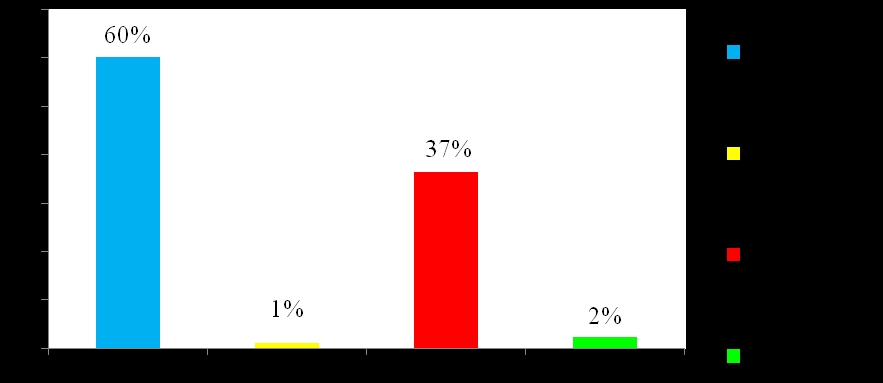
Management of pesticide residues after treatment: The majority of producers surveyed (60%) keep the remains of pesticides for a future application in their homes or in their fields. A minority spills into nature (2%) and (1%) buries in the ground. Some producers, or 37% of them, did not have any product left over after treatment because they believed they controlled the quantities to be used (Figure 6). This result corroborates that of Ngameni, et al., [16]. Analysis of the results showed that storing pesticides at home exposes market gardeners, and spillage or burial poses risks of environmental contamination. Pesticides can become obsolete if stocks are not used for a long time. In addition, prolonged storage of pesticides can cause leaks and contaminate soil and water in storage areas. Pesticides that are obsolete and stored in poor conditions can lead to unacceptable levels of residues in agricultural soils and crops.
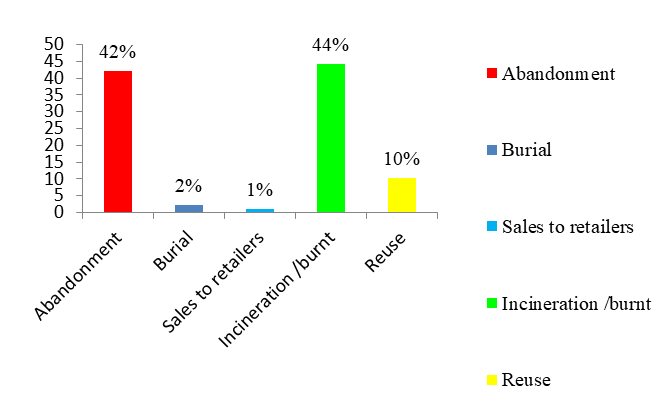
Management of empty pesticide packaging after use: We note from the results of the surveys that, the majority of empty packaging is 44% abandoned in the fields and (42%) incinerated. Other disposal methods vary between household use 11%, burial 2% and sale to retailers 1 %, (Figure 7). After analyzing this result, it is clear that, market gardeners practice poor management of this empty pesticide packaging since the FAO recommendations [17] stipulate that, they should be taken back by distributors for appropriate treatment. This mismanagement of the packaging of phytosanitary products is due to the fact that farmers are very little informed on the ecological risks incurred by the mismanagement of this packaging. In fact, most of the time, the empty bags of pesticides are thrown away and end up in a water point and contaminate the entire ecosystem, in particular the aquatic environment [18]. The abandonment of packaging in the fields or in the open air not only contaminates the water, but also degrades landscape aesthetics. In addition, the incineration of empty packaging, especially those made from chlorinated products, is responsible for the emanation of toxic smokes and persistent organic pollutants (POPs) such as dioxins which are harmful to human health and the environment. Burying empty pesticide packaging also contaminates water, especially groundwater. The proximity of the city’s drinking water supply dam (source of water supply for our market gardeners) to the fields can be the source of contamination by various routes of the water from the dam by phytosanitary products.
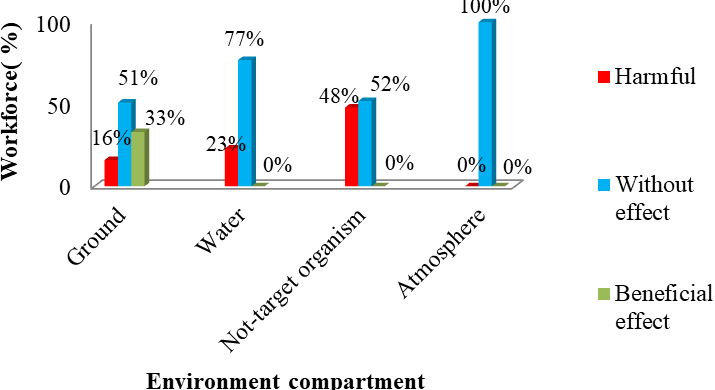
Perception of environmental risks by market gardeners: According to the results of the survey, various perceptions of the effect of pesticides on soil, water, atmosphere and non-target organisms emerge (Figure 8). The majority of producers 51% say that pesticides have no effect on the soil. On the other hand, 33% of respondents think that pesticides have beneficial effects on the soil and a small part of respondents 16% think that they induce harmful effects on the soil in the sense that these products degrade, weaken the land and thus lower its fertility. When herbicides are applied regularly in the plots, there is a weakening of the land which has as a corollary a decrease in soil fertility and yield and the appearance of hardy soils. Regarding the effects of plant protection products on water, 77% of producers say they do not perceive it. On the other hand, 23% of market gardeners say that pesticides are harmful to water. However, on the beneficial effects on water, no producer commented. In addition, all market gardeners claim not to perceive the effects of phytosanitary products on the atmosphere. When it comes to effects on non-target organisms, 52% of producers say chemical pesticides have no effect. On the other hand, 48% of market gardeners declare that pesticides could have harmful effects, in particular on organisms such as birds, earthworms and terrestrial animals. For them, pesticides are poisons which, while they can kill caterpillars, can kill other animals when exposed to high doses. After analyzing the results, it is clear that the majority of producers are very poorly informed about the risks associated with the use of pesticides and do not seem to perceive any harmful effects from phytosanitary treatments. Rather, they think more about the beneficial effects of chemical pesticides. This therefore raises questions about their actual knowledge of the effects of pesticides on the environment, on living animal organisms and on humans, despite the inscriptions on product packaging. Therefore, one would think of the low level of education in the locality surveyed, which justifies the ignorance of the risks by market gardeners. Similar results have been reported by Belhadi, et al. [19], who showed that greenhouse growers in three localities in Ziban-East Algeria. For these same authors, this ignorance is linked to the lack of education, more than half of greenhouse growers and to the low level of education 32.57%, and also to the total lack of training on pesticides.
Conclusion
At the end of this study, it was first of all a question of making an inventory of the phytosanitary products used by market gardeners, then knowing the use of these products and at the end evaluate the perception of the risks associated with the use these phytosanitary products on the environment. Our study shows that the market gardeners in the prospected area are mostly young, with average age of 36 years with a low level of education. The results of the survey also showed that, the high experience in the field of agriculture and the use of phytosanitary products is not always a factor of success in the good use of these products because despite a long experience of the majority of producers in the locality surveyed, they do not know the doses when preparing the solution for treatment and do not follow the instructions prescribed by the manufacturer. 33% pesticides have beneficial effects on the soil and 16% induce harmful effects on the soil. 77% of producers say they do not perceive the risk of phytosanitary products but on the other hand, 23% say that pesticides are harmful to water.52% of producers say chemical pesticides have no effect, but on the other hand, 48% declare that pesticides could have harmful effects, in particular on organisms such as birds. Poor management of empty packaging has also been observed, 44% were abandoned in the fields and 42% incinerated, other methods are also applicate to household use 11%, burial 2% and sale to retailers 1 %. With regard to perceptions of health and environmental risks in particular, the results of the survey show that the majority of market gardeners are very poorly informed of the risks associated with the use of plant protection products on environmental compartments.
Others go so far as to say that, these products are good for the soil and enhance their productivity; these seem to be primarily concerned with ensuring a harvest of quantity and not of quality. The impact of pesticides on their health during treatment, on the environment and on the consumer is less important. In other words, the socioeconomic aspect is more important than the environmental aspect.
References
-
Dongmo T, Gockowski J, Hernandez S, Awono LDK, Moudon (2005) Peri-urban agriculture in Yaoundé: its relationship with poverty reduction, economic development, conservation of biodiversity and the environment. Tropicultura 23(3): 130-135.
-
Delamarche M (2007) Urban agriculture, cities that are becoming rural, Tropical and Mediterranean markets. Strategies and investment in Africa 3212: 5-6.
-
Ba A (2007) The functions recognized for intra- and peri-urban agriculture (AIPU) in the Dakar context; characterization, analysis and sustainability diagnosis of this agriculture with a view to its integration into the urban project of Dakar (Senegal). Doctoral THESIS in Agricultural and Environmental Sciences, pp: 202.
-
Ahouangninou C (2011) Assessment of health and environmental risks of phytosanitary practices of market garden producers in the rural commune of Tori-Bossito (SudBenin). Cahiers Agriculteurs (8): 216-222.
-
Donafologo BS, Meit L, Traoré SK, Koné M, Dembélé A, et al. (2012) Experimentation with the treatment of phytosanitary effluents from the rinsing of tank bottoms and sprayers by abiotic degradation: Case of diazinon. Journal of the West African Society of Chemistry 033: 7-14.
-
Toé AM, Kinané M, Koné S, Boyarm E (2013) Non- compliance with good agricultural practices in the use of Endosulfan as an insecticide in cotton cultivation in Burkina Faso: some consequences for human health and the environment. African Journal of Animal Health and Production 2(3-4): 275-280.
-
Diop A (2013) Diagnosis of use practices and quantification of pesticides in the Niayes area of Dakar (Senegal). In Doctoral thesis Analytical chemistry, pp: 241.
-
Diakalia S, Somda I, Legreve A, Schiffers B (2017) Phytosanitary practices of tomato producers in Burkina Faso and risk for health and the environment. Cah Agric, pp: 26.
-
Ahouangninou CA (2013) Sustainability of market gardening production in southern Benin: a test of the eco-systemic approach. Doctoral thesis, option: Environment, Health and Sustainable Development. University of Abomey-Calavi. Benin, pp: 333.
-
Ouattara ZA (2016) Characterization of market gardening production systems and analysis of the determinants of soil fertility under market gardening in the Houét province (Burkina Faso). Engineering dissertation, option: agronomy. Institute of Rural Development, Polytechnic University of Bobo-Dioulasso, Burkina Faso, pp: 61.
-
Meeker JD, Barr DB, Hauser R (2008) Human semen quality and sperm DNA damage in relation to urinary metabolites of pyrethroid insecticides. Human Reproduction 23(8): 1932-1940.
-
Kpan GK, Tiho S, Ehouman MN, Touré M, Dembélé A (2017) Evaluation of the toxicity of a 2,4-D-based herbicide on earthworms. Moroccan Review of Agronomic and Veterinary Sciences 5(3): 304-312.
-
Ibrahimou (2017) Environmental risk assessment of phytosanitary products in the market gardening area of Meskine (Far North, Cameroon), pp: 32.
-
Ntow WJ, Gijzen HJ, Kelderman P, Drechsel P (2006) Farmer perceptions and pesticide use practices in vegetable production in Ghana. Pest Manage Sci 62: 356- 365.
-
Adjovi ISM, Adjovi CYS, Ayi-Fanou L, Ayandji P, Sanni A (2017) Pesticide use practices by market gardeners in Benin: sociological perspectives, pp: 33.
-
Ngameni T, Chamadeu N, Nkontcheu KDB, Djomo Nana E (2017) Assessment of environmental risk factors linked to the misuse of pesticides by market gardeners in Cameroon: the case of Balessing in West Cameroon, pp: 96.
-
FAO (1999) Guidelines for management of small quantities of unwanted and obsolete pesticides. FAO Disposal Series N7. Food and Agriculture Organization of the United Nations, Rome, pp: 41.
-
Thiamet MB, Sagna (2009) Pesticide monitoring at grassroots community level, Africa Regional Report, Dakar, Senegal. Pesticide Action Network Africa, pp: 57.
-
Belhadi A, Mehenni M, Reguieg L, Yakhlef H (2016) Phytosanitary practices of greenhouse market gardeners in three localities in eastern Ziban and their potential impact on human health and the environment. Revue Agriculture special issue: 09-16.
- Plant Diversity, Regeneration Dynamics, and Socio-Ecological Impacts at the Forest-Savanna Transition Zone, Cameroon
- Bird Community, Feeding Guilds and Habitat Associations Along the Proposed River Dibombe Hydropower and Transmission Line Project in Nkam and Moungo Divisions, Cameroon
- Plant Diversity and Carbon Storage Potential Across Different Land Use Types in Infrastructure Development Landscapes in Cameroon: Implications for no Net Loss of Biodiversity
- Optimization and Modelling for the Remediation of Brilliant Green Dye and Ni2+ ions from Water Using Advanced gC3N4/PVA@ Alginate Bio-Polymeric Hydrogel Beads
- The Negative Implications of Using Cell Phones on Human Health and Environment
- A Comprehensive Survey of Population Ecology in Insects