
History of Anatomy in the Reflection of Collecting Media
The article presents the materials of the study devoted to the reflection in the means of collecting, information about the contribution to the anatomical study of the human body, by famous scientists-anatomists, both antiquity and modernity, Such as Avicenna, Ibn al-Nafiz, Andrei Vesalius, William Garvey, Ambroise Paré, Giovanni Baptista Morgagni, Miguel Servet, Gabriel Fallopius, Bartolomeo Eustachio, Leonardo da Vinci, Jan Yesenius, John Hunter, Ales Hrdlichka of the past and a number of others, in the reflection of various means of philately and numismatics. All these scientists made a significant contribution to the development and formation of anatomy as a basic medical science, but were also the founders of a number of related medical disciplines, such as pathological anatomy, operative surgery and topographic anatomy, forensic medical examination. The tools, techniques and techniques developed by them for the autopsy of corpses and the preparation of various parts of the body of deceased people, all the practical experience they have gained, are still actively used in modern anatomy and medicine. It is not surprising that the memory of these great scientists, anatomists and doctors is reflected in a number of types of modern collecting, in particular such as philately and numismatics. The article is illustrated with images of postage stamps, envelopes, postal blocks, commemorative medals and tokens of different countries and years of issue, their description and additional information is given.
Introduction
Studying the history of medicine and, in particular, such a basic discipline as anatomy, is a very useful and interesting activity for any medical professional.
This helps us, people of the 21st century, to better understand how in those years, in the past centuries, without the help of modern achievements of science and technology, often in conditions of misunderstanding and persecution, they were able to study in such detail and deeply the structure of the human body and convey us, our invaluable knowledge, without which today’s medicine would not have achieved such impressive success [1, 2, 3, 4]. It should be noted that all the anatomical scientists who thoroughly know the structure of the human body were also excellent surgeons who performed operations to treat their patients.
Modern collectibles, in particular, such as philately and numismatics, did not stand aside, so as not to reflect the history of the development of anatomy and capture on their miniatures, portraits of famous scientists anatomists, and plots dedicated to the preparation of corpses of dead people. These collection materials, as illustrations, will be presented in the text of the article and will be accompanied by explanations and comments.
Material and Methods
In carrying out this research work, we used the method of in-depth literary-critical analysis of available scientific sources of information on the issue under study, using reference books, encyclopedias, catalogs, specialized periodicals, and Internet resources.
Result and Discussion
Questions concerning the study of the structure of the human body worried scientists from an early age, in many countries of the ancient world. And, although the autopsy of the bodies of dead people was not welcomed not in Christianity or in Islam, nevertheless, much attention was paid to this direct process of studying the structure of the human body, scientists, both in the Ancient East and the period of the Middle Ages and the Renaissance. So, in Figure 1, a selection of postage stamps is presented, telling about the study of the basics of anatomy by the famous physician Avicenna, and the famous Arab scientist, anatomist, and physician, Ibn al Nafis [5]. This Arab scientist, very carefully studied the human circulatory system, the structure, and function of the heart, the blood supply to organs.
![Figure 1: Philatelic materials dedicated to the studies of anatomy by Avicenna and Ibn al-Nafis. I would like to start my story with the presentation of collection materials (postage stamps, card maximums) and commemorative medals dedicated to one of the founders of anatomical science, who is considered by many to be the father of modern anatomy - Andreas Vesalius [1,3,5-7].](/fulltextimages/7576/fig_1.png)
Figure 1: Philatelic materials dedicated to the studies of anatomy by Avicenna and Ibn al-Nafis. I would like to start my story with the presentation of collection materials (postage stamps, card maximums) and commemorative medals dedicated to one of the founders of anatomical science, who is considered by many to be the father of modern anatomy - Andreas Vesalius [1, 3, 5, 6, 7].
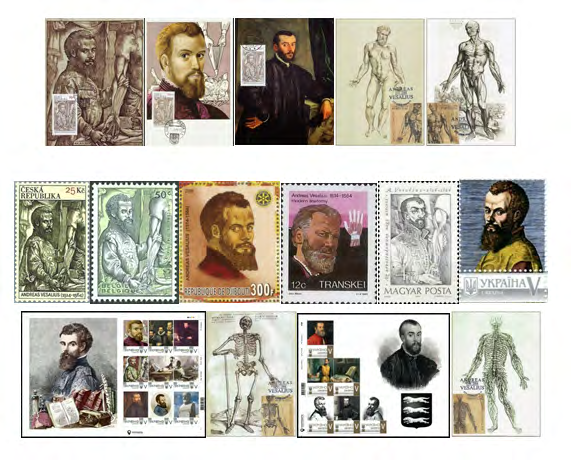
In Figure 2, I would like to present a selection of philatelic materials (postage stamps, postage blocks, and maximum cards) of the Czech Republic, Belgium, Hungary, Djibouti, Transkei, dedicated to Andrei Vesalius [1, 3, 6, 5, 7].
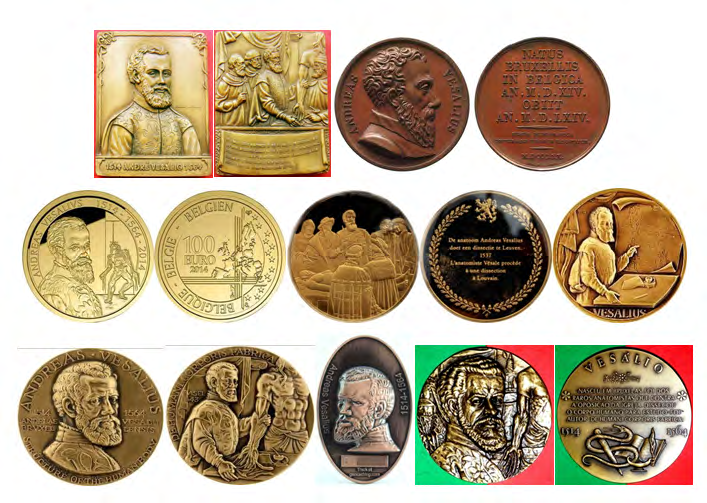
In Figure 3, commemorative numismatic materials (commemorative medals and coins) dedicated to Andrei Vesalius are presented. We have selected the brightest and most informative specimens, presented, for the most part, in obverse and reverse, although there are also one-sided specimens [1, 3, 6, 7, 8].
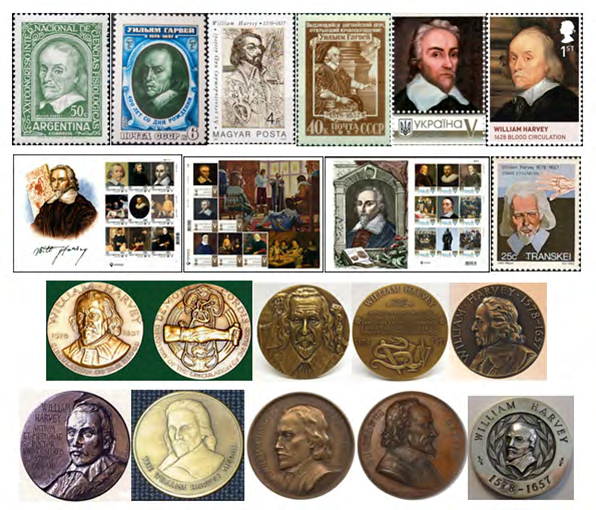
Further, there are philatelic materials dedicated to the famous English anatomist and physician, William Harvey (1578-1657). W. Harvey is known for his close study of the human circulatory system. In Figure 4 presents philatelic materials from countries such as the USSR, Ukraine, Argentina, Hungary [5]. Also, in Figure 5, a small selection of commemorative medals dedicated to W. Harvey and his contribution to anatomy and world medical science is presented [5].
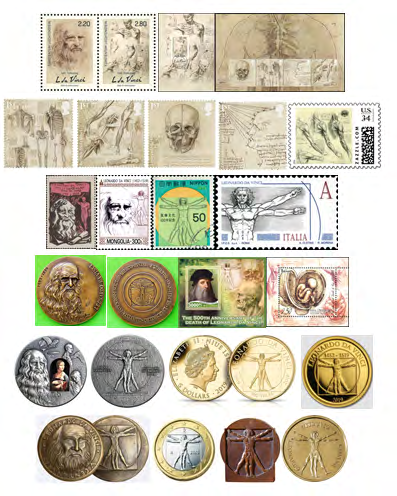
Further, in Figure 5, a selection of philatelic materials from Great Britain and Liechtenstein is presented, dedicated to anatomical research, by the great Italian scientist Leonardo da Vinci [9, 10, 11]. Excellent knowledge of human anatomy, laid the foundation for the active use of anatomical knowledge and human proportions, in the visual arts. His “golden
section” of the proportions of the human body is known not only to anatomists, morphologists, artists but also to many enlightened people around the world [9, 10, 11].
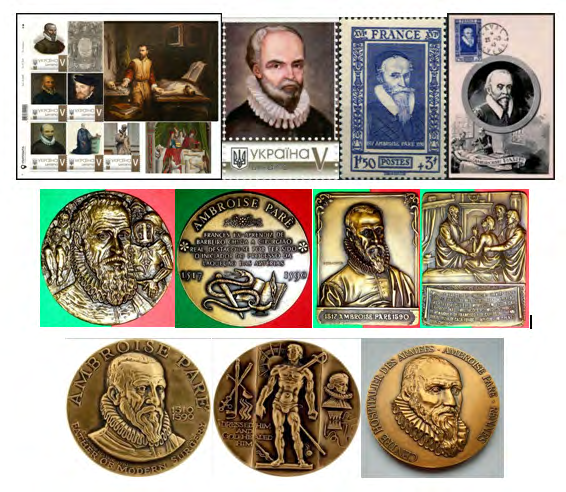
Quite famous, during the Middle Ages, was a scientist, anatomist and an excellent surgeon - Ambroise Paré (1510- 1590). Without a wonderful knowledge of human anatomy, it would be impossible to carry out numerous operations on the wounded, with various types of weapons, soldiers.
Ambroise Paré, possessing anatomical knowledge, brought military field surgery to a completely different, highest level of medical art! In Figure 6 presents philatelic materials (postage block and postage stamp) dedicated to Ambroise Paré [12, 5].
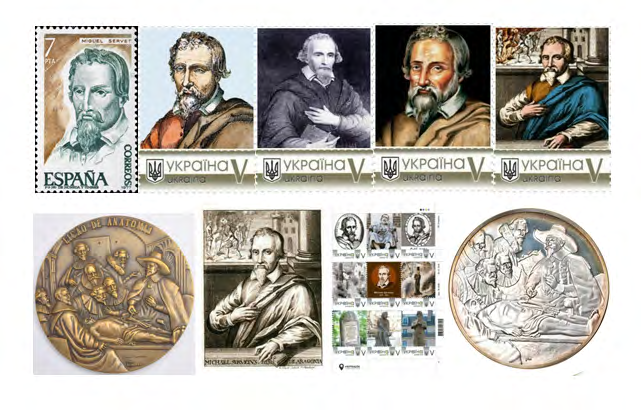
In Figure 7, a selection of materials is presented (postage stamps of Spain and Ukraine and a commemorative medal of Spain) dedicated to Miguel Servetus (1511-1553), a Spanish anatomist, physician and scientist who studied the circulatory system and the structure of the human body [5].
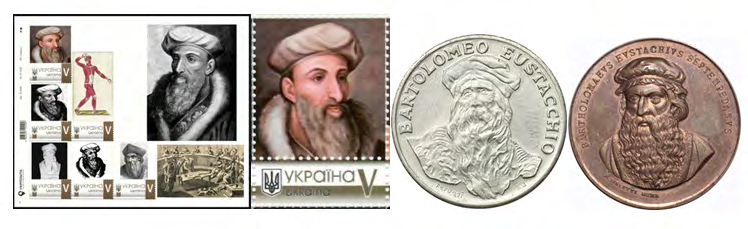
In Figure 8, there is a postage stamp and postal block of Ukraine, and also a silver and bronze medal dedicated to the famous Italian anatomist and doctor, professor of anatomy at the Roman school of Sapienza - Bartolomeo Eustachio [6, 5].
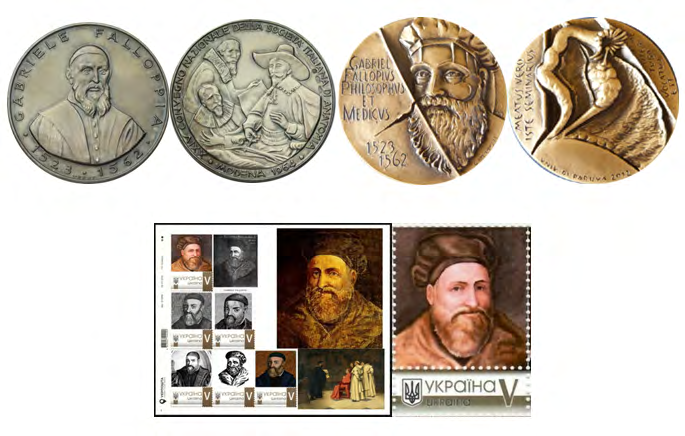
In the next, Figure 9, presents a small selection of philatelic and numismatic materials (commemorative medals) dedicated to Gabriele Falloppio (1523-1562), anatomist and surgeon. This and the silver medal, which was issued by the Italian community of anatomists, in 1964, and the bronze medal with his portrait on the obverse, as well as, with the image of the ovary and fallopian tube, named after him [6, 5, 13].
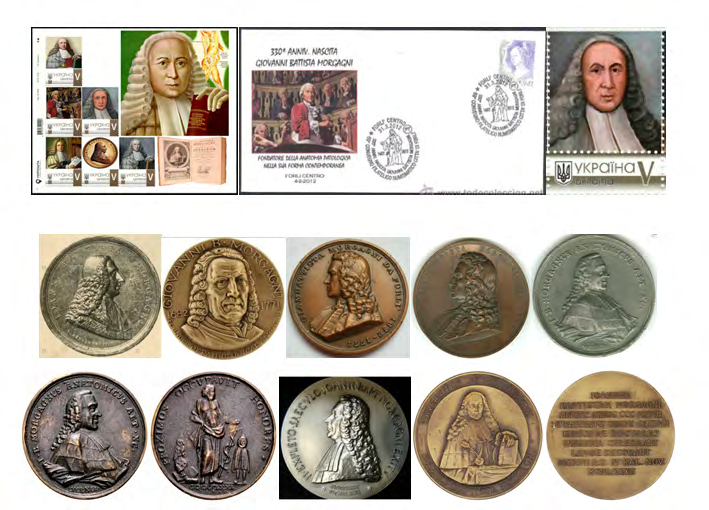
Philatelic and numismatic materials presented in Figure 10 dedicated to the great Italian scientist, anatomist and physician - Giovanni Battista Morgagni (1682-1771). Giovanni B. Morgagni, is the “father” of pathoological anatomy. This is a postage block and a stamp of Ukraine, an envelope of the first day of Italy, a commemorative medal by the author of Abram Belsky, Italian commemorative medals dedicated to this scientist-anatomist [14, 15, 16, 5].
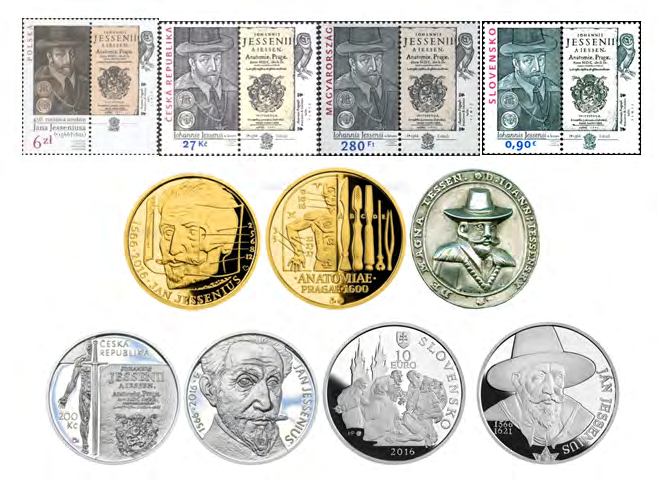
In Figure 11, philatelic materials from Poland, the Czech Republic, Slovakia and Hungary are presented, dedicated to the famous Polish, Slovak, Hungarian and Czech physician anatomist and surgeon, Jan Jessenius, who in 2021 turns 400 years from the date of death [17].
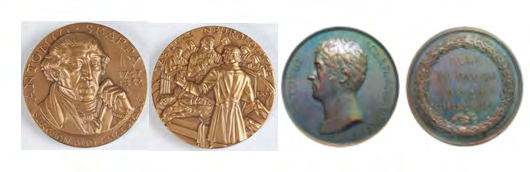
Also, there is a commemorative medal, by the famous medalist Abram Belsky, dedicated to the famous Italian scientist, anatomist and surgeon, Antonio Scarpa (1747-
1832), which is presented, in obverse and reverse, in Figure 12 [4, 18].
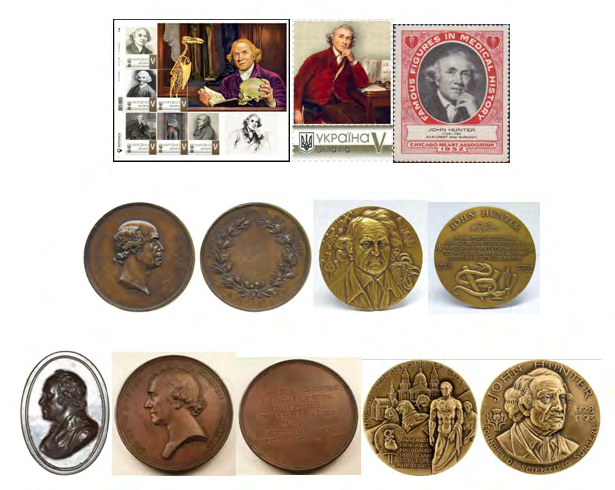
Further, in Figure 13, presents a collection of philatelic and numismatic materials dedicated to the famous Scottish scientist, anatomist and surgeon, John Hunter (1728-1793) [19, 5]. As a surgeon, he studied human anatomy for many years, in order to later skillfully apply his knowledge, operating on his many patients.
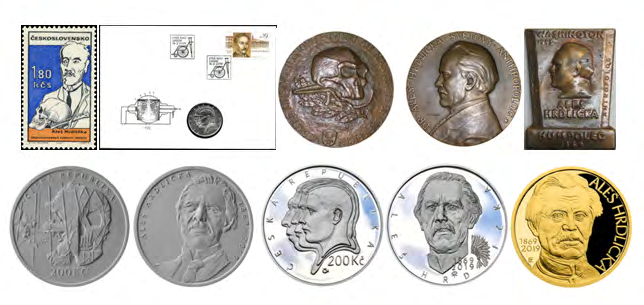
In Figure 14, provides information about the famous Czech scientist, anatomist and anthropologist, Aleš Hrdlička (1869-1943). A selection of philatelic and numismatic materials (postage stamp and commemorative medals of the Czech Republic, issued in honor of the 150th anniversary of his birth, are shown in Figure 14 [2].
The next plot is dedicated to the famous Austrian anatomist and physiologist Josef Hirtl (1810-1894). At the age of 26, he became professor of anatomy at Charles University in Prague, then taught anatomy in Vienna. In his honor, an Austrian postage stamp and an art stamped envelope were issued, timed to coincide with the 7th European Anatomical Congress in Austria, which was held there on September 3-7,
1974. Also, in Figure 15, on the obverse and reverse, there is a commemorative medal dedicated to this scientist, as well as postage stamps of Austria and Ukraine [5].
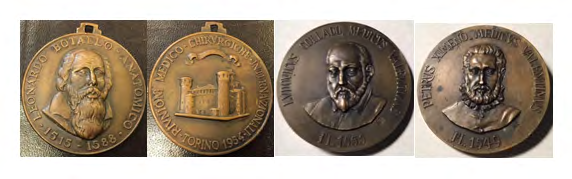
![Figure 15: Collectible materials dedicated to Jozeph Hyrtl. In Figure 16, a selection of commemorative medals dedicated to the less famous at the world level, but revered in their countries, the Italian scientist-anatomist Leonardo Botallo (1515-1588) and the anatomists - Luis Collado and Pere Jimeno is presented. The first medal was issued in 1954 for the Congress of Surgeons in Turin, and the other two - in 1962, for the International Congress of Anatomists in Valencia [20,17].](/fulltextimages/7576/fig_15.png)
Figure 15: Collectible materials dedicated to Jozeph Hyrtl. In Figure 16, a selection of commemorative medals dedicated to the less famous at the world level, but revered in their countries, the Italian scientist-anatomist Leonardo Botallo (1515-1588) and the anatomists - Luis Collado and Pere Jimeno is presented. The first medal was issued in 1954 for the Congress of Surgeons in Turin, and the other two - in 1962, for the International Congress of Anatomists in Valencia [20, 17].
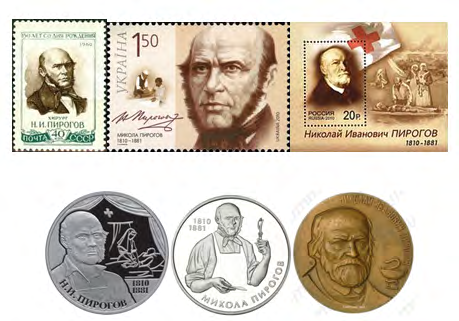
It is impossible not to mention, in a number of well- known world anatoms, contribution to the science and name of the famous Russian anatoma and surgeon, Nikolai Ivanovich Pirogov (1810-1881). One of the great discoveries in the field of global anatomy is its “ice anatomy”. A small selection of phylathemical and numismatic materials is presented in Figure 17 [21, 19].
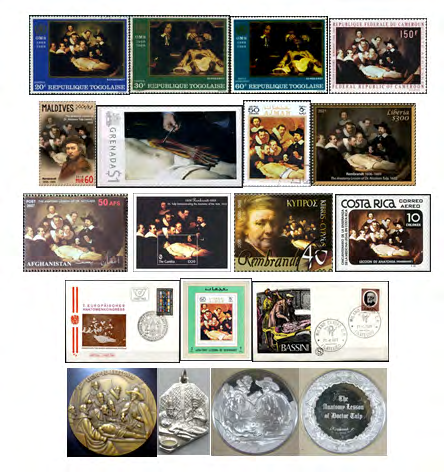
In the next, Figure 18, a large selection of philatelic and numismatic materials (commemorative medals) dedicated to the study of the structure of the human body during the late Middle Ages and the Renaissance is presented. Basically, this is a reflection in philately and numismatics of the plots of the paintings of the great Rembrandt “Anatomy Lesson of Doctor Tulpa”, written by the artist in 1632, the plot of which is devoted to the process of autopsy of dead people [19, 18, 22, 23, 5]. Doctor Tulp dissects the hand and forearm of the corpse of a previously hanged criminal, nicknamed Aris Kindt “The Kid” - Adriaan Adriaans [19, 18, 22, 23, 5]. In this collection, the plot of another painting by Rembrandt - “The Anatomy Lesson of Dr. Deiman”, 1656, which presents the process of dissection of the human brain, is given. Also, there is a first day envelope, depicting on it the process of the preparation of a corpse, by the Italian anatomist and surgeon Bassini E [24].
This concludes a brief overview concerning the reflection in philately and numismatics, the history of world anatomy and famous scientists anatomists of different centuries of human history.
Conclusion
1. The article presents new materials of the study, devoted to the reflection in the collection media, the memory of a number of world famous scientists-anatomists, their scientific contribution to the world anatomical and medical science, as well as the formation and formation of the foundations of modern anatomy.
2. The presented text and illustrative materials, taking into account the limited volume of the article, quite fully correspond to the goals and objectives of writing this article, submitting the information presented in a format convenient for the reader.
3. The materials of the article can be of great interest to scientists, teachers and students of medical schools, practitioners and other categories of medical workers of various orientations who are interested in anatomy and medicine.
4. The presented illustrative materials can be used as an auxiliary informative tool in the study of such disciplines as “Anatomy”, “Operative surgery and topographic anatomy” and “History of medicine” in specialized universities and departments.
5. Modern collectibles, in all their diversity, quite fully, brightly and creatively, reflect information about any medical discipline and its heroes.
6. In the short term, in his new article, the author plans to continue his research in the field of reflection of various sections of the anatomy of human internal organs, presented in the reflection of such collectibles as philately, numismatics and faleristics.
References
-
Vesalius y la Anatomía moderna, Universidad de La Laguna, ACDC.
-
Aleš Hrdlička (1869-1943) Investment Gold.
-
Circulating Now from the Historical Collections of the National Library of medicine (NLM).
-
Tulane University Digital Library.
-
Ibn al Nafis, Ukraine, Europe, Stamps, pp: 9.
-
Eustachio B (1510-1574) Artemide-Asta Numismatica 31E, pp: 14.
-
Vesalius A (1514-1564) 3 pól - Magazín plný pozitivní energie. Zakladatel moderní anatomie člověka.
-
Bugaevsky KA, Bugaevskaya NA (2018) Andreas Vesalius: life and scientific feat in the reflection of collectibles. Bulletin of SMUS74 1(20): 16-20.
-
Leonardo da Vinci (1452-1519) Art 500 years since the death of Leonardo da Vinci.
-
Leonardo da Vinci (1452-1519) 500th Anniversary of Death.
-
Leonardo da Vinci (1452-1519) 50 ans du premier alunissage, 500ème anniv, Philatélie.
-
Bugaevsky KA, Bugaevskaya NA (2017) Ambroise Paré: the history of life and service to medicine in the reflection of collectibles. Bulletin of SMUS74 4(19): 22-26.
-
Falloppio G (1523-1562) NumisBids: Artemide Aste s.r.l. Auction 31E. Lot 694: Modena, Anatomista e chirurgo.
-
Morgagni GB (1682-1771)FORLI’-Giovanni Battista Morgagni.
-
Morgagni GB (1682-1771) Father of Anatomical Pathology.
-
Morgagni GB (1682-1771) Medicine, Italy.
-
Joint Stamp Issues.
-
Scarpa A (1747-1832) Commemorative medale.
-
Bugaevsky KA, Bugaevskaya NA (2018) Surgery and foreign surgeons in philately, faleristics, numismatics and bonistics. Bulletin of SMUS74 2(21): 4-14.
-
Botallo L (1515-1588) Famous Italians.
-
Bugaevsky KA, Bugaevskaya NA, Pirogov N (2016) postcards and envelopes from different countries. Bulletin of SMUS74 3(14): 8-16.
-
Human Anatomy on Stamps - Stamp Community Forum.
-
Human Anatomy, Medical Science Education Nurse Health MNH, Libya.
-
Bassini CE (1846-1924) Details of Author.
- Pattern of Breast Lesions in Ovu Inland, Delta State, South Southern Nigeria
- Morphometric Analysis of the Human Femur: Exploring Platymetric and Robusticity Indices Among the Nigerian Population
- Anatomical Variation of Arteria Lusoria: Clinical Implications for Dysphagia Lusoria and Surgical Risk
- Morphometric Study of the Vertebral Body and Pedicle of Typical Cervical Vertebrae Using Radiological Image
- Epigenetic Mechanisms Driving Human Evolutionary Changes
- Neuroprotective Effects of Ginkgo Biloba Extract on Bilateral Common Carotid Artery Ischaemic Stroke Induced in Wistar Rat