
Performance on the Variants of Generative Naming Performance in Younger and Middle Aged Adults
Generative naming task is a commonly used task in screening and diagnostic tests and is a part of neuro-psychological test batteries. In this task, the participant is expected to list items belonging to a specific lexical category such as animals the task has been studies in regard to demographic variables such as age, gender, socio-cultural variables. The conventional generative naming task is modified by adapting the concept of switching. The participant is asked to switch between the lexical categories or is asked to switch between the languages L1 and L2) holding the lexical category as a constant, the current studied the performance of young and middle aged adults considering the language switching conditions. A total of 50 participants were considered for the current study and the participants were divided into two groups based on their age. The participants were asked to list lexical items belonging to the category ‘animals’ under three switching conditions: free switching, no switching and conditional switching conditions. The median scores were higher for free switching followed by no switching condition and conditional switching conditions, the same trend was observed across the two groups. Fried man’s test revealed significant difference between the conditions only for the group 2 participants showing that the cognitive substrates may impose challenges to the performance of these participants.
Introduction
Generative naming is a part of numerous neuro- psychological test batteries. It assesses for the divergent lexical naming. This task assesses for the divergent mechanism of lexical retrieval. No direct referent is given to the participant undergoing the task and the participant is expected to generate a list of items adhering to the lexical category (in case of semantic verbal fluency) and to a phoneme (in case of phonemic verbal fluency task). The generative naming would assess for semantic knowledge, storage and retrieval (semantic memory) [1]. The semantic knowledge would be tapped as the person should entail this semantic knowledge in listing the items, storage, roots back to the concept of semantic field [2] and access as the final retrieval is dependent on how quickly and accurately, the participant is able to retrieve names. The performance on generative naming can vary based on certain subject related variables such as education, cultural background of the participant etc [3]. Language proficiency is considered to be a major governing variable influencing the performance of the participant Roberts PM, et al. [4], considering the current scenario, most of the individuals are bilinguals regardless of the proficiency in the second language, as a consequence there could be instances like the participant retrieving the name of the lexical item in the other language known to them (based on the frequency of the lexical item in the given language), hence there would be a need to modify the conventional generative naming task catering to the bilinguals. The generative naming task has been modified considering the interest of bilinguals by incorporating the switching conditions. The generative naming task has three switching conditions fitting the bilinguals; free switching, conditioned switching and no switching based on the instructions provided by the examiner to restrict to a given language or switch. In a nutshell the switch can be used for assessing the performance of an individual on generative naming under the conditional performance scenarios.
The switching condition also taps cognitive skills of an individual or the executive functions per se as the individual should adhere to the instructions provided by the investigator and generate the lexical items [5]. Skills such as sustained attention, cognitive flexibility and response inhibition are considered to be the essential substrates of the generative naming task with switches [6, 7]. Switching can be a part of alternating fluency task where the participant has to switch between two lexical categories [8, 9] based on the instructions provided by the participant, the lexical categories further can be proximal or distal in nature (based on the semantic relationship), the switching condition can be incorporated by considering the bilingual scenario also. Conditions like no switch, free switch and conditional switch can be incorporated when this is adapted in the bilingual scenario. The no switch condition is where the participant is supposed to retrieve the lexical items in only one language (assuming that the participant is a bilingual and tested in bilingual scenario) while the conditional switch is where the participant is asked to switch between the languages as instructed by the investigator, while the free switch condition is where the participant is not constrained and is free in receiving the items based on the language of their choice [10]. In all the aforementioned conditions, the lexical category is held constant (one at a time) i.e. the participant is expected to list the items within a specific category in the two languages known to the participant and shortlisted by the participant.
Need of the Study
It is noteworthy that the generative naming is modified incorporating the switching condition in bilingual testing condition, however there is a clear sparsity in the studies carried out considering the above-mentioned scenarios in the testing condition especially in the vivid Indian context. There is plethora of studies on generative naming in participants of different age groups, however there is a clear dearth of studies on the generative naming under switching conditions, this further strengthens the premise for conducting the current study.
Objective
The aim of the study was to determine the performance on younger and middle aged Hindi-English balanced bilinguals on three conditions associated with generative naming.
Method
50 neuro-typical balanced bilingual speakers of Hindi and English were considered for the study. The participants were divided into groups, group 1 (n=28) composed of participants in the age range of 18-35 years and the second group (n=22) consisted of participants in the age range of 36-60 years. Language Experience and Performance questionnaire Marian V, et al. [11] was administered on the participants and the self-rating part of the questionnaire was used as a criterion for selecting participants, this question allows the participants to self-rate their proficiency on a scale of 0-9 for understanding, speaking, reading and writing. The current study selected high proficient bilinguals (who rated 8 or 9 on all the four skills) in both languages, making them balanced. Hence the total number of participants specified above was after applying this filter in selection. Random Sampling was followed for recruitment of participants. The data collection was carried out in the state of Gujarat. Informed consent was taken from the participants and ethical approval was sought (AIISH/IRB/24-09).
Stimulus
Generative naming task was administered on the participants. A total of 6 lexical categories (fruits, vegetables, common object, vehicles, animals and birds) were considered. The usage of language was governed under the three language switching conditions (no switching, free switching and conditional switching conditions).
Procedure
A total of three switching conditions and six lexical categories were considered. That means, each switching condition was applied for two lexical categories each. For the lexical category animals and fruits were presented in free switching conditions, the lexical categories birds and vegetables were presented in conditional switching condition and the lexical categories vehicles and common objects were presented in free switching condition. However, the lexical categories and switching conditions were randomised across the participants to counteract the variability tweaking from the lexical category. The average duration of data collection was 30 minutes per participant.
Scoring
Each correct response was given a score of 1 and an incorrect response was given a score of 0. The response was deemed correct when the response produced by the participant matched with lexical category specified by the investigators and adhered to the switching condition, in other words when an appropriate lexical category was produced in the intended language, the response was considered correct, while the response was considered incorrect when these conditions were not met.
Results
The number of responses generated by the participants was computed for the switching conditions as aforementioned under the scoring section. Each switching condition was applied over two lexical categories as mentioned under procedure section. While computing the number of responses, the average scores were obtained i.e. the average of the two lexical categories for which each switching condition was applied. This was basically done to counteract the variability occurring from considering each lexical category in isolation. The primary objective considered for the study was to determine the performance on younger and middle aged Hindi-English balanced bilinguals on three switching conditions associated with generative naming, hence the average responses produced by group 1 and group 2 participants was compared. The median responses for the three naming conditions was 11, 8 and 10 for group 1 and 8, 5 and 9 for group 2 on Free-Switching, Conditioned Switching and No Switching conditions respectively.
The data was subjected to test of normality using Shapiro-Wilk’s test of normality and the p value obtained was <0.05 indicating that the data was non-parametric hence the median scores was computed. The same is graphically represented in Figure 1.
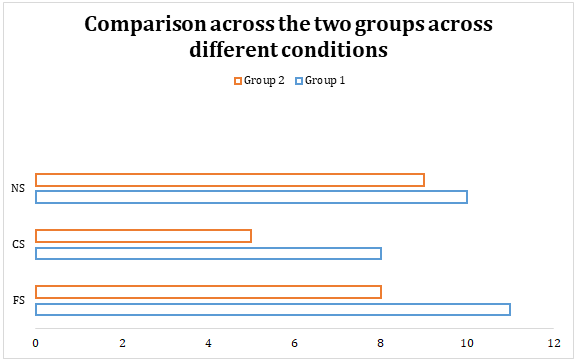
Further Friedman’s test was administered to compare the median scores of the two groups across each of the switching conditions. The X2 value of 1.8, 2.3 and 1.23 was obtained for the three conditions respectively and the corresponding p values showed significant difference between the two groups only for the conditioned switching condition.
Discussion
The primary objective considered for the study was to determine the performance on younger and middle aged Hindi-English balanced bilinguals on the three switching conditions associated with generative naming task. The median scores were higher for group 1 (younger individuals) compared to group 2 irrespective of the switching condition. The median scores were higher for free switching followed by no switching and conditioned switching, this trend was observed for participants of both the groups and this was a direct reflection of the task complexity. The free switching condition is where the participant was allowed to use any language of their choice while listing lexical items. This constraint free condition yielded maximum score as expected and this was followed by the no switching condition. In the no-switch condition, the participant was constrained to use only one language, it was observed that the participants produced responses that belonged to the other language quite often, however most of the participants were able to perform this task well and the response further was dependent on the lexical category taken into consideration, most of the common objects and vehicle names were named in English leading to reduction of scores. The conditioned switching was the most complex of the three as far as the participants of the two groups were considered. Participants of group 2 exhibited greater difficulty while performing this task and the difference between the two groups was significant statistically for the conditioned switching, this could mean that the cognitive constraints were more for this group compared to the other group (younger participants). It is note-worthy that second group comprised of adults who were in middle age to early aging. Though the group cpmprised of participants in the broad age range of 35-60 years deliberately more participants in the age range of 45- 60 years were enrolled and these individuals experienced difficulty in channelizing attention or difficulty in exercising the switching due to subtle difficulty in cognitive flexibility and response inhibition [6, 7]. Owing to which the participants would have underperformed. The basic limitation of the study was that it was done on limited number of participants and the study can be extended considering participants who are above 60 years old in order to verify if the performance reduces further as a consequence of aging. This will increase the inferential generality of the study as it would apply to all the sub-sets of the population.
Conclusion
The current study was carried with the aim of investigating the effect of aging on the different variants of generative naming i.e. free switching, no switching and conditioned switching in individuals between 18-35 years (group 1) and 36-60 years (group 2) and the results revealed that conditioned switching was effective in unveiling the difference between the young and middle aged adults suggesting that there were constraints in naming in this particular age group.
References
-
Edmonds LA, Kiran S (2004) Effect of semantic naming treatment on cross-linguistic generalization in bilingual aphasia. Journal of Speech Language and Hearing Research 49(4): 729-748.
-
Hillis AE (2001) The organization of the lexical system. In: Rapp BC (Ed.), The Handbook of Neuropsychology: What deficits Reveal About the Human Mind, PA: Psychology Press, Philadelphia, USA, pp: 185-210.
-
Peña ED, Bedore LM, Zlantic-Guinta R (2002) Category- generation performance of bilingual children: The influence of condition, category, and language. Journal of Speech Language and Hearing Research 45(5): 938-947.
-
Roberts PM, Le Dorze G (1997) Semantic organization, strategy use and productivity in bilingual semantic verbal fluency. Brain and Language 59(3): 412- 449.
-
Selezneva SS (2008) Generative naming performance in Russian-English bilingual speakers: The influence of category and language. Unpublished Master’s Thesis. University of Texas at Austin, Austin, USA.
-
Luo L, Luk G, Bialystok E (2010) Effect of language proficiency and executive control on verbal fluency performance in bilinguals. Cognition 114(1): 29-41.
-
Abhishek BP, Rao PK (2013) Comparison of Confronation Naming and Generative Naming Abilities in Neurologically Healthy Individuals and Persons with Aphasia. Language in India 13(1): 321-338.
-
Magiste E (1979) The competing language systems of the multilingual: A developmental study of decoding and encoding processes. Journal of Verbal Learning and Verbal Behavior 18(1): 79-89.
-
Grosjean F (1997) Processing mixed language: Issues, findings, and models. In De Groot AMB, Kroll JF (Eds.), Tutorials in bilingualism: Psycholinguistic perspectives, Lawrence Erlbaum Associates Publishers, Mahwah, USA, pp: 225-254.
-
Li R, Kiran S (2023) Treatment-Induced Recovery Patterns Between Nouns and Verbs in Mandarin-English Bilingual Adults With Aphasia. American journal of speech-language pathology 32(5): 2128-2145.
-
Marian V, Blumenfeld HK, Kaushanskaya M (2007) The language experience and proficiency questionnaire (LEAP-Q): Assessing language profiles in bilinguals and multilinguals. Journal of Speech Language and Hearing Research 50(4): 940-967.
- Ramsay Hunt Syndrome Presenting as Gait Imbalance without Facial Paralysis: A Case Report
- Unveiling Hidden Culprits: An Observational Study of Upper Gastrointestinal Endoscopy Findings in Symptomatic Cholelithiasis Patients
- Assessing Health Care Providers’ Proficiency in International Patient Safety Goals: A Study to Assess the Knowledge &Practice on Patient Safety in a Tertiary Care Teaching Hospital in Gujarat
- Challenges in Diagnosing Child Language Disorders
- Stunting Service Management Model in the South-Central Timor Region, East Nusa Tenggara, Indonesia
- Acute Small Bowel Obstruction Presenting as Gangrenous Jejunal Loop Secondary to Intestinal Endometriosis – A Rare Case Report