
Study of Correlation of Rajastrav (menstrual flow) with Prakriti in Vandhyatwa (Primary Infertility): An Observational Study
Aartav described in Ayurved has great similarity with menstrual flow of woman. The woman health is greatly dependent on normal cyclic menstrual pattern (Rutustrava) which is influenced by many factors like Prakriti, Kaal, etc. The duration of menstrual flow varies from 3 to 7 days according to different Ayurved compendia. The Doshas which have impact on Prakriti, may vary the pattern of Rutustrava. Due to influence of Rutu (seasonal variation), the Doshas attain variations which have impact on Rutustrava. It is known that all the Dosha are important for regulation of menstrual cycle which are acting on its various phases. The predominance of individual’s Prakriti may interfere and alter the quantity and duration of flow was the research question. Similarly the vitiation of Doshas causes the abnormal menstrual flow which may result in Vandhyatwa. Thus the present study enlightens the relationship between Prakriti & Rajastrav. Aim & Objective: Study the correlation of Rajastrav (menstrual flow) with Prakriti in Vandhyatwa (primary infertility). To assess the characteristics of Rajapravrutti in different Prakriti in cases of primary infertility. Material & Methods: Observational study, 50 diagnosed cases of primary infertility were included in the study and their observations were recorded in case record form prepared as per criteria mentioned in the methods and results were analyzed by Chi square test. Result- The maximum women with Vataj Prakriti had high grades of menstrual flow is 23 (46%) among them 20 in grade 2. In Pittaj Prakriti out of total 19 (38%) cases 18 had high grade of menstrual flow in grade 3. Whereas in Kaphaj Prakriti 7 out of total 8 (16%) cases shows grade 1 menstrual flow. Statistically significant association was found between Prakriti and menstrual flow. Conclusion- The strong association of Prakriti of women with duration and quantity of menstrual flow is found in this study. The duration of menstrual flow seen vary from 3 to 6 days in this study which is very nearer to the opinions of Ayurved compendia i.e. 3-7 days.
Introduction
Aartava which is comparable with menstrual flow according to Ayurved is said to be Agneya (hot) in nature and has characteristics of Rakta (blood). It forms Garbha (foetus) when gets combined with Shukra in uterus and is also essential for life [1]. Difference of opinion regarding durations of Rajastrav (menstruation) is seen in Ayurved compendia, according to Vagbhata, Sushruta and Bhavmishra durations of Rajastrav is 3 days, as per Charak it is 5 days while Harita and Bhela told 7 days durations of Rajastrav [2].
Prakriti is a unique concept of Ayurveda pertaining to homogenous combination of Shukra and Shonita at the time of conception [3]. The difference of opinion regarding duration of Rajastrav seen in various compendia may be due to Prakriti of female. Doshas are absolute factors, for the formation of Prakriti whose prominence changes according to age. Present generation females are facing many problems related to their menstruation like painful menstruation, irregular cycles and irregularity in bleeding patterns etc. in their adolescent age without any specific pathology in their reproductive system which causes the chances of Vandhyatwa. Prakriti indicates the predominance of natural Doshas which may interfere with the normal body physiology. The nature and pattern of all the physiological and psychological processes are dependent on it. The temperament and prototype of the Rajastrav may have some relation with Prakriti. Prakriti of individual would
Subjective parameters- Assessment of Rajastrav
Sr. No.
Pattern of Menstrual
Number of sanitary pads
flow /24 Hrs
1 Spotting 0 0 Not soaked 0 2 Light/ scanty 3 1-2 days Lightly soaked 1 3 Normal 4-Mar 3-4 days Moderately soaked 2 4 Heavy 10-May 5-6 days Heavily soaked 3 be an influencing factor for variation in the characteristics of Rajapravrutti. Hence there is need of study in this direction.
Aim & Objective
Study the correlation of Rajastrav (menstrual flow) with Prakriti in Vandhyatwa (primary infertility).To assesses the characteristics of Rajapravrutti in different Prakriti in cases of primary infertility.
Material & Methods
Observational study
Conceptual Study
Bhrihat-trayee, Laghu-trayee with their commentaries, other text books related to topic, modern text books of eugenics and journals were extensively referred.
Clinical Study
50 diagnosed cases of primary infertility were included in the study and their observations were recorded in case record form prepared as per criteria mentioned below.
Sanitary Pads
For measuring the amount of menstrual blood within 24 hours same size sanitary pads (Stayfree secure extra- large) were used.
Total days of Menstrual
Type of Soaking of
Sanitary Pads Gradation
flow Prakriti assessment was done by Prakriti Vinischaya based on Doshas [4].
Observations & Results
Aartava: Aartava is the menstrual flow of blood through vagina in every month. It is slightly black in colour that is brought to the mouth of vagina by Vayu Mahabhoota [5]. The normal cycle of menstrual flow starts at the age of twelve years and stops at the age of fifty years in women [6].
Rasa, Arundatta opines that this Raja is formed from Ahar-rasa and not from Rasadhatu. Sharangdhar and Bhavmishra mention Raja as by-product (Upadhatu) of Rakta [8].
Appearance of Shuddha Aartava
The menstrual blood which is either like rabbit’s blood or like liquid shellac and which blood colour does not stain on the clothes, having no bad smell, such a menstrual blood is known as Shuddha Aartava [9].
Properties & Amount of Aartava
Aartava is Agneya, has characteristics of Rakta (blood), forms Garbha (foetus) and is also essential for life [10]. The estimated quantity of Aartava in female body is four Anjali (approximately four ounces) [11]. The Aartava excreted in more or fewer amounts are not Shuddha [12].
Aartava or Raja as Hormones
The estrogen and progesterone are responsible for female characters and development of reproductive organs. Appearance of hair in the body (Romaraji) and development of breast, uterus and vagina etc. occur due to accumulation of Aartava in the body during puberty. Sushruta told Apara (placenta) is formed from Aartava.
The development of breast and preparation of breast for the secretion of milk are controlled by both estrogen and progesterone. According to Vagbhat, blackening of areola of nipple and lips occurs due to Aartava. The hyper pigmentation of areola, nipple and face is the function of estrogen [13]. Irregular and scanty menstruations are the clinical features of both Aartava Kshaya and estrogen deficiency [14].
Factors influencing the menstrual cycle
- Rasa: Raja is said to be an Upadhatu of Rasa.
- Rakta: The blood discharged by woman during her menses is the same which circulates through the body.
- Dhamani: Vata acts through Dhamani for the discharge of menstrual fluid. Especially Apan is said to be responsible for this action. Influence of Apan through Dhamani is that of nervous system acting on the uterine vessels.
- Dosha: All the physiological process of menstruation is governed by three Doshas, viz. Vata, Pitta and Kapha [15].
- Rutuchakra: Menstrual cycle occurring in females has been termed in Ayurved as Rutuchakra. A single Rutuchakra covers a period of one Chandramasa (28 days) which is divided into three parts.
| S | N | Specific stage | Duration | Condition of Reproductive system | Dominant Dosha | |||||||||
|---|---|---|---|---|---|---|---|---|---|---|---|---|---|---|
| 1 | Rajakaal (Menstrual Phase) | 3-5 or 7 days | Menstrual blood loss | Vata, excretion is function of Apan Vayu | ||||||||||
| 2 | Rutukaal (Proliferative Phase including ovulation) | 12 or 16 days Or whole month, Even without menstruation | Establishment of new Raja (new cycles), optimum chances of fertilization, increased sexual desire etc. | Kapha, Reconstruction of tissues is done by Prithvi and Jala which are components of Kapha. | ||||||||||
| 3 | Rutuvyatita- Kaal (Secretary Phase) | 9-13 days | Fibrinolysis - a fibrin clot, the product of coagulation, is break down. Its main enzyme plasmin cuts the fibrin mesh at various places, leading to the production of circulating fragments. | Pitta Presence of Purana Raja and constriction of Yoni, less chances of conception, raised body temperature. |
Table 1: Comparison of Prakriti with menstrual flow.
Table No 1: Dominant Doshas in specific stages of Rutuchakra [16]. Clinical Study: Correlation of Prakriti.
| Prakriti | Menstrual Flow | Total | |||||||||||||||
|---|---|---|---|---|---|---|---|---|---|---|---|---|---|---|---|---|---|
| Grade 0 | Grade 1 | Grade 2 | Grade 3 | ||||||||||||||
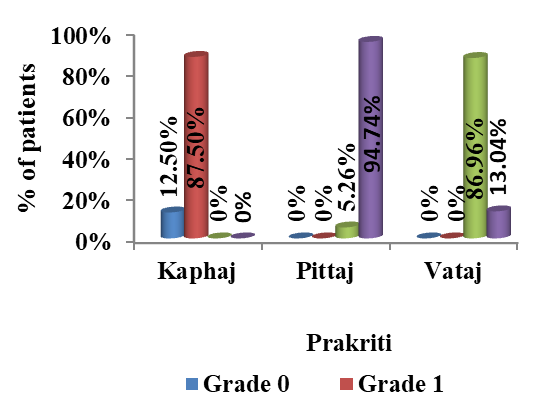
| Kaphaj | 1(12.50%) | 7(87.50%) | 0(0%) | 0(0%) | 8 (16%) | ||||||||||||
| Pittaj | 0(0%) | 0(0%) | 1(5.26%) | 18(94.74%) | 19(38%) | ||||||||||||
| Vataj | 0(0%) | 0(0%) | 20(86.96%) | 3(13.04%) | 23(46%) | ||||||||||||
| Total | 1(2%) | 7(14%) | 21(42%) | 21(42%) | 50(100%) | ||||||||||||
| χ2-value | 83.06, p-value=0.0001, Significant |
Table 2: Comparison of Prakriti with menstrual flow.
The maximum women with Vataj Prakriti had high grades of menstrual flow is 23 (46%) among them 20 in grade 2. In Pittaj Prakriti out of total 19 (38%) cases 18 had high grade of menstrual flow in grade 3. Whereas in Kaphaj Prakriti 7 out of total 8 (16%) cases shows grade 1 menstrual flow. Statistically significant association was found between Prakriti and menstrual flow of the patients by using chi-square test (χ2-value=83.06, p-value=0.0001, significant).
Discussion
Aartava is the menstrual flow of blood within a few hours of the necrosis caused by constriction of terminal arteries of uterus followed by their dilatation in every month which is slightly black in colour that is brought by Vayu Mahabhoota. Aartava refers to ovum by some Aacharya while Arundatta assumed it as only menstrual flow. Vatsayana clearly mentioned concept of Bahirpushpa and Antahpushpa which means menstrual flow and ovum respectively. In general Aartav is meant for menstrual flow because the appearance of Shuddha and Dushta Aartav described by many compendia reveals its resemblance with it. Though ancient Ayurved compendia described Aartav mostly in terms of menstrual flow, they were known about the association of this menstrual flow with normal and abnormal functioning of ovary or reproductive health of a woman [17].
Biological variability is the greatest variability found in universe. The duration of menstrual flow ranges between 3 to 7 days according to different Acharyas. Many physiological parameters have influence of Desha, Kaal and environment. Whatever the variations observed in duration of menstrual flow may be because of various geographic and other variations like Kaal. The individuals Prakriti has major role in many physiological variations among the subjects. Aartava or menstrual flow is such an entity which may have association with Prakriti for its duration of flow. In this perspective the clinical study was performed to assess the role of Prakriti in menstrual flow as per the methodology specified in materials and methods. The observations obtained are summarized as above in the respective column.
Statistically significant association was found between Prakriti and menstrual flow of the patients by using chi- square test (χ2-value=83.06, p-value=0.0001, significant). As mentioned in above observation table the Grade-3 menstrual flow is observed in 21 (42%) cases in which 18 are from Pitta Prakriti and 3 from Vata Prakriti women. It means that Grade-3 flow is prominent in Pitta Prakriti individuals. According to Assessment criteria for Grade-3 menstrual flow stated in methodology the duration of menstrual flow is 5-6 days which suggest duration of flow more compared to the normal values. In Vata predominant individuals 20 (40%) cases had shown Grade-2 menstrual flow out of total 21. Here the duration of flow is 3-4 days and considered as normal flow. Aartav- pravrutti (excretion of Aartav) is primarily a function of Apan Vayu which comes under the influence of Vata. In Vata Prakriti women normal menstrual flow is observed which signifies the normal function of Vata in these cases. Whereas out of total 8 cases of Kapha Prakriti women; 7 had shown Grade-1 and 1 case had shown Grade-0 menstrual flow. Kapha promotes the integrity and buildup of body tissues and not helps for lysis action like Pitta which is needed in menstrual flow. So in Kapha predominant individuals the less quantity of menstrual flow is observed with minimal duration of 1-2 days. All the findings observed in this study are significant as per the test specified above. It means that there is definitely the role of Prakriti of individuals in body physiology which is seen in terms of menstrual flow in this study. The variations in duration of menstrual flow mentioned in Ayurved compendia by different Aacharya mostly may be because of Prakriti of individuals and it is observed in this study. It can be said that the normal duration of menstrual flow may vary from 3 to 6 days which is very nearer to the opinions of Ayurved compendia i.e. 3-7 days.
- Vataj flow
- Pittaj flow
- Kaphaj flow
- As the Vata Dosha dominates the uterus, its
- Sheeta and Khara qualities causes the blood
- Pitta is hot and sharp. So it brings more fluidity to the blood so that it vessels to constrict. Ruksha Guna depletes the bodily tissues and finally causes early flows easily. Pitta resides in blood cessation of menstrual flow. Due to decrease in plasma and blood tissues, decreased nourishment to the endometrial and in excess it may cause heavy bleeding. As it causes tendency for swelling, it leads to tender, swollen lining of uterus the overall flow and menstrual discharge will be less, Where ever there is a blockage for the free flow of
- Vata, there will be pain. So most of the Vata breasts, acne etc that Women experience during their premenstrual period. dosha dominating cycles will be painful.
Table 3: Qualitative Difference in Menstrual Flow on Predominance of Tridosha [18].
Conclusion
Study indicates Aartava can be considered as both menstrual flow and ovum. The terms Bahirpushpa and Antahpushpa are comparable with menstrual flow and ovum respectively. Rutuchakra mentioned in Ayurved can be understood as menstrual cycle in which the menstrual phase is dominated by Pitta Dosha, later due to increased Kapha Dosha it persists a few days and Vata Dosha helps to propel the ovum from the follicle at the time of ovulation. The strong association of Prakriti of women with duration and quantity of menstrual flow is found in this study. The duration of menstrual flow seen vary from 3 to 6 days in this study which is very nearer to the opinions of Ayurved compendia i.e. 3-7 days. The study shows stronger relationship and one of the main causes of primary infertility. By evaluating prakruti one should approach infertility.
References
-
Sushruta (2013) Sushruta Samhita, ‘Vidhyodaya’ Gurjar commentary, Sharirsthana, Chapter 5 verse: 3, Edited by Parmar Dayal, 1st ed. Ahmedabad; Sarsvati Pustak Bhandar, pp: 707.
-
Tiwari P (1998) Text book of Prasuti-Tantra, Ayurvediya prasuti-Tantra evam Stree Roga, Chapter 2, Varanasi; Chaukhambha oriantalia publications, pp: 60-64.
-
Sushruta (2007) Sushruta Samhita, Sharirsthan, Chapter 4, Verse: 62-63, Edited by Sharma PV, Varanasi; Chaukhamba Orientalia Publications, pp: 360. Development of Standardized Prakriti Assessment Tool: An Overview of Ongoing CCRAS Initiatives. Journal of Research in Ayurvedic Sciences 1: 165-208.
-
Sushruta (2016) Sushruta Samhita, Ayurved- tatvasandeepika Hindi commentary, Sharirsthana, Chapter 3 verse: 8, Varanasi; Chaukhambha Sanskrit Sansthan, pp: 27.
-
Sushruta (2015) Sushruta Samhita, Ayurvedrahasyadeepika Hindi commentary, Sharirsthana, Chapter 3 verse: 11, New Delhi; Meharchand Laxman Das publication, pp: 80.
-
(2015) The Shabdakalpadrum, an encyclopedic dictionary of Sanskrit series, volume 1, Chaukhamba Surbharati Prakashan, pp: 196.
-
Ibidem (2) Text book of Prasuti-Tantra, Chapter 2, pp: 58-59.
-
Sushruta (2014) Sushruta Samhita, with Nibandhasangraha commentary, Sharir Sthan, Chapter-2; Verse 17, Varanasi; Chaukhamba Surbharti Prakashan, pp: 346.
-
Sushruta (2017) Sushrut Samhita, ‘Sushruta- vimarshini’ Hindi commentary, Sutrasthan, Vol 1, Chapter-15, Verse- 7, Varanasi; Chaukhamba Surbharati Prakashan, pp: 115.
-
Vagbhata (2014) Ashtanga-Hridayam, Vol. 1, Sharirsthan, Chapter 3, Verse 81, Edited by Murthy KRS, 10th [Edn.], Varanasi; Chowkhamba Krishnadas Academy, pp: 412.
-
Agnivesh-Charak-Drudhbala (2017) Charak Samhita, Vol. 2, Chikitsasthan, Chapter 30, Verse 225, Edited by Shukla V & Tripathi R., Delhi; Chaukhamba Sanskrit Pratishthan, pp: 780.
-
Sidheshwar Sathua (2014) Garbha Vigyan (Embryology), Chapter 6, Varanasi; Chaukhamba Sanskrit Sansthan, pp: 59.
-
Sushruta (2014) Sushrut Samhita, Hindi commentary, Sutrasthan, Vol. 1, Chapter-15, Verse- 12, Edited by Thakral KK.,1st [Edn.], Varanasi; Chaukhambha Orientalia, pp: 164.
-
Nirmala Joshi (2006) Ayurvedic Concept of Gynecology, Chapter 2, Chaukhamba Sanskrit Pratishthan, Delhi, pp: 17.
-
Ibidem (2) Text book of Prasuti-Tantra, Chapter 2, pp:
-
Khedikar Sachin G (2016) Critical Appraisal of Embryological Concepts (Garbhasharir) Delineated in Ayurveda J Res Trad Medicine 2(2): 45-50.
-
Aayushma, Mahesekar N (2018) Rutuchakra -An ayurvedic prospective on menstrual cycle, AIIRJ 5(2): 157.
- Management of Ear Keloid with Ksharsutra: A Case Study
- Yoga and Global Sustainability: A Holistic Path to One Earth, One Health
- Autoimmune Diseases in Ayurveda: A Narrative Review with Classical and Modern Perspectives
- Management of Cluster Headache Associated with Pituitary Apophysitis by CERT (Chakrasiddh Energy Release Technique): A Case Report on Energy Rebalancing
- Zygophyllum Geslini Coss : Biochemicals and Antioxidant Activity
- Observations of a Beginner Vaidya