
In vitro Antioxidant Activity of Trichosanthes dioica Root
Trichosanthes dioica Roxb. (Cucurbitaceae), called pointed gourd in English, Potol in Bengali is a dioecious climber vine found wild throughout the plains of India and cultivated widely for its consumable fruits. The objective of the present study is to evaluate the in vitro antioxidant activity of hydroalcohol extract of roots from Trichosanthes dioica Roxb (TDA). In vitro antioxidant activity of TDA was assessed by DPPH, nitric oxide, hydroxyl radical, peroxynitrite and superoxide radical scavenging methods. TDA exhibited marked and concentration dependent free radical scavenging affect in all five in vitro models. The results from the present work demonstrated that T. dioica root possesses promising in vitro antioxidant effect which may provide the basis of its several activities in vivo.
Introduction
Human body system is exposed to a large number of foreign chemicals (xenobiotics) in the daily life, most of which are anthropogenic and our incapability to properly metabolize them negatively affects our health by generation of free radicals. Free radicals are also generated during normal metabolism of aerobic cells. Highly active free radicals and their uncontrolled production are responsible for numerous pathological processes such as cancers, inflammatory, neurodegenerative and cardiovascular diseases [1, 2]. Various reactive species include superoxide anions, hydroxyl, nitric oxide and peroxynitrite radicals play an important role in oxidative stress related to the pathogenesis of various diseases. These reactive oxidative and nitrosative species cause the cellular damage by reacting with various bio- macromolecules such as proteins, membrane lipids, enzymes and nucleic acids. This damage may be counteracted by the use of antioxidants which may scavenge the reactive free radicals and boast the endogenous antioxidant defense system of body. Antioxidants are important in the prevention of various free radical mediated human diseases. Naturally occurring antioxidants such as ascorbic acid, carotenoids, vitamin E, and phenolic compounds possess the ability to reduce the oxidative damage associated with many diseases, including cancer, cardiovascular diseases, cataracts, atherosclerosis, diabetes, arthritis, immune deficiency diseases and ageing [3, 4, 5].
Trichosanthes dioica Roxb. (Cucurbitaceae), called pointed gourd in English, Potol in Bengali and Patola in Sanskrit, is a dioecious climber vine found wild throughout the plains of North and North-East India from Punjab to Assam and Tripura states of India. It is also cultivated in India and Bangladesh for its fruits, a common culinary vegetable. In India, all parts of this plant have been traditionally used for various medicinal purposes. According to Ayurveda, the traditional system of Indian medicine, its root is a purgative. The root has been traditionally used in India as purgative and as tonic, febrifuge, in treatment of jaundice, anasarca and ascites [6, 7]. The leaves and tender shoots are also used medicinally and as culinary vegetable in West Bengal and Assam, called as Palta in Bengali. Previously the authors have reported anthelmintic, anti-inflammatory, cytotoxic, antitumor, chemo preventive, laxative and arsenic toxicity ameliorative effects of T. dioica root. Except the root, in vitro antioxidant activity has been reported for all parts of T. dioica [6, 8]. In the present study, we have aimed to evaluate the in vitro antioxidant activity of T. dioica root extract by different in vitro antiradical assay methods.
Materials and Methods
Plant Material
The mature tuberous roots of T. dioica were collected during December 2009 from Majdia, Nadia district, West Bengal, India. The species was identified by Dr. M. S. Mondal, at the Central National Herbarium, Botanical Survey of India, Howrah, West Bengal, India, and a voucher specimen (CNH/II/57/2009/Tech. II/493) was deposited at our research laboratory for future reference. Just after collection, the plant material was washed thoroughly with running tap water and shade dried at room temperature and ground mechanically into a coarse powder.
Preparation of extract: The powdered plant material was macerated at room temperature (24–26°C) with 20% ethanol water for 4 days with occasional shaking, followed by re-maceration with the same solvent for 3 days. The macerates were combined, filtered and evaporated to dryness in vacuo. The dry extract (TDA, yield: 12.15%) was kept in a vacuum desiccator until use. Preliminary phytochemical analysis revealed the presence of reducing sugars, amino acids, triterpenoids and steroids in TDA [9].
Reagents and chemicals: 1,1-diphenyl-2-picrylhydrazyl (DPPH) was obtained from Sigma Chemicals, USA. Nitroblue tetrazolium (NBT), phenazine methosulphate (PMS), reduced nicotinamide adenine dinucleotide (NADH), sodium nitroprusside (SNP), napthyl ethylene diamine dihydrochloride (NED), ascorbic acid, trichloroacetic acid (TCA), thiobarbituric acid (TBA), potassium nitrite (KNO2), sodium hypochlorite (NaClO), potassium ferricyanide [K3Fe(CN)6], diethylene triamine pentaacetic acid (DTPA) and 5, 5'-dithiobis 2 nitrobenzoic acid (DTNB) were procured from Spectrochem, Mumbai, India. Folin-Ciocalteu’s phenol reagent (FCR) was purchased from SISCO Research Laboratories, Mumbai, India. Manganese dioxide (MnO2) was obtained from S.D. Fine Chemicals, Mumbai, India. All other chemicals and solvents used were of high analytical grade.
Evaluation of in vitro Antioxidant Activity
DPPH radical scavenging activity: DPPH stable free radical scavenging activity was determined based on the previously described method [10]. The absorbance of the various concentrations of extract was measured at 517 nm. The inhibition percentage was calculated as:
Radical scavenging activity (%) = (Abs. control – Abs. sample)/ (Abs. control) × 100.
Scavenging activity against NO and OH• radicals: Sodium nitroprusside in aqueous solution at physiological pH spontaneously generates nitric oxide (NO), which interacts with oxygen to produce nitrite ions, which can be estimated using Griess Illosvoy reaction [11]. Scavengers of NO compete with oxygen, leading to reduced production of NO and a pink coloured chromophore is formed. The absorbance of these solutions was measured at 540 nm against the corresponding blank solutions. Percentage inhibition was calculated as per the above formula.
The OH
- scavenging activity of the plant extract (50, 100 and 150µg) was measured according to previously described method [13]. The intensity of the colour formed was measured spectroscopically at 412 nm against reagent blank. The percentage of OH
- scavenging activity (TDA) was calculated by the above stated formula.
Peroxynitrite scavenging activity: Peroxynitrite (ONOO) is a cytotoxic intermediate produced by the reaction between the superoxide anion (O$^2$) and nitric oxide (NO). Synthesis of ONOO was carried out according to the described method by previous researchers [13]. The concentration of ONOO was measured spectrophotometrically at 302 nm (€=1 670 M$^{-1}$ cm$^{-1}$). An Evans blue bleaching assay was used to measure peroxynitrite scavenging activity. The assay was performed by propose method of previous worker with minor modifications. The percentage scavenging of ONOO was calculated by using the above mentioned formula.
Superoxide anion scavenging activity: Superoxide radicals are generated in a PMS-nicotinamide adenine dinucleotide (reduced form, NADH) system by oxidation of NADH and assayed by the reduction of NBT. Measurement of superoxide anion scavenging activity was done based on the previously described method [12]. The percentage inhibition of superoxide was calculated by the above mentioned formula. Ascorbic acid served as reference in all these five assays.
Statistical Analysis
Results are expressed as mean ± standard error of mean (SEM), 50% inhibitory concentration (IC50) were calculated by plotting the data in the graph as concentration versus percentage inhibition using Graph Pad Prism ver. 5.
Results
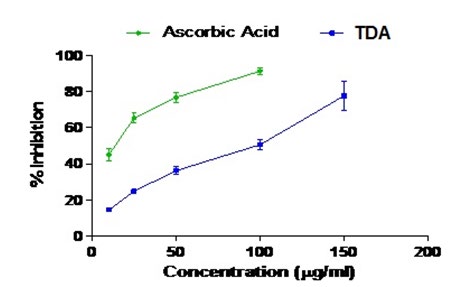
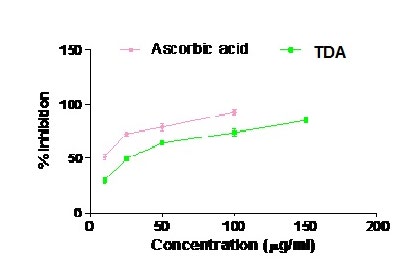
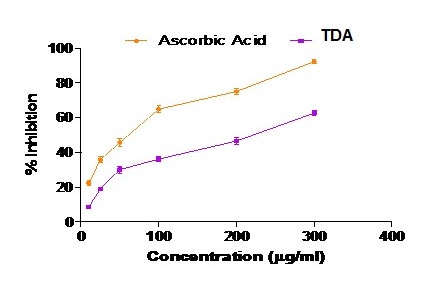
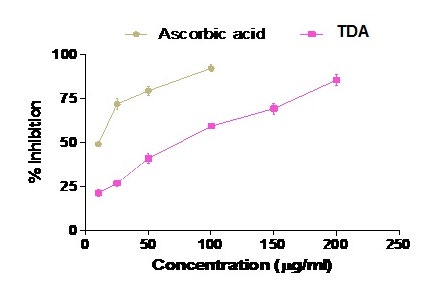
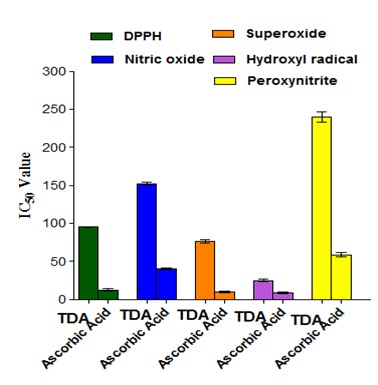
In the present study, the percentage of scavenging activity of hydroalcohol extract of T. dioica root (TDA) was observed and compared with reference compound ascorbic acid on the above mentioned five free radical scavenging assay methods. The extract (TDA) showed the concentration dependent activity in all above mentioned in vitro free radical scavenging test models (Figures 1-5). 50% inhibitory concentrations (IC50) of TDA and reference ascorbic acid for DPPH, nitric oxide, hydroxy radical, peroxynitrite and superoxide anion were found to be: 97.09 ± 3.45 and 13.38 ± 1.79 µg/ml; 150.73 ± 3.42 and 41.7 6± 1.90 µg/ml; 25.03 ± 5.10 and 9.10 ± 4.0 µg/ml, 218.93 ± 8.75 and 58.87 ± 3.93 µg/ml, 75.12 ± 5.01 and 11.48± 0.81 µg/ml respectively (Figure 6).
Discussion and Conclusion
Free radical scavenging activity plays a vital role in a biological system in maintaining endogenous redox balance of the body. Many secondary plant metabolites serve as sources on antioxidants and exhibited free radical scavenging activities [14]. In the present study, it was observed that T. dioica root possess effective antioxidant activity in vitro. The 1,1-diphenyl-2-picryl-hydrazyl (DPPH) is a stable free radical and accepts an electron or hydrogen radical to become a stable diamagnetic molecule. Antioxidants on interaction with DPPH, transfer electron or hydrogen atom to DPPH and thus neutralizing its free radical character and convert it to 1-1diphenyl-2-picrly hydrazine and the degree of discoloration indicates the scavenging activity of the chemical. The degree in absorbance of DPPH radical caused by antioxidant is due to the reaction between antioxidant molecules and radical progress which results in the scavenging of the radical by hydrogen donation. It is visually noticeable as a change in colour from purple to yellow. Hence, DPPH is usually used as a substance to evaluate the antioxidant activity [15]. In the present study the extract of T. dioica has significant effect on the DPPH radical with a dose dependant manner. It is a well-known fact that, nitric oxide plays an imperative role in disperate systemic process, higher levels of these radical are toxic to tissue and contributes to vascular collapse, carcinoma and ulcerative colitis. The toxicity of nitric oxide increases when it reacts with superoxide radical forming highly reactive peroxy nitrate anion (ONOO-) [12]. TDA shows a declining effect of nitrite generated from the decomposition of sodium nitroprusside in vitro, which may be due to the inhibition of nitrite generation by competing with oxygen to react with nitric oxide.
Hydroxyl radicals are major active oxygen species causing lipid peroxidation and enormous metabolic damage in a biological system. This method involves in vitro generation of OH
- radicals using Fe3+/ascorbate/EDTA/H2O2 system using Fenton reaction. The oxygen derived hydroxy radicals along with the added transition metal ion (Fe2+) causes the degradation of deoxyribose into malondialdehyde which produces a pink chromogen with thiobarbituric acid. Upon the addition of TDA to the reaction mixture, it removed the OH
- from the sugar and prevent the reaction. Peroxynitrite (ONOO¯) leads to oxidative damage to tissue [12]. Peroxynitrite bleaches Evans Blue by oxidizing it. In the present study, TDA acts in a dose dependant manner in scavenging peroxynitrite. Superoxide anion is very harmful to cellular components and produced from molecular oxygen due to oxidative enzyme of body as well as via non-enzymatic reaction such as autoxidation by catecholamines [13]. Superoxide dismutase catalyzes the dismutation of highly reactive superoxide anion to oxygen and hydrogen peroxide. The superoxide radicals generated from dissolved oxygen by PMS-NADH coupling can be measured by their ability to reduce NBT [11]. With decrease in the absorbance at 560 nm, TDA exhibited the ability to quench superoxide radicals in the reaction mixture.
From the present preliminary investigation, it can be concluded that the T. dioica root shows promising antioxidant property against oxidative and nitrosative free radicals in vitro thus the plant part can serve as a natural source of antioxidant agents that can be used in experimental field for the prevention and cure of free radical mediated diseases. To the best of our knowledge, this is the first report of in vitro antioxidant effect of T. dioica root. The observed in vitro antioxidant activity of T. dioica root may provide the foundation for its reported anti-inflammatory, antitumor and cancer chemo preventive effects in vivo as mentioned under introduction section.
Acknowledgement
The authors are thankful to the authority of Jadavpur University, Kolkata, West Bengal 700032, India for the present study.
References
-
Bhattacharya S, Ahmed KKM, Chakraborty S (2011) Free radicals and cardiovascular diseases: An update. Free Rad Antiox 1(1): 17-22.
-
Bhattacharya S, Haldar PK, Zaman MK (2011) Anti-inflammatory activity and antioxidant role of Zanthoxylum nitidum bark. Oriental Pharm Exp Med 11: 271-277.
-
Bhattacharya S, Haldar PK (2012) Trichosanthes dioica fruit ameliorates experimentally induced arsenic toxicity in male albino rats through the alleviation of oxidative stress. Biol Trace Elem Res 148(2): 232-241.
-
Bhattacharya S (2018) Heavy metal profiling of medicinal plants-exigent safety strategy. J Nat Ayurvedic Med 2(4): 1-2.
-
Bhattacharya S (2011) Natural antimutagens: A review. Res J Med Plants 5: 116-126.
-
Khandaker M, Akter S, Imam MZ (2018) Trichosanthes dioica Roxb.: A vegetable with diverse pharmacological properties. Food Sci Hum Wellness 7(1): 34-48.
-
Khare CP (2010) Indian medicinal plants, an illustrated dictionary. New Delhi: Springer.
-
Islam MT (2018) A literature-based phytochemical evidence and biological activities of Trichosanthes dioica Roxb. Orient Pharm Exp Med 18: 77-85.
-
Bhattacharya S, Zaman MK (2009) Pharmacognostical evaluation of Zanthoxylum nitidum root. Pharmacogn J 1(1): 15-21. 10. Bhattacharya S, Haldar PK, Zaman MK (2010) Anti- inflammatory and in vitro antioxidant property of Zanthoxylum nitidum root. Curr Trends Biotechnol Pharm 5(4): 774-783.
-
Chanda S, Dave R (2009) In vitro models for antioxidant activity evaluation and some medicinal plants possessing antioxidant properties: An overview. African J Microbiol Res 3(13): 981-996.
-
Kumar RBS, Dolai N, Karmakar I, Bhattachaya S, Haldar PK (2016) Evaluation of in vitro antioxidant activity of Streblus asper bark. Global J Pharmacol 10(1): 1-5.
-
Beckman JS, Chen H, Ischiropulos H, Crow JP (1994) Oxidative chemistry of peroxynitrite. Meth Enzymol 233: 229-240.
-
Bhattacharya S (2011) Are we in the polyphenols era? Pharmacogn Res 3(2): 147.
-
Noipa T, Srijaranai S, Tuntulani T, Ngeontae W (2011) New approach for evaluation of the antioxidant capacity based on scavenging DPPH free radical in micelle systems. Food Res Int 44(3): 798-806.
- Management of Ear Keloid with Ksharsutra: A Case Study
- Yoga and Global Sustainability: A Holistic Path to One Earth, One Health
- Autoimmune Diseases in Ayurveda: A Narrative Review with Classical and Modern Perspectives
- Management of Cluster Headache Associated with Pituitary Apophysitis by CERT (Chakrasiddh Energy Release Technique): A Case Report on Energy Rebalancing
- Zygophyllum Geslini Coss : Biochemicals and Antioxidant Activity
- Observations of a Beginner Vaidya