
Physicochemical, Thermal and Spectroscopic Characterization of the Energy of Consciousness Healing Treated Withania somnifera (Ashwagandha) Root Extract
Ashwagandha root extract is widely used in nutraceutical preparations due to its broad range of pharmacological activities. The objective of this study was to analyse the impact of Biofield Energy Treatment (The Trivedi Effect®) on the physicochemical, thermal and spectral properties of ashwagandha root extract by using various analytical techniques. The sample of ashwagandha root extract was divided into two parts in which one part was kept untreated and called as control sample; while the other part was provided with the Consciousness Energy Healing Treatment remotely by the Biofield Energy Healer, Mr. Mahendra Kumar Trivedi and termed as Biofield Energy Treated sample. The study reported that the particle size values at d10, d50, d90, and D (4,3) in the Biofield Energy Treated sample was significantly decreased by 9.23%, 9.04%, 11.86%, and 10.59%, respectively compared with the control sample. Thus, the surface area of the treated sample was significantly increased by 10.75% compared to the control sample. The PXRD analysis showed that the control as well as the Biofield Energy Treated samples was amorphous in nature. The DSC analysis showed that the onset evaporation temperature and latent heat of vaporization were significantly altered by 2.18% and-10.29%, respectively in the Biofield Energy Treated sample compared with the control sample. The TGA analysis indicated the four step thermal degradation of both the samples. The 1st, 2nd, 3rd, and 4th steps of thermal degradation of the treated sample showed an alteration in the weight loss by -6.59%, 1.97%, -1.80%, and -8.65%, respectively along with 0.81% reduction in the total weight loss, compared with the control sample. Besides, the maximum thermal degradation temperature (Tmax) in the control sample was observed at 234.17°C and 365.12°C for the two broad peaks, which was decreased by 1.73% and 0.82%, respectively compared to the control sample. The overall analysis suggests that the Energy of Consciousness Healing Treatment might enhance the solubility, absorption, and bioavailability profile of ashwagandha root extract along with altered thermal stability. Such altered properties might help in designing better pharmaceutical and nutraceutical preparations; thereby provide better therapeutic response against various diseases such as amnesia, arthritis, anxiety, cancer, impotence, neurodegenerative, and cardiovascular diseases.
Introduction
Withania somnifera (ashwagandha) commonly known as winter cherry, its root extract contain active metabolites i.e. withanolides possess a broad range of pharmacological activities. Ashwagandha as nutraceuticals supports the healthy energy levels, healthy mental cognition, cardiovascular health, and healthy endothelial function along with improved lipid profile. Ashwagandha root extract contains a wide array of nutrients and phytochemicals; thus, it is also used as a dietary supplement and for health restoration [1]. In addition, ashwagandha root and leaf extract is widely used in most of the Indian herbal pharmaceuticals and nutraceuticals for the treatment of various diseases due to its various bioactive compounds and thereby exerts significant biological activities. The plant extract and its bioactive compounds are used in the prevention and treatment of various disorders, such as arthritis, amnesia, anxiety, impotence, cancer, neurodegenerative, and cardiovascular diseases, and others [2]. In ancient time, it was used as a tonic to arrest the ageing process, rejuvenate the body and boost the defence against infectious disorders and also promote the longevity [3]. Ashwagandha is commonly found in market as fine sieved powder, which is generally consumed with water, ghee (clarified butter) or honey. It vitalizes mind and body, enhances brain and nervous function system and improves the memory. Besides, it maintains reproductive system function and promotes healthy sexual and reproductive balance [4]. It used as an important nutraceutical in stress relief [5], due to its powerful adaptogen nature, which was studied using a rat model of chronic stress [6, 7]. Ashwagandha improves cell-mediated immunity and regulate body’s defence as immunomodulatory against many diseases, potent antioxidant properties to fight against cellular damage caused by free radicals, and muscle strength [8]. Besides, literatures reported that withanolides such as withaferin A, withanolide D, withanolide E, etc., possess significant anticancer, immunomodulating, neuroprotective, antiepileptic, antibacterial, adaptogenic, spermatogenic, anti-depression, anti-anxiety, hepato-protective, anti- inflammatory, anti-arthritic, anti-microbial, hypoglycaemic, hypolipidemic, aphrodisiac, anti-ulcer, and many more actions in the body [9].
The Trivedi Effect®-Energy of Consciousness Healing Treatment has been widely known now days for its influence on the drug properties that could be used in improving the solubility, dissolution and bioavailability profile of various pharmaceutical/nutraceutical compounds [10, 11, 12]. Biofield Energy is considered as a unique energy which is para- dimensional and exists in the form of electromagnetic field around the human body. Based on Biofield (Putative Energy Fields) there are several Energy Healing Therapies in the world that are known to pose significant impacts against various disease conditions [13]. Thus, a human has the ability to harness energy from the earth and transmit it to any living or non-living object(s) around the globe [14]. Such energy therapies are included under the Complementary and Alternative Medicine (CAM) and also recommended by the National Institute of Health/National Center for Complementary and Alternative Medicine (NIH/NCCAM) due to their several advantages [15]. The Trivedi Effect®- Consciousness Energy Healing Treatment has also been reported for its astonishing ability to affect the characteristic properties of several pharmaceuticals [16, 17], nutraceuticals [18], organic compounds [19, 20], metals and ceramic [21, 22, 23], improve the overall productivity of agricultural crops [24, 25], impacted the culture medium [26, 27], skin health [28, 29], and the isotopic abundance ratio in the organic compounds [30, 31, 32]. Thus, the current study was designed to determine the impact of Biofield Energy Treatment (The Trivedi Effect®) on the physicochemical, thermal and spectral properties of ashwagandha root extract by using various analytical techniques such as, particle size analysis (PSA), powder X-ray diffraction (PXRD), differential scanning calorimetry (DSC), thermogravimetric analysis (TGA)/ differential thermogravimetric analysis (DTG), UV-visible and FT-IR spectroscopy.
Materials and Methods
Chemicals and Reagents
Withania somnifera (Ashwagandha) root hydroalcoholic extract was purchased from Sanat Product Ltd., India. All other chemicals used in the experiment were of analytical grade available in India.
Consciousness Energy Healing Treatment Strategies
Ashwagandha root extract i.e., the test sample was divided into two parts. Among both parts, one portion was denoted as control sample that did not receive the Biofield Energy Treatment. Besides, the other part of ashwagandha root extract was considered as treated part that received the Energy of Consciousness Healing Treatment by a renowned Biofield Energy Healer, Mr. Mahendra Kumar Trivedi (USA), and named as the Biofield Energy Treated sample. In the process of Biofield Energy Treatment, the sample was kept under the standard laboratory conditions and the Biofield Energy Healer provided the Trivedi Effect® - Energy of Consciousness Healing Treatment to the sample, remotely, for 3 minutes through the Unique Energy Transmission process. On the other hand, the control ashwagandha root extract was subjected to “sham” healer under the similar laboratory conditions, who did not have any knowledge about the Biofield Energy Healing Treatment. Consequently, the control as well as Biofield Energy Treated ashwagandha root extract samples were kept in similar sealed conditions and further characterized by using PSA, PXRD, DSC, TGA/DTG, UV-Vis, and FT-IR techniques.
Characterization
Particle Size Analysis (PSA)
The particle size analysis was done using wet method, which involves the use of instrument, Malvern Mastersizer 3000, UK. The instrument has a detection range between 0.01 µm to 3000 µm [33], and the method involves the filling of sample unit (Hydro MV) with light liquid paraffin oil, which acts as dispersant medium. The refractive index values for dispersant medium and samples were 0.0 and 1.47, respectively. Later on, it was stirred at 2500 rpm, and the measurement was taken twice after reaching obscuration in between 10% and 20%, followed by averaging both measurements. The PS analysis provides data in the form of $d_{10} \mu m, d_{50} \mu m, d_{90} \mu m,$ and $D(4,3)$ values, representing the particle diameter corresponding to 10% 50% and 90% of the cumulative distribution. The calculations were done by using software Mastersizer V3.50.
The percent change in particle size (d) for $d_{10}, d_{50}, d_{90}$ and $D(4,3)$ was calculated using following equation 1:
$$\% \text{change in Particle size} = \frac{[d_{\text{Treated}} - d_{\text{control}}]}{d_{\text{control}}} \times 100$$ (1)
Where, $d_{\text{Control}}$ and $d_{\text{Treated}}$ are the particle size (µm) for at below 10% level ($d_{10}$) 50% level ($d_{50}$) and 90% level ($d_{90}$) of the control and Biofield Energy Treated samples, respectively. Percent change in surface area (S) was calculated using following equation 2:
$$\% \text{change in Particle size} = \frac{[d_{\text{Treated}} - d_{\text{control}}]}{d_{\text{control}}} \times 100$$ (2)
Where, $S_{\text{Control}}$ and $S_{\text{Treated}}$ are the surface area of the control and Biofield Energy treated ashwagandha root extract, respectively.
Powder X-ray Diffraction (PXRD) Analysis
The PXRD analysis of the control and Biofield Energy Treated samples of ashwagandha root extract was done with the help of PANalytical X'Pert3 powder X-ray diffractometer, UK. In this, the copper line was used as the radiation source for diffracting the analyte at 0.154 nm X-ray wavelengths, which is running at 40 mA current and 45 kV voltage. Also, the scanning rate for instrument was kept at 18.87°/second over a 20 range of 3-90° and the ratio of Kα-2 and Kα-1 was 0.5 (k, equipment constant). The data produced by the instrument was collected with the help of X'Pert data collector and X'Pert high score plus processing software. It provides the data in the form of a chart of the Bragg angle (2θ) vs. intensity (counts per second), and a table providing information regarding the peak intensity counts, d value (Å), full width half maximum (FWHM) (°2θ), relative intensity (%), and area (cts*°2θ). From this data, the crystallite size (G) was analyzed with the help of the Scherrer equation (3) as follows:
$$G = k\lambda / (b \cos \theta)$$ (3)
Where, $k$ is the equipment constant (0.5), $\lambda$ is the X-ray wavelength (0.154 nm); $b$ in radians is the full-width at half of the peaks and $\theta$ is the corresponding Bragg angle.
Later on, the percent change in crystallite size (G) of ashwagandha root extract was calculated using following equation 4:
$$\% \text{change in Crystallite size} = \frac{[G_{\text{Treated}} - G_{\text{control}}]}{G_{\text{control}}} \times 100$$ (4)
Where, $G_{\text{Control}}$ and $G_{\text{Treated}}$ are the crystallite size of the control and Biofield Energy Treated ashwagandha root extract samples, respectively.
Differential Scanning Calorimetry (DSC)
The DSC analysis of the samples was done under the dynamic nitrogen atmosphere with the help of DSC Q2000 differential scanning calorimeter, USA, at the flow rate of 50 mL/min. In this process, 2-4 mg sample was weighed and sealed in Aluminum pans. Later on, the sample was equilibrated at 30°C followed by heating up to 450°C at the rate of 10°C/min under nitrogen gas as purge atmosphere [34]. The thermogram reveals the value for onset, end set, peak temperature, peak height (m) or mW), peak area, and change in heat (J/g) for each peak. Later on, the percent change in melting temperature (T) of the control and Biofield Energy Treated samples was calculated using following equation 5:
$$\% \text{change in melting temperature} = \frac{[T_{\text{Treated}} - T_{\text{control}}]}{T_{\text{control}}} \times 100$$ (5)
Where, $T_{\text{TControl}}$ and $T_{\text{Treated}}$ are the melting temperature of the control and Biofield Energy Treated ashwagandha root extract samples, respectively.
Also, the percent change in the latent heat of fusion (ΔH) was calculated using following equation 6:
$$\% \text{change in latent heat of fusion} = \frac{[\Delta H_{\text{Treated}} - \Delta H_{\text{control}}]}{\Delta H_{\text{control}}} \times 100$$ (6)
Where, $\Delta H_{\text{Control}}$ and $\Delta H_{\text{Treated}}$ are the latent heat of fusion of the control and Biofield Energy Treated ashwagandha root extract, respectively.
• Thermal Gravimetric Analysis (TGA) / Differential Thermogravimetric Analysis (DTG) TGA/DTG analysis was done using TGA Q500 themoanalyzer apparatus, USA under dynamic nitrogen atmosphere (50 mL/min). It involves heating the samples from 25°C to 800°C at the rate of 10ºC/min using platinum crucible [34]. In TGA analysis, the weight loss in gram as well as percent loss for each step was recorded from the thermogram with respect to the initial weight of the sample. Consequently, the DTG analysis revealed the thermogram from which, the onset, endset, peak temperature and integral area for each peak was recorded. The percent change in weight loss (W) was calculated using following equation 7:
[W - W ] %changein weight loss = ×100 W
Treated control
(7) control Where, WControl and WTreated are the weight loss of the control and Biofield Energy Treated samples, respectively.
Also, the percent change in maximum thermal degradation temperature (Tmax) (M) was calculated using following equation 8:
[M - M ] %changein T (M) = ×100 M
Treated control max control
(8) Where, MControl and MTreated are the Tmax values of the control and Biofield Energy Treated ashwagandha root extract samples, respectively.
• Ultraviolet-visible Spectroscopy (UV-Vis) Analysis The UV-Vis spectral analysis of the control and Biofield Energy Treated ashwagandha root extract samples was done with the help of Shimadzu UV-2400PC SERIES with UV Probe (Shimadzu, JAPAN). The spectrum was recorded in the wavelength range of 190-800 nm using 1 cm quartz cell having a slit width of 0.5 nm. The absorbance spectra (in the range of 0.2 to 0.9) and wavelength of maximum absorbance (λmax) were recorded.
• Fourier Transform Infrared (FT-IR) Spectroscopy FT-IR spectroscopy of ashwagandha root extract was done by using Spectrum ES Fourier transform infrared spectrometer (Perkin Elmer, USA) with the frequency array of 400-4000 cm-1. The process involves pressed KBr disk technique in which, ~2 mg of sample was taken along with about 300 mg of KBr as the diluent, followed by forming the pressed disk and running the sample in the spectrometer.
Results and Discussion
Particle Size Analysis (PSA)
Particle size analysis was done for the control and Biofield Energy Treated ashwagandha root extract and the results are mentioned in Table 1. The particle size distribution of the control sample was observed at d10 (32.5 µm), d50 (88.5 µm), d90 (194 µm), and D(4,3) (102 µm). Consequently, the particle size distribution of the Biofield Energy Treated sample at d10, d50, d90, and D(4,3) was found as 29.5 µm, 80.5 µm, 171 µm, and 91.2 µm, respectively. Thus, the analysis showed that the particle size values at d10, d50, d90, and D(4,3) in the Biofield Energy Treated ashwagandha root extract was significantly decreased by 9.23%, 9.04%, 11.86%, and 10.59%, respectively as compared with the control sample (Table 1). However, the surface area of the Biofield Energy Treated ashwagandha root extract (101.50 m2/g) was observed to be significantly increased by 10.75% compared with the control sample (91.65 m2/g).
| Test Item | d (µm) 10 | d (µm) 50 | d (µm) 90 | D(4,3) (µm) | SSA(m2/Kg) | |
| Control sample | 32.5 | 88.5 | 194 | 102 | 91.65 | |
| Biofield Energy Treated sample | 29.5 | 80.5 | 171 | 91.2 | 101.5 | |
| Percent change* (%) | -9.23 | -9.04 | -11.86 | -10.59 | 10.75 |
Table 1: Particle size distribution of the control and Biofield Energy Treated _W. somnifera_ (Ashwagandha) root extract. d10, d5
Table 1: Particle size distribution of the control and Biofield Energy Treated W. somnifera (Ashwagandha) root extract. d10, d50, and d90: particle diameter corresponding to 10%, 50%, and 90% of the cumulative distribution, D(4,3): the average mass- volume diameter, SSA : the specific surface area; *denotes the percentage change in the particle size distribution of the Biofield Energy Treated sample with respect to the control sample.
The results indicated the impact of Biofield Energy Treatment on the physico-chemical properties of ashwagandha root extract. It was previously reported that the particle size, shape and surface area of the drug may pose their impact on the solubility, dissolution rate, bioavailability, and the therapeutic efficacy of the dosage form [35, 36]. Also, the decreased size of the particle along with the increased surface area may also help in enhancing the solubility, absorption and bioavailability profile of drug [37]. Thus, it is anticipated that the Biofield Energy Treated ashwagandha root extract might show the enhanced absorption rate and thereby a better bioavailability profile as compared to the untreated sample.
Powder X-ray Diffraction (PXRD) Analysis
PXRD study of the control and Biofield Energy Treated ashwagandha root extract was done to determine the crystalline pattern of the samples. The diffractograms of both the control and Biofield Energy Treated samples are given in Figure 1, and there was no any sharp diffraction peak in the diffractograms of both the samples. Thus, it revealed that both samples were amorphous in nature and the Biofield Energy Treatment might not affect the crystallinity and pattern of the ashwagandha root extract.
Differential Scanning Calorimetry (DSC) Analysis
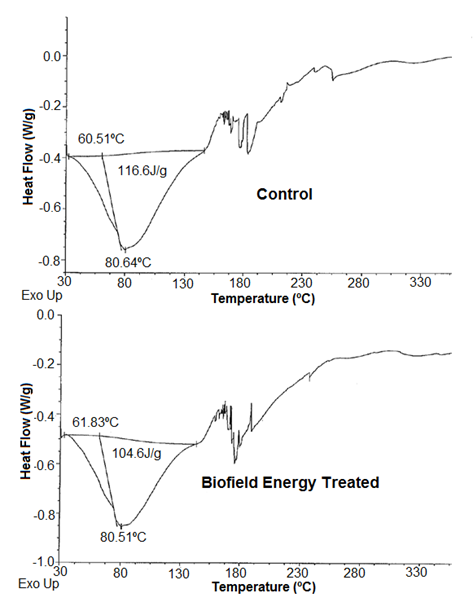
The DSC thermograms of the control and Biofield Energy Treated ashwagandha root extract are given in Figure 2. The DSC thermograms of the control and Biofield Energy Treated samples showed a broad endothermic inflection at 80.64°C and 80.51°C, respectively. This peak might be originated due to the evaporation of the bound water present in the samples. However, there was no significant difference observed in the evaporation temperature between the control and the Biofield Energy Traeted sample. Moreover, the onset evaporation temperature and the latent heat of vaporization in the Biofield Energy Treated sample were observed to be altered significantly by 2.18% and -10.29%, respectively, compared with the control sample (Table 2). Thus, it is assumed that the Biofield Energy Treatment might affected the intermolecular force, which probably resulted in the decreased heat change in the Biofield Energy Treated sample as compared to the control sample. Besides, the thermograms of both the samples also showed several endothermic peaks near 180°C (Figure 2), which might appeared as a result of presence of multiple phytoconstituents in small concentration in the root extract [38, 39].
![Figure 2: The DSC thermograms of the control and Biofield Energy Treated samples showed a broad endothermic inflection at 80.64°C and 80.51°C, respectively. This peak might be originated due to the evaporation of the bound water present in the samples. However, there was no significant difference observed in the evaporation temperature between the control and the Biofield Energy Traeted sample. Moreover, the onset evaporation temperature and the latent heat of vaporization in the Biofield Energy Treated sample were observed to be altered significantly by 2.18% and -10.29%, respectively, compared with the control sample (Table 2). Thus, it is assumed that the Biofield Energy Treatment might affected the intermolecular force, which probably resulted in the decreased heat change in the Biofield Energy Treated sample as compared to the control sample. Besides, the thermograms of both the samples also showed several endothermic peaks near 180°C (Figure 2), which might appeared as a result of presence of multiple phytoconstituents in small concentration in the root extract [38,39].](/fulltextimages/6709/fig_2.png)
| Sample | Tonset (℃) | Tpeak (℃) | ΔHvaporisation (J/g) |
|---|---|---|---|
| Control sample | 60.51 | 80.64 | 116.6 |
| Biofield Treated sample | 61.83 | 80.51 | 104.6 |
| % Change* | 2.18 | -0.16 | -10.29 |
Table 2: The melting point (°C) and latent heat of fusion (J/G) values of the control and Biofield Energy Treated _W._ _somnifera
Table 2: The melting point (°C) and latent heat of fusion (J/G) values of the control and Biofield Energy Treated W. somnifera (Ashwagandha) root extract. Tonset: Onset vaporization temperature, Tpeak: Peak vaporization temperature, ΔH: Latent heat of vaporization, * denotes the percentage change of the Biofield Energy Treated sample with respect to the control sample.
Thermal Gravimetric Analysis (TGA)/ Differential Thermogravimetric Analysis (DTG)
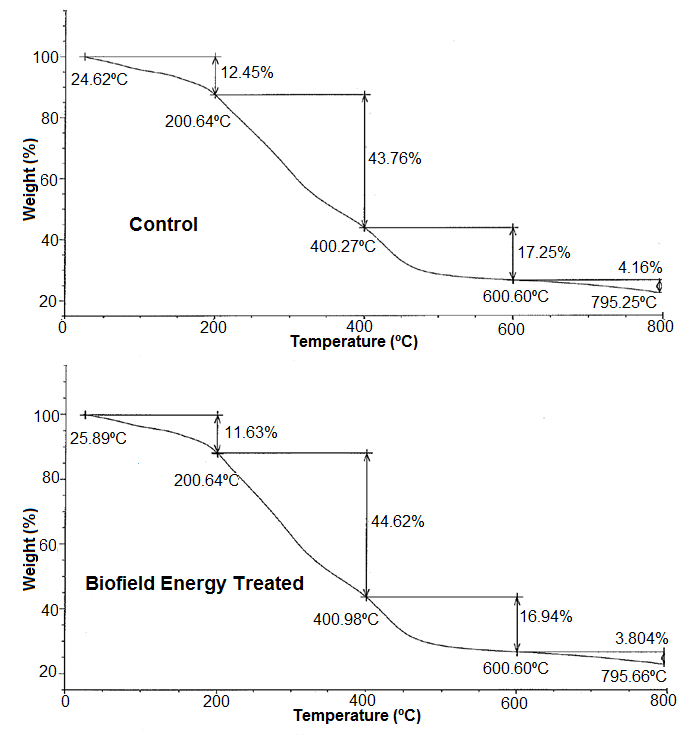
The thermal stability studies of the control and Biofield Energy Treated ashwagandha root extracts was done by using TGA/DTG technique and the TGA thermograms of both the smaples showed four steps of thermal degradation (Figure 3). The analysis revealed that in the 1st, 3rd, and 4th steps of thermal degradation, the weight loss of the Biofield Energy Treated sample was significantly decreased by
6.59%, 1.80%, and 8.65%, respectively compared with the control sample (Table 3). Although, the 2nd step showed some increase in the weight loss of the Biofield Energy Traeted sample, but the total weight loss (76.99%) was slightly reduced by 0.81% compared with the control sample (77.62%). Thus, it is presumed that the thermal stability of the Biofield Energy Treated sample was increased after the Consciousness Energy Healing Treatment compared to the untreated sample.
| Step | Temperature (oC) | Weight loss % | % Change* | ||
|---|---|---|---|---|---|
| Control | Treated | Control | Treated | ||
| 1st step of degradation | 200.64 | 200.64 | 12.45 | 11.63 | -6.59 |
| 2nd step of degradation | 400.27 | 400.98 | 43.76 | 44.62 | 1.97 |
| 3rd step of degradation | 600.6 | 600.6 | 17.25 | 16.94 | -1.8 |
| 4th step of degradation | 795.25 | 795.66 | 4.16 | 3.8 | -8.65 |
| Total weight loss | - | - | 77.62 | 76.99 | -0.81 |
Table 3: Thermal degradation steps of the control and Biofield Energy Treated W. somnifera (Ashwagandha) root extract. *denotes t
Besides, the DTG thermograms of both the control and Biofield Energy Treated samples showed two broad peaks (Figure 4). The analysis revealed the maximum thermal degradation temperature in the control sample at 234.17°C and 365.12°C for these two broad peaks, however the Biofield Energy Treated sample showed Tmax at 230.11°C and 362.13°C corresponding to those peaks (Table 4).
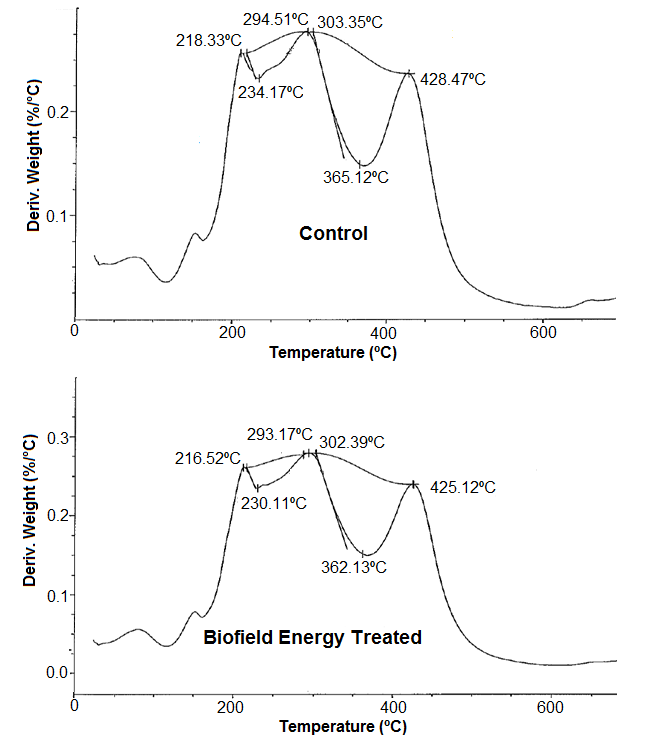
Thus, the Tmax of the Biofield Energy Treated sample was decreased by 1.73% and 0.82%, respectively compared to the control the sample. Overall, the thermal studies indicated that the thermal stability of the Biofield Energy Treated ashwagandha root extract was altered compared to the control sample.
| Description | T (°C) max | |
|---|---|---|
| Peak 1 | Peak 2 | |
| Control Sample | 234.17 | 365.12 |
| Biofield Energy Treated Sample | 230.11 | 362.13 |
| % Change* | -1.73 | -0.82 |
Table 4: The DTG thermal degradation steps of the control and Biofield Energy Treated _W. somnifera_ root extract. *denotes the p
Ultraviolet-visible Spectroscopy (UV-Vis) Analysis
The UV-vis spectra of both the control and Biofield Energy Treated samples are shown in Figure 5.
The spectra of both the smaples showed the maximum absorbance at 204 nm (λmax). However, the peak at 204 nm was showed a minor shift of absorbance maxima from 1.4594 in control to 1.5376 in the Biofield Energy Treated sample. The UV absorbance occurs due to the different type of energy transitions and such electronic transitions only taken place when there is the energy difference between the lowest unoccupied molecular orbital (LUMO) and the highest occupied molecular orbital (HOMO) and it is significantly higher than the activation energy of the compound [40]. Thus, the UV-Vis studies revealed no difference in the control and Biofield Energy Treated sample in terms of λmax, which means that the molecular structure of the phytoconstituents in the Biofield Energy Treated sample remained same as that of the control sample.
Fourier Transform Infrared (FT-IR) Spectroscopy
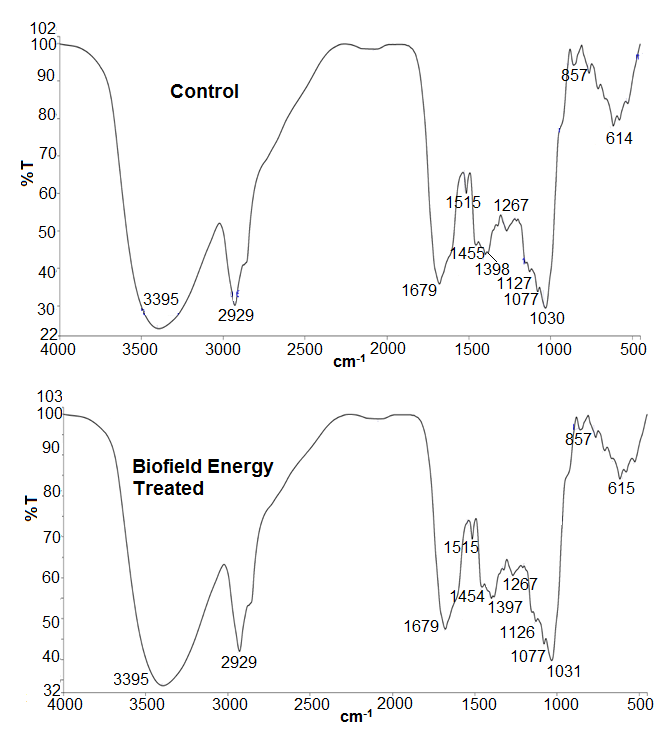
The FT-IR spectra of the control and Biofield Energy Treated ashwagandha root extract are shown in Figure 6. It is reported that if other factors remain constant, the vibrational frequency (wavenumber) is directly proportional to the force constant; however, there are several factors that may affect it such as hybridization, bond strength, resonance, conjugation [41, 42].
![Figure 6: It is reported that if other factors remain constant, the vibrational frequency (wavenumber) is directly proportional to the force constant; however, there are several factors that may affect it such as hybridization, bond strength, resonance, conjugation [41,42].](/fulltextimages/6709/fig_6.png)
The FT-IR spectral analysis revealed that the vibrational frequencies of the Biofield Energy Treated sample corresponding to the characteristic functional groups of ashwagandha root extract such as C-H, C-C, C-O, and C=O groups were similar to the control sample. The broad peak at 3600-3200 cm-1 may be due to the O-H functional group frequency of the hydroxyl groups present in phytoconstituents of the sample. The O-H stretching was observed at 3395 cm-1 in both the samples. Similarly, the C-H stretching for both the samples was observed at 2929 cm-1. Moreover, the C=O stretching (α, β-unsaturated ketone) was observed at 1679 cm-1 in both the control and the Biofield Energy Treated sample. The peaks corresponding to C-C stretching in the spectra of control sample were observed at 1515, 1455, 1398, and 1267 cm-1 and similarly these peaks were observed at 1515, 1454, 1397, and 1267 cm-1 in the spectra of the Biofield Energy Treated sample. Consequently, the peaks regarding C-O bonding (in alkoxy) were observed at 1127, 1077, and 1030 cm-1 in the control sample; while at 1126, 1077, and 1031 cm-1 in the Biofield Energy Treated sample. The peaks corresponding to C-H aromatic bending were also similar in both the samples and were observed at 857 and 614 cm-1 in the control sample; while at 857 and 615 cm-1 in the Biofield Energy Treated sample. The presence of epoxide, unsaturated lactone, 1-keto-2-ene functional groups are very important regarding the pharmacological activities of withanolides [43, 44, 45, 46, 47]. However, the FT-IR results suggested that the spectra of both the samples remained same, which means there was no impact of Consciousness Energy Healing Treatment on the ashwagandha root extract at the atomic level to change the force constant of various atomic bonds.
Conclusion
The present study concluded the impact of Consciousness Energy Healing Treatment (The Trivedi Effect®) on the physicochemical and thermal properties of the ashwagandha root extract. The particle size analysis showed that the particle size values at d10, d50, d90, and D(4,3) in the Biofield Energy Treated sample was significantly decreased by 9.23%, 9.04%, 11.86%, and 10.59%, respectively as compared with the control sample. Moreover, the Biofield Energy Treated sample showed significant increase in the surface area by 10.75% compared to the control sample. The DSC analysis indicated that the onset evaporation temperature of the Biofield Energy Treated sample was significantly increased by 2.18% along with a reduction of 10.29% in the latent heat of vaporization compared with the control sample. The thermal stability analysis involving TGA data showed four steps of thermal degradation in both the control and Biofield Energy Treated samples of ashwagandha root extract. Among these steps, the 1st, 3rd, and 4th steps of thermal degradation of the treated sample showed reduction in the weight loss by -6.59%, -1.80%, and -8.65%, respectively; whereas the 2nd step showed 1.97% increase in weight loss as compared to the control sample. Also, the total weight loss of the Biofield Energy Treated sample was slightly decreased by 0.81% compared to the control sample. Consequently, the DTG analysis revealed two broad peaks in both the samples in which, the Tmax for the control sample were observed at 234.17°C and 365.12°C for the two broad peaks. On the other hand, the Biofield Energy Treated sample corresponding to both peaks showed reduction of 1.73% and 0.82% compared to the control sample and were observed at 230.11°C and 362.13°C, respectively. UV-vis analysis showed the similar λmax for both the samples i.e. at 204 nm. Overall, the Energy of Consciousness Healing Treated ashwagandha root extract might showed better dissolution, absorption, and bioavailability profile along with the increased thermal stability compared with the control sample. Thus, the Biofield Energy Treated ashwagandha root extract could be preferd to be used in the pharmaceutical and nutraceutical formulations that may be helpful in providing better therapeutic response against various diseases such as septic shock, impotency, confusion, low libido, diabetes mellitus, mood swings, stress- related disorders insomnia, mental restlessness, depression, lack of motivation, migraines, obsessive/compulsive behavior, immunological and inflammatory diseases rheumatoid arthritis, irritable bowel syndrome, multiple sclerosis, Alzheimer’s disease, osteoporosis, motor neurone disease, spinal muscular atrophy, chronic infections, etc.
Acknowledgements
The authors are grateful to GVK Biosciences Pvt. Ltd., Trivedi Science, Trivedi Global, Inc., and Trivedi Master Wellness for their assistance and support during this work.
References
-
Singh N, Bhalla M, Jager P, Gilca M (2011) An overview on ashwagandha: A rasayana (rejuvenator) of ayurveda. Afr J Tradit Complement Altern Med 8: 208-213.
-
Mishra LC, Singh BB, Dagenais S (2000) Scientific basis for the therapeutic use of _Withania somnifera_ (ashwagandha): A review. Altern Med Rev 5(4): 334-346.
-
Misra L, Mishra P, Pandey A, Sangwan RS, Sangwan NS, et al. (2008) Withanolides from _Withania somnifera_ roots. Phytochemistry 69(4): 1000-1004.
-
Dongre S, Langade D, Bhattacharyya S (2015) Efficacy and safety of ashwagandha (_Withania somnifera_) root extract in improving sexual function in women: A pilot study. Bio Med Research International.
-
Archana R, Namasivayam A (1998) Antistressor effect of _Withania somnifera_. J Ethnopharmacol 64(1): 91-93.
-
Bhattacharya S, Muruganandam A (2003) Adaptogenic activity of _Withania somnifera_: An experimental study using a rat model of chronic stress. Pharmacol Biochem Behav 75(3): 547-555.
-
Provino R (2010) The role of adaptogens in stress management. Aust J Med Herbal 22(2): 41-49.
-
Wankhede S, Langade D, Joshi K, Sinha SR, Bhattacharyya S (2015) Examining the effect of _Withania somnifera_ supplementation on muscle strength and recovery: A randomized controlled trial. Journal of the International Society of Sports Nutrition 12: 43.
-
Kumar V, Dey A, Hadimani MB, Marcović T, Emerald M (2015) Chemistry and pharmacology of _Withania_ _somnifera_: An update. Tang (Humanitas Medicine) 5(1): 1.1-1.13.
-
Trivedi MK, Branton A, Trivedi D, Nayak G, Balmer AJ, et al. (2017) Evaluation of physicochemical, thermal, structural, and behavioral properties of magnesium gluconate treated with energy of consciousness (The Trivedi Effect®). Journal of Drug Design and Medicinal Chemistry 3(1): 5-17.
-
Trivedi MK, Branton A, Trivedi D, Nayak G, Balmer AJ, et al. (2017) Evaluation of physicochemical, spectral, thermal and behavioral properties of the biofield energy healing treated sodium selenate. Science Journal of Chemistry 5(2): 12-22.
-
Trivedi MK, Branton A, Trivedi D, Nayak G, Balmer AJ, et al. (2017) Study of the energy of consciousness healing treatment on physical, structural, thermal, and behavioral properties of zinc chloride. Modern Chemistry 5(2): 19-28.
-
Rubik B, Muehsam D, Hammerschlag R, Jain S (2015) Biofield science and healing: history, terminology, and concepts. Glob Adv Health Med 4: 8-14.
-
Zahra M, Farsi M (2009) Biofield therapies: Biophysical basis and biological regulations. Complement Ther Clin Pract 15(1): 35-37.
-
Barnes PM, Bloom B, Nahin RL (2008) Complementary and alternative medicine use among adults and children: United States, 2007. Natl Health Stat Report 12: 1-23.
-
Trivedi MK, Patil S, Shettigar H, Singh R, Jana S (2015) An impact of biofield treatment on spectroscopic characterization of pharmaceutical compounds. Mod Chem Appl 3(3): 159.
-
Trivedi MK, Branton A, Trivedi D, Nayak G, Bairwa K, et al. (2015) Spectroscopic characterization of disulfiram and nicotinic acid after biofield treatment. J Anal Bioanal Tech 6: 265.
-
Trivedi MK, Branton A, Trivedi D, Nayak G, Balmer AJ, et al. (2017) Evaluation of physicochemical, thermal, structural, and behavioral properties of magnesium gluconate treated with energy of consciousness (The Trivedi Effect®). Journal of Drug Design and Medicinal Chemistry 3(1): 5-17.
-
Trivedi MK, Branton A, Trivedi D, Nayak G, Bairwa K, et al. (2015) Physical, thermal and spectroscopical characterization of biofield treated triphenylmethane: An impact of biofield treatment. J Chromatogr Sep Tech 6(6): 292.
-
Trivedi MK, Branton A, Trivedi D, Nayak G, Bairwa K, et al. (2015) Physicochemical and spectroscopic characteristics of biofield treated _p_-chlorobenzophenone. American Journal of Physical Chemistry 4(6): 48-57.
-
Trivedi MK, Tallapragada RM, Branton A, Trivedi D, Nayak G, et al. (2015) The Potential impact of biofield energy treatment on the atomic and physical properties of antimony tin oxide nanopowder. American Journal of Optics and Photonics 3: 123-128.
-
Trivedi MK, Tallapragada RM, Branton A, Trivedi D, Nayak G, et al. (2015) Characterization of physical and structural properties of aluminium carbide powder: Impact of biofield treatment. J Aeronaut Aerospace Eng 4: 142.
-
Trivedi MK, Tallapragada RM, Branton A, Trivedi D, Nayak G, et al. (2015) Physical, atomic and thermal properties of biofield treated lithium powder. J Adv Chem Eng 5: 136.
-
Trivedi MK, Branton A, Trivedi D, Nayak G, Mondal SC, et al. (2015) Impact of biofield energy treatment on soil fertility. Earth Sciences 4(6): 275-279.
-
Trivedi MK, Branton A, Trivedi D, Nayak G, Gangwar M, et al. (2015) Evaluation of vegetative growth parameters in biofield treated bottle gourd (_Lagenaria siceraria_) and okra (_Abelmoschus esculentus_). International Journal of Nutrition and Food Sciences 4: 688-694.
-
Trivedi MK, Branton A, Trivedi D, Nayak G, Bairwa K, et al. (2015) Physicochemical and spectroscopic properties of biofield energy treated protose. American Journal of Biomedical and Life Sciences 3: 104-110.
-
Trivedi MK, Branton A, Trivedi D, Nayak G, Bairwa K, et al. (2015) Effect of biofield treatment on physical, thermal, and spectral properties of SFRE 199-1 mammalian cell culture medium. Advances in Biochemistry 3: 77-85.
-
Dodon J, Trivedi MK, Branton A, Trivedi D, Nayak G, et al. (2017) The study of biofield energy treatment based herbomineral formulation in skin health and function. American Journal of Bio Science. 5(3): 42-53.
-
Kinney JP, Trivedi MK, Branton A, Trivedi D, Nayak G, et al. (2017) Overall skin health potential of the biofield energy healing based herbomineral formulation using various skin parameters. American Journal of Life Sciences 5(2): 65-74.
-
Trivedi MK, Branton A, Trivedi D, Nayak G, Saikia G, et al. (2015) Characterization of physico-chemical and spectroscopic properties of biofield energy treated 4-bromoacetophenone. American Journal of Physical Chemistry 4(4): 30-37.
-
Trivedi MK, Branton A, Trivedi D, Nayak G, Saikia G, et al. (2015) Quantitative determination of isotopic abundance ratio of 13C, 2H, and 18O in biofield energy treated _ortho_ and _meta_ toluic acid isomers. American Journal of Applied Chemistry 3(6): 217-223.
-
Trivedi MK, Branton A, Trivedi D, Nayak G, Saikia G, et al. (2015) Thermal, spectroscopic and chromatographic characterization of biofield energy treated benzophenone. Science Journal of Analytical Chemistry 3(6): 109-114.
-
Trivedi MK, Branton A, Trivedi D, Nayak G, Lee AC, et al. (2017) A comprehensive analytical evaluation of the Trivedi Effect® - Energy of Consciousness Healing Treatment on the physical, structural, and thermal properties of zinc chloride. American Journal of Applied Chemistry 5(1): 7-18.
-
Trivedi MK, Branton A, Trivedi D, Nayak G, Plikerd WD, et al. (2017) A systematic study of the biofield energy healing treatment on physicochemical, thermal, structural, and behavioral properties of iron sulphate. International Journal of Bioorganic Chemistry 2(3): 135- 145.
-
Chereson R (2009) Bioavailability, bioequivalence, and drug selection. In: Makoid CM, et al. (Eds.), Basic pharmacokinetics (1st edn) Pharmaceutical Press, London.
-
Khadka P, Ro J, Kim H, Kim I, Kim JT, et al. (2014) Pharmaceutical particle technologies: An approach to improve drug solubility, dissolution and bioavailability. Asian J Pharm Sci 9(6): 304-316.
-
Buckton G, Beezer AE (1992) The relationship between particle size and solubility. Int J Pharmaceutics 82(3): R7-R10.
-
Mitra D, Francis S, Varshney L (2004) Calorimetry thermal investigations on γ radiation processed natural medicinal products (ashwagandha, amla and hartiki). J Therm Anal Cal 78: 821-829.
-
Srivastava A, Alam S, Shahbaaz S, Tiwari M, Mittal A, et al. (2014) Formulation and evaluation of antiacne cream containing _Withania somnifera_. J Pharm Sci Inv 3(4): 348- 352.
-
Hesse M, Meier H, Zeeh B (1997) Spectroscopic methods in organic chemistry, Georg Thieme Verlag Stuttgart, New York.
-
Stuart BH (2004) Infrared spectroscopy: Fundamentals and applications in analytical techniques in the sciences. John Wiley & Sons Ltd., Chichester, UK.
-
Reichenbacher M, Popp J (2012) Challenges in Molecular structure determination, Springer-Verlag Berlin Heidelberg.
-
Zhao J, Nakamura N, Hattori M, Kuboyama T, Tohda C, et al. (2002) Withanolide derivatives from the roots of _Withania somnifera_ and their neurite outgrowth activities. Chem Pharm Bull 50(6): 760-765.
-
Misra L, Lal P, Chaurasia ND, Sangwan RS, Sinha S, et al. (2008) Selective reactivity of 2-mercaptoethanol with 5β, 6β- epoxide in steroids from _Withania somnifera_. Steroids 73(3): 245-251.
-
Joshi P, Misra L, Siddique AA, Srivastava M, Kumar S, et al. (2014) Epoxide group relationship with cytotoxicity in withanolide derivatives from _Withania somnifera_. Steroids 79: 19-27.
-
Gu M, Yu Y, Gunaherath GMKB, Leslie Gunatilaka AA, Li D, et al. (2014) Structure-activity relationship (SAR) of withanolides to inhibit Hsp90 for its activity in pancreatic cancer cells. Invest New Drugs 32(1): 68-74.
- Management of Ear Keloid with Ksharsutra: A Case Study
- Yoga and Global Sustainability: A Holistic Path to One Earth, One Health
- Autoimmune Diseases in Ayurveda: A Narrative Review with Classical and Modern Perspectives
- Management of Cluster Headache Associated with Pituitary Apophysitis by CERT (Chakrasiddh Energy Release Technique): A Case Report on Energy Rebalancing
- Zygophyllum Geslini Coss : Biochemicals and Antioxidant Activity
- Observations of a Beginner Vaidya