
A Protocol of Assessing Ras Dosha Prabhav of Ayurvedic Medicine on Kapha Vruddhi Lakshan
Healthy and unhealthy state of a person's being depends on normal and abnormal functional state of Tridosha, considering the physiological importance of Dosha in maintenance of homeostasis of the body they also are called as roots of the body. All the functions of the body might be explained in terms of Dosha, Dhatu and Mala. Tridosha are the biological entities derived from Panchamahabhuta, liable for regulation of all bodily functions and its regulation. Variations in functional state of Tridosha with reference to age, day-night, and season occurs to accommodate body with the environmental influences like sunrise, sunset and differences due to the season. Ayurveda has described three dynamic states of Tridosha, namely Sama (balanced state). This paper is aimed to summarize and analyze the descriptions regarding the hypo and hyper functional states of Tridosha (Dosha Kshya-Vriddhi) made by Ayurvedic scholars and suggest some objective parameters to assess the functional state of Tridosha. Aim of study is Evalution of the Concept Of Ras-dosha sambandh siddhant by Using Kaphshamak Ras (Katu, Tikta, Kashay) Dravyas In Kaphvruddhi Lakshanani. Study Design is seven arm comparative clinical study, Study Type is Interventional study Sample size is 420 Subjects (60 in each group) Sample selection techniques: Selections of subjects will be done by lottery method. Subjects in the age group of 16-50 years of irrespective sex having cardinal features of kaphavruddhi lakshan Agni sadan, Prasek, Alasya, Gaurav, Shvaithya (white discoloration),Shaithya (coldness), Shlathangatva (looseness of the body parts), Shwasa (dyspnoea), Kasa (cough, cold), Atinidrata (excess of sleep. 7-7½ hrs). • Criteria for Selection of Subjects: Subjects with signs and symptoms of Kaphvruddhi Lakshanani will be selected from OPD Deptartment of Swasha rakshan (MIMS Sumati bhai Shah Ayurved Mahavidyalaya, Pune). Approval of the study will be taken after presentation from institute’s ethics committee The cases will be enrolled after describing the treatment and obtaining informed consent in English and local language. Subjects eligible for inclusion criterion who will be selected for clinical trial, drugs are Standardized and well authenticated chitrak, patala, bhibhitaka will be procured from market. Interventional trial will be measured and by proper statistical analysis the observations of parameters are assessed.
Introduction
Ayurveda aims at prevention and cure of diseases. Acharya Sushruta defined “Aarogya” as equilibrium or balanced state of dosha, agni, dhatu and mala, pleasant state of atma, indriya and mana is healthy state [1, 2]. The basic concept of Ayurveda is dosha-man. This Siddhanta provides fundamental knowledge for understanding of the theories of Ayurveda regarding Ahara pachana, Dhatu Utpatti, Vyadhi Utpatti, Ayu parigyana etc. With the help of that particular dosha-man, the body gets its samprapti by serial development of diseases. This can be understood in the terms of dosha how it’s vitiated and what is the possible management of it. It is quite clear that we simple approach the symptoms so that even don’t need to be having whole disease management, therefore a Vaidya should always take care of dosha -man who is least examined in course of treatment. Any disturbance in the equilibrium of dosha is known as disease and on the other hand the state of their equilibrium is health [3]. According to charak Samhitas “kaphavruddhi” is the basic cause for kaphjanya pathogenesis of disease [4].
Literary Review
The concept of ras-dosha sambhandh is unique and if one wan to manage the disease we must know pre- symptoms, sign and symptoms, upshay, sankhya, pradhanya, vidhi, vikalp, bal, kal vishesh, type of samprampti then we one know dosha as first priority, later aushdh, desh kal,bal, sharer, sar ahar, satmya, satwa [4]. A vaidya must know all by just how it’s vitiated at extent it vitiated, treatment of any disease and symptoms is purely depedent on dosha man. Then it’s very easy to manage everything. Acharya Charak has mentioned that before management one should follow type of dosha which is involved in samprapti by just knowing the exactly at what extent it’s vitiated or mitiated.
In rasviman addhay Acharya charaka mentioned that, ek-ek dosha is to be formed by ek-ek ras in the process of digestion. While katu, kashay and tikta ras aggrevates vatdosha, madhur amla lavan mitigates vaatdosha. Katu amla lawana ras aggrevates pittadosha while madhur tikt kashay mitigates pitta dosha, madhur amla and lawan ras aggrevates the kapha dosha while katu tikta kashay mitigates kapha dosha [5, 6]. This main principle of management of disease by simple way approaches its pre-symptoms and symptoms. Details of mutual combination and proportional variation with regard to them are innumerable because these variations are innumerable. (Ch.Vi.1/8) Where there is a critically analyze the role of rasas or dosas individually and then decide the effect of the substance or the disorder wholly. (Ch.Vi.1/9) Chitrak (sweta) mul31, Patala fal30 and bhibhitak faltwak are Katu 30, Tikta and Kashay Rasa Pradhan Dravya respectively which will be used for study. In Charak Samhita, Sushrut Samhita, Ashtangsangraha and Kashay Skanda respectily and also described as Kaphshamak. All these drugs are easily available so selected for the study. Dravyas which are dominant in their rasa are indicated in nighantu. Patala has tikta ras as dominent rasa. Bhibhtak has kashay ras as dominent rasa. Chitrak has tikta ras as dominent rasa. Katu, tikta, kashay rasa mitigates kaphavruddhi lakshananini.
Need of Study
Dosha man of any disease is simple way to approach a disease. Dosha-man gives idea at what extent dose samprapti of dosha happens. There is co-relation between ras and dosha. Dravya are classifies on the basis of their ras-dosha prabhav. It’s extent of choosing for management of disease.
- In ayurveda we should follow the ras-dosha relation without knowing samprapti.
- Dravya take part into action with pradhan ras, dravya acts by ras parbhav and hence use of Kaphashamak ras is treat the kaphavruddhi in any disease.
- Kaphashamak ras and its sanyog is best treatment for kaphavruddhi lakshans.
- Kaphashamak ras and its sanyog acts by its panchbhautik sanghtan and act on kaphavruddhi.
Production of excess “kaph” a main cause of sickness due to kaphavruddhi, root cause of all diseases is kaphavruddhi its simple to treat by selecting type of ras dravya Thus deciding the dosha man which vitiated which affects body balance is of prime importance, to assess healthy and unhealthy state. Subjective parameters for assessment of kaphavruddhi mentioned in classical text.
Aim and Objectives
Aim of study: Evalution of the Concept Of Ras-dosha sambandh siddhant by Using Kaphshamak Ras (Katu, Tikta, Kashay) Dravyas In Kaphvruddhi Lakshanani.
Objectives
Primary Objectives of study: To evaluate Rasdosha sambandh Siddhant by using kaphashamak ras (Katu,Tikta, kashay) dravyas in management of kaphavrudhi lakshanani.
Secondary Objectives of study
- To study the effect of Ekal rasa dravya on Kaphvruddhi lakshanani.
- To study the effect of Dwi rasa dravyas on Kaphvruddhi lakshanani.
- To study the effect Tri rasa dravyas on Kaphvruddhi lakshanani.
- To compare the effect of rasa-sanyog of Kaphashamaka dravyas on Kaphvruddhi lakshanani.
Material and Methods
Materials
Participants: Subjects with Kaphvruddhi lakshans will be randomly selected from the OPD and IPD of Hospital.
Drug Review
| Dravya | Chitrak [7] | Patala [8] | Bhibhitak [9] |
|---|---|---|---|
| Latin Name /Chemical name | Plumbago zeylanika Linn. | Trichosanthus dioica Roxb. | Terminalia Belerica Linn. |
| RasDosha karma | Katu Kaphshamak kar | Titka Kaphshamak kar | Kashay Kaphshamak kar |
| Part used | Root | Whole Fruit | Fruit except seed |
Table 1: Kaphshamak Ras dravya.
Treatment Protocol
| 1 | 2 | 3 | 4 | 5 | 6 | 7 | |
|---|---|---|---|---|---|---|---|
| Dravya | Ek Ras | Ek Ras | Ek Ras | Dvay Ras | Dvay Ras | Dvay Ras | Tray |
| sanyog | dravya | dravya | dravya | dravya | dravya | dravya | Ras dravya |
| Group | Group A | Group B | Group C | Group D | Group E | Group F | Group F |
| Drugs | Chitrak | Patala | Bhibhitak | Chitrak + Patala | Chitrak + Bhibhitak | Patala+ Bhibhitak | Chitrak + Patala+ Bhibhitak |
| Contents | 3 gm | 3 gm | 3 gm | 1.5 gm each | 1.5 gm each | 1.5 gm each | 1.00 gm Each |
| Dose | 3 gm Vati (500mg each) | 3 gm Vati (500mg each) | 3 gm Vati (500mg each) | 3 gm Vati (500mg each) | 3 gm Vati (500mg each) | 3 gm Vati (500mg each) | 3 gm Vati (500mg each) |
| Anupan | Water | Water | Water | Water | Water | Water | Water |
| Kal | Anannakal (Before meal) | Anannakal (Before meal) | Anannakal (Before meal) | Anannakal (Before meal) | Anannakal (Before meal) | Anannakal (Before meal) | Anannakal (Before meal) |
Table 2: Kaphshamak Ras dravya combinations in group.
Methodology
Study design: Comparative Clinical Seven arm study. Type of study: Prospective Interventional study Study Area: OPD/IPD of College hospital. Study Duration: 1.5 years. Sample size: 60 patients in each group. Type of Sampling: Purposive sampling
Sample size calculation
( ) 2 $$ n = \frac {z ^ {2} p (1 - p)}{d ^ {2}} $$
n= sample size z=standard deviation (1.96) p= prevalence d= error (0.05)
( ) 2
2 z p 1-p n= d Sample size will be calculated on the basis of pilot study of 20 patients.
Sampling Technique
Subject will be selected by using Purposive sampling method from patients in OPD and IPD who meet the eligibility criteria till the desired sample size achieved. Patients of kaphavruddhi lakshanani will be selected in OPD on the basis of irrespective of gender, economic states, religion, and occupation. Assessment will be done pre-post Treatment follow-up and data collection will be done on 1st, 3rd, 5th, 7th, 9th day of treatment. Treatment will be given to patients as it mentioned previously and there efficacy will be seen.
Method of Selection of Patients
Grouping: Dosha pariksha of all the selected subjects will be done on the basis of subjective parameters (Case Report Proforma). Then Cardinal signs and symptoms of kaphvrudhi will be identified. Accordingly all the participants will be divided equally in seven groups.
- Group A: Subjects receiving Chitrak churna.
- Group B: Subjects receiving Patala churna.
- Group C: Subjects receiving Bhibhitak churna.
- Group D: Subjects receiving two drug combination Chitrak + Patala.
- Group E: Subjects receiving two drug combination Chitrak + Bhibhitak.
- Group F: Subjects receiving two drug combination Patala+ Bhibhitak.
- Group D: Subjects receiving three drug combinations Chitrak + Patala+ Bhibhitak.
Case Definition
Kaphavrudhhi lakshan: Kapha, when increased produces, Agnisadana-weak digestive activity, Praseka-excess salivation, Alasya-lassitude, laziness, Gaurava-feeling of heaviness, Shvaithya-white discoloration, Shaithya – coldness,, Shlathangatva-looseness of the body parts, Shwasa-dyspnoea, Kasa-cough, Atinidrata-excess of sleep. 7 – 7½ hrs.
Probable Mode of Action
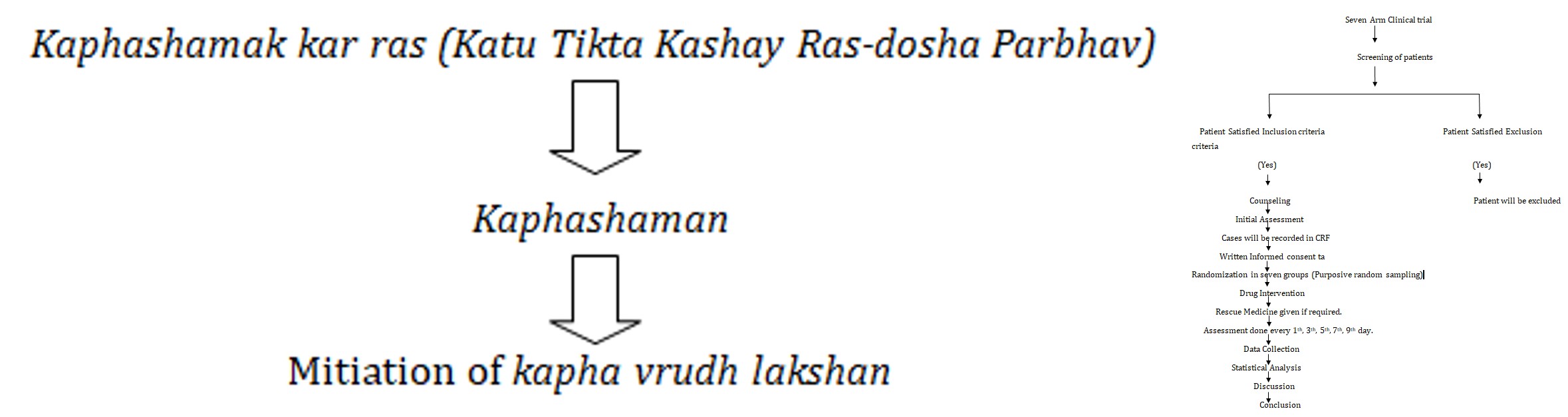
Inclusion Criteria
- Subjects of either gender between age group 16-50 yrs will be selected.
- Cardinal signs and symptoms of Kaphvruddhi (Agnisadana, Praseka, Alasya, Gaurava, Shvaithya, Shaithya, Shlathangatva, Shwasa, Kasa, Atinidrata).
- Obedient and regular in attending or reporting the OPD & IPD patients.
Exclusion Criteria
- Subjects having sign and symptoms other than Kaphvriddhijanya vikar.
- Patients known case of tuberculosis, carcinoma of stomach and intestine etc.
- Subjects with addiction of alcohol, tobacco, smoking, kharra, mava etc.
- Pregnant woman and lactating mothers.
- Subjects performing night duty shifts.
Withdrawal Criteria
- Patients willing to quit in between the trial will be allowed to quit and replaced.
- If any adverse effect and drug reaction develops patients excluded.
Other Work
- Preparation of case record form
- Selection of study subjects.
- Written consent of patient will be taken priory.
- Administration of drug for 7 days.
Drug Standardization
All Raw materials used in trial in crude form will be collected from genuine source. They Will be Authenticated and standardized.
Preparation of Drug
Preparation of Churna vati will be prepared is done in attached pharmacy.
Study Plan
Assessment Criteria
Parameters for Subjective Criteria
- Symptoms of Kaph dosha vrudhhi
- Agni sadan
- Prasek
- Alasya
- Gaurav
- Shvaithya (white discoloration)
- Shaithya (coldness)
- Shlathangatva (looseness of the body parts)
- Shwasa (dyspnoea)
- Kasa (cough, cold)
- Atinidrata (excess of sleep. 7 – 7½ hrs)
Statistical Methods
With proper s Statistical analysis:
- Student’s Unpaired - T test
- Paired T test
- Pearson’s Correlation Coefficient test
- ANOVA test, Chi square test
Observation and Results
Assessment of Results
The effect of Chitrak churna. Patala churna. Bhibhitak churna on in seven groups (results) will be assessed regarding the clinical signs and symptoms. All subjective parameters will be observed and recorded as before Treatment (BT) and after Treatment (AT) then the comparison of the inter group relationship and intragroup relationship result of seven the group will be done.
- Ethical Consideration: Study will be started after the ethical clearance from IEC.
- Withdrawal Criteria: Patient will be withdrawn from the study if there will be any adverse effect occurs, and then he or she will be treated for the same in free of cost.
- Consent according to ICMR/WHO Format: Enclosed and will be taken.
- Information to the Patients: All information about Shirodhara procedure will be given to the subject in his/ her language
Expected Results
The Subjects with kaphavuddhi lakshan fit for oral intervention of chitrak patala and bhibhitaka and the limiting sign and symptoms in kaphavuddhi is expected result will be withdrawn on the basis of observations.
Outcome
- Reliving in sign and symptoms in the subjects intervened. Correlation between Ras-dosha on the basis of Subjective parameters of Kaphshamak Ras dravya.
- Transitory scale of assessing Ras-dosha prabhav by choosing type of ras. Founding new drug Intervention which effective on to dosha lakshans by choosing on type of dravya.
- Early indentifcation and management of Kaphvruddhi lakshan which may prove key factor on preventing future lifestyle disorders.
Discussion
Discussion will be done on the basis observations and results of individual groups and comparative statistical Analysis. A number of articles related to dravya, guna, karma and rasa prabhav and related conditions available in this region were reviewed [6, 7, 8, 9, 10, 11, 12, 13, 14, 15, 16].
References
-
Samhita C, Dass S (2005) Viman sthan Rasviman adhyaya, Choukhamba Orientalia. 1st (Edn.), Varanasi 2(5): 1120.
-
Samhita SS, Shastri A, Sutrasthan (2009) 15th Chapter Dosha adhatumalak shayavruddhi vigyaniyam Adhyaya. Choukhamba Krishnadas acadmy, Varanasi 1(41): 354.
-
Samhita C, Dass S (2005) Chikitsa sthan Grahanichikitsa adhyaya. Adhyaya 15th (Edn.), Choukhamba Orientalia, Varanasi 3(3-4): 1863.
-
Vagbhata, Hridayam A, Sitaram B (2005) Sutra sthan 1st Chapter, Ayushkamiya Adhyaya, Choukhamba Orientalia, Varanasi 1(19): 11.
-
Vagbhata, Hridayam A, Sharma P (2005) Nidan sthan, 12th Chapter, Vatavyadhinidanam Adhyaya, Choukhamba Orientalia, Varanasi 1(3): 389.
-
Bhoyar K, Mhaiskar B, Pusadkar S, Bhoyar S, Salankar H, et al. (2021) A Review Article on Ahar Vihar According to Ritus in Ayurveda. Indian Journal of Forensic Medicine & Toxicology 15(2): 4.
-
Mhaiskar B (2019) Role of kshar amla siddhant in understanding and treating the vyadhi by enhancing kalagamitva. National conference proceeding book Kala anveshanam 1: 127-139.
-
Mishra J (2008) 1st Chapter, Chowkhambha Sanskrit Series Office. Astanga Samgraha of Vagbhatta, Sutrasthana, Varanasi 19: 6.
-
Acharya YT (2008) 46th Chapter, Chaukhambha Orientalia, Sushruta Samhita of Sushruta, Sutrasthana, 9th (Edn.), Varanasi 528: 253.
-
Shastri BS (2009) Chaukhambha Prakashan, Yogaratnakara, Purvardha, Ashtasthana Nirikshanam, Varanasi 1: 5.
-
Acharya YT (2007) 15th Chapter, Chaukhambha Prakashan. Charaka Samhita of Agnivesha, Chikitsasthana, Varanasi 94: 519.
-
Sushruta, Samhita S, Shastri A, Sthan S (2009) 21st Chapter, Dosha adhatumalakshaya vruddhi vigyaniyam Adhyaya, Choukhamba Krishnadas acadmy, Varanasi 1(3): 226.
-
Charak, Samhita C, Dash S (2005) Chikitsa sthan Grahanichikitsa adhyaya. Adhyaya 15th (Edn.), Choukhamba Orientalia, Varanasi 3(11): 240.
-
Verma V, Agrawal S, Gehlot S (2018) Possible measures to assess functional states of tridosha: A critical review. Int J Health Sci Res 8(1): 219-234.
-
Samprapti CV, Rajayakshma O (2020) Unique Journal of Ayurvedic and Herbal Medicines.
-
Dhumal VP, Satpute VS (2019) Review of therapeutics associated with aggregation of kapha.
- Management of Ear Keloid with Ksharsutra: A Case Study
- Yoga and Global Sustainability: A Holistic Path to One Earth, One Health
- Autoimmune Diseases in Ayurveda: A Narrative Review with Classical and Modern Perspectives
- Management of Cluster Headache Associated with Pituitary Apophysitis by CERT (Chakrasiddh Energy Release Technique): A Case Report on Energy Rebalancing
- Zygophyllum Geslini Coss : Biochemicals and Antioxidant Activity
- Observations of a Beginner Vaidya