
Role of Nasal Instillation with Ayurvedic Polyherbal Formulation in Melasma: A Case Study
Background: External beauty of human being is mainly dependent upon the quality of skin. Melasma is common hyperpigmentation disorder in the facial skin of the Indian women. It is the cause of common socio-cosmetic stigma along with hindrance to the success of more or less all professions. Allopathic management of melasma is having higher recurrence rate with mild to moderate adverse effect. This case study is to establish a scientific data to the Ayurvedic cosmetology in the management of melasma. Case summary: A 25 year old female, known case of melasma since last 5 years attended OPD of Panchakarma dept. Rishikul campus. After assessing the nidan and samprapti, she was planned for nasya with kumkumadi tailam along with some herbomineral compound. Allopathic medication which she had been taking for the same problem was reduced in tapering dose and after 1 week she was completely on Ayurvedic management. During the total study period (56 days) the patient was assessed for five times. Patient had shown significant improvement in symptoms like darkness, area involvement, itching, swelling, dryness related to the patches. Subjective and Objective parameters of the study is observed and assessed with the criteria as per the modern cosmetology. Conclusion: Ayurveda, in the field of cosmetology is a promising aspect of practice. This single case study has shown highly significant result with combined management of Ayurvedic internal medication with panchakarma therapy. It surely can lead to find out solution of different problems in the field of cosmetology with Ayurvedic/panchakarma treatment.
Introduction
Beauty is a combination of qualities, such as shape, colour, or form, that pleases the aesthetic senses. External beauty of an individual mainly dependent upon the quality of skin. A healthy skin gives self- confidence and pleasure to the onlooker. In some professions skin health and beauty is the means of success.For a healthy skin, you have to invest time and effort, there is no instant miracle. There are many causes which disturb texture of the facial skin and one of them is melasma. The term “melasma” is derived from Greek word ‘Melas’ meaning black. It is one of the most common acquired hyper-pigmentation disorders characterized by gary brown symmetrical hyperpigmented macules on face. The prevalence of melasma varies between 1.5% and 33.3% depending on the population [1, 2]. Its prevalence in pregnancy is around 50-70% and affects predominantly Hispanics and Indians [3, 4].
Cause of melasma is multi factorial and includes pregnancy, exposure to sunrays, hormone therapy, use of cosmetics, and racial or genetic effects. Some of the major causes are sun exposure, pregnancy, or oral contraceptives. On the basis of signs and symptoms it can be correlated with Vyanga in Ayurveda. Acharya Sushruta was the first to give a detailed and separate description of this disease under “Kshudra Roga” [5]. Doshas responsible for manifestation of the disease, are Vata and Pitta, they are aggravated due to different Manasika nidana (psychological factors) and affects the Mukha Bhaga (face). It is associated with an assortment of sign and symptoms like Niruja (painless), Tanu(thin) and shyavabarna Mandalas (bluish-black patches) on face over Mukha Pradesha [6]. Proper diagnosis with severity is very essential for treating this disease. In modern medical science, treatment varies according to cause of the disease, there is no such specific treatment for eradication of this disease but topical steroids have been described. However, the topical steroids are not completely free from adverse effects such as irritation, rashes etc. Therefore, there is a need for a better and effective treatment to overcome this disease. Ayurveda can contribute a lot in the field of cosmetology with its holistic approach. This particular case study means to prove scientifically the role of Nasya with Kumkumadi Taila in management of melasma with satisfactory result.
Case Report
A 25 year old female, known case of melasma since last 5 years attended OPD of Panchakarma department Rishikul campus. After assessing the Nidan and Samprapti, she was planned for Nasya with Kumkumadi Tailam along with some herbo-mineral compound. Allopathic medication which she had been taking for the same problem was reduced in tapering dose and after 1 week she was completely on ayurvedic management. During the total study period (56days) the patient was assessed for five times during which she had shown significant improvement in symptoms like darkness, area involvement, itching, swelling, dryness related to the patches. Subjective and Objective parameters of the study is observed and assessed with the criteria as per the modern cosmetology.
Patient Information
A 25 year old female was asymptomatic 5 years ago. She gradually developed symmetrical spotted brown to blackish discolouration on the face region. She also had associated symptoms like burning sensation, itching and swelling in the affected parts of face region. The black spots were homogenously distributed into both right, left malar region, forehead, nose and chin of the patient. Patient had been suffering from irregular menstruation and white discharge per vagina in the past 1 year. She has undergone allopathic treatment for the same complaint but, did not get any significant relief. Gradually her facial skin was becoming dry and photosensitivity was noted. She came to Panchakarma OPD of Rishikul Campus (P.K.-6265), UAU Haridwar for better management. After all the physical examinations she was provisionally diagnosed asa case of Melasma.
Past History
Patient did not have gave any history of hypertension, diabetes mellitus, typhoid problem, jaundice, malaria. She had a history of dengue fever one month back and was managed in hospital. Cyst was detected in her left breast, for which she was operated 2 years back. She did not have any history of allergy and any accident/trauma. Patient had no documented history of taking steroidal or cytotoxic drugs.
Examination on Admission
The Patient, resident of Roorkee, Haridwar an unmarried girl of Hindu community from middle class family who works as part timer (morning and evening shift alternately) in chemical industry. She is habituated to mixed diet (mainly oily and spicy) with addiction to tea (4/5 cup daily). Appetite is reduced. Bowel habit and micturition is normal. Other features of general examinations are within normal limit. There is family history of melasma noted. Basic parameters such as Blood Pressure (120/76 mm Hg), Pulse (80/min), Temperature 980F, Respiratory Rate(20/min), were within normal limits. No abnormality was detected in cardiovascular, respiratory and central nervous systems.
Ayurvedic Review
During Dashavidhparikshaya bhava Examination, Patient was observed as
- Pakruti: Kapha-Pitta
- Vikriti: Vata-Pitta predominant
- Sara: Mamsa, medasarata in Pravar; Rasa, Rakta, Asthisarata in Madhyam; Majja, Shukrasarata in Avar matra.
- Samhanana: Madhyam
- Pramana: Madhyam
- Satmya:Madhyam
- Satva: Madhyam
- Ahara shakti: Madhyam
- Vyayama shakti: Madhyam
- Vaya: Madhyam Samprapti Ghatak
- Dosha: Vata, Pitta, Rakta
- Dushya: Twak, Rasa, Rakta
- Srotas: Rasavaha, Raktavaha
- Agni: Vishamagni
- Rogamarga: Bahya
- Sadhyasadhyta: Sadhya
- Ritu: Shisir, visargakaal
Intervention
Treatment was planned after considering all the inclusion, exclusion criteria and Doshik involvement of the disease. Shaman Nasya was given in two sittings, each sitting was of 7 days. 14 days of interval was choosen after each sitting of Nasya. Follow up of the patient was done after 56 days from the first treatment schedule. Vitals were checked each day prior to the therapy. Assessments were done on 1st, 7th, 21st, 28th and 56th day of the study. Nasya dose was adjusted in Arohi krama starting from 8 drops increasing up to 16 drops then to decrease until the initial dose.
Assessment Criteria
The assessment was done on the basis of both subjective and objective parameter described below A) Melasma Area Severity Index (MASI) which assess the percentage of total area involved based on three variables [7]. (Tables 1-3).
| Day | Day 1 | Day 7 | Day 21 | Day 28 | Day 56 | ||
|---|---|---|---|---|---|---|---|
| 0 | no involvement | MASI score | 36 | 30.6 | 29.6 | 20.3 | 10.2 |
| 1 | < 10% involvement | ||||||
| 2 | 10-29% involvement | ||||||
| 3 | 30-49% involvement | ||||||
| 4 | 50-69% involvement | ||||||
| 5 | 70-89% involvement | ||||||
| 6 | 90-100% involvement |
Table 3: Percentage of total area involved (A).
| 0 | normal skin colour without evidence of hyperpigmentation |
|---|---|
| 1 | barely visible hyperpigmentation |
| 2 | mild hyperpigmentation |
| 3 | moderate hyperpigmentation |
| 4 | severe hyperpigmentation |
Table 1: Darkness (D).
| 0 | normal skin colour without evidence of hyperpigmentation |
| 1 | specks of involvement |
| 2 | small patchy areas of involvement < 1.5 cm diameter |
| 3 | patches of involvement > 2cm diameter |
| 4 | uniform skin involvement without any clear areas. |
Table 2: Homogenecity (H).
Total MASI Score: Forehead 0.3(D+H) A + Right malar0.3 (D+H) A + Left malar 0.3 (D+H) A + Chin0.1 (D+H) A The result of assessment of MASI score is tabulated below ( Table 4) for Day 1st, 7th, 21st, 28th and 56th
| Day | Day 1 | Day 7 | Day 21 | Day 28 | Day 56 | |
|---|---|---|---|---|---|---|
| 0 | MASI score | 36 | 30.6 | 29.6 | 20.3 | 10.2 |
| 1 | < 10% involvement | |||||
| 2 | 10-29% involvement |
Table 4: Assessment of MASI Score.
Fair and Lovely Fairness Meter was taken for the assessment of changes in the skin colour of the Melasma spots. In this meter the darkness of the spots is measured in total 26 points (Figure 1). Assessment was done correlating the pictorial representation from the meter (Table 5) on day 1st, 7th, 21st, 28th and 56th.

| Day | Day 1 | Day 7 | Day 21 | Day 28 | Day 56 |
| Fair and Lovely Fairness Meter | 23 | 20 | 12 | 9 | 7 |
Table 5: Assessment on Fair and Lovely Fairness Meter.
| Day 1 | Day 7 | Day 21 | Day 28 | Day 56 | |
|---|---|---|---|---|---|
| Itching | Present | Reduced | reduced | absent | Absent |
| Dryness | Present | Reduced | Absent | relapsed | Reduced |
| Burning sensation | Present | Reduced | Absent | absent | Absent |
| Facial swelling | Present | Reduced | reduced | reduced | Absent |
Table 6: Assessment of other associated symptoms.
Results
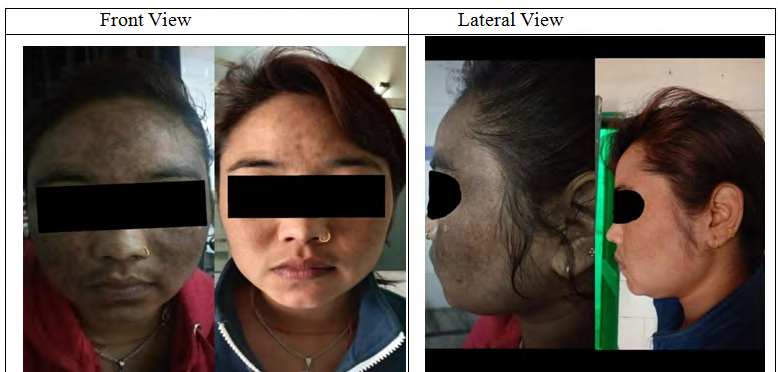
After the course of treatment there was satisfactory result in area of involvement and pigmentation (analysed by MASI score, (Table 4) and Fair and Lovely Fairness Meter (Table 5). Associated symptoms like itching, dryness, burning sensation and facial swelling were reduced with due time (Table 6). Significant improvement was noticed in the symptoms of facial swelling, itching and burning sensation. Patient had given up her allopathic treatment after 1 week of beginning of Ayurvedic treatment. Her problem of whitish discharge per vagina was getting stopped. Other vitals were within normal limit in the whole course of the study.
Discussion
Melasma is a chronic, acquired cutaneous, relapsing hyper melanosis characterized by hyperpigmented patches on sun-exposed areas of the face, neck, and forearms [8]. On the basis of signs and symptoms it can be co- related with Vyanga. In Ayurveda Vyanga is explained under the heading of Kshudra Roga. Psychological factors like Krodha (anger), Shoka (grief) and Shrama (exhaustion) plays a very important role in the Samprapti of Vyanga that’s why while describing the etiological factors of Vyanga, Acharya has given special emphasis towards psychological factors. Acharya Charaka has mentioned that the aggravation of Pitta along with Rakta is the chief culprit for initiation of the pathology. Vyanga is a Rakta Pradoshaja Vyadhi, hence the very first Dosha affected is Rakta Dhatu [9]. However due to etiological factors like Krodha and Shoka mainly Pitta vitiation takes place which in turn affects the Jatharagni and normal functioning of Ranjaka Pitta. Here Ranjaka Pitta is responsible for the conversion of Rasa Dhatu into Rakta Dhatu which results in the formation of normal skin color. Based on Ashraya-Ashrayee Bhavas, the derangement of Pitta Dosha leads to abnormality of Rakta Dhatu.i.e., Varnotpatti. Shrama and Shoka will lead to Udana Vata vitiation. Thus, these vitiated Dosha (Ranjaka Pitta, Rakta Dhatu as well as UdanaVata) travel in the body through Dhamanis and get Sthana Samshraya in Mukhagata Twacha and causes vitiation of Bhrajaka Pitta giving rise to discoloration of the skin.
It is clearly mentioned in Ashtang Hridyatha that Nasya is the main Chikitsa for Vyanga [10]. It is described “Shamanamneelikavyangakeshadoshaakshirajishu” [11]. In Ashtanga Hridya Uttartantra Kumkumaditailam is mentioned as the best medication for Vyanga because of all the ingredients almost all are Varnya and tridoshaghna, sheetavirya, madhurvipak and act on Rasavaha and Raktavaha Srotas [12]. Thus, karma of kum kumaditaila is to pacify mainly vata-pitta disorders and Rakta pradosajavikar.
In this case, patient has been habituated to irregular food habit, taking too much oily food, late night sleeping, sun exposure, over thinking and too some extent worried in nature. These all nidanas in long term caused prakopa of vata dosha which in turn vitiated bhrajak pitta on face region. Patient was advised to modify her lifestyle correction and simultaneously treatment was planned. Nasa is said to be the gateway to Shira. Shiras is considered as most important part of the body since it is the seat of five sense organs and the abode of Prana. Hence it is termed as the Uttamanga. While explaining the Phalashruti of Taila, Acharyas have said that Taila mitigates Vata and at the same time it does not increase the Kapha.
After the instillation of Nasya Dravya in nostrils, the lipid soluble substances diffuse through the plasma membrane of nasal mucosa due to greater affinity of passive absorption and reaches to olfactory receptor cells and finally reaches toShringatakmarma (Table 7). From there the medicine gets distributed into Murdha, Siramukha of netra, karna, kantha etc [13]. That doesn’t mean that it is directly connected to brain but somehow pharmacodynamically through olfactory nerve and blood vessels. When drug is administered it causes irritation due to which blood circulation increases and it snatches out the morbid Dosha from all the mentioned regions of the supra clavicular region (like the removing Munjagrass from its stem) [14].
| Sanskrit name | Botanical name |
| Kumkum | Crocus sativus |
| Ushir | Viteviria zizanoides |
| Manjistha | Rubia cordifolia |
| Nyogrodh | Ficus benghalensis |
| Neelotpal | Alstonia scholaris |
| Kaliyak | Santalum album |
| Laksha | Laccifer lacca |
| Padmakam | Prunus ceraseides |
Table 7: Contents of Kumkamadi Taila are tabulated.
Drugs of Kumkumadi oil are mostly sheeta virya, madhur vipak and act on rasavaha, rakta vaha shrotas. Thus karma of kumkumadi taila is to pacify mainly vata-pitta disorders and raktapradosaja vicar-vyanga. In the phalashruti of kumkumadi taila it is clearly indicated for vyanga. Though vyanga is urdhajatrugata vyadhi, so kumkumadi taila was given in the form of nasya. The treatment applied showed significant result in the normal colouration of Melasma spots and other associated symptoms like facial swelling, itching and burning sensation.
Conclusion
Melasma is common cosmetic problem in white female. Indian women also have been suffering from this problem in recent days. The treatment protocol of this disease may vary according to it’s causative and predisposing factors. In this case analysing the Samprapti of the disease, management was planned. She got marked relief from the ayurvedic panchakarma treatment. This is a ray of hope for the ayurvedic management of melasma.
References
-
Pichardo R, Vallejos Q, Feldman SR, Schulz MR, Verma A, et al. (2009) The prevalence of melasma and its association with quality of life in adult male Latino migrant workers. Int J Dermatol 48(1): 22-26.
-
Werlinger KD, Guevara IL, González CM, Rincón ET, Caetano R, et al. (2007) Prevalence of selfdiagnosed melasma among premenopausal Latino women in Dallas and Fort Worth, Tex. Arch Dermatol 143(3): 424-425.
-
Rathore SP, Gupta S, Gupta V (2011) Pattern and prevalence of physiological cutaneous changes in pregnancy: A study of 2000 antenatal women. Indian J Dermatol VenereolLeprol 77(3): 402.
-
Wong RC, Ellis CN (1984) Physiologic skin changes in pregnancy. J Am Acad Dermatol 10(6): 929-940.
-
Shastri KA, (2003) Chaukhamba Sanskrit Sansthan, 14th (Edn.), Varanasi.
-
(2003) Sushruta, Sushruta Samhita, Nidana Sthana, Kshudraroga Nidana Adhyaya, 13/45-46; pp: 288.
-
Shastri KA (2003) Sushruta, Sushruta Samhita, Nidana Sthana, Kshudraroga Nidana Adhyaya,Chaukhamba Sanskrit Sansthan, 14th (Edn.), Varanasi. 13/45-46; pp: 288.
-
Green KCK, Griffiths CE, Finkel LJ, Hamilton TA, Ransby BSM, et al. (1994) Topical retinoic acid (tretinoin) for melasma in black patients. A vehicle-controlled clinical trial. Arch Dermatol 130(6): 727-733.
-
Shastri KA (2000) Sushruta, Sushruta Samhita, Sutrasthana, Vrana Prashna Adhyaya, 21/19, Chaukhamba Sanskrit Sansthan, 14th (Edn.), (91), Varanasi.
-
Acharya VJT, (2009) Agnivesha, Charaka, Dridhabala, Charaka Samhita, (Ed.), Vividashitapeeteeya Adhyaya 28/11-12. Chaukhamba Prakashan, (179), Varanasi.
-
Acharya VJT (2008) Ashtang Hridya Uttartantra, Chapter 32/27, Chaukambha subharti prakashan K-37/117 Gopal mandir lane, Varanasi, pp: 792.
-
Acharya VJT (2008) Ashtang Hridya Uttartantra, Chapter 32/27-30, Chaukambha subharti prakashan K-37/117, Gopal mandir lane, Varanasi, pp: 792.
-
Murthy KRS (2012) Vagbhata; Astangasamgraha, Sutra sathana, 29th Chapter, Chaukhambha Orientalia 2nd Sloka 1: 511.
-
Sharma RK (2011) Charaka; Charaka Samhita, siddhisthana 2th Chapter, Bagawandash Chowkamba Sanskrit Series, 22th Sloka 6: 202.
- Management of Ear Keloid with Ksharsutra: A Case Study
- Yoga and Global Sustainability: A Holistic Path to One Earth, One Health
- Autoimmune Diseases in Ayurveda: A Narrative Review with Classical and Modern Perspectives
- Management of Cluster Headache Associated with Pituitary Apophysitis by CERT (Chakrasiddh Energy Release Technique): A Case Report on Energy Rebalancing
- Zygophyllum Geslini Coss : Biochemicals and Antioxidant Activity
- Observations of a Beginner Vaidya