
A Review Article on Samprapti-Vighatana of Manyastambha (Cervical Spondylosis) by Panchakarma Therapy
Cervical Spondylosis is a degenerative condition of the cervical spine that causes pain, stiffness, and tingling sensations radiating from the shoulder to the digits along the course of the nerve, indicating nerve root compression. Loss of curvature, reduction of disk space, osteophytes formation these are main anatomical changes associated with cervical spondylosis that is a common spinal problem nowadays. Cervical spondylosis affects approximately 95% of people by the age of 65, and it is the most common spine dysfunction in the elderly. but occupational trauma is increasing its prevalence in young and middleaged people. According to their symptoms, cervical spondylosis is co-related with Manyastambha in Ayurvedic perspective. Manyastambha is one of the Vata Vyadhis mentioned in Vata Nanatmaja Vyadhi. According to Sushruta Nidana Sthana the Vata covered by Kapha is caused by day sleep, sitting and standing (in fixed position), and constantly gazing upward these are some of the important Nidans of Manyastambha. Ruka and Stambha (pain and stiffness) are the sign and symptoms mentioned in our text. Abhyanga, other Ayurvedic treatments, particularly Panchakarma, can aid in successful management.
Introduction
Today is the era of modernization and fast life, everyone leads a busy, stressful life, and as a result of the modern human being’s changing lifestyle, their biological system is experiencing many imbalances. The prevalence of cervical spondylosis is rising due to the advancements in a busy, professional, and social life, poor sitting posture in offices, continuous work, working long hours on computers, night jobs, watching hours of television, sleeping on abnormally soft mattresses and pillows, and placing the bare minimum importance on healthy physical, mental, and dietary habits.
The overall prevalence of neck pain in the general population ranges between 0.4% and 86.8% (mean: 23.1%); point prevalence ranges from 0.4% to 41.5% (mean: 14.4%); and yearly prevalence ranges from 4.8% to 79.5% (mean: 25.8%) [1]. Cervical Spondylosis is a degenerative disorder involving intervertebral discs, cervical spines and joints of the cervical region [2]. This is a degenerative condition of the cervical spine found almost universally in persons over 50 years of age. There is degeneration of the intervertebral disc with its protrusion and bony overgrowth of adjacent vertebrae, causing narrowing of the cervical canal and intervertebral foramina with resultant compression of nerve roots, cords, or both. Symptoms of cervical spondylosis manifest as neck pain and neck stiffness and can be accompanied by radicular symptoms when there is compression of neural structures. X-rays can reveal vertebral spurs, joint thickening, and narrowing of the spaces between the intervertebral discs. MRI scans are the most effective for visualizing the intervertebral discs and determining the extent of disc herniation.
Based on sign and symptoms mentioned above cervical spondylosis can be corelated to Manyastambha. Manyastambha is explained one of the Vataja Nanatmaja Vikara [3]. Manya is Chala i.e., locomotor part of the body_. _Amarkosha describes ‘Manya’ (Neck region) as Greeva Paschat Sira [4] (Nerves of Neck region) due to its location and compound structure, and mobility, the cervical region gets injuries. According to Sushruta Samhita, the Vata Dosha and Kapha Dosha get aggravated and take Ashraya at Manya Pradesh, affecting the Manya Siras (nerves of neck) causing Ruja (pain) and Stambha (stiffness or difficulty in mobility) of the neck [5]. Acharya Charaka has considered the Manyastambha and Antaryama to be one and has described Manyastambha under the Antaryama itself [6] based on the Doshik involvement Manyastambha can be divided into two stages.
- The acute stage of Manyastambha is the first stage of the disease when Stambha (stiffness) is predominant. Kapha is the dominant vitiated Dosha at this stage. For this Ruksha Baluka Swedanass is chosen because Vata plays a secondary role in the etiopathogenesis of the disease.
- The chronic stage of Manyastambh is the later stage of the disease in which Vata is the vitiated Dosha. Following a review of the disease’s pathogenesis, Agnikarma is recommended last, following Ruksha and Patrapinda Swedana.
Management of Manyastambha
Ruksha Baluka Swedanass
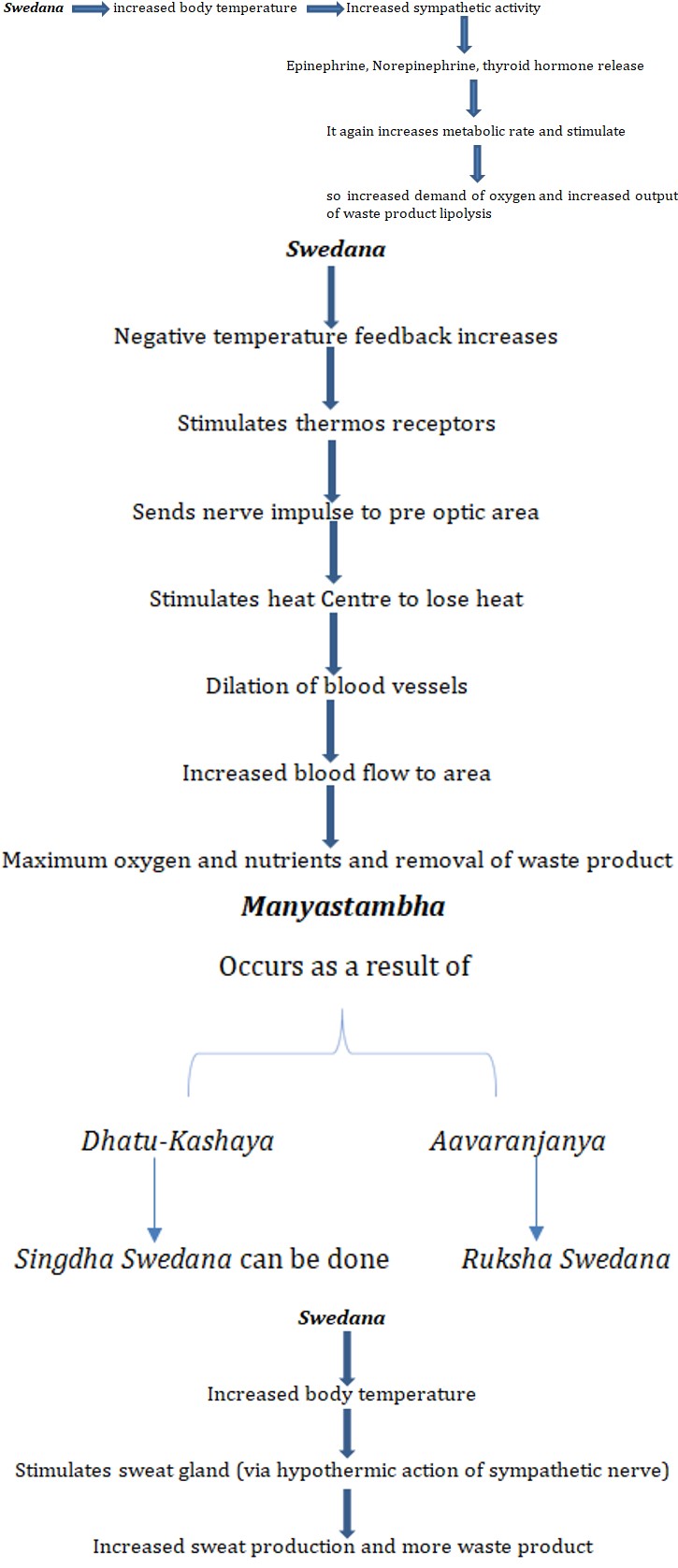
Swedana is mentioned as one among Poorva Karma and Pradhan Karma for management of various disease in Ayurveda. Basically, there are two types of Swedana Ruksha Swedana and Snigdha Swedana. According to Acharya Susruta Manyastambha is Vata-Kaphajvyadh. Baluka Sweda is mainly predominant in Agni and Vaayu Mahabhuta. Ruksha Swedana is also indicate in Samshamaniya Sweda in Sama Dosha. Swedana dose Agnideepana, Twakaprasadana, and Mradukar. skin contains a lot of sweat glands which activate through Swedana therapy excrete various toxin substance of body in form of sweat. Baluka Swedana is a type of Ruksha and Sankar Swedana according to Acharya Charaka [7]. According to Acharya Susruta it is a type of Tapa Sweda [8].
Mode of Action of Swedana
Increased in Metabolic Rate
Vasodilation
Stimulation of Sweat Glands
Patra Pottali Pind Swedana
The term Patra pottali swedana is derived from the words Patra (leaves), Pinda (bolus), and Swedana (sweating). Patra pottali swedana, on the other hand, refers to the sudation performed by a specially prepared bolus of medicinal leaves (generally VataKaphahara). Sweating is used in this treatment procedure to eliminate bodily toxins. It has a higher therapeutic efficacy in orthopedic disorder. Patra Pinda Sweda is a variant of Pinda Sweda, which is nothing more than Acharya Charaka’s Sankara Sweda. According to Acharya Sushruta and Acharya Vagbhata, it is a type of Tapa Sweda. Patra Pinda Sweda is a type of SnigdhaSweda that is unrivalled in the treatment of painful conditions caused primarily by Vata Dosha, typically in degenerative diseases. Furthermore, by adjusting the drugs, it can be used in Vata- Kapha conditions as well. Patra Pinda Sweda is primarily used to relieve pain, inflammation, swelling, and stiffness caused by bone, joint, or musculoskeletal pains. Required Temperature- 42-46°C Duration- 30-45 min everyday (5-10 min each 7 postures of Abhyanga)
Mode of Action
Sedative Effect
• Swedana increases blood supply (removal of waste product hence getting good nourishment) [9]
$$ \downarrow $$ Relieves the pain • The pain gate theory of Melzack and Wall explains how heat, as a counter-irritant, can influence pain sensations [10].
Vata is the factor that causes pain, and the properties of Vata and Swedana are diametrically opposed. As a result, heat can reduce swelling, remove coldness at the site, and cause perspiration [11].
Relieves Stiffness (Stambha) [12,9]
- Swedana – Snigdha, Ushna properties (Due to Usna Guna -Srotosuddhi, Amapachana) Relieves Stambha
- Raise In Temperature:
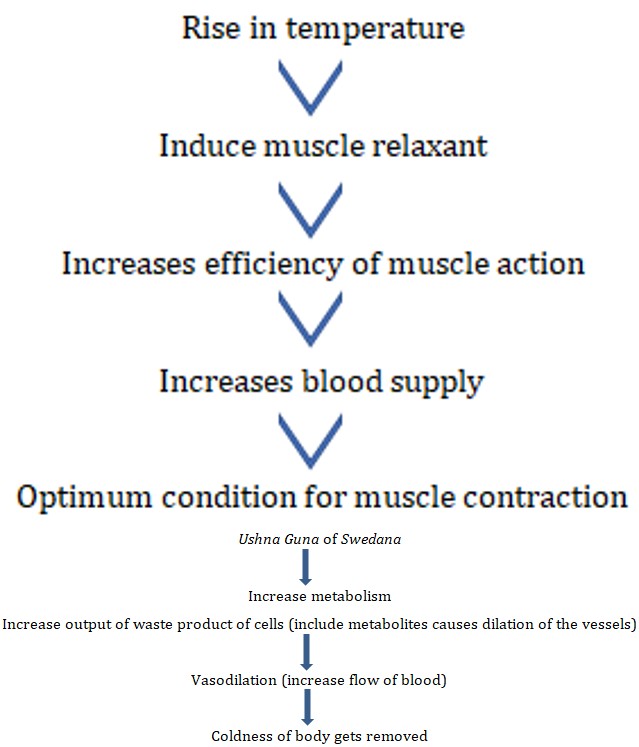
Rerlives Coldness [9]
Relieves Heaviness
Feeling of lightness in body is due to Swedana by means of which fluid sustained in the body are excreted [13].
Agni Karma
Agni karma is said to be the most superior of all the Anushastra Karma. Agnikarm_a is superior to _Ksharkarma because disease treated with Agni will never recur, and disease that cannot be cured with medicine, Kshar, or surgery can be cured with Agnikarma. • Ushna Guna and Agni have Anonyasritbhava, Ushna Tikshana Sukshama and Laghu Guna of Agni breaks Srotoavrodha, which was produced by Vata and Kapha Dosha. Consequently, the severity of the pain is reduced.
- Agnikarma also functions as a Dosha- Dushya Vighatanakarka because Ushna Guna serves two purposes
- Stimulating that is Dhatuvagni’s Utkleshana, and as a result of this action, Sama Dhatu (localized Ama) is digested.
- Srotas channel dilation is thus removed (cleaning the respective Srota, channel)
- Agnikarma may stimulate sensory receptors in the muscles, which sends massage to the brain, stimulating the pituitary gland to release endorphins, which bind with opiate receptors in pain cells, blocking pain stimuli.
- Red hot Shalaka, which raises the temperature of injured tissue, may also hasten the metabolic process, improve circulation through vasodilation, and reduce edema, pain, and stiffness. Additionally, it destroys free nerve endings, which tend to close the ‘gate’ and prevent sensory transmission on pain.
Conclusion
In modern medicine heat therapy is used for rehabilitation purpose. it may be effective self-care treatment for conditions like rheumatoid arthritis.it was found to increase extensibility of collagen tissue, relives muscle spasm increase blood flow. Ayurveda offers application of heat in various disorders. In Manyastambha there is a derangement of Vata and Kapha implying pain, stiffens and decreases movement of neck. heat therapy is form of Ruksha and Snigdha Swedana can be effectively which in-turn will decrease pain and stiffness by improving the local blood circulation and eliminating the toxic waste.
References
-
Hoy DG, Protani M, De R, Buchbinder R (2010) the epidemiology of neck pain. Best Pract Res Clin Rheumatol 24(6): 783-792.
-
Alagappan R (2017) Manual of Practical Medicine. 6th (edn), Jaypee Brothers Medical (P) Ltd, New Delhi, India, pp: 720.
-
Agnivesha (2015) Charaka Samhita, Vidyotini Hindi commentary. In: Sastri PK et al. Sutra Sthana 20/11. Chaukhambha Sanskrit Pratishthan, Delhi, India, pp: 399.
-
Shastri Paradakara PH (1998) amarkosh or namalinganushasana Dwitiya kand manushya varg 6/65 chaukhambha Sanskrit sansthan, varansi, India, pp: 209.
-
Sushrut (2013) Sushrut Samhita. In: Shastri AD (Ed.), Ayurved Tattav Sandipika Hindi commentary, Part 1. Purvardh Nidan sthan1/67, Chaukhambha Oriental Varanasi, India, pp: 303.
-
Agnivesha (2016) Charaka Samhita. In: Sastri PK, et al. (Eds.), Vidyotini Hindi commentary. Chikitsa sthan 28/45, Chaukhambha Sanskrit Pratishthan. Delhi, India, pp: 784.
-
Agnivesha (2015) Charaka Samhita. In: Sastri PK, et al. (Eds.), Vidyotini Hindi commentary. Sutra Sthana 14/39, Chaukhambha Sanskrit Pratishthan. Delhi, India, pp: 289.
-
Sushrut (2013) Sushrut Samhita. In: Shastri AD, et al. (Eds.), Ayurved Tattav Sandipika Hindi commentary Part 1. Purvardh chikitsa sthana 32/4, Chaukhambha Oriental Varanasi, India, pp: 173.
-
Energetics and Metabolic Rate. In: Gyton and Hall, Textbook of Medical Physiology, 72 chapter, Jaypee Brother Medical Publishers Ltd, India, pp: 859-865.
-
Sembulingam K, Sembulingam P (2012) Physiology of Pain. In: Essentials of Medical Physiology, Sixth edition, 145th Chapter, Jaypee Brother Medical Publishers Ltd, India, pp: 841.
-
Agnevesa (2011) Charaka Samhita with Ayurveda Deepika Commentary of Chakrapani Datta. In: Acharya YT (Ed.), Charaka and Dridabala, Chaukhamba Sansthan Sanskrit Bhavan, Varansi India, Chikitsa Sthan, 22nd Chapter Sloka No 11, pp: 120.
-
Forster A, Palastanga N, Clayton BE (1981) Clayton’s Electrotherapy; Theory And Practice, CBS Publishers and Distributors Pvt Ltd, 8th(Edn.), Baillière Tindall, London, pp: 97.
-
Sharma AK (2002) Panchkarma Treatment of Ayurveda Including Keraliya Panchkarma. Shri Satguru Publication, pp: 23.
- Management of Ear Keloid with Ksharsutra: A Case Study
- Yoga and Global Sustainability: A Holistic Path to One Earth, One Health
- Autoimmune Diseases in Ayurveda: A Narrative Review with Classical and Modern Perspectives
- Management of Cluster Headache Associated with Pituitary Apophysitis by CERT (Chakrasiddh Energy Release Technique): A Case Report on Energy Rebalancing
- Zygophyllum Geslini Coss : Biochemicals and Antioxidant Activity
- Observations of a Beginner Vaidya