
An Ayurvedic Approach in Management of Vatarakta
In present era Vatarakta is a common metabolic disorder which disturbs day-today life of the patients. It is a Santarpana- Janya Vyadhi, caused due to Avarana pathology. Compared with the other Vatavyadhi, Vata-rakta possesses a special place in the literature, due to its high prevalence (0.2 to 3.5 per 1000, with an overall prevalence of 2 to 26 per 1000) in the society, increased incidence as age advances, step-wise succession, and so on. It is correlated with gout in modern science due to similarities of symptoms between them. Incidence of Vatarakta is increasing Day by day. It is creating a lot of concern all over the world as it is causing serious complications with disabilities to human. Considering this fact, it was decided to do write an article on Vatarakta. All the material related to article has been collected from classical Ayurvedic texts and various published research article on Vatarakta. The purpose of this study was to investigate the understanding of Vatarakta with its treatment protocol and to compile the results of various Vatarakta-related studies.
Introduction
Vatarakta is a Vata pradhana Tridoshaja Vyadhi where Rakta is main Dushya [1, 2]. It is caused by vitiation of Vata and Rakta. Aggravated Vata blocked by vitiated Rakta, in turn leading to further aggravation of Vata. Thus aggravated Vata vitiates the Rakta leading to condition Vatarakta [3].
Acharya Charaka and Vagbhatta_assign a separate chapter to this disease and mentioned two types of _Vatarakta as Uttana (_superficial form) and _Gambhira (joints involved) while Sushruta described this condition under Vatavyadhi with eight types according to Dosha and said that Uttana and Gambhira are stages of it [4].
In modern science it is interrelated with Gouty arthritis due to similarities of symptoms between them. Gout is an atypical purine metabolic disorder which causes hyperuricemia and deposition of monosodium urate crystals in joint [5]. The effectiveness of different treatment protocols mentioned for Vatarakta such as Raktamokshana, Virechana and Basti Karma, in addition the Shamana, Rasayana Dravyas along with external applications like Lepa, Upanaha, Parisheka, Abhyanga showed evidence in numerous former studies. The description of Vatarakta is found in Brihattrayi
and other classical textbooks. Charaka and Sushruta Samhita describe its aetiology, epidemiology, types and sites of manifestation, clinical features, prognosis, and management in detail (Tables 1-5).
Nidana
| Aetiological factors | Ch. | Su. | A.S. | A.H. | |
|---|---|---|---|---|---|
| 1 | Aaharaj Nidana | ||||
| Ati Amla Rasa | + | + | |||
| Ati Lavana, Katu, Tikta, KashayaRasa. | + | ||||
| Ati Kshara Sevana | + | + | |||
| Snigdha | + | ||||
| Ushna | + | + | |||
| Ruksha | + | + | |||
| a. | Vidahi Anna (Irritable foods) | ||||
| Shaaka (greenvegetables) | + | + | |||
| Klinna Mamsa, Shushka Mamsa, Ambuja Mamsa | + | ||||
| Anoop Deshiya Mamsa, Ikshu | + | ||||
| Vidahi Anna | + | + | + | ||
| b. | Vidahi Pana (irritable drinks) | ||||
| Arnala, Sourviraka, Shukta, Sura (wine) | + | ||||
| Aasava / Madyapan | + | + | |||
| Dadhi, Takra | + | ||||
| c. | Faulty dietary habits | ||||
| Adhyashana, Ajeerna. | + | ||||
| Virudhashana (incompatible food intake) | + | + | |||
| Alpashana, Langhana | + | ||||
| Mithya Aahara Vihara | + | + | + | ||
| Mishthana Bhojana | + | ||||
| 2 | Viharaj Nidana | ||||
| Diwaswapanama | + | + | |||
| Ratri Jagrana | + | + | |||
| Achakramana Sheela (sedentary habits) | + | + | |||
| Ambukrida (Water games), Ambuplavan. | + | ||||
| Ativyayama (doingexcessive exercise) | + | + | |||
| 3 | Vegavidharana | ||||
| Mala, Mutra, | + | ||||
| Avyavaya (abstinence) | + | + | + | ||
| Ativyavaya (excessive sexual indulgence) | + | + | |||
| 4 | Hasti, Ushtra, AshwaRiding | + | + | ||
| 5 | Kalaja Nidana | ||||
| Ritu Satmya Viparayaya | + | ||||
| 6 | Mansika Nidana | ||||
| Ati Krodha (excessive anger) | + | ||||
| Shoka (grief) | + | ||||
| 7 | Agantuja Nidana | ||||
| Abhighata (Traumatic injury) | + | + | |||
| 8 | Prakirana Nidana (Miscellaneous Factors) | ||||
| Sukumara | + | + | + | ||
| Stholya | + | ||||
| Ashodhana | + | + | |||
(Ch.Ch. 29/5-7, Su. Ni.1/40-42, A.S.Ni. 16/3,4, A.H.Ni. 16/-3) Table1: Showing Nidana of Vatarakta.
Samprapti [6]
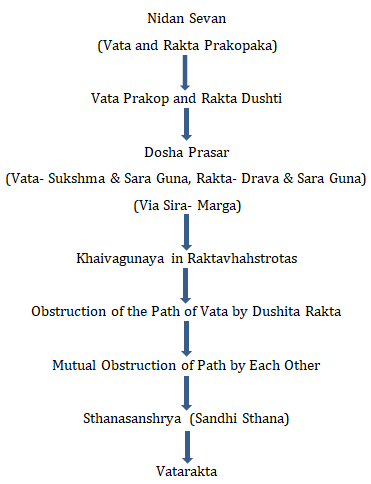
Samprapti Ghataka
| Dosha | Vata Pradhan Tridosha-Janya Vyadhi |
| Dushya | Rakta, Twak, Mamsa |
| Agni | Mandagni |
| Udhbhava-Sthana | Pakvashya |
| Sanchara-Sthana | Sarava Sharira |
| Vyakta Sthana | Sandhi(Visheshata Kara Pada Sandhi) |
| Srotas | Raktavaha, Asthivaha, Majjavaha |
| Srotodushthi Prakara | Sanga,Vimargagaman |
| Rogamarga | Madhyam |
Table 4: _Samprapti_ _Ghataka_.
Poorva-Roopa
| Poorva-Roopa | C.S | S.s | A.s | A.h |
|---|---|---|---|---|
| Asveda | + | + | + | + |
| Alasya | + | - | - | - |
| Atisweda | + | - | + | + |
| Seveda | - | + | - | - |
| Ksatae ati ruk | ++ | - | - | - |
| Sandhi shaithilya | + | + | + | + |
| Nistoda/ toda | + | + | + | + |
| Spurana | + | - | + | + |
| Karshnyata/ vaivarnyta | + | + | - | - |
| Sadana | + | - | + | + |
| Supti | + | + | + | + |
| Guruta | + | + | + | + |
Table 2: Gambira Vatrakta.
(Ch.Ch. 29/16-17, Su. Ni.1/47, A.S.Ni. 16/4, A.H.Ni. 16/5-6) Table 3: Poorva-Roopa of Vatarakta.
Roopa
| Roopa | C.S | S.s | A.s | A.h |
|---|---|---|---|---|
| Kandu | + | - | + | + |
| Daha | + | - | + | + |
| Ruja | + | - | - | - |
| Ayama | + | - | + | + |
| Toda | + | - | + | + |
| Spurana | + | - | + | + |
| Kunchana | + | - | - | - |
| Shyava twaka | + | - | + | + |
| Rakta twaka | + | - | + | + |
| Bheda | - | - | + | + |
| Gourava | - | - | + | + |
| Suptata | - | - | + | + |
Table 3: Poorva-Roopa of Vatarakta.
(Ch.Ch. 29/20, Su. Ni.1, A.S.Ni. 16/6, A.H.Ni. 16/-9) Table 4: Uttana Vatrakta.
Gambira Vatrakta
| Roopa | C.s | S.s | A.s | A.h |
| Svathu stabdhata | + | - | - | - |
| Svathu Kathinya | + | - | - | - |
| Brusharti | + | - | - | - |
| Shyavatha | + | - | - | |
| Tamra twaka | + | - | - | - |
| Daha | + | - | - | - |
| Todha | + | - | + | + |
| Spurana | + | - | - | - |
| Paka | + | - | - | - |
| Ruja | + | - | - | - |
| Vidhaha | + | - | + | + |
| Kanajtwa | + | - | + | + |
| Pangutwa | + | - | + | + |
| Svayathu grathitha | - | - | + | + |
| Angasya vakrikarana | + | - | + | + |
| Vatasy sandyasthimajasu chindanniva charanam | + | - | - | - |
Table 5: _Uttana Vatrakta._
(Ch.Ch. 29/21, Su. Ni.1, A.S.Ni. 16/7, A.H.Ni. 16/10-11) Table 5: Gambira Vatrakta.
Chikitsa
The term Chikitsa is derived from the root “KIT ROGAAPNAYANE” [7] i.e., to adopt measures against the disease. The line of treatment has to be planned according to aetiopathogenesis, symptomatology and other aspect of the disease so that no complications can arise [8].
In the treatment of Vatarakta, both Samsodhana
Previous Researches Work
and Samsamana Chikitsa are mentioned. Vitiated Dosha is evacuated from the body using Samsodhana C_hikitsa_ (Raktamokshana, Virechana, and Basti Karma), and then Samsamana Chikitsa is given to the patients to maintain homeostasis, thereby alleviating the signs and symptoms of Vatarakta [9]. Many Herbomineralformulation are mentioned in the classical Ayurvedic Texts to alleviate the signs and symptoms of Vatarakta.
| Procedure | No.of patient | |
|---|---|---|
| 1 | Guduchi Siddha Yoga Basti [9,10] (Sa-Ghrita Guduchi Ksheera Siddha Niruha) (Guduchi Siddha Taila Anuvasana) | No. of Patients 20 Niruha 50 gm- Guduchi Ksheera paka- Guduchi Kwath Choorna +400 ml milk=1600ml water = Ksheera avashesha (400ml), Madhu, Saindhav, Shatpuspha and Total duration -24 days Madanphala Kalka |
| 2 | Jalouka-Avcharana [9,11] | No. of patient 10 3 times at interval of 1 week |
| 3 | Siravyadha [9,10] | No. of patient 20 Siravyadha twice a day with an interval of 11 days |
| 4 | Ardhamatrika Basti [3] | No. of patient 50 |
| 5 | Virechana [3] (Nimbamritadi Eranda Thailam) | No. of patient 50 |
Table 6: Showing Previous researches work done on various Panchkarma procedures.
| Symptom | Guduchi Siddha Yoga Basti11 (in %) | Jalouka-Avcharana12 (in %) | Siravyadha11 (in %) | ArdhamaTrika Basti13 (in %) | Virechana13 (Nimbamritadi-Eranda Thailam (in %) |
| Sandhi Shool | 95 | 60.8 | 95 | 99.85 | 48.97 |
| Sandhi Shotha | 25 | 61.5 | 65 | 73.33 | 72.09 |
| Sparsh -Asahtva | 75 | - | 75 | 90.1 | 72.15 |
| Twak Vavarnya | - | - | - | 86.44 | 67.18 |
| Raag(Erythema) | 95 | 65.38 | 75 | - | - |
| Vidaha | 85 | 66.6 | 85 | - | - |
| Effect On Serum Uric Acid | 21.4 reduction | 4.4 Reduction | 13.33 reduction | 43 reduction | 32.83 reduction |
Table 7: Showing % result of Panchkarma procedure.
| No. of patients | |
|---|---|
| Bodhivruksha Kashaya [12] | Total no. of pt. 10 |
| Bodhivruksha Kashaya [12] | Trial 45 days |
| Guduchi Kwath [12] | Total no of pt. 10 |
| Guduchi Kwath [12] | Total trial 45 days |
| Trikarshika Kwath [13] | Total no. of pt 30 |
| Trikarshika Kwath [13] | Total trial 45 days |
| Punarnava Amrita Guggulu [14] | Total no. of pt. 10 |
| Punarnava Amrita Guggulu [14] | 500mg thrice each day with Anupaanas of Amritadi Kashaya |
| Amrita Guggulu [15] | Total no of pt. 30 |
| Amrita Guggulu [15] | 500 mg thrice each day |
| Amrita Guggulu With Amrita Kashaya [15] | Total no of pt. 30 |
| (Amrita Guggulu Contain Punarnava + Chitraka) | 500 mg thrice each day with Anupaanas of Amritadi Kashaya 72 ml |
| Patoladi Kwath [1] | Total no of pt. 25 |
| Patoladi Kwath [1] | Trial 90 days |
| Patoladi Kwath [1] | 40 ml Kwath twice each day |
| Combination of Kaishore Guggulu with Punarnavadi Guggulu [16] | No of pt 32 |
| Combination of Kaishore Guggulu with Punarnavadi Guggulu [16] | 2 tabs {500mg} twice each day |
| Combination of Kaishore Guggulu with Punarnavadi Guggulu [16] | Total trial 42 days |
Table 8: Showing various Shamana yogas in previous researches work.
| Bodhi vruksha Kashaya14(in %) | Guduchi kwath14(in %) | Trikarshik kwath15(in %) | Punarnava Amrita guggulu16(in %) | Amrita guggulu17(in %) | Amrita guggulu with amrita Kashaya17(in %) | Patoladi kwath18(in %) | Combination of Kaishore guggulu with Punarnavadi guggulu19(in %) | |
| Sandhi Shool | 85 | 80 | 46.56 | 65.11 | 66.75 | 65.11 | 68.96 | 80 |
| Sandhi Shotha | 86.66 | 81.25 | 40.01 | 87.5 | 85.71 | 87.5 | 79.5 | 87 |
| Sparsh -Asahtva | 77.77 | 66.66 | 34.62 | 91.48 | 78.35 | 91.48 | 70.2 | 81 |
| Twak Vavarnya | 85 | 58.33 | - | 43.47 | 38.88 | 43.47 | 29.94 | - |
| Raag (Erythema) | 84.61 | 80 | 31.43 | 55.55 | 88.75 | 55.55 | 79.5 | 84 |
| Vidaha | 82.33 | 78.57 | 35.7 | 87.5 | 63.66 | 87.5 | 73.85 | 76 |
| Effect on serum uric acid | 39.04 reduction | 23.93 reduction | 42.57 reduction | 43.43 reduction | 38.09 reduction | 43.43 reduction | 20.76 reduction | 17 reduction |
Discussion
Vatarakta is a more upsetting and painful disease that is commonly found in the modern era. Intense pain is a major symptom of Vatarakta, interfering with the affected patient’s daily lives. The Shodhana and Shamana Chikitsa is not only an essential component of Ayurvedic treatment, but it also serves as the ultimate foundation of Ayurvedic treatment. Previous Shodhana therapy research has revealed Ardhamatrika Basti has a highly significant result in Sandhi Shoola, Twak Vavarnya and Effect on serum uric acid , with values of approximately 99.85%, 86.44% and 43% (reduction) respectively, Guduchi Siddha Yoga Basti has a 95% success rate in Sandhi shoola and Raga and an 85% success rate in Vidaha, Siravyadha has a significant improvement in Sandhi Shoola of approximately 95% and in Vidaha of approximately 85%, Jaluka Avcharana has a significant improvement in Vidaha of approximately 66% and Virechana (Nimbamritadi Eranda Thailam) has a significant improvement in Sandhi Shotha and Sparsh -Asahtva of approximately 72%.
In the Shamana Chikitsha Bodhivruksha Kashaya showed maximum effect in Sandhi Sotha about 86.66% , Guduchi Kwath showed maximum effect in Sandhi Sotha about 81.25%, Trikarshik kwath showed maximum effect in Sandhi Soola about 46.56%, Punarnava Amrita Guggulu showed maximum effect in Sparsh -Asahtva about 91.48%, Amrita guggulu showed maximum effect in Raag (erythema) about 88.75%, Amrita Guggulu with Amrita Kashaya showed maximum effect in Sparsh - Asahtva about 91.48%, Patoladi Kwath showed maximum effect in Sandhi Sotha and Raag (erythema) about 79.50%, Combination of Kaishore Guggulu with Punarnavadi Guggulu showed maximum effect in Sandhi Sotha about 87%. Punarnava Amrita Guggulu and Amrita Guggulu with Amrita Kashaya showed maximum reduction (43.43%) on serum uric acid.
Conclusion
Due to the desk-bound regime, Vatarakta is one of the common illnesses in modern medical practise. Therefore, it is imperative to investigate the function and uses of Ayurvedic medicines in Vatarakta. After reviewing various previous research studies on Vatarakta management, it was discovered that, Ardhamatrika Basti, Siravyadha, Guduchi Siddha Yoga Basti and Jaluka Avcharana as Shodhana therapy and Punarnava-Amrita Guggulu, Guduchi Kwath, Amrita guggulu, Combination of Kaishore guggulu with Punarnavadi guggulu, Amrita Guggulu with amrita Kashaya as Shamana _Chikitsha_showed significant improvement.
However, Ardhamatrika Basti, Guduchi Siddha Yoga Basti, Kaishore guggulu combined with Punarnavadi guggulu, and Bodhivruksha Kashaya are more effective in improving the signs and symptoms of Vatarakta.
References
-
Gupta D, Sachdev K, Garg R (2019) A Clinical Study to Evaluate the Efficacy of Patoladi Kwath with or without Rasnadi Pradeh in cases of Vatarakta (W.S.R. to Gouty Arthritis). Journal of Drug Delivery & Therapeutics 9(2S): 98-110.
-
Rana V, Mishra A, Mehra BL (2017) Effect of Punarnava- amrita Guggulu with Amritadi Kwath in The Management of Vatarakta W.S.R. To Gout-a clinical trial. World Journal of Pharmaceutical Research 6(8): 1149.
-
Prashanth AS (2019) A Pre-Test and Post-Test Design to Assess the Efficacy of Virechana and Ardhamatrika Basti in Gouty Arthritis W .S. R To Vatarakta. Ayushdhara 6(2): 2120-2127.
-
Sushruta (2010) Sushruta Samhita (Ayurveda tatva Sandipika Hindi Vyakhya) Vol 1. Shastri KA (eds.) 1st (edn.) Chikitsha sthana Mathavatavyadhi 5/3, Chowkhamba Sanskrit Sansthana Varanasi, pp: 37.
-
Bhavar V, Kumari J, Trivedi AB (2022) Comparative Study to Evaluate Role of Bodhi Vriksha Kashaya and Guduchi Kashaya in Vatarakta ~ Hyperuricemia. World Journal of Pharmaceutical Research 11(8): 996-1005.
-
Charaka (2009) Charaka Samhita (Vidyotini Hindi Commentary). Shastri R, et al. (eds.) 1st (edn.) Chikitsa Sthana, 29/10-13. Chaukhamba Bharti Academy, Varanasi, pp: 820-821.
-
Raksha Pathak KR (2002) Kaya Chikitsha Vol 1. Chaukhamba Bharti Academy, Varanasi 1(1): 5.
-
Pathak P, Tegta N, Jagota A, Shukla U, Gupta R et al. (2020) An ayurvedic perspective of Vatarakta. World Journal of Pharmaceutical and Medical Research 6(8): 344-356.
-
Patel P, Bhatted SK, Dharmarajan P (2020) Systematic Review on Understanding and Management of Vatarakta (Gouty Arthritis). International Journal of Health Sciences and Research 10(9): 198-204.
-
Adithya AK, Ahalya Sharma (2013) Evaluation of the efficacy of Siravyadha and Guduchi Siddha Yoga Basti With in the Management of Vatarakta with special reference to Gout. Int J Res Ayurveda Pharm 4(3): 402- 409.
-
Shashanka Jha, Londhe PD (2014) Role of Leech Application in Vatarakta: a pilot study. International journal of Ayurvedic Medicine 5(1): 129-132.
-
Saini RK, Thakur A, Sharma S, Srivastva AK, Manglesh R (2018) To Evaluate the Comparative Effect of Bodhi Vriksha Kashaya and Guduchi Kashaya in The Management of Vatarakta W. S. R To Gout. World Journal Of Pharmaceutical And Medical Research 4(9): 198-209.
-
Ansaril T, Ghosh S, Singh SK (2021) A comparative clinical study of trikarshika kwatha with and without lifestyle modification in the management of vatarakta with special reference to hyperuricaemia. International Journal of AyurvedaandPharma Research 9(1): 10-19.
-
Sharma U, Sharma KK, Singh M, Shrivastava AK, Shukla GD, et al. (2015) Role of Punarnava Amrita Guggulu Within the Management of Vatarakta-A Clinical Trial. Ayurpharm Int J Ayur Alli Sci 4(1): 1-9.
-
Sharma U, SharmaKK, Bohra M (2015) A Comparative Study of Efficacy of Two Different Samples of Amrita Guggulu in the Management of Vatarakta. World journal of pharmacy and pharmaceutical sciences 4(6): 589- 603.
-
Nariyal V, Sharma OR, Dhiman KS (2017) A Combined Effect of Kaishora Guggulu and Punarnavadi Guggulu in The Management of Vatarakta (Gout): A case series. Int J Adv Res 5 (6): 1793-1798.
- Management of Ear Keloid with Ksharsutra: A Case Study
- Yoga and Global Sustainability: A Holistic Path to One Earth, One Health
- Autoimmune Diseases in Ayurveda: A Narrative Review with Classical and Modern Perspectives
- Management of Cluster Headache Associated with Pituitary Apophysitis by CERT (Chakrasiddh Energy Release Technique): A Case Report on Energy Rebalancing
- Zygophyllum Geslini Coss : Biochemicals and Antioxidant Activity
- Observations of a Beginner Vaidya